Educating at scale

You can’t run a high-quality business school with 20 faculty members

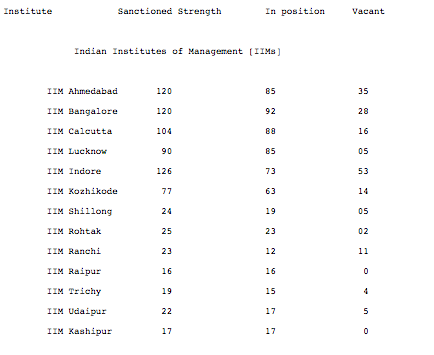
In the course of a twitter discussion yesterday, journalist Mathang Seshagiri quoted numbers from a parliamentary reply by the ministry of HRD (on the 24th of November 2014) on the sanctioned faculty strength and vacancies in “institutes of national importance”. While his purpose was to primarily show that even the older IITs and IIMs have massive vacancies, what struck me was the sanctioned faculty strength of the newer IIMs. Here is the picture posted by Mathang:

Source: Parliamentary Proceedings (Rajya Sabha). November 24th 2014. Reply by MHRD

Look at the second column which shows the sanctioned faculty strength in each IIM. Once you go beyond the six older IIMs, the drop is stark. The seven newer IIMs have a sanctioned faculty strength of about 20! The question is how one can run a business school with such a small faculty base.

About ten years back, when I was a student at IIM Bangalore, I had gone for an event where I met someone from another business school in Bangalore whose name I can’t remember now. During the course of the conversation he asked me how many electives he had. I replied that we had about 80-100 courses from which we had to pick about 15. This he found shocking for in his college (from what I remember) there were only three or four electives!

The purpose of an MBA is to provide broad-based education and broaden one’s horizons. Thus, after a set of core courses in the first year (usually about fifteen courses), one is exposed to a wide variety of electives in the second year. It is a standard practice among most top B-schools to fill the entire second year with electives. In fact, in IIM Bangalore, electives start towards the end of the first year itself.

With 20 faculty members, there are only so many electives that can be offered each year. For example, in the coming trimester, IIM Bangalore is offering students (about 400 in the batch) a choice of about 40-50 electives, of which each student can pick four to six. This gives students massive choice, and a good chance to tailor the second year of their MBA and mould themselves as per their requirements.

By having 20 faculty members, the number of electives that can be theoretically offered itself is smaller (given research requirements, most IIM professors have a requirement to teach no more than three courses a year, and they have core and graduate courses to teach, too), which gives students an extremely tiny bouquet of choices – if there is any choice at all. This significantly limits the scope of what a student in such a school can do. And the student has no option but to accept the straitjacket offered by the lack of choice in the school.

In the ensuing twitter conversation this morning, Mathang contended that it is okay to have a faculty strength of 20 in schools with 60 students per batch. While this points to an extremely healthy faculty-student ratio, the point is that for broad-based education such as MBA, faculty-student ratio is not a good metric. What makes sense is the choice that the student is offered and that comes only at scale.

Thus, the new IIMs (Shillong “onwards”) are flawed in their fundamental design. It is impossible to run a quality business school with only 20 faculty. One way to supplement this is by using visiting faculty and guest lectures, but some of the new IIMs are located in such obscure places (where there is little local business, and which are not easily accessible by flight) that this is also not an option.

Merging some of these smaller IIMs (a very hard decision politically) might be the only way to make them work.

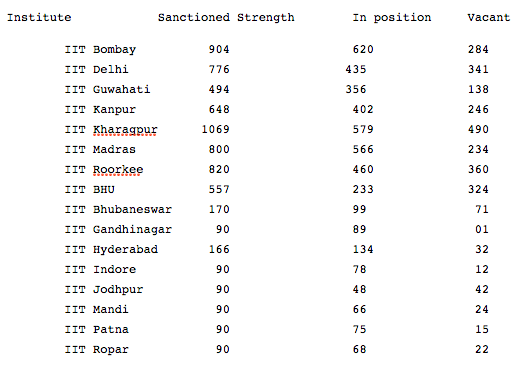
PS: Here is the sanctioned faculty strength and actual faculty strength numbers for IITs (same source as above). I might comment upon that at a later date.

Source: Parliamentary reply by Ministry of HRD; November 24th 2014

Why Petromax is Repugnant

Every time I talk about the concept of “Petromax”, people give me looks as if I’m from some other planet. Sometimes they shudder. Sometimes they think I’m uncouth. While I believe that the “problem” is just that I say things like they are (rather than couching them in niceties), given that everyone reacts in a negative way when I talk about Petromaxes implies that there’s something repugnant to it. And I think I’ve found the answer – the answer lies in Option Theory.

First of all, a recap on what petromax is all about. The concept was invented by Anant Nag in Golmaal Radhakrishna back in 1990. It goes “the wife is like the lamp you light in front of God. When the wife is not at home, the house plunges into darkness, and that’s when you need a petromax”. Those of you who understand Kannada might want to watch this youtube video from the movie:

Now that the definition is out of the way, let’s come to why the concept is repugnant. It is repugnant because being a petromax is like writing an option. And in the relationship business, nobody likes being a writer of options – it makes them look “cheap” and desperate. Let me explain.

I live in Bangalore. My wife lives abroad. So I’m in a long-distance marriage and going by the Petromax theory my house is “filled with darkness”. And the theory posits that I need a Petromax. Let’s say that you are interested in filling this gap and being “my Petromax”. So far so good. Where is the problem?

The problem happens when my wife comes home, and “fills it with light”. Remember that I’m still married to her, and deeply in love with her, and that I only took you on as a petromax. So for the duration when she is here, I don’t need you any more, and don’t bother about you! So in effect, I have an option of “being with you” whenever I want, while you don’t have the same option (unless you are also using me as a Petromax, but then I won’t be available whenever you want so I won’t be a reliable petromax). So under the petromax arrangement defined above, I have the right but not the obligation to be with you. You, the petromax, have the obligation but not the right to be with me. Effectively you’ve sold me an option!

Now, in the relationships business options don’t work. The writer of the option will start thinking that the “buyer” is using him/her. Being used is not a good thing in the relationship business. Among other things, showing the world that you are willing to be used reduces your “value” going forward. So you don’t want to do this. So you don’t like to be the petromax. So the deal doesn’t work for you. And so it doesn’t work for me, since when I’m looking for a Petromax I’m looking for optionality.

And so when you say that someone is someone else’s petromax, it is an implicit admission that the said person is willing to get “used”, and is thus willing to lower his/her value. Which is not a nice thing from the point of view of this person. And hence the term petromax is repugnant. And the concept of the petromax is also thus repugnant.

But the petromax concept has been seen to work in real life. How does it work then? Being part of a small community helps, since the valuation drop is seen only in that particular community. Then, there can be some restricted structuring where neither sells each other an option, and set up an “and condition” (being together if and only if both are available and interested at the same instant).

Ok I realise that this post itself might be repugnant to some of you but these things need to be explained!

LinkedIn, WhatsApp and Freaky Contact Lists

So one of the things I do when I’m bored is to open the “new conversation” (plus sign) thing on my WhatsApp and check which of my contacts are there in my WhatsApp social network. I do this periodically, without any particular reason. On the upside, I see people who I haven’t spoken to for a long time, and this results in a conversation. On the downside, this is freaky.

The problem with WhatsApp is that it automatically assumes that everyone in your phone book is someone you want to keep in touch with. And more likely than not, people make their WhatsApp profile pictures visible to all. And sometimes these profile pictures have to do with something personal, rather than a simple mugshot. Some people have pictures of their homes, of their kids, and of better halves. And suddenly, everyone who has their number on their phone book gets a peek into the part of their lives they’ve chosen to make public by way of their WhatsApp profile pictures!

Some examples of people on my phone book into whose lives I’ve thus got a peek includes a guy who repairs suitcases, a guy who once repaired my refrigerator, a real estate broker whose services I’d engaged five years back to rent out my house, and so forth. And then there are business clients – purely professional contacts, but who have chosen to expose through their WhatsApp profile pictures aspects of their personal lives! Thus, through the picture function (of course you can choose to not make your picture public), you end up knowing much more about random contacts in your phone book than you need to!

The next level of freakiness comes from people who have moved on from the numbers that they shared with you. So you see in the photo associated with an old friend someone who looks very very different and who is definitely not that friend! And thanks to their having put pictures on WhatsApp, you now get an insight into their personal lives (again I tell you that people put intensely personal pictures as their WhatsApp profile pictures). I haven’t tried messaging one of these assuming they are still the person who is my friend and used to once own their number!

Then there are friends who live abroad who gave you the numbers of close relatives when they were in town so that you could get in touch with them. These numbers have now duly passed back on to the said relatives (usually a parent or a sibling) of your overseas friends, and thanks to the pictures that they put on WhatsApp, you now get an insight into their lives! Then you start wondering why you still have these contacts in your phonebook, but then it’s so unintuitive to delete contacts that you just let it be.

The thing with Android is that it collects your contacts from all social media and puts them into your phone book – especially Facebook and LinkedIn. On Facebook people are unlikely to give out their phone numbers, and everyone on my facebook friends list is my friend anyway (today I began a purge to weed out unknown people from my friends list) it’s not freaky to see them on your whatsapp. But then thanks to the Android integration, you have your LinkedIn contacts popping up in your address books, and consequently whatsapp!

Again, LInkedIn has a lot of people who are known to you, though you have no reason to get to know their personal lives via the photos they put on WhatsApp. But on LinkedIn you also tend to accept connection requests from people you don’t really know but think might benefit from associating with them at a later date. And thanks to integration with WhatsApp, and profile pics, you now get an insight into the lives of your headhunters! It’s all bizarre.

So yes, you can conclude that I might be jobless enough to go through my full WhatsApp contacts list periodically. Guilty as charged. The problem, though, is that people don’t realise that their WhatsApp profile pictures are seen by just about anyone who has their number, irrespective of the kind of relationship. And thus people continue to put deeply personal pictures as their WhatsApp profile pictures, and thus bit by bit give themselves away to the world!

The solution is simple – put a mugshot or a “neutral” photo as your WhatsApp profile picture. You don’t know how many people can see that!

Certainty in monetary policy

Two big takeaways from today’s monetary policy review are the institution of a formal inflation target and a commitment to consistency in monetary policy

I found two major takeaways from RBI Governor Raghuram Rajan’s press conference this morning following the RBI policy review (where both the policy rate and the cash reserve ratio were held constant).

Firstly, Rajan used this opportunity to set for the bank a long-term inflation target. In a previous review, it had been announced that the RBI was focussed on targeting a 6% inflation rate by January 2016, and that conversations were on between the RBI and the Government regarding setting a formal inflation target.

In today’s review, Rajan took this one step further announcing that after January 2016, the RBI will set its policy rate targeting an inflation rate of 4% +/- 2%. This is extremely significant for for the first time it signifies a primarily inflation-targeting objective for the Reserve Bank of India. Over the last few months Rajan has made several attempts to explain that low and stable inflation is a necessary condition for a high and stable growth rate, and having primed us with this narrative, he has finally committed to a long-term inflation target.

The second important takeaway was the emphasis on consistency in policy. Rajan mentioned that while he is prepared to cut rates when the conditions are ripe, what he doesn’t want to do is to flip-flop on rates. This means he is likely to cut rates in this policy review only if he is confident that the requirement of having to raise rates in the next policy review is going to be low. This is extremely significant, as this kind of a direction is an implicit commitment to both savers and borrowers that they can expect the same direction for a significant amount of time, which means that they can plan better.

While some commentators might be disappointed that rates were not cut today, I think today’s policy review was extremely fruitful and some of the commitments made will have important consequences in the long run. Consistency in policy is an extremely important step, and the adoption of a formal inflation target at a time when global oil and food prices are dropping is excellent timing.

The press conference itself was quite insightful, and the way Rajan and his deputies handled the questions was extremely instructive. For example, one journalist mentioned that we’ve already hit 6% inflation which was the target for January 2016, and asked why rates weren’t cut on that account. Rajan replied that the fact that inflation is 6% today doesn’t imply that it will stay there a year later, and we need to work towards holding it there, and that the holding of rates in today’s review was a step in that direction.

Protocol and the human touch

A high Mata Amrita Index is like the mythical shepherd-boy crying “wolf”, and devalues the hug.

Recently I was discussing my recent blogpost on the Mata Amrita Index with the wife. Rather, when I had written the blog post, I had expected a response from her, and when none was forthcoming, I mentioned the post to her while talking to her and asked what she thought about it.

Now, before we proceed, I must mention that the wife considers herself to be an expert on relationships (she fancies herself as a “Marriage Broker Auntie“), and on hugging. In fact, if I remember right, one of our earliest intellectual conversations (way long back) was on what different kind of hugs mean in terms of the relationship between the huggers. This conversation had caused some confusion between us the first time we met, regarding protocol, and I had been later told that I had broken protocol.

So given that she’s a domain expert on the subject of hugging, and has a Mata Amrita Index which I think is on the upswing, I asked the wife what she thought about my post on enhancement of the Mata Amrita Index. I somehow expected a “very nice analysis” kind of comment from her, but she chided me. It was wrong that I had looked at something as “sacred” as a hug between two people as a protocol, she said. She went on to say that you hug someone if and only if you feel affectionate towards that person, and that every time I was faced with a question on whether to hug (this is going into Gandhiji’s Talisman territory here), I should ask myself if I feel affectionate, and if I do, go ahead an offer a hug!

So sometime last week I was thinking about this, and was thinking about this one person I know who has an extremely high Mata Amrita Index. Thinking about it, I realised how mechanical our greetings had become, and that though we hug every time we meet (sometimes twice – once when we meet, and once when we par), it has become so ingrained in protocol that it effectively means nothing!

The wife also told me about how the “cheek-peck” has gone the same way in her college. The cheek peck, also known as air kiss, is a weird form of greeting practiced in Western Europe, and which was reportedly invented so that you don’t leave lipstick marks on one another’s cheeks, as you would with a normal peck (the cheek peck is a common woman-woman and man-woman greeting. It’s seldom used between two men). To cheek peck, you touch your cheeks to each other (right cheek to right cheek or left cheek to left cheek) and then kiss the air in front of your lips, thus making a kissing sound! And since you’re leaning, for balance, you hold on to each other, perhaps at the shoulders.

Now, I’m told that the standard convention is that it’s not done every time you meet someone – you cheek peck only once in a while, or when at least one of the parties feels affection towards the other. In the wife’s college, on the other hand, it has reportedly become protocol and you almost have NC2 (N choose 2) cheek pecks every day, since the largely international student body has misunderstood it to be a protocol, while the Spanish themselves hardly cheek peck. So the wife argues that though she ends up touching plenty of shoulders and cheeks every day, it is done so much as part of protocol that it doesn’t count for human touch at all!

So the basic funda is this – when you elevate (or perhaps reduce) a particular form of greeting to protocol, you run the risk of devaluing the effect of the protocol. It is effectively like the shepherd boy crying “wolf”. If we have an unwritten protocol that we hug every time we meet, then soon our hug starts becoming meaningless, and does nothing to bring us closer (metaphorically that is), while a hug is intended to do that! If either of us feels affection towards the other, the hug is no more an instrument that can be used to express it! And restricting our discussion to non-romantic relationships, it becomes extremely difficult to find a means of affection-appreciation superior to the hug, and it becomes an unexpressable emotion!

On the other hand, if there is someone who you don’t hug as part  of protocol, but only do so when one of you feels affection towards the other, the hug retains value, and the touch thus introduced can work its magic (again note that we’re strictly leaving out romantic relationships from our discussion)!

So if you have a high Mata Amrita Index, it is actually not such a good thing, since it removes the hug as a means of conveying real human touch! I’m in full-on admiration to the wife right now for coming up with this theory! And since we’re leaving out romantic relationships out of this discussion, I’m not telling you how I’ll express my appreciation to her!

Mob courts and social media

The withdrawal of the invitation to former Tehelka editor Tarun Tejpal from the Times of India Lit Fest (to be held later this week) has been held up as a stellar example of “victory of social media over traditional media”. Tejpal, who has been accused of rape and is out on bail, was invited to be part of a panel discussion at the lit fest. However, following vehement protests in the social media, the invitation was withdrawn.

Tejpal’s rape case is sub-judice and this blog does not have an opinion on that. This blog also does not at the moment have an opinion on whether it is appropriate for on-bail undertrials to appear at public functions. What this blog is concerned about, though, is about how social media is helping give voice to large collectives of people to outrage and effect change in public life.

A couple of other examples are of relevance here. Last week, Nobel laureate and co-inventor of the double helix structure of the DNA James Watson announced that he was going to auction his Nobel prize medal to raise funds, for most of his sources of income had dried up following a politically incorrect comment he made in 2007 about the intelligence of black people. Then, about a year back, PR executive Justine Sacco lost her job after a tweet which was intended to be a joke went viral and she was accused of racism.

It has long been touted as a good thing that social media gives a vehicle for the “small”, whose voice was hitherto unheard, to come together with other similar “small” people and make enough noise that their opinion be heard. While the merits of such “democratisation of public airing of opinion” are undoubted (for example I’ve made most of my reputation thanks to blogging, a means unavailable to me say fifteen years ago), the concern is that too much importance given to comments on the social media can alter discourse and end up muffling voices (whether “small” or “large”) that have occasionally said something unparliamentary.

The big downside of such outrage and muffling is that it can lead people to stop taking risks in terms of what they say, for saying something even remotely unpopular or politically incorrect might suffice to be branded a villain, which can have crippling impacts on professional (and sometimes even personal) lives. I can actually imagine this leading to a dystopian world where every sentence you say is judged by “the people” for political correctness, where the utterance of a a single politically incorrect statement can result in instant death (of course I’m severely extrapolating here, and constructing a hypothetical dystopian world, so don’t let this blog post become an example of what it’s warning against!). In such a world, as one could imagine, people would only say things that they are absolutely sure that a majority of other people will agree with. People will talk less (not necessarily a bad thing in itself), but creativity itself will be stifled (Copernicus and Galileo come to mind) and there is a good chance that in such a world growth and development might come to a standstill.

I’m in no way proposing that the voice of the “small” be gagged (this blog is also one such voice), or to go unheeded. All I’m asking for is that we do not go the way of being ruled by the mob, in terms of making decisions that receive the highest shouts in favour. For one, the mob is not always right. Secondly, it might only be people on one side of the debate who are loud and vocal, and the other side might, for whatever reason, not be able to make its voice heard. The world simply cannot progress without some people making unpopular decisions or unpopular statements.

So the Times of India, if it didn’t see merit in calls for withdrawal of Tejpal’s withdrawal, might have argued that while the matter was sub-judice, the matter of discussion had nothing to do with Tejpal’s case and that he had enough to offer to make his presence a positive. Magazines could have given Watson writing assignments arguing that he has much to offer in terms of science writing and that one politically incorrect column doesn’t make him a “persona non grata”. Sacco’s employer might have argued that she was entitled to have a bad sense of humour (though given that she worked in PR this (bad sense of humour) is not a useful skill to have). Listening to the most vocal voices is not always good policy.


Anniversaries past and present

I realise that whenever there is an occasion where I want to write something and I don’t know what to write, I can simply rely on my superior long-term memory, and do a this-day-that-year kind of thing. So here goes, recounting past anniversaries.

-1 (2009): The day began with some errands. I even remember what those errands were but it doesn’t matter here. I finished up with those errands and drove up to Rajajinagar and picked up the now wife and her sister (who I was meeting for the first time) from in front of the Nirmala toilet in Rajajinagar, in front of the Capuchin monastery. We drove up to the 100 ft restaurant in Indiranagar and had lunch.

Then we went shopping. Of course those were still early days for me to buy stuff for her, but she bought lots of things anyway. And that was the day I realised what it’s like to take out a woman shopping – hanging out in the area just outside the dressing rooms while she tried stuff, without trying to look awkward. And then Baada, who had brought his then-newlywed-wife shopping to the same place “caught” me there.

Later in the evening I visited her place for the first time, and had both “tiffin” and dinner there. And made small talk with the in-laws, whom I’d met for the first time less than a week earlier.

1 (2011): It was quite unremarkable, frankly. She went to work. I bummed around all morning and went for a lecture in the afternoon (all the way across town) and walked out of it in half an hour since it was so uninteresting. We went to RimNaam at the Oberoi on MG Road for dinner. Apart from the complimentary cake they gave us (since we told them it was our anniversary), it was quite unspectacular.

2 (2012): We were doing a week-long holiday in Goa, along with the in-laws. The day began with the mother-in-law picking flowers from all over the resort and making a small bouquet and handing it over to us. Presently we went to the flea market in Anjuna (it was a Wednesday) and got bored, since we hate bargaining. We then decamped to Calangute, and discovered Infantaria where we had an awesome lunch.

In the evening we went to Thalassa in Vagator where we emptied a bottle of Chilean wine and ate awesome Greek food. We hadn’t booked early enough to catch a cliff-side seat, though, but it didn’t matter since the sun set behind clouds that day.

3 (2013): The day itself was unremarkable. The previous day I was returning from a work trip to Bombay, and I hunted around the airport for a gift, not able to decide until they called for boarding when I picked up what was frankly an unremarkable pair of artificial earrings. She had put in more thought into my gift, though. I got a nice large notebook (which I’ve never used much) and a nice Parker ballpen (which I’ve used so much  that I’ve had to change the refill already).

The next day (technically speaking, since the flight was at 1 am or something) we went off to Singpur, where we enjoyed Sushobhan and Sudha’s hospitality, visited museums, got stuck in rain, waited for taxis and were again taken for a wonderful dinner by Sushobhan and Sudha.

4 (2014): Still early in the day yet, early for me and very very early for her. I’m in Bangalore, she’s in Barcelona. Our first long-distance anniversary. I might update this post tomorrow.

And finally, 0 (2010): It was a long day. I actually woke up late. Was paranoid while shaving since I didn’t want to cut myself on the day of my wedding. The late start meant I had the opportunity to eat good breakfast, a luxury she didn’t have since she was involved in some pre-ceremony poojes. The ceremony started at 11, and we went for a ceremonial lunch at 5 (yeah, South Indian brahmin weddings take so long). And then we had to get ready for the reception. Both of us started laughing at each other since we were both so badly made up! And then two hours of standing and shaking people’s hands and posing for photographs. And then some more ceremonies.

And then we went home, where I had some Absolut Orange stashed away. We hadn’t bothered getting the ceremonial glass of milk, so we just took a shot each of the Absolut. And we couldn’t even sleep in peace since there were remnants of the wedding ceremony the following day!


GMail and Unsolicited Emails

About a year and a half back, GMail moved to this tabbed inbox format, where “promotional” and “social” mails were filtered out and delivered to separate tabs. This meant that most of the promotional mail and mail from social networks you got never hit the main inbox, which meant that your phone wouldn’t buzz for those and that you need not read all of to keep that “inbox zero” count (I know a lot of people apart from me who are obsessed about that).

What this meant was that we didn’t really bother about all that unsolicited mail – it would sit somewhere in the inbox away from where you saw, and all you did occasionally was to click on the “social” and “promotions” tabs so that nothing would be seen in the tab headers (for the OCD includes making sure those headers are empty).

In fact, now that all these promotional mail was hidden away, you didn’t mind getting more of that. And when more social networks and advertisers started approaching you, you didn’t mind. It was easy to ignore them. And once in a while you would click through, resulting in a payment somewhere, which made sense to the advertisers.

The new Inbox that google has pioneered in the last one month, though, has changed all that. Now, while there are several more tags which are automatically added to mails and they don’t hit your inbox directly (“updates”, “finance” and “forums” are examples), these tags are now treated no differently from the “social” or “promotions” tags.

Also, the way the mails under these tags are shown is interesting. Every time there is at least one unread mail under a tag, the tag shows up near the top of your inbox. And when you click on it, all “undone” mails under that tag are shown. So if there was a promo which I simply ignored and clicked “done” on the tag (rather than on the promo mail itself) it would show up again the next time something landed in the tag. And that is an irritant.

To put it differently, when a promo or social mail lands in my inbox, I now have this compulsion to open it and mark it as “done”. And over the last few days I’ve found myself doing this way too many times.

As a consequence I’m now making a conscious effort to track down and unsubscribe from any unsolicited mails I was getting. LinkedIn sends me a daily digest of some groups. I’ve unsubscribed from all of them. Amazon and Flipkart used to hit me often with promotions. That has stopped. Livejournal birthday reminders are gone, too. Over the last few days, I’ve been hunting down the “unsubscribe” button on all promotional mail and actively unsubscribing from unsolicited mail.

I’m now going to extend from my one data point and assume that others are behaving similarly. Based on this, I think GMail’s tabbed inbox format was great for promoters – by keeping the promos away in one tab, it meant people didn’t mind getting those, and they would click through once in a while.

In the Inbox, though, since promos are almost treated similar to “normal” mail, the annoyance factor has increased, and thus people are unsubscribing. And it is not good news for advertisers.

Uber’s surge pricing, Urban Ladder’s Diwali sales and clearing marketplace transactions

I recently bought a bed from Urban Ladder. Since I bought it during their Diwali sale, I got a 20% discount on it. It was supposed to be delivered in three weeks, but it took four. For the trouble caused by the delayed delivery, they gave me an additional 5% discount. As a lay customer, I would have been delighted. As someone with ideas on liquidity and two-sided markets, I’m still delighted by the customer service but intrigued as to why they had to offer the sale at all.
Before we proceed, a word on two-sided markets. By definition, all markets are two-sided, for there is a set of buyers and a set of sellers. The difference between a “traditional market” and a “two sided market” or “platform” as we understand it is that in the former case, the owner and designer of the market is also a participant. Rather the designer of the market is the only participant on the sell side. In a “platform” scenario, the designer of the market is not a participant. The designer makes money by enabling and facilitating transactions. For the rest of this post, however, we will return to the popular definitions and imply “two sided markets” to refer to markets where the market designer is not a participant.
In a two-sided market (by popular definition), the owner of the market usually makes money on a transaction basis. She either takes a fixed sum of money per transaction or more usually a proportion of the value transacted. For example, when you trade stocks, both buyer and seller pay small fees to the exchange (this is in addition to the fees paid to their respective brokers). When you ride an Uber, the marketplace (Uber) takes 20% of the ride proceeds (not currently the case in India, though). Thus, it is in the interest of the designer of the market to maximise the volume/value (usually the latter) of transactions on the market.
Now, two-sided markets have a virtuous cycle/positive feedback built in. The more the buyers you have, the more the sellers want to sell on your “exchange”. And the more the sellers you have, the more the buyers who want to buy. Thus, as a market designer, your job is to “seed” the exchange, to an extent that this virtuous cycle takes off, and then you can essentially relax as the market builds itself and more transactions are transacted.
This necessitates that in the initial stages of building the market, the marketplace will have to make some investments such that buyers and sellers find it profitable to transact. For example, you might choose to take the hit on most of the transaction costs that buyers and sellers face. For example, consider the cab companies in India such as Uber and Ola, which are subsidising both drivers and customers in the hope of building up their respective marketplaces. Once these marketplaces are built and the virtuous cycle kicks in, the platforms can then start making profits.
Building a marketplace is in a sense like climbing two ladders simultaneously, with one foot on each. You have to make constant efforts to beef up both demand and supply, for if at any point in time one goes too far ahead of the other, the market gets unbalanced and you will either have dissatisfied participants (because they could not find a counterparty) or you have to take a hit to ensure that the market gets cleared (to continue the metaphor you either strain your loins or you fall off the ladders 🙂 ). From this perspective, the recent Diwali sale on Urban Ladder doesn’t make too much sense.
I’m getting into anecdata territory here, but as a customer my main pain point regarding Urban Ladder has been their availability. Every time I’ve wanted to buy something it’s either been out of stock or the delivery cycle has been too long – never has the price been a problem to me. My understanding of their market, thus, has been that demand has been far outstripping supply, and at their current market clearing prices (notice that urban ladder sets the prices at which customers buy on the platform), quantity demanded far exceeds quantity supplied. The normal economic response to this would either be to jack up prices – to a level where the market clears, or to aggressively woo suppliers, such that the market clears at current prices. Instead, Urban Ladder made the problem worse by subsidising customers, which further pushed up the gap between quantities demanded and supplied.
Figure 1 illustrates this problem. In the face of the discount (effectively a subsidy) by Urban Ladder, the demand curve shifted right. There was already a gap between demand and supply at the undiscounted price (which was lower than the market clearing price), and the introduction of the discount only made this gap worse. (the Y axis of this graph refers to the price received by the seller).
In the face of the discount, demand moves downward along the curve, and the demand-supply gap increases as shown in the figure.
urbanladder2
During Diwali, Urban Ladder offered a 20% discount. It is unlikely that this discount would have been passed on to their suppliers, which means that the marketplace took a temporary hit in margins in order to grow their market. While it would have grown the market in terms of increasing orders from the buy side, it is unlikely that the market itself would have grown – since the problem with Urban Ladder is supply and not demand.
In the traditional inventory-led model, sales promotions and customer incentivisation are common techniques in order to grow sales – the incentives not only lead you to increase your sales, but also result in a clearing out on your inventory to make room (and working capital) for fresh stocks. In a marketplace model, however, where the bottleneck is clearly on the supply side, it is not clear how a sale results in growth. It seems like Urban Ladder got carried away by the traditional model of growing topline in an inventory-led model.
So does that mean that Urban Ladder’s Diwali sale was wrong? Not really, for they could have done it better. The way to do it would have been to first approach suppliers and lock in an increase in supply. This would have necessitated some subsidies on the supply side – like for example guaranteeing a certain amount of orders during the sale month. Supplies thus guaranteed, Urban Ladder could have then brought on a sale on the demand side to an extent that
1. it would be within their promotional budget and
2. the market would have been cleared.
In fact, it is not even necessary that the discount would have to be entirely monetary – for Urban Ladder could have structured the discount as “10% off sale price and 1 week delivery” or something.
The important thing to consider, thus, is that in a market place model, both demand and supply side are elastic – something that is not the case in an inventory led model where once you have the inventory the supply is largely inelastic. Thus, when demand exceeds supply, one way to clear the market is to actually raise the incentives for the supply side (rather than reducing incentives for the demand side). And this is something that Uber gets right with its surge pricing.
When there is a surge in demand on Uber, prices are jacked up, and more importantly, the jacked up prices are passed on to the drivers. Thus, the jacked up prices help clear the market from two sides – culling demand and increasing supply – for higher prices for a ride would mean that drivers who would otherwise be loathe to venture out into heavy traffic or rain (conditions when surge usually kicks in) would have more incentive to come in and help clear the market!
A market place such as Uber or Urban Ladder is basically a mechanism of matching supply to demand, and the key is in getting the pricing right. Constantly “listening” to both demand and supply helps you do that, and as Uber’s constantly updating surge prices show, adjustments are required. Of course such frequent adjustments are not prudent from the perspective of a company like Urban Ladder. But it is important for them to get at least the direction in the price movement right.
Errata
The original version of this piece indicated the change in price as effecting a shift in the demand curve itself. As those of you know Econ 101 better than I do know, this is simply wrong and the price change results in a movement along the curve. Thanks to Shruti Rajagopalan for pointing this out.
Coasters are evil

I asked my cook to make me a cup of tea. He did so and placed the steel tumbler full of tea on a coaster on my dining table. I went to pick it up. As I picked up, the bottom of the tumbler seemed to get stuck to the coaster, because of which I couldn’t pick up the tumbler cleanly. And the tumbler came up along with the coaster, and toppled, spilling tea all over the dining table.

And so I had the task of cleaning up the dining table of all the tea spilt on it. Thankfully there was no tea on the floor, and I didn’t lose too much tea. Yet, none of this happens on most days when the cook places my teacup directly on the dining table without an intermediating coaster.

So it is all the coaster’s fault, I tell you. Coasters are evil.

Speaking of coasters, Monkee had once commented that coasters are the ultimate sign of domestication – curtains being an intermediate sign of domestication. And thinking about it, these coasters (one of which was responsible for the spilled tea today) were bought during my honeymoon!