Implementation and rule of law

Draconian laws coupled with lax implementation deliver too much power to regulators. This makes the business environment unpredictable and makes it harder to do business.

Following the arrest for rape of a taxi driver who was hailed using the Uber app, the Delhi government has gone on to ban Uber. Not satisfied with that, it has gone on to ban all other app-based taxi hailing services (Ola and TaxiForSure are the other big ones). Following the incident last weekend, the government has suddenly decided to throw the rule book at these aggregators and accused them of running taxi services without a license. The point to note here is that until the weekend’s alleged rape, it seems that these businesses were all kosher.

A few months back Mint had an excellent piece (I hope I’ve got the link right) on the absurdities of some of India’s labour laws, and pointed out that most companies are in the breach of such laws. Essentially while the labour laws in India are not very short of being Draconian, what allows businesses to do business and people to go about their lives is lax implementation. And it seems that this issue of draconian laws and lax implementation is not restricted to labour alone.

The iconic Bangalore Club in Bangalore has had its liquor license withdrawn following a raid by the excise department last week. The trigger for this raid is alleged to be a case where a security guard of the club refused to let in the car of a police officer who was not carrying his membership card. This is alleged to have led to a series of cases which finally led to the excise raid and the cancellation of the license. It seems that before the police officer’s car was stopped, there was no violation of excise rules.

In a recent dispute on VAT, the Karnataka government has forced Amazon to stop storing third party goods in its “fulfilment centres”. There has since been back and forth on this and the commissioner of commercial taxes who implemented the order has since been transferred. It was initially expected that the Karnataka government would take the legislative route to clarify this tax dispute in the current Assembly session at Belagavi, but that seems to now be put on hold. Instead, it is likely that the laws are going to remain the way they are and Amazon will by “spared” on account of lax implementation.

Lax implementation of laws is a major impediment to doing business, for it removes predicability. Clear laws which are implemented well set down clear rules for businesses and there is little in terms of what is right or wrong. Such laws make it possible for businesses that choose to be “100% legal” to take a path where there is no ambiguity on their activities. Lax implementation, however, biases the playing field in favour of players who are willing to play on the borders of legality and who rely on lax implementation and benevolence by regulators to continue doing business which is technically illegal. Soon, this results in an equilibrium where everyone is in violation of some rule or the other and remains in business only due to the “benevolence” of regulators.

This implies that regulators who are in charge of implementing these draconian laws have enormous powers over the business they regulate, for any move by the business that the regulator does not like can be responded to by a throw of the proverbial rule-book. This places these businesses at the effective control of these regulators and helps perpetrate what Amit Varma calls the “mai-baap sarkar” – where you function solely due to the benevolence of the government or people acting on behalf of it.

Prime Minister Narendra Modi has stated that one of his goals is to improve the ease of doing business in India. As long as we do not have predictable and rule-based implementation of law, it results in giving significantly higher powers to the regulators, which makes the business environment unpredictable, and makes it harder to do business. If we have to improve our ease of doing business ranking to 50 (as stated by Modi), a necessary step is to implement each of our laws in letter and spirit, without any room for ambiguity. Of course this will lead to the diminishing of power of the regulators over their “regulatees”, but solving that is a political problem which the government ought to solve.

Pricing markets in cabs and beer

Earlier this evening Udhay and I shared a cab back after beer and biryani. We don’t stay particularly close by (using the place we met as point of reference), but I think it was pareto optimal for us to share the cab rather than take two cabs. I got off first at my place and Udhay went on to his place. We used Uber’s fare splitting feature for the trip.

I just got the bill and saw that I’ve been charged exactly half of the total bill. Given the distance from our meeting point to my place and Udhay’s place it perhaps was pareto optimal but had we met any closer it may not have been a fair split – if the place we met was closer to my place than my place is to Udhay’s, then splitting the fare equally would have been unfair to me – for I would have paid more for sharing the ride than I would have had I taken a cab by myself! Can Uber do better?

Once we have enabled the ride sharing and splitting thing, Uber knows who all are travelling, and Uber knows where each of us gets off (if our phones are on, that is). Based on where we break off from the cab, can Uber estimate where each of us got off and split the fare accordingly? Given how good their app has been so far, I would expect them to tweak their ride splitting algorithm and introduce this measure soon.

Going a little back in the day, Udhay and I were at Punjabi By Nature in SuddgunTepALya. We were there during the restaurant’s “happy hours” where they have a buy-one-get-one-free offer on beer. However, it was after we had ordered a “tray” of samplers that we were told that the Bogof didn’t apply to the tray. We also ordered another glass of beer, which duly arrived with a “partner”.

There are two things about Punjabi By Nature’s pricing that I found interesting. The first bit was the non-applicability of “happy hours” to the tray. Is it a measure by them to reward their regular customers who know what to drink at the cost of first-timers who invariably ask for the sampler set? Any other explanation for happy hours not applying to the tray?

The second interesting bit is about the pricing of the drinks itself. A 500ml glass of beer was priced at Rs. 240 plus taxes, which is par for the course for a microbrewery in Bangalore. In most other microbreweries, the sampler trays are priced “reasonably”, approximately at the same per-ml price as the glasses of beer. Here, though, the tray (on which we didn’t get Bogof, remember) was prices at Rs. 625 per taxes! Of course, there were six beers that were sampled in the tray and the quantity was also significantly more than at other sampler trays (here it was at least 150ml per glass if I’m not wrong; in other microbreweries in Bangalore it’s more like 100ml), yet the premium in pricing for the samplers was significant!

I wonder what makes other microbreweries price their samplers at about the same per-ml cost as their glasses – given that the standard practice is to incentivise customers to buy in larger units. I also wonder what makes Punjabi By Nature impose a “penal” price (assuming it was 150ml per sample, it works out to about 70 paisa per ml. The glass of beer (not accounting for happy hours) costs 240/500 = 48 paisa per ml, so the sampler is 50% more expensive) on its samplers. For now that I know how it’s priced, the next time I go to Punjabi By Nature I’m going to order glasses of beer (hopefully in happy hours) and not the sampler!

Pricing is a funny game, I tell you!

Languages as memes

A while back on this blog I had compared religious and cultural practices to memes (in the original Richard Dawkins sense of the word). Back then I had written:

So if you were to look at it in terms of responsibility to society, you need to propagate only those cultural traits that you deem to be relevant and important. “So what if everyone stops celebrating Ganesh Chaturthi?” you may ask. If that would happen that would simply mean a vote of no confidence for the festival and an indication that the festival needs to be phased out. If everyone were to propagate only those cultural traits they find useful, traits that a significant proportion of society finds significant will continue to survive and thrive. For Ganesh Chaturthi to exist 30 years hence, it isn’t necessary for ALL families that have inherited it to celebrate it now. As long as a critical mass of families celebrate it, the festival will survive. If not, it probably doesn’t need to exist.


Now, thinking about it, you can consider language to also be a meme. When a bunch of you find that there is a concept for which the language you speak in has no word, you invent a word and add it to the language (this is like a genetic mutation). If enough people like this mutation (i.e. if it is “fit”) it will propagate, and soon become part of the language.

If there is a word in the language that is archaic and not useful for describing any of the phenomena that you are likely to encounter, you stop using it. When people stop using such words, they become “archaic” (ok I see circular reasoning in this paragraph) and effectively drop out of the language. Thus, a living language is always dynamic, receptive to new words (to describe concepts that earlier didn’t need description) and receptive to discarding words that are not useful any more. Thus, the feature that defines a living language is dynamism and change.

This has several policy implications.

1. The concept of “purity” of language is wrong. Some people want to speak in the “pure form” of a language. As long as it is a language that has been truly alive (and not kept alive mostly by ancient literature) there exists no “pure form”, for the definition of a successful language involves frequent “mutations”. So if you ask me to talk in “pure Kannada” it is nonsense. Pure Sanskrit, on the other hand, has some meaning, for the language has been so little used that it’s stopped evolving and mutating.

2. People like to appoint themselves guardians of culture and dictate top-down what words should be part of a particular language. For example, there exists a body under the Government of Karnataka (if I’m not wrong) which dictates what “Kannada words” must be used for different new concepts. This is wrong, and a recipe for such words not being used.

Instead, “memetics” must be respected and evolution must be bottom up. People find the need to describe phenomena around themselves and if they don’t find a word in their language that describes it, they will either invent or borrow one such word. Some such new words become widely used, at which point of time they can be introduced into the language dictionary. Usage should precede presence in the dictionary, not the other way round.

3. “Slang” is a part of language, and a leading indicator of how the language is going to evolve. It should be encouraged and not denounced. For it exists because the language as it stands now cannot effectively enough describe certain concepts.

I’m currently reading this book called The Information by James Gleick, which has a chapter or two dedicated to languages and dictionaries. It was while reading it that I realised how languages are memes.


Return gift – combined feed

Today is my happy birthday. After a very long time I’ve turned a power of two (not hard to guess which one!). On this occasion I think it’s my duty to give you all a return gift.

Some of you might know that I have two other blogs – one “work blog” and one “public policy blog”. That might explain why some “funda-posts” have disappeared from this blog which has mostly nonsense nowadays.

While some of you are aware of this, some are not, so I thought it makes sense to offer you a combined RSS feed of all my blogs. Currently I don’t write anywhere else, but in case I do I’m sure to link to it from this blog. If I write elsewhere on a regular basis (like Mint, perhaps) I’ll add the feed to that also to the combined feed so that you need to go to only one place to find all my stuff.

I’ve used this site called Chimpfeedr for the purpose, and my combined feed is available here (http://mix.chimpfeedr.com/0140e-SKimpy). I recommend that you subscribe to that to be updated on all my writing.

Update: How (in)appropriate that today being the 6th of December, the gift has to do something with RSS!

Customised Google Doodle

I’m very impressed with Google for having customised a Doodle for my birthday. I’m always logged in to Chrome, and I’ve told Google Plus when my birthday is, so it’s rather trivial to do this. However, that they have done this is rather impressive, and I’m happy with them.

Customised Google Doodle

I’m also happy with most financial institutions I have a relationship with, for since morning my mailbox has been flooded with messages from all these institutions wishing me a happy birthday. I don’t know what information other e-commerce sites have about be, but not many of them have bothered to wish me so far  (not that I’m complaining). The only exception is FabFurnish (which is bizarre since I’ve never bought from them) which has not only wished me but also sent me a discount code!

This whole business of Customer Relationship Management is bizarre, I tell you!

Categorisation and tagging

Tagging offers an efficient method to both searching and for identifying customer preferences on the axis most appropriate for the customer

The traditional way to organise a retail catalogue is by means of hierarchical categorisation. If you’re selling clothes, for example, you first divide it into men’s and women’s, then into formal and casual, and then into different items of clothing and so on. With a good categorisation, each SKU will have a unique “path” down the category tree. For traditional management purposes, this kind of categorisation might be useful, but it doesn’t lend itself well to both searching and pattern recognition.

To take a personal example (note that I’m going into anecdata territory here), I’m in the market for a hooded sweatshirt, and it has been extremely hard to find. Having given up on a number of “traditional retail” stores in the “High Street” (11th Main Road, 4th Block, Jayanagar, Bangalore) close to where I stay, I decided to check online sources and they’ve left me disappointed, too.

To be more precise, I’m looking for a grey sweatshirt made with a mix of cotton and wool (“traditional sweatshirt material”) with a zipper down the front, pockets large enough to keep my hands and a hood. Of size 42. This description is as specific as it gets and I don’t imagine any brand having more than a small number of SKUs that fit this specification.

In case I were shopping offline in a well-stocked store (perhaps a “well stocked offline store” is entering mythical territory nowadays), I would  repeat the above paragraph to a store attendant (good store attendants are also very hard to find nowadays) and he/she would pick out the sweatshirts that would conform to these specifications and I would buy one of them. The question is how one can replicate this experience in online shopping.

In other words, how can we set up our online customer catalog such that it becomes easy for shoppers to search specifically for what they’re looking for. Currently, most online stores follow a “categorisation” format, where you step into two or three levels of categorisation, where you’re shown a large assortment. This, however, doesn’t allow for efficient search. Let me illustrate by my own experience this morning.

1. Amazon.in : I hit “hoodies” in the search bar, and got shown a large assortment of hoodies. I can drill deeper in terms of sleeve length, material, colour and brand. My choice of material (which I’m particular about) is not there in the given list. There are too many colour choices and I can’t simply say “grey” and be shown all greys. There is no option to say i want a zip-open front, or a cotton-wool mix. My search ends there.

2. Jabong (rumoured to be bought by Amazon shortly): I hover over “Men’s”, click on “winter wear” and then on “hoodies”. There is a large assortment of both material (cotton-wool mix not here) and brand. There are several colours available, but no way for me to tell the system I’m looking for a zip-down hoodie. I can set my price-range and size, though. Search ends at a point when there’s too much choice.

3. Flipkart: Hover over “men’s”, click “winter wear” and then sweatshirt. Price, size and brand are the only axes on which I can drill down further. The least impressive of all the sites I’ve seen. Too much choice again at a point when I end search.

4. Myntra (recently bought by Flipkart, but not yet merged): The most impressive of all sites. I hover over “Men’s” and click on sweaters and sweatshirts (one less click than Jabong or Flipkart). After I click on “sweatshirts” it gives me a “closure” option (this is the part that impresses me) where I can say I want a zippered front. No option to indicate hood or material, though.

In each of the above, it seems like the catalog has been thought up in a hierarchical format, with little attention paid to tagging. There might be some tags attached such as “brand” but these are tags that are available to every item. The key to tagging is that not all tags need to be applicable for all items. For example, “closure” (zippered or buttoned or open) is applicable only to sweatshirts. Sleeve length is applicable only to tops.

In addition to search (as illustrated above), the purpose of tagging is to identify patterns in purchases and know more about customers. The basic idea is that people’s preferences could be along several axes, and at the time of segmentation and bucketing you are not sure which axis describes the person’s preferences best. So by having a large number of tags that you assign to each SKU (this sadly is a highly manual process), you give yourself a much superior chance of getting to know the customer.

In terms of technological capability, things have advanced much in terms of getting to know the customer. For example, it is now really quick to do a Market Basket Analysis based on large numbers of bills, which helps you identify patterns in purchase. With the technology bit being easy, the key to learning more about your customers is the framework you employ to “encase” the technology. And without efficient tagging, you are giving yourself a lesser chance of categorising the customer on the right axis.

Of course for someone used to relational databases, tagging requires non-trivial methods of storage. Firstly the number of tags varies widely by item. Secondly, tags can themselves have a hierarchy, and items might not necessarily be associated with the lowest level of tag. Thirdly, tagging is useless without efficient searching, at various levels, and it is a non-trivial technological problem to solve. But while the problems are non-trivial, the solutions are well-known and advantages large enough that whether to use tags or not is a no-brainer for an organisation that wants to use data in its decision-making.


A mistimed trip to Ayutthaya

This day (5th December) last year I went to Ayutthaya, near Bangkok in Thailand. It wasn’t meant to be that way. When we booked a vacation in Bangkok between the 4th and 8th of December, the assumption was that we would go to Ayutthaya, the “Ayodhya of Thailand” on the 6th of December. And for sheer troll value, I would pose in front of one of the temples there giving the RSS salute and upload it on social media. Just for kicks.

But then it didn’t happen that way. On the 5th of December last year, we reached the “victory monument” in Bangkok from where private minibuses are available to nearby locations. Our plan for the day was to go to Kanchanaburi, where we could see the Bridge on the River Kwai and the related museum. But then we reached the Victory Monument at a time when the previous bus to Kanchanaburi had just left and the next one wouldn’t leave for another 45 minutes. The bus to Ayutthaya was going to leave in another 10 minutes and we gladly hopped on!

We got dropped off somewhere in the middle of Ayutthaya town and we seemed to be the only tourists on the minibus. There wasn’t much of a choice for us in terms of tuk-tuks to take us sightseeing, and we tried to strike a bargain with the one tuk-tuk that was there where the bus dropped us. I remember it being a particularly hot day (it was December but Bangkok is close to the tropics). The tuk-tuk driver knew no English. Instead he had a laminated sheet of A4 paper on which pictures of monuments had been printed. He pointed us to some three or four of these and said he would take us there. We settled at THB 150 per hour (if I’m not wrong).

And you read that right – we engaged the tuk-tuk by the hour. In a place like Ayutthaya, where there is little traffic, roads are good and you can go as fast as the tuk-tuk takes you; and where the monuments are all located close enough to each other that distance is not too much, the biggest cost for the driver of the tuk-tuk is his time. Thus, hourly engagement means that tourists are likely to hurry up and not take too much time in seeing the monuments. And this results in faster “turnover” for the driver and he can hope to take around more batches of tourists each day. And considering that he spoke no English, there was little “guide role” that he could play.

As we got on to the back of the tuk-tuk, we saw a woman and baby climb into the front with the driver – he was bringing along his entire family to take us around! So at each monument we would get off and take a look around and they would just hang around the tuk-tuk. As soon as we returned, the three of them would squeeze into the front of the tuktuk and we would get into the back (this tuktuk was like a Piaggio Ape), and off we would go! Each time we reached a monument, the driver’s wife would hold up that printed sheet of A4 paper and point us to a picture which corresponded to the monument!

The monuments were themselves nothing too special to write about – especially since we had spent the earlier three days at Siem Reap. But the overall process itself was interesting. Some monuments were really crowded, though, for it was also King Bhumibol Adulyadej (Rama IX)’s birthday, and people had got together in all places that seemed marginally religious to celebrate his birthday. Monuments attached to such places were crowded. Others had no people at all.

I remember spending three hours seeing all of Ayutthaya thus. We then went to a restaurant close to the bus stand. I remember the football fan in me facing a dilemma as to what beer to drink. Obviously there was no Carlsberg available there, and Chang was out thanks to it being Everton’s sponsor. I settled for the other Thai beer Singha. It was only later I was to find that Singha was Chelsea’s official beer!

Later that evening we went out for dinner and got caught in a monumental traffic jam thanks to the King’s birthday celebrations. We got off the tuk-tuk and started walking, using the maps on my dying phone to find out the directions. My sense of direction held good, but sense of sight didn’t as I hit myself quite badly against a parked car, badly injuring my shin as I later found out. And later in the night we had trouble finding transport back to the hotel. Now that Uber has started operations in Bangkok, next time it shouldn’t be as hard!

Good things do happen to those who wait

So once again I’ve taken myself off Twitter and Facebook. After a three-month sabbatical which ended a month back, I was back on these two social networks in a “limited basis” – I had not installed the apps on my phone and would use them exclusively from my computer. But as days went by, I realised I was getting addicted once again, and losing plenty of time just checking if someone had replied to any of the wisecracks I had put on some of those. So I’ve taken myself off once again, this time for at least one month.

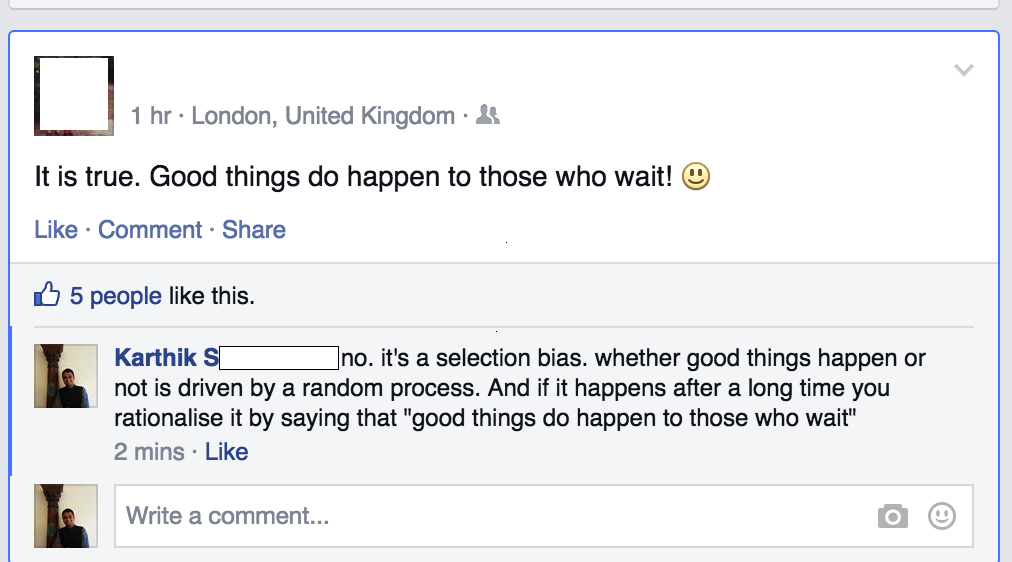
This post is about the last of my wisecracks on facebook before I left it. A facebook friend had put an update that said “good things do happen to those who wait”. I was in a particularly snarky mood, and decided to call out the fallacy and left the comment below.

Good things

In hindsight I’m not sure if it was a great decision – perhaps something good had happened to the poor guy after a really long time, and he had decided to celebrate it by means of putting this cryptic message. And I, in my finite wisdom, had decided to prick his balloon by spouting gyaan. Just before I logged out of facebook this morning, though, I checked and found that he had liked my comment, though I don’t know what to make of it.

Earlier this year I had met an old friend for dinner, and as we finished and were walking back to the mall parking lot, he asked for my views on religion. I took a while to answer, for I hadn’t given thought to the topic for a while. And then it hit me, and I told him, “once I started appreciating that correlation doesn’t imply causation, it’s very hard for me to believe in religion”. Thinking about it now, a lot of other common practices, which go beyond religion, are tied to mistaking correlation for causation.

Take, for example, the subject of the post. “Good things happen to those who wait”, they say. It is basically intended as encouragement for people who don’t succeed in the first few attempts. What it doesn’t take care of it that the failures in the first few attempts might be “random”, or that even success when it does happen is the result of a random process.

Say, for example, you are trying to get a head upon the toss of a coin. You expect half a chance of a head the first time. It disappoints. You assume the second time the chances should be better, since it didn’t work out the first time (you don’t realise the events are independent), and are disappointed again. A few more tails and disappointment turns to disillusionment, and you start wondering if the coin is fair at all. Finally, when you get a head, you think it is divine retribution for having waited, and say that “good things happen to those who wait”.

In your happiness that you finally got a head, what you assume is that repeated failure on the first few counts actually push up your chance of getting your head, and that led to your success on the Nth attempt. What you fail to take into account is that there was an equal chance (assuming a fair coin) of getting a tail on the Nth attempt also (which you would have brushed off, since you were used to it).

In my comment above I’ve said “selection bias” but I’m not sure if that’s the right terminology – essentially when things go the way you want them to, you take notice and ascribe credit, but when things don’t go the way you want you don’t notice.

How many times have you heard people going through a happy experience saying they’re going through it “by God’s grace?”. How many times have you heard people curse God for not listening to their prayers when they’re going through a bad patch? Hardly? Instead, how many times have you heard people tell you that God is “testing them” when they’re going through a bad patch?

It’s the same concept of letting your priors (you see God as a good guy who will never harm you) affect the way you see a certain event. So in my friend’s case above, after a few “tails” he had convinced himself that “good things do happen to those who wait” and was waiting for a few more coin tosses until he finally sprang a head and announced it to the world!

Now I remember: I think it’s called confirmation bias.

Batch Parity

From several sources I’ve heard of this bizarre concept called “batch parity”, where you assume that everyone who joined a particular school or company in a particular year is identical. This leads to people passing up on opportunities because they are not given such parity.

I’ve been hearing of this from way too many sources nowadays so I wrote off a rant, on LinkedIn. Here is an extract:

So while it might be tough for people to stomach, this whole concept of batch parity is, to put it simply, nonsense. At its heart is the assumption that the world is linear, and that after a certain arbitrarily chosen point in time, people ought to all run at the same place.


Communists and Chintamani

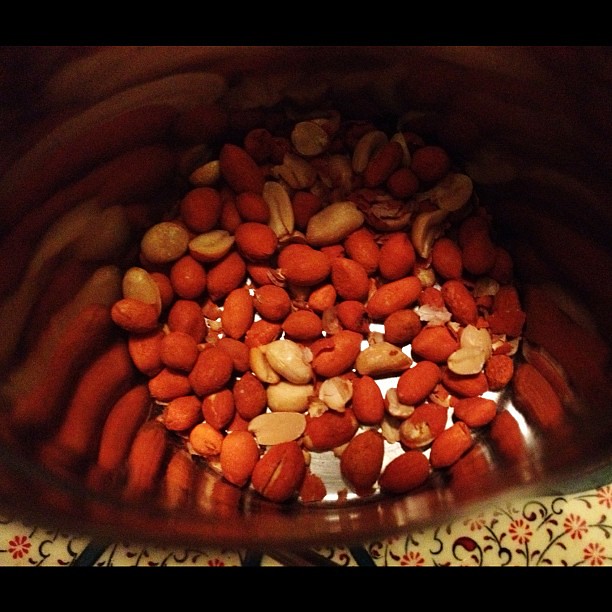
My grandmother Narasamma, who was my last surviving ancestor before she passed away earlier this year, used to make roasted red peanuts. I don’t know the exact process for making them but it basically consists of applying a mix of salt and chilli powder to peanuts and roasting them (or the other way). If there is one thing I’m unlikely to forget about this grandmother, it’s the red roasted peanuts she would make.

I had never eaten these peanuts until when I was about eight years old when this grandmother moved in with us. I can’t really say that I ever got along particularly well with her, but these peanuts more than made up for all of that. Interestingly it was after she moved out a few years later that the supplies of these peanuts started going up. Anyway, in due course of time I had come up with the phrase “ajji kaDlekai” (grandmother’s peanuts) to refer to these peanuts.

Source: Flickr

As she grew older the supplies of these peanuts started drying up and I had to look for other sources. I soon settled upon Srinivasa Condiment Stores (more popularly known as “Subbamma stores”) in Gandhi Bazaar for my supplies. On my first few visits I would just point at it and be told a price and would buy without bothering what the name was. It was less than a decade ago that I discovered that these “ajji kaDlekai” actually had a name.

It was at Subbamma stores that I once went to procure such peanuts and couldn’t find them on display. I asked the shopkeeper if he had “red peanuts” (kemp kaDlekai) and he shouted to his associate deep into the store “one communist!”. It was then that I realised that the popular name of these red peanuts is “communist”.

The etymology is not hard to guess – the yellow “split” peanuts are called Congress (thanks to the congress split around 1970), and they wanted to come up with a political name for other varieties of peanuts also. Thus, being red in colour these peanuts came to be called “communist” (some disambiguation was required here – for there is another variety of red peanuts which are fried rather than roasted. They’ve been named “Oil King”). I don’t know how popular the name is but in Subbamma stores at least these peanuts are called “Communist”. Similar peanuts roasted with green masala are called “green revolution” (unlikely the name ever caught on! ).

When I moved to North Bangalore two years back I no longer had access to Subbamma Stores for my Communist fix. And I had to find stores close to my home there that would supply it. It was hard enough to find so I cultivated several sources (somehow Communist is not as popular as Congress in condiment stores – perhaps reflecting political parallels). Sometimes it would be from Ganesh Condiments in Rajajinagar first block. On other occasions it was the Iyengar’s bakery at the end of my road (but he never got the difference between communist and oil king and so I stopped buying from him). And sometimes as far away as the Ace Iyengar store in Malleswaram.

There was one thing common to the communists procured from these sources though – the label. Each of them were manufactured by a different small scale industry named after a different god. But the place of manufacture was the same – Chintamani town in Chickballapur district. It was after I had seen similar labels several times that it all started coming together.

I remembered that my father was born in Chintamani, which means that Chintamani is my grandmother’s hometown (given how births were conducted back in the 1950s one could infer this). And this explained how she had picked up this skill for making these Communist peanuts – something most of my other relatives (none of whom were from Chintamani) lacked.

I was reminded of all this a while back when I was eating Communists, procured from Gayathri Stores in Jayanagar 4th block (incidentally run by actor Kashinath’s brother). This one came without a label, and when I had asked the shopkeeper (Kashinath’s brother) for the source, he had replied “naave maaDstivi” (we get them made). Maybe the communists I had for a snack a while back weren’t made in Chintamani, but they were crisp and perfectly spiced!

The communists have moved beyond Chintamani!