BrEntry

So we moved to London yesterday. The wife has got a job here, and Berry and I have tagged along as “dependants”. My dependant visa allows me to work here, though it has been mentioned rather complicated as “Restricted no doctor/dentist training no sport”. Basically I can do everything else. The five-month old’s visa stamp simply says “work permitted”! Go figure.

This is not the first time I’m living in London. I’d very briefly (for the length of a mid-MBA internship) lived here twelve years ago, and as luck would have it, our cab from the airport to the temporary apartment passed under that office on the way (that employer has moved offices since, I’ve been told).

London welcomed us with some fabulous weather yesterday – I actually considered getting my sunglasses out! Wasn’t too cold (one jacket was enough) and mostly didn’t rain, so despite being sleepless and tired from our journey, we ended up setting out to put beats and meet some friends. While we were waiting at the bus stop, though, it did drizzle a bit, making me reconsider whether we should really go out. Then, my wife reminded me that we weren’t in Bangalore any more, and poor weather is no excuse to put NED.

We took Berry in her stroller yesterday. Walking around with it was peaceful – for the large part, footpaths exist, and though not as smooth as Hema Malini’s cheeks, there are no problems at all with taking the stroller around. It’s not a problem on buses either, but the tube is a real bitch. Most stations don’t have elevators, and you need to carry the strollers up or down stairs. And we haven’t yet figured how to hold it while climbing down escalators, which left little Berry rather scared as she got on for her first tube ride. Henceforth, when a tube ride is involved, we’ll most likely put her in her baby carrier rather than the stroller!

Keeping her warm is a challenge, though. As a good South Indian kid, she refuses to wear any warm clothes and we need to endure significant screaming when we make her wear a warm jacket. We also need to figure out a strategy for the rain. We’ve got this plastic cover for her stroller, but a different strategy is required when carrying her in her carrier (the carrier is also hard to wear when wearing a coat of any kind).

Finally, a note about coffee. Firstly, it isn’t that expensive – a typical coffee at Costa is around £2.25 (I’m still conditioned to thinking GBP/EUR = 1, though I realise I need to add 15% to convert pound prices to Euros, which I’m used to). But the coffee at Costa itself was disappointing.

They promised a Cortado, which is a Spanish concept where very little milk is added to a shot of espresso, giving a rather strong coffee. Costa advertised at their door that they served some three kinds of Cortado (a travesty in itself). And the cortado itself had way too much milk for it to be called a Cortado!

I hope to continue to make pertinent observations, unless I join an employer where continued blogging might seem too dangerous (I’ve worked for those kinds of employers in the past but don’t want to take chances again)! And you might remember that this blog “took off” in terms of the number of posts the first time I was in Britain!

Upside down pricing in payment services

Some Indian banks charge for services that are cheap to execute, and offer for free expensive services 

Last week I enddd up spending some time waiting at a teller counter at a bank. This was due to some mess up with a cheque I had received. During my time at the teller counter I had the opportunity to observe other people at the same counter. 

There were a few people depositing cash into their business accounts. A few others were depositing cheques. What caught my attention, however, was this guy from a nearby business who came to deposit a large number of cheques. 

He had an entire book of challan leaves (banks regularly issue those to business customers), to each of which was stapled a cheque. As I watched, the teller would put a seal on a cheque, its corresponding challan and another seal on the counter foil. This process was repeated for each challan in the book. 

And this process was only to accept the cheques. Later on there would’ve been further effort on behalf of the bank to cash the cheque and actually execute the fund transfer. And then add in the effort of writing out all those cheques, writing out all those challans (they’re hard to print) and then take them to the bank. 

It was a rather laborious process all round, on behalf of all parties involved. Yet, banks mostly execute this function for free for most customers. 

On the other hand, they charge for account to account transfers, and the amount isn’t particularly small. Like this morning I was moving money from one account  to another, a process that took me a minute and that wouldn’t have cost the bank any human minutes. And icici bank decided to charge me for it. 

It seems like banks have their pricing and the valuation of their own effort all wrong. For electronic payments the cost is direct – what the banks have to pay the payments systems and any per use software costs. And this makes it easier to value and charge for such services. 

The effort in transacting through cheques, on the other hand, is not directly measurable (though by no means an impossible exercise). There are back offices that do the job whose cost is easy to measure, but several employees who also do other things spend time processing cheques. And this difficulty in measurement means that most banks just don’t charge for cheques. 

Around 2000 when foreign banks expanded their branch networks in india there was an attempt to charge customers for walking into the branch – customers were encouraged to do their business at ATMs or over the phone, instead. This was in recognition of the costs of customer walkins into branches.  

Banks would do well now to do something similar for cheques as well – despite the cheque truncation system (CTS), the effort involved in organising payments through cheques is massive for the bank. 

There is only one upside to cheques – and this is a downside for customers. Cheques result in money going into limbo. The payer doesn’t know when the funds will leave his account and can’t use the funds. The recipient can’t use it either until he has got it. So for the duration that the amount is “in transit” (and this duration can vary significantly) banks can happily use these funds without them being called. 

It’s possible that the benefit to the banks from this float more than compensates for the pain of processing cheques. If not, cheques have no business existing any more! 

India post payments bank

I’d once written about India Post Payments Bank, after a visit to a post office, and wondered if it will actually help foster financial inclusion. Now that the bank is about to launch, it seems to be doing some interesting thing, and mostly in terms of the intermediary it will be.

Being a payments bank, IPPB can only take deposits, and not give loans. It is trying to build a platform where it will simply act as a distributor for loans, and different lenders can make use of its customer transaction data and lend to its customers.

Also, since payments banks can only invest their deposits in government securities, the “float” is limited by the difference between the yield on such securities and the interest offered to depositors. Competitive pressures mean that the latter needs to be high, resulting in a thin float. Consequently, a payment bank needs to make money on payments and selling third party products such as investments insurance.

A recent interview with IPPB CEO Ashok Pal Singh gives some interesting pointers about how the bank might go about this. Firstly, the bank will dispense with the investment+insurance products, and will sell pure unbundled life insurance. The logic is that since the clientele is likely to be the hitherto unbanked, they will not be able to understand complicated products, and there is a high chance of misselling. By restricting product choice to those that are highly unlikely to be missold, the bank can ensure customer protection.

Similarly, in case of mutual funds, distributors have an incentive to recommend funds with high fees since they also tend to offer higher distributor commissions. Again, given IPPB’s clientele, the chances of mis-sale are high, and so the bank has decided to sell only index funds!

This is remarkable since index funds have hitherto been non-starters in India. Benchmark Mutual Fund had managed to establish a market, but a series of acquisitions has meant that the market hasn’t really taken off. Most financial advisors in India swear by actively managed funds. So a bank, however small, announcing that it will only sell index funds can give a massive boost to that market!

Apart from selling “simple” products such as term life insurance and index funds, the way the bank is going about the process is also interesting. Rather than tying up with a single provider of these products (as most other banks have done), IPPB plans to take the “broker” route and distribute products from different asset managers and insurers. This ensures that the rates remain competitive, though it is natural that the end salesperson might choose to sell products with the highest commissions/incentives. Nevertheless, with the products being inherently simple, the rates to the end customers are still likely to be competitive.

After over a decade of slumber, the RBI licensed a few (limited) banks last year. It is interesting to see the kind of diversity this new set of licensing has unleashed. Again goes to show that removal of barriers to entry can result in significantly better markets!

During his last few speeches, former RBI Governor Raghuram Rajan kept mentioning how full-service bank licenses will be soon “put on tap”. The sooner that happens, the better it is for Indian banking customers.

Incredible stupidity in taxi marketplaces

So it’s nearly a week since Uber and Ola drivers in Bangalore went on strike, and there’s no sign of it (the strike) ending. The longer the strike goes on for, the more incredibly stupid all parties involve look.

The blame for the strike should first fall on Uber and Ola, who in some hare-brained madness, forgot that running a platform means that both sides of the market are customers and need to be taken care of. They took good care of passengers, providing discounts and growing their market, but rather quickly pulled the plug on drivers, and there is no surprise that drivers are a rather pissed off lot.

The root cause of driver dissatisfaction has been falling bonus payments, and consequently, incomes. This is a result of Uber and Ola providing too great a subsidy during the time they built up the market.

I don’t fault them for providing those bonuses – when you are building a two-sided market, you need to subsidise one side to solve the chicken-and-egg problem. Where I have the problem is with the extent of bonuses, which gave drivers an income far in excess of what they could make in steady state. This meant that as the market approached steady state and incentives were withdrawn, once side of the market started getting pissed off, undermining the market (Disclosure: I’d once proposed to Ola that they hire me to help them with pricing and incentive structuring. the conversation didn’t go too far).

With Uber and Ola having done their stupid things, the next round has gone to the drivers. In a misguided attempt that a long strike will help them get better deals from the platforms, they are prolonging the strike. They’ve even ransacked Uber’s offices, and gone to the government for help.

What they don’t realise is that having invested what they have in their cars to drive on these marketplaces, their success is inextricably tied to the success of the marketplaces. And the more the jeopardise the marketplaces, the less their incomes in future.

A long strike reduces market size on two counts – it gives people time to adjust to the absence of service and get adjusted to alternate arrangements, and it decreases the reliability of the marketplaces in the eyes of the passengers. Thus, the longer and more frequent the strikers by the drivers, the less that passengers will look to use these services in the future.

A strike can work when the striking employees are protected by some form of labour laws, and there is no way ahead for their employers apart from a negotiated settlement. In case of a marketplace, the platform has absolutely no obligation to the drivers, and Uber and Ola can simply do what Uber and Lyft did in Austin, TX – pack up and move on. And if they do that in Bangalore, the drivers with their shiny new cars will be significantly worse off than they were before the strike.

The other act of stupidity on the drivers’ part has been to involve the government, which, as expected, has responded in a nandelliDLi (“where do I keep mine?”) fashion. The recent ban on shared rides (UberPool/OlaShare) came after a regulator read the rulebook after the last strike by the drivers. Given the complex economics of platform markets, any further regulation can only hurt the drivers.

All in all, the drivers’ stupidity can be traced back to not understanding platform markets, and protesting the way protests used to be done in highly unionised industries. Drivers, whose main skill is in driving cars, cannot be faulted so much for not understanding platform markets. Uber and Ola, on the other hand, have no such excuse!

Letters to my Berry #5

https://www.instagram.com/p/BQjvvFkF9sa/

Your biggest milestone in your fifth month is that you started to eat. Beyond the milk that Amma directly provided you, and the formula milk that we had started you on after the doctor’s advice, the fifth month was when we started giving you what I called as “real food”.

You started with this thing called “ragi cherry” which I personally didn’t like too much – it was made out of a flour made by mixing ragi and other cereals with some nuts, etc. We would make a porridge out of this with some sweet element, and the first time I ate it, I said it tasted like soapnut powder.

Initially you made a fuss eating the ragi cherry, but to my utmost happiness, you seem to be yet another banana lover. After only two or three times of my feeding you bananas, all I had to do was to take your silver bowl and spoon and make mashing noises – and you’d immediately start salivating.

This was also the month where you started implementing Amma’s old company’s slogan “moving forward”. Given the size of your head you had trouble holding it up, but you invented your own way of moving forward while still keeping your head to the ground. I tried without success to draw an animal analogy – sometimes it seemed like you were like an ostrich with its head buried in the sand. Ranga said you were like an Aardvark, moving forward with your head on the ground.

One night I’d left you on the carpet with my house slippers at the other end of the carpet. I hadn’t been gone for a couple of minutes when I saw that you’d somehow traversed the length of the carpet and was about to eat my slippers! Yet another day, we had left you in your bouncer and gone somewhere, and you were trying to slide down. Amma stopped you, but the next time you attempted it, we let you slide. And we were amazed with the poise with which you got down to the carpet, never once worrying us that you would hurt yourself!

This was also the month when you attended your first wedding – your aunt Barbie’s. You were such a centre of attraction during some of the pre-wedding festivities that you were tired and slept through most of the wedding. Halfway through both the wedding ceremony and the reception, we sent you home so you didn’t tire further. So apart from the photos taken at the beginning of each session, you unfortunately don’t appear in any photos!

And of course, the biggest event in your fifth month was that you got named. While you had been named even before you were born, and your official name had been submitted to the municipality when you were a day old, we did a small naming ceremony for you. There, the family priest Nagabhushana Sharma made us give you several names.

So there was the maasa naama (month name) which the priest himself decided. You were “Shachi”. Then there was the nakshatra naama (star name), which we had to come up with on the spot with the given starting letter. The starting letter for you was “Go” and Amma quickly came up with “Goda”, which she later elongated to “Godavari”.

And there was the vyavahara naama (trade name) which was supposed to represent one of your ancestors. The day I first met Amma in 2009, she had told me that she wanted to name her daughter Rukmini, after her grandmother. So there was no doubt about this one.

And then there was the nija naama (real name), which of course had to be Abheri. I had to shout it loud three times, and I did that with my mouth close to your ear. Thankfully you didn’t get startled – suggesting you like your name, and you won’t hate us later in life for it!

This is a monthly series that ordinarily runs on my wife’s blog, but since I wrote it this time (for the first time), I’m putting it here. 

Earlier editions:

Letters to my Berry – Month#1

Letters to my Berry – Month#2

Letters to my Berry – Prelogue

Letters to my Berry#4


When a two-by-two ruins a scatterplot

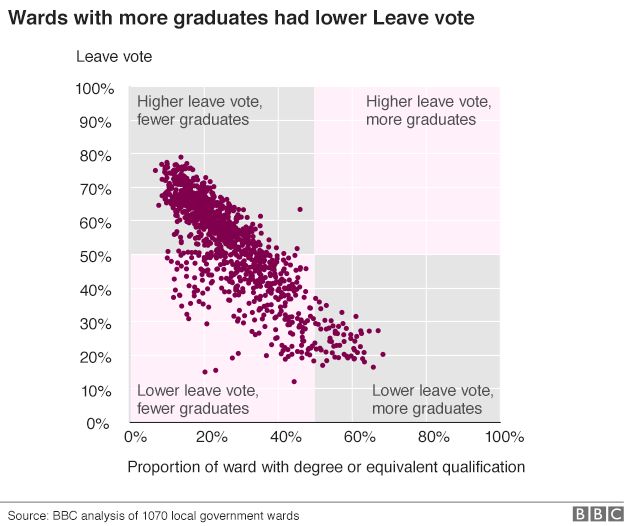
The BBC has some very good analysis of the Brexit vote (how long back was that?), using voting data at the local authority level, and correlating it with factors such as ethnicity and educational attainment.

In terms of educational attainment, there is a really nice chart, that shows the proportion of voters who voted to leave against the proportion of population in the ward with at least a bachelor’s degree. One look at the graph tells you that the correlation is rather strong:

‘Source: http://www.bbc.com/news/uk-politics-38762034And then there is the two-by-two that is superimposed on this – with regions being marked off in pink and grey. The idea of the two-by-two must have been to illustrate the correlation – to show that education is negatively correlated with the “leave” vote.

But what do we see here? A majority of the points lie in the bottom left pink region, suggesting that wards with lower proportion of graduates were less likely to leave. And this is entirely the wrong message for the graph to send.

The two-by-two would have been useful had the points in the graph been neatly divided into clusters that could be arranged in a grid. Here, though, what the scatter plot shows is a nice negatively correlated linear relationship. And by putting those pink and grey boxes, the illustration is taking attention away from that relationship.

Instead, I’d simply put the scatter plot as it is, and maybe add the line of best fit, to emphasise the negative correlation. If I want to be extra geeky, I might also write down the R^2 next to the line, to show the extent of correlation!


Yet another failed attempt at curbing wedding reception queues

For a long time now I’ve been obsessed about queues at Indian wedding receptions. The process at a reception is simple – you get to the hall, and immediately line up. Once you hit the head of the queue, you get to greet the newly wed couple, give them gifts and get photographed with them. Then you’re shown the way to the dining hall where you have dinner and put exit.

When I started my research into reception queues, my aim had been to save the guests at my own wedding the trouble of lining up for too long. As it happened, I’d failed to spot the bottleneck in time, and hence failed spectacularly. Over a few more weddings that I attended, I cracked the mystery, though – the main bottleneck was in the wedding video.

As I wrote a few months back:

… Then you hear the click of the photographer’s shutter, and start moving, and the videographer instructs you to stay. For he is taking a “panning shot” across the width of the stage. Some 30 seconds later, the videographer instructs you to move, and the bride and groom ask you to have dinner and show you the way off stage.

The embarrassing bit for the guests, in my opinion, is that having struck a photogenic pose for the photo, they are forced to hold this pose for the duration that the videographer pans. Considering that photogenic poses are seldom comfortable, this is an unpleasant process….

So when my sister-in-law got married a couple of days back, I thought it was time to finally put my research to good use, and save her guests the trouble of standing in line for too long. A couple of hours before the reception on Thursday, I went and had a quiet word with the videographer. I told him about how the panning shot held up queues, and so he should make it quick. After a little discussion, he agreed to use a wider angle for the shot, and cut down the time by half.

Around 8 pm, half an hour after the reception started, the queue wasn’t too long. I was secretly happy that my method was working, but there was the possibility that the short queue was down to low arrival rate rather than high process rate. Fifteen minutes later, the queue had built up through the length of the hall, and would remain so for another half hour. My efforts had come down to nought.

It was when I went up on stage to introduce some of my relatives to the bride (I was the cut-vertex in the network between the married couple and these guests, so my presence was required) that I realised what the problem was. The videographer I’d spoken to had been doing his job, panning quickly, but he wasn’t the only one.

There is always a level of mistrust between the families of the couple at any Indian wedding, and this is mainly down to them not knowing each other well. So there is redundancy built in. Usually, each side brings its own priest. The two halves of the couple collect their gifts separately. And most annoyingly for me, each side arranges for its own photographer and videographer.

So the problem was that while our videographer had been panning quickly as instructed, the videographer engaged by my now brother-in-law-in-law was in no such hurry, and was taking his own time to plan. And since I hadn’t engaged him, it wasn’t possible for me to tell him to hurry up.

And so some guests had to endure a long wait in the queue. If you were one of those, my apologies to you – for I didn’t anticipate the double-videographer problem which would hold up the queue. And my apologies once again to those who had to wait in queue at my wedding as well!

Dreaming on about machine learning

I don’t know if I’ve written about this before (that might explain how I crossed 2000 blogposts last year – multiple posts about the same thing), but anyway – I’m writing this listening to Aerosmith’s Dream On.

I don’t recall when the first time was that I heard the song, but I somehow decided that it sounded like Led Zeppelin. It was before 2006, so I had no access to services such as Shazam to search effectively. So for a long time I continued to believe it was by Led Zep, and kept going through their archives to locate the song.

And then in 2006, Pandora happened. It became my full time work time listening (bless those offshored offices with fast internet and US proxies). I would seed stations with songs I liked (back then there was no option to directly play songs you liked – you could only seed stations). I discovered plenty of awesome music that way.

And then one day I had put on a Led Zeppelin station and started work. The first song was by Led Zeppelin itself. And then came Dream On. And I figured it was a song by Aerosmith. While I chided myself for not having identified the band correctly, I was happy that I hadn’t been that wrong – given that Pandora uses machine learning on song patterns to identify similar songs, that Dream On had appeared in a LedZep playlist meant that I hadn’t been too far off identifying it with that band.

Ten years on, I’m not sure why I thought Dream On was by Led Zeppelin – I don’t see any similarities any more. But maybe the algorithms know better!

Who do you subsidise?

One basic rule of pricing is that it is impossible for all buyers to have the same consumer surplus (the difference between what a buyer values the item at and what he paid). This is because each buyer values the item differently, and is thus willing to pay a different price for it. People who value the item more end up having a higher consumer surplus than those who value it less (and are still able to afford it).

Dynamic pricing systems (such as what we commonly see for air travel and hotels) try to price such that such a surplus is the same for all consumers, and equal to zero, but they never reach this ideal. While the variation in consumer surplus under such systems is lower, it is impossible for it to come to zero for all, or even a reasonable share of, customers.

So what effectively happens is that customers with a lower consumer surplus end up subsidising those with a higher consumer surplus. If the former customers didn’t exist, for example, the clearing price would’ve been higher, resulting in a lower consumer surplus for those who currently have a higher consumer surplus.

Sometimes the high surplus customer and the low surplus customer need not be different people – it could be the same person at different times. When I’m pressed for time, for example, my willingness to pay for a taxi is really high, and I’m highly likely to gain a significant consumer surplus by taking a standard taxi or ride-hailing marketplace ride then. At a more leisurely time, travelling on a route with plenty of bus service, I’d be willing to pay less, resulting in a lower consumer surplus. It is important to note, however, that my low surplus journey resulted in a further subsidy to my higher surplus journey.

When it comes to markets with network effects (whether direct, such as telecommunications, or indirect, like any two-sided marketplace), this surplus transfer effect is further exacerbated – not only do low-surplus customers subsidise high-surplus customers by keeping clearing price low, but network effects mean that by becoming customers they also add direct value to the high surplus customers.

So when you are pleasantly surprised to find that Uber is priced low, the low price is partly because of other customers who are paying close to their willingness to pay for the service. When you pay an amount close to the value you place on the service, you are in turn subsidising another customer whose willingness to pay is much higher.

This transfer of consumer surplus can be seen as an instance of bundling, but from the seller’s side. Since a seller cannot discriminate effectively among customers (even with dynamic pricing algorithms such as Uber’s surge pricing), the high-surplus customers come bundled with the low-surplus customers. And from the seller’s perspective, this bundling is optimal (see this post by Chris Dixon on why bundling works, and invert it).

So the reason I thought up this post is that there has been some uncertainty about ride-hailing marketplaces in Bangalore recently. First, drivers went on strike alleging that they weren’t being paid fairly by the marketplaces. Then, a regulator decided to take the rulebook too literally and banned pooled rides. As i write this, a bunch of young women I know are having a party, and it’s likely that they’ll need these ride-hailing services for getting home.

Given late night transport options in Bangalore, and the fact that the city sleeps early, their willingness to pay for a safe ride home will be high. If markets work normally, they’re guaranteed a high consumer surplus. And this will be made possible by someone, somewhere else, who stretched their budget to be able to afford an Uber ride.

Think about it!

Cross-posted at RQ

On holding stocks

I never understood one thing about investment analyst reports – the “hold” recommendation. This is “between” the “buy” and “sell” recommendations (which are self-explanatory), and it tells an investor to hold on to the stock if he already owns it, but not to buy if he doesn’t.

The problem with this is that the difference between buying and holding a stock is small, especially given the current efficiency of equity markets and consequent low transaction costs. The only difference between holding and not holding a stock is that in the latter case, you spend the transaction cost of buying the stock. That is all. Based on this, it is intriguing that the two have remained distinct analyst recommendations for ages now.

I can think of two possible explanations:


  1. One can assume that the investor is fully invested (not holding any cash), and so buying a stock means that he has to sell something else in order to allocate capital to this stock. So in other words, the cost of getting the stock into you portfolio is higher than the trading cost itself – it comes in at the cost of another stock. With these increased transaction costs, it’s possible that it’s not worth buying the stock .

  2. Analysts hate to admit it (look at the precision with which they dictate price targets), but there is a wide band of error around their estimates of what price the stock will trade at at some point of time in the future. So the buys are those that are much more likely to be trading up than the holds. So by saying “hold” you are saying “yeah this stock might go up, so I’m not so confident about it so don’t bother buying if you don’t have it already”.

But then there is this school of thought that says that analyst’s buy/hold/sell recommendations do not matter at all, and the value they add is in providing the investor access to the company’s management. Matt Levine has written plenty about this, and you should read his latest stuff on this.