No dosa on Saturdays and Sundays

Back when I was a student at IIM Bangalore a decade ago, I had tried to run this series on this blog (its predecessor, to be precise) on “delivery mechanisms in South Indian Fast Food restaurants”. I had half a mind to do a project on that, too, but then worse sense prevailed, and I did some random shyte on post offices.

Anyway, given that I’ve been living alone for a year now, I tend to frequent South Indian Fast Food Restaurants fairly often for breakfast (and tiffin, sometimes), and thought I should resume this series.

So this morning I went to “duplicate Brahmin’s” for breakfast. This is a place in Jayanagar 4th Block (next to the 560041 post office) and should not be confused with the “original Brahmin’s” in Shankarpuram. I don’t know if this Brahmins has anything to do with that Brahmins, though I’m pretty sure people would have outraged about a restaurant with a (upper) casteist name in these times. Some hypotheses go that this restaurant was started by disgruntled employees of the “original” Brahmins. Anyway, it doesn’t matter since the food here is pretty good (though not as good as at the original Brahmins).

This restaurant has aped a large number of features from the “original” Brahmins. The first is a limited menu – there are only some five or six items made daily. This is usually a good feature of fast food restaurants since it results in aggregation of demand and lower wastage, resulting in lower costs. It also results in significantly quicker service since there are only so many “lines” that need to be maintained in the kitchen.

The other feature this has aped from the “original Brahmin’s” is that there is no sambar. While this might shock Tamilians and North Indians, it’s a fairly normal thing in Bangalore. In fact, Sambar with breakfast is not normal for Bangalore, and most “traditional” restaurants only serve chutney. The advantage of this is (as Pavan pointed) that people can hold their plates in their hands (chutney is cold, unlike hot sambar), so you don’t need that much table space!

There are normally six items on the menu in the duplicate Brahmin’s (apart from beverages) – idli, vada, kesribhath, kharabhath, “ricebhath” (a redundant term like Avenue Road, I know; and this is only served during lunch. It’s a catchall term encompassing “tomato bhath”, “veg pulao”, puLiyOgare, chitrAnna, etc.) and masala dosa. And the odd man out is the last one for the rest are “made to stock”. Masala dosa is usually “made to order” since its quality “decays” quite quickly after it’s made.

It was pleasantly surprising to see a board saying “no masala dosa on Saturdays and Sundays” when I went to duplicate Brahmin’s this morning. The restaurant was already fairly crowded when I went, and there was a queue about five people long at the cash counter. The restaurant is designed in a way that there is this one not-so-large counter across which everything (coupons, food, beverages) is served, and there was a crowd today at every part of the counter (only the cash counter had a queue, at the rest of the places people just crowded around).

That’s where the “no masala dosa on weekends” board makes sense. With the dosa being made to order, people have to linger around the  counter once they’ve handed in their order until they have received their dosa. And given the rather small size of the counter and the weekend crowds, this simply leads to unnecessary crowding and shoving. It also seems like the demand for Masala Dosa at duplicate Brahmin’s is not high or predictable enough to warrant making it to stock. And hence, it’s a rational decision to ration the supply of dosas (to zero) on weekends.

The question is why the restaurant makes dosas at all (on weekdays), given that the original Brahmin’s doesn’t. The answer to this lies in a cost-benefit analysis. On weekdays, the supply chain is not tight and there are no people crowding at the counter. This means that the strain imposed on the system by people waiting around for their dosas is not too high.

Studying fast food restaurants can be a fascinating exercise.


Maybe not a fanboy any more

Over the last one year or so I’ve been on course to becoming an Apple fanboy. I had already quite liked the interface of the iPod touch and the iPad, though I hadn’t taken very well to the wife’s iPhone4. And then around this time last year, she bought herself a Macbook Air.

That was a gamechanger as both in terms of physical specifications and ease of use, it seemed a world away from the Windows laptops that I had at that time. A couple of months later (my laptop needed replacement anyway), I bit the bullet and invested in a Macbook Pro. And I became a bigger fanboy. I even decided last month that my next phone will be an iPhone (I’ve never had one so far).

After the events of the last two weeks, however, I’m not so sure. I was upgrading the iPad (it’s technically my wife’s since I had gifted it on her birthday two years back, but I’ve used it more than her) to iOS 8.4 when the update failed midway. It was inexplicable. I tried it a few more times, upgraded iTunes on my computers, downloaded the OS again, did a zillion things but the update continued to fail.

Considering that the iPad isn’t as integral to my life as the phone or computer, it was two weeks before I took it to hospital. Yesterday I went to iCare, an authorised Apple service centre, and showed them the iPad. They took it in and asked me to come back after an hour. An hour later, they said it wasn’t updating and that there was a hardware issue and the iPad was effectively dead.

It was then that I started losing it (I thought the lack of updation was a routine bug that happens with OS upgrades). And it was clear that these guys had done nothing more than what I had done at home. Connected iPad to iTunes, hit on the process to update, see error code, become clueless and give up. And then say “hardware issue”.

I mean, I’m an engineer, and I know that there is clearly no hardware problem with the iPad. And I couldn’t have possibly burned something in it when updating the OS. Who are they bullshitting when they say that it’s a “hardware issue”?

And so off I went to another (this time unauthorised) service centre which had come recommended. They made me wait, and tried all sorts of things. I had to wait longer here since they had to download iOS 8.4. Again it is not clear if they did anything beyond what I had already done at home. And I repeatedly told them not to repeat that but to find out what the problem is. And they seemed clueless.

So the iPad is a brick now. And since it’s been two weeks, I’ve really started missing it. I’m fairly pissed off with Apple right now, for making something that cannot be repaired. And for staffing their service centres with incompetents who do little more than what can be done at home.

I’m not sure I’m a “fanboy” any more. It seems like there is too much “tail risk” in apple’s products. To their credit, they possibly recognise that and exhort you to buy extended warranty (which I now plan to do for my Macbook). But it’s surely a problem that their repair centres (I’m not talking about the “unofficial” place) don’t do much more than what can be done at home.

I’m not so sure that I’m going to buy that iPhone now. If you’re investing so much (relative to “competition”) into a single product that carries so much tail risk, I don’t know if it’s all that worth it. But lack of worthy androids might just push me in that direction.

Meanwhile, I need to figure out how to salvage my iPad. Does anyone know of any competent apple service centres that I can take it to, where they’ll do more than just a cursory sniff? And are the so-called “geniuses” at Apple stores in the US actually good?

English and phonetic spellings

So my nephew Samvit, who recently turned 4, has learnt to spell. And he has learnt to use a computer (and phone) keyboard. He seems to love the keyboard so much that he apparently refuses to write using pen and paper.

They say that he’s taken after me in many ways (despite us sharing just 1/16 of our genes – he’s my cousin’s son), and I must mention that my writing output exploded after I had learnt to type and got access to a computer keyboard.

The point of this post is not about his writing, however. Yesterday, they made him spell out a few words, and here is how he spelt them out. One thing I might want to disown him for is that he uses all caps. Leaving that aside, the way he spells is extremely interesting. Here is the list of words he spelt out, as emailed to me by his mother:

THIORI
ELEKTRIC
MAGNET
ANTENA
MYKRO
STRIP
HELIX
PERABOLA
DYPOLE
HORN
GYD
COSMIK
PLANET
ANIMUL
DANS
SING
CUK
DRAMA
MUZIC
HOUS
TEMPUL
SOUND
SOFA
WATUR
AEROPLEN
SHIPYARD
GARDUN
CHOKLET
BRED
JUS
BANANA
ORENJ
AVACADO
ORIYO

As you might notice, it’s all very phonetic. He has learnt the English alphabet, and sounds associated with each letter, and then tried to fit that to the words that he has had to type out. It appears weird at first, but then if you take a closer look, you realise that it’s rather intuitive.

He seems to have figured out the polymorphism behind certain letters, for he uses multiple sounds of U in “Jus” (which is how I think it’s spelt in certain European languages, btw) and in “Gardun”. He hasn’t figured out the polymorphism in i-y though, as he says “thiori” and “gyd”.

Then his use of Cs and Ks for the Ka sound is also interesting, as he uses both of them, and he seems to have a certain logic for using them. I’ve been trying to reverse engineer this logic but so far failed. He says “cuk” and “cosmik”, from which you might think he uses “c” when its the beginning of a syllable and “k” when it’s the end of a syllable.

But then you also notice that he says “elektric” which throws this hypothesis out of the window. And there is “avacado” and “choklet”.

Overall, though, it is fascinating to see how a four-year-old who has just learnt the language spells, Maybe if we get a bunch of four-year-olds who still haven’t been formally taught to spell to spell, we might understand what English spelling should intuitively be like! It might even be possible that going forward the language may evolve to this new spelling!

Are there any other interesting patterns you notice in the other list of words? Are there any other interesting ways in which you’ve seen other kids spell? What does this mean for the English language – should it be simplified?

Ghoti

Shoes and metrics

The best metric to measure the age of a pair of shoes is the distance walked in them

My latest pair of “belt chappli” (sandals with a belt going around the heels) is only ten months old, but has started wearing. Walking long distances in the said sandals has become a pain. The top is nice, the sole is fantastic, but the inner sole has gotten FUBARed. Maybe it was a stone that got stuck under my feet which I didn’t notice. Maybe it was several such small stones. But with the inner sole “gone”, time is nigh to possibly retire the chappal.

But then a good pair of sandals is supposed to last much longer (and I did 2 longish foreign trips in this period where this chappal didn’t travel with me). Historically, good sandals have lasted two years or more. And it is not that this one is cheap. I paid close to Rs. 2000 for it, and it’s branded, too (Lee Cooper), and I had found it after a lot o difficulty (three months of searching). That it has lasted less than a year is not fair.

But then the question arises as to whether I have the right metrics in place. The number of months or years that a pair of shoes lasts is an intuitive metric of its quality, but it is not the right one. For, a pair of shoes doesn’t wear when it is not worn! Of course there might be mild wear and tear due to weather conditions, but for a pair of shoes made of good leather, that can be ignored.

So maybe the best metric for a pair of shoes is the amount of time it is worn? Then again, while a shoe might wear while its worn, it doesn’t wear too much when it’s at rest –  I mean its shape changes to fit the wearer’s foot (over the medium term) and that might cause some wear and tear, but in the long run, there is unlikely to be much wear and tear at rest.

From that perspective, I hereby declare that the best metric to measure a shoe’s performance is the number of kilometres walked or run in it (latter causes significantly more wear and tear, but let’s assume that walking shoes and running shoes are mutually exclusive (which they’re not) ). This is an excellent because it takes care of a number of features that correlate with the wear and tear, and is not hard to fathom.

Going by this metric, my current pair of “belt chappli” has put in considerable service. Over the last ten months, the frequency of going on “beats” in Jayanagar has gone up, and the distance covered in each beat, too. Having pretty much stopped driving, I walk more than I used to, and this is my default shoe for such perambulations.

The problem now is the search cost – good belt chapplis that fit my feet are hard to find. It’s a liquidity problem, I think (:P). Maybe I should just consider getting the inner sole replaced and get on with this one.

Revenue management in real estate

Despite there continuing to be large amounts of unsold inventory of real estate in India, prices refuse to drop. The story goes that the builders are hoping to hold on to the properties till the prices rebound again, rather than settling for a lower amount.

While it is true that a number of builders are stressed under bank loans since banks have pretty much stopped financing builders, this phenomenon of holding on to houses while waiting for prices to recover is actually a fair strategy, and a case of good revenue management. Let me illustrate using my building.

There are eight units in my building which was built as a joint venture between the erstwhile owner of the land on which the building stands and the builder, both receiving four units each. The builder, on his part, sold one unit from his share very soon after construction began.

Given the total costs of construction, the money raised from sale of that one apartment went a long way in funding the construction of the building. It wasn’t fully enough – the builder faced some cash flow issues thanks to which construction got delayed,  but since he managed to raise that cash, he didn’t need to sell any other units belonging to his share. He continues to own his other three units (and has rented out all of them).

The economics of real estate in India are such that the cost of land forms a significant part of the cost of an apartment. According to a lawyer I had spoken to during the purchase of my property (he also has interests in the construction industry), builders see a significant (>100%) profit margin (not accounting for cost of capital) in projects such as my building.

What this implies is that once the builder has taken care of the cost of land (by paying for it in terms of equity, for example, like in the case of my building), all he needs to do to fund the cost of construction is to sell a small fraction of the units. And once these are sold, there is absolutely no urgency to sell the rest.

Hence, as long as the builder expects prices to recover (when it comes to house prices, builders are usually an optimistic lot), he would rather wait it out (when he can realise a higher price) than sell it currently at depressed prices. Hence, downturns in housing markets are not characterised by an actual drop in prices (few builders are willing to drop prices) but by a drop in the volume of transactions.

While there might be a large number of housing units that remain unsold, it is unlikely that there are apartment complexes which are completely unsold – there will be a handful of bargain-hunting early buyers who would have bought and funded the construction of the complex. And given the low occupancy rates, these people are losers in the deal, for it will be hard for them to move in.

And it is also rational for the builder to invest in new projects even when they are currently holding on to significant inventory. All they need to do is to find a willing partner who can contribute the necessary real estate in the form of equity. And new projects will inevitably find the first set of early buyers looking for a bargain, irrespective of the builder’s track record.

And so the juggernaut rolls on..

The toin coss method

My mother had an interesting way to deal with dilemmas for which she had no solution – she would just toss a coin. She had only one rule for the “game” – that once she had decided to toss the coin, she would accept the “coin’s decision” and not think further about it.

This enabled her to get over many instances of decision fatigue – you have a dilemma only when you have two comparable choices, and won’t do too much worse by picking either.

So there’s this dilemma that’s hit me since this morning and facing trouble in making the decision (one of the choices has unquantifiable benefits so an objective cost-benefit analysis is not possible), I thought I should go back to my mother’s old method. And conveniently I see a coin lying on the table a metre away from me.

Thinking about it, tossing it and accepting its decision is acceptable only if I’m equally inclined to the two possibilities (assuming it’s a fair coin). Let’s say that I want to pick choice A three out of four times (“mixed strategies” can be rational in game theory), then I should toss the coin twice and pick A if either of the tosses returns a head. And so forth.

Considering how much decision fatigue I face (there have been times when I’ve actually turned around a dozen times after having taken only one step in each direction, not able to make up my mind), I should perhaps adopt this method. This makes me think that decision fatigue is also hereditary – and it was because she faced so much decision fatigue that my mother had to invent the coin toss method.

The title of this post is a tribute to an old colleague who would unfailingly say “toin coss” every time he intended to say “coin toss”, and tossing coins was an analogy he would make fairly often.

China, Reporting and Bias

The amount of attention that the rising Chinese stock market received over the last one year is nothing close to the attention that the falling market has received over the past month or so.

While the markets have fallen by at least a fourth, which is more than what the Dow Jones Industrial Average (DJIA) fell on Black Monday, the fact is that this followed nearly a year of insane rise in the markets, the fact is that markets are still up 80% over a year ago.

I hereby present two charts. Both are time series and hence drawn as lines, and both start from 1st of January 2014. The first shows the SSE Composite Index  (refer to Yahoo finance for a more interactive plot. I couldn’t embed the chart here).

chinaThe second shows the Google Trends for “China Stock Markets” over the same time period.


I don’t think I need to explain much further. On the way up, there was little commentary on China’s markets, apart from that there might be a bubble. On the way down, though, there is so much more!

The asymmetry in markets is rather intriguing!

In appreciation of Dustin Brown

As a kid, I used to watch a fair bit of tennis. This “fair bit” must be qualified, though, since it was limited by what Doordarshan, India’s state broadcaster, would show. So this would typically mean the second weeks of the French Open and Wimbledon (US Open and Australian Open were in “wrong” time zones, and DD seldom telecast non-Slams), and the odd Davis Cup tie.

I don’t remember much of the Davis Cup ties (apart from Leander Paes and Ramesh Krishnan’s run to the semifinals of the Davis Cup one year (where they got roundly thrashed by a Wally Masur-led Australia) ), but some of the French Open and Wimbledon memories still stay, the high point being that I still remember the full scorecard of the 1992 Wimbledon finals when Andre Agassi beat Goran Ivanisevic in an epic 5-setter (6-7 6-4 6-4 1-6 6-4; checksum being that both players won 25 games each).

Over the last decade or so, though, I’ve steadily lost interest in tennis. I surely watched the two European slams (which are telecast in prime time in India) most years during the Sampras era, but remember very little of the Federer-Nadal era. The last Grand Slam final I remember watching was in 2009 when Federer beat Roddick at Wimbledon. That final I remember as one I wasn’t particularly interested in, as I polished off Aakash Chopra’s Beyond the Blues as I watched it.

In the last few years, I’ve tried watching tennis (mostly out of Twitter peer pressure; yes such a thing exists), but have found it very hard. Rallies are way too long. It’s too much of a power game nowadays than one of guile. You get bored watching players hitting it across from baseline to baseline endlessly.

And then there is Rohit Brijnath. This is one journalist most people on my Twitter timeline worship, but I think he has ruined tennis for me. His endless articles about Nadal’s “grit” (which get a page all for themselves in Mint Lounge) have resulted in my over-analysing the playing styles of anyone playing, not able to enjoy the game for what it is. And with endless baseline battles (which I didn’t really mind back in the era of Courier and Agassi and Bruguera) there is not that much to enjoy either!

Living alone has meant that I watch more TV nowadays than I used to earlier (but strictly restricted to live sport), and that has meant that Wimbledon has been the “default background process” during the last few evenings. That hasn’t necessarily meant that I’ve watched much – it’s just a “background process”, except for one game.

I started watching Dustin Brown’s game against Rafael Nadal sometime in the second set simply out of sheer curiosity given the way Brown looks. Noticing that Nadal was a set down, it seemed like it might be an interesting game, but I had my laptop out for good measure. Soon, it became evident that this Brown guy is different, and it wasn’t too long before I was heavily rooting for him.

The way he was playing was refreshingly different. A really big first serve. A quick rush to the net immediately after. Great net play. Innovative shots. And he was erratic as hell. Within a game or two of my switching on, it was certain that this was going to be one of those legendary games.

Nadal is one of those guys who is intelligent and accurate. If you are erratic, he will make sure he will take advantage of you. And advantage of Brown’s errors he took as he wrapped up the second set without much ado. But it was from the third set onwards that it seemed that this wasn’t going to be as straightforward after all.

Brown was erratic for sure, and played some absolutely strange shots (like this double handed shot with the racquet in front of his face), but his playing style surely unsettled Nadal. He simply didn’t let Nadal get into a rhythm, and his frequent rushes to the net meant that Nadal simply wasn’t able to play his usual waiting game where he breaks down the opponent (has anyone written a piece yet drawing parallels between Nadal and Magnus Carlsen?) slowly. This was a kind of opponent one doesn’t come across too often nowadays, and Nadal failed to adapt. By now, I was strongly rooting for Brown.

But life wasn’t easy then, given Brown’s propensity for errors. You would think he had all but wrapped up a game, when he would make an outrageous move and lose the point. And then make up for it a minute later with some spectacular brilliance. It was a brilliant roller-coaster ride, but the best part for me was that after a long time I was watching a brand of tennis I had grown up on!

Watching that game, I was reminded of some of the tennis vocabulary that I had grown up with, and never come across later on. “Passing shot”. “Down the line”. “Cross-court”. The dominant style of tennis nowadays make all these terms moot. And it was exhilarating to be reminded, albeit for one match, of what tennis used to be like a couple of decades back!

There was no surprise in Brown’s loss in the next round to Troicki. His style is too erratic to take him too far, and his ranking around 100 is probably deserved. But he has surely left his mark on the world of tennis, and on me for sure! Kudos to him.

Update

I just came across this other piece I’d once written about Wimbledon, and it’s not funny how much these two posts have in common. I seem to be repeating myself way too much. Maybe I should just retire from blogging.

Barriers to entry in cab aggregation

The news that Reliance might be getting into the cab aggregation game got me thinking about the barriers to entry in this business. Considering that it is fundamentally an unregulated industry, or rather an industry where players actively flout regulations, the regulatory barrier is not there.

Consequently, anyone who is able and willing to make the investment and set up the infrastructure will be able to enter the industry. The more important barrier to entry, however, is scale.

Recently I was talking to an Uber driver who had recently switched from TaxiForSure. The latter, he said had lost “liquidity” over the last couple of months (after the Ola takeover), with customers and drivers deserting the service successively in a vicious cycle. Given that cab aggregation is a two-sided market, with prominent cross-sided network effects (number of customers depends on number of cabs and vice versa), it is not possible to do business if you are small, and it takes scale.

For this reason, for a new player to enter the cab aggregation business, it takes significant investments. The cost of acquisition for drivers and passengers is still quite high, and this has to be borne by the new player. Given that a significant number of drivers have to be initially attracted, it takes deep pockets to be able to come in.

Industry players were probably banking on the fact that with the industry already seeing consolidation (when Ola bought TaxiForSure), Venture Capitalists might stop funding newer businesses in this segment, and for that reason Uber and Ola might have a free rein. Ola had even stopped subsidising passengers in the meantime, reasoning (correctly for the time) that with their only competition being Uber they might charge market rates.

From this perspective it is significant that the new player who is entering is an industrial powerhouse with both deep pockets and with a reputation of getting their way around in terms of regulation. The first ensures that they can make the requisite investment (without resorting to VC money) and the second gives the hope that the industry might get around the regulatory troubles it’s been facing so far.

I once again go back to this excellent blog post by Deepak Shenoy on the cab aggregation industry. He had mentioned that what Uber and Ola are doing is to lay down the groundwork for a new sector and more efficient urban transport services. That they may not survive but the ecosystem they create will continue to thrive and add value to urban transport. Reliance’s entry into this sector is a step in making this sector more sustainable.

Will I switch once they launch? Depends upon the quality of service. Currently I’m loyal to Uber primarily because of that factor, but if their service drops and Reliance can offer better service I will have no hesitation in switching.

The ET article linked above talks about drivers cribbing about falling incentives by Uber and Ola. It will be interesting to see how the market plays out once the market stabilises and incentives hit long-run market rates (at which aggregators need to make a profit). A number of drivers have invested in cabs now looking at the short-term profits at hand, but these will surely drop with incentives as the industry stabilises.

Reliance’s entry into cab aggregation is also ominous to other “new” sectors that have shown a semblance of settling down after exuberant VC activity – in the hope that VCs will stop funding that sector and hence competition won’t grow. After the entry into cab aggregation, I won’t be surprised if Reliance Retail were to move into online retail and do a good job of it. The likes of Flipkart beware.

The Art of Drawing Spectacular Graphs

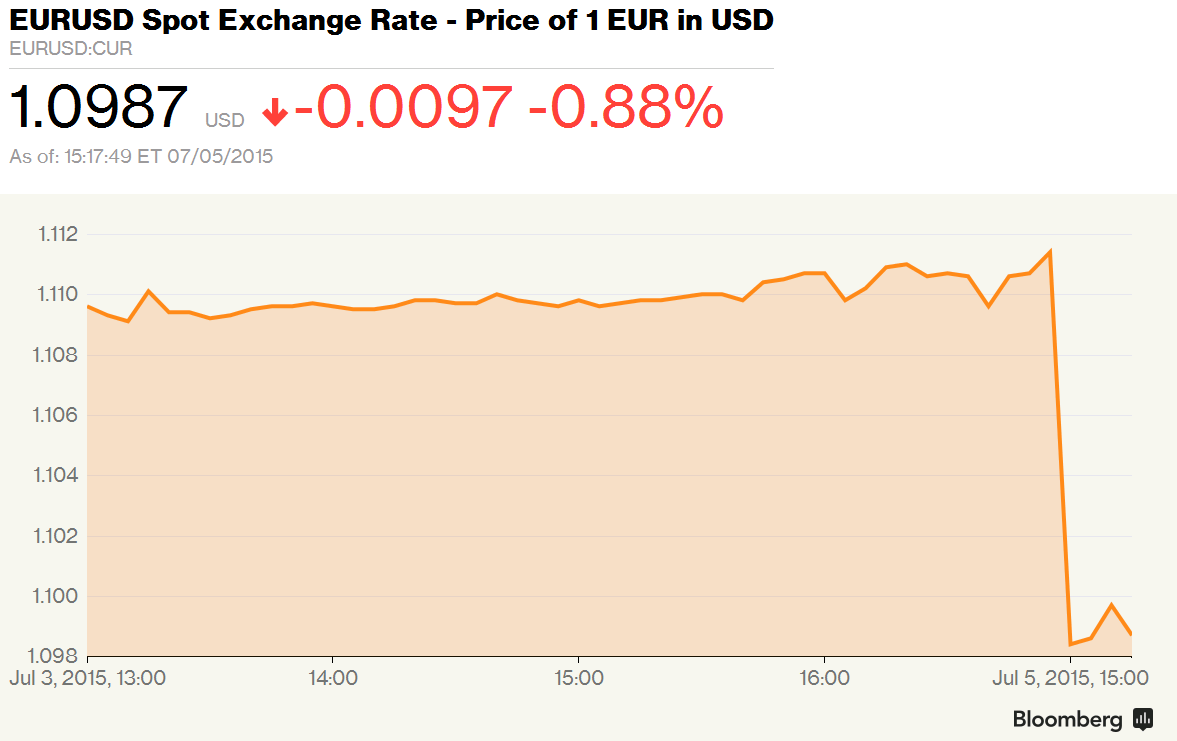
Bloomberg Business has a feature on the decline of the Euro after the Greek “No” vote last night. As you might expect, the feature is accompanied by a graphic which shows a “precipitous fall” in the European currency.

I’m in two minds of whether to screenshot the graphic (so that any further changes are not reflected), or to not plagiarise by simply putting a link (but exposing this post to the risk of becoming moot, if Bloomberg changes its graphs later on. It seems like the graphic on the site is a PNG, so let me go ahead and link to it:

You notice the spectacular drop right? Cliff-like. You think the Euro is doomed now that the Greeks have voted “no”? Do not despair, for all you need to do is to look at the axis, and the axis labels.

The “precipitous drop” that is indicated by the above graph indicates a movement of the EUR/USD from about 1.11 to about 1.10. Or a fall of 0.88%, as the text accompanying the graph says! And given how volatile the EUR/USD has been over the last couple of months (look at graph below), this is not that significant!

eurusd


I won’t accuse Bloomberg of dishonesty since they’ve clearly mentioned “0.88%”, but they sure know how to use graphics to propagate their message!