Bleg: News sources

I’ve decided to take yet another social media sabbatical (long time readers know I do this once in a while), and since I’m currently living abroad, one of the downsides of this is that I now have no direct access to news (social media did provide news, but came along with extremely fierce commentary and outrage).

I use Flipboard to curate some news, but the way I’ve been curating it of late means that I don’t get much news about India. Online editions of newspapers are there, but I find that most simply use them to archive stories, and the curation that is present in newspapers is missing.

So I’m basically looking towards curated sources of news that i can read and be satisfied that I know what’s happening in this world. I currently subscribe to two newsletters – the Economist Espresso that arrives in the morning and tells me all that’s happening in the world, and Matt Levine’s newsletter that arrives in the afternoon (Europe time) and tells me everything that’s happening in world markets.

Do any Indian newspapers have good curated content in the form of newsletters? Or any third party newsletter aggregators in India? Do let me know (by leaving a comment here or reaching me directly – if you don’t have my contact details, you can use the contact form on this blog). Thanks in advance.

The importance of queen side counterplay

Back in 1994 when I was still playing competitive chess (I practically retired in a year’s time after a series of blunders under pressure), I had played in this one special tournament that was played to “prepare Karnataka youngsters for national events”. Though I wasn’t travelling to any of these events, being a “promising youngster” I had received an invitation to play.

It was a weird kind of tournament, for apart from us “youngsters”, there were these senior players from the state who participated in the tournament on and off. Their scores weren’t tallied – all they did was to make sure each “youngster” played an equal number of games against a “senior player” and only youngsters’ scores counted.

In the first round of the tournament, I faced off against a senior named Nagesh (if I remember correctly). Nagesh played white and played a King’s Indian Attack against my Sicilian Defence (part of this special tournament was to expose us to non-standard openings and plays). It was a hard fought middle and end game where experience ultimately prevailed, and I lost.

In the analysis after the game, Nagesh pointed out that while he had an established centre and strong kind side attack, I had managed to build up a fairly expansive position on the queen side, and that I should have “pushed harder on the queenside for counterplay” rather than simply defending. While I took his point, I didn’t see the point of expanding on the queen side to grab a couple of pawns and (with a remote chance) threaten to queen one of my pawns there when my king was under heavy attack.

This bewilderment continued through the next year, as I studied openings for which the stated strategy was to “get counterplay on the queenside”. Not being a particularly great endgame player (though I did show some promise in that in my brief career), the advantage that could be gained by the gain of a pawn was lost to me, and I would prefer to go for a more tactical game (which usually didn’t go too well).

As an adult, while I don’t play competitively any more, I continue to follow chess and watch videos from time to time for entertainment. I’ve developed more nuance on strategy, and in playing a positional game. I’ve seen how small advantages (like space, or even a pawn) can be turned into decisive victories, and given myself shit for not learning to play endgames better back during my playing career. It’s a more holistic view of chess than the one I had formed as a schoolboy having mugged up all the moves of Morphy’s 17-move win against the Duke of Brunswick and Count Isouard (I still remember that game by heart).

Though it doesn’t take much convincing now for me to appreciate the joys of positional play, and going for queen side counterplay when your king is under attack, I found the game played by Viswanathan Anand against Veselin Topalov in the first round of the ongoing Candidates tournament rather interesting.

The two players go for different strategies – while Topalov builds up for an attack against Anand’s king, Anand goes for queen side counterplay (the bit I didn’t get back when I was a young player) and goes pawn grabbing. It was a rather complex game and both players played rather inaccurately under time pressure, but it is an excellent example of how queen side counterplay can help defuse an attack.

Anand’s queen nearly gets trapped (in the press conference after the game, he said he was reconciled to giving it up if attacked). There is a massive piledriver of pieces Topalov stacks up on the king side to attack Anand’s king. There is absolutely no threat of danger on Topalov’s king.

Yet, from time to time, Anand’s pawn grabbing strategy means Topalov has to move back some pieces to the queen side for its defence, blunting the attack. Then, Topalov needs to recover lost material, and moves his rooks to the queen side for that purpose. There is a mad scramble around the time control (both players got into time trouble) when the position gets liquidated with a lot of pieces exchanged.

After the dust settles, we find that Topalov’s remaining pieces are horribly misplaced on the queenside (on a pawn recovery campaign), while Anand’s are now trained towards an attack on Topalov’s king. As Topalov scrambles to defuse this attack, he loses material, and ultimately resigns.

It was a fascinating game to get a potentially fascinating tournament underway. I hope to follow it as best as I can, though that might not be so trivial given the holiday I’m taking later this month. Watching GM Daniel King’s analysis of Anand’s game (linked above) started making me wonder if I’d have played differently had I had access to such high quality commentary when I was still a competitive player two decades ago.

As for that tournament, I ended up beating the other senior player I played against. He blundered his queen in a typical tactical Sicilian Dragon Yugoslav Attack position (I was white). I placed second among all the “youngsters” there, and got my only prize money from chess after that game – a princely Rs. 80 (which wasn’t that bad for a schoolboy in 1994)!

Maximum Retail Price is a conspiracy by FMCG companies

A few months back, Anupam Manur, a colleague at the Takshashila Institution, had written an Op-Ed in The Hindu that the Maximum Retail Price (MRP) mechanism is archaic and needs to be shelved.

Introduced in 1990 by the Department of Civil Supplies, this regulation governs that the maximum price at which packed goods can be sold be printed on the packet, and makes any transactions at a price higher than this price illegal. This was intended to be a mechanism to protect consumers from usurious shopkeepers (remember this was introduced just before economic reforms were launched), and Anupam’s piece also treats the intention as such.

Having now briefly lived in a country with no such regulations (Spain), I must say that my entire perspective of how retail works has been turned upside down (and this, having spent a year consulting for a major retail chain in India).

The existence of the MRP in India means you tend to look at everything in retail from that perspective – the manufacturer/packager, for example, can set margins (a percentage of the MRP) that each segment of the supply chain can earn. As a consequence, players in the chain have little leverage on what prices to charge – at best, they can forego a part of their (usually tiny) margins in order to drive sales.

Without the existence of MRP, however, the (power) equation is turned upside down. Two supermarkets close to my home in Barcelona (about 200m from each other), for example, charge €0,79 and €0,96 respectively for identical cartons of milk (of the same brand, etc.). This price difference (17% or 21% the way you look at it) of a retail commodity between two nearby stores would be impossible to see in India.

Given the broad similarity in these two supermarkets, it is unlikely that there’s too much difference in what they would have paid to procure these cartons of milk. In other words, one supermarket makes a far higher margin selling this milk (which is possibly compensated by the other’s higher sales).

In other words, in a market without MRP, the manufacturer/brand loses control over the pricing once he has sold products down the chain – it is up to the respective player in the chain to determine what he will charge for from his buyers, and thus manage his own revenues. While free markets mean that prices of products broadly converge across stores, the manufacturer/brand can do little in order to dictate them beyond a point.

With this kind of pricing power missing from retailers in a market like India (with MRP), the retailer is at a greater mercy of the manufacturer. The manufacturer can allow the retailer some leeway in pricing, for example, by setting an artificially high MRP, but the question is whether the manufacturer wants the retailer to have this leeway.

Under the current system (MRP), the retailer is mostly at the mercy of the manufacturer. The manufacturer has bargaining power over how much stocks to distribute to the retailer and when, and there is little leeway for the retailer to manage his stocks intelligently. In fact, for some products, manufacturers even control discounts and don’t allow retailers to sell below a particular price (threatening to stop supplies in case they do so). Without the MRP, this kind of coercion on behalf of manufacturers will be significantly reduced.

In this context, it is useful to look at the MRP as a tool that shifts the balance of power in the packaged goods supply chain in favour of the manufacturers/brands and away from the retailers. As Anupam has established in his piece, customers don’t necessarily benefit from this regulation. They are merely an excuse for manufacturers of packaged goods to exert bargaining power over the retailers.

In other words, the MRP is a conspiracy by the FMCG companies, who stand to benefit most from such regulations (at the cost of retailers and customers).

With the current union government supposedly enjoying support of the trading community, there is no better opportunity for this MRP regulation to go.

How computers have changed chess

Prior to computers, limited depth of analysis meant chess strategies were “calibrated to model”. Now they’re calibrated to actual results and that results in better strategies (unconstrained by aesthetics)

With the chess Candidates tournament starting in Moscow today (to decide World Champion Magnus Carlsen’s next challenger), I’ve been watching a few chess videos of late, and participating in discussions on why Anand has been finding it hard to play of late.

One thing that people have widely agreed is that computers have changed the way chess is played, and the “new generation” (Carlsen, Hikaru Nakamura, Fabiano Caruana, Anish Giri, etc.) have learnt the game in a completely different way from the old-timers, which dictates the way they play.

For example, these new guys play the kind of positions that earlier generations wouldn’t dream of playing. Given a position and a bunch of moves that seem similarly strong, the moves the new generation picks is different from what an older player would pick. And computer analysis is credited with this.

The basic advantage with computer analysis is that positions can now be evaluated easily to a much larger “depth” (number of moves from current position) compared to earlier manual analysis. In the manual analysis, you could evaluate the position for a few moves after which you would reach a position that you would judge manually. Judging different possible continuations this way, you would evaluate a position and figure what was a good continuation.

The problem with limited depth search was that after a certain depth, you simply had to use your judgment on what was a good position, and this judgment (the “boundary condition” that went into your model) would have a profound effect on how you evaluated different moves. Over time, all you cared about was the aesthetics of the chessboard, and not really how you could translate the position to victory (or a draw).

In other words, in the days before computers, chess players were building their strategies by calibrating them to a model rather than by calibrating them to actual results on the board. And this resulted in a bias towards “pretty strategies” and those that gave advantages that were obvious.

With computers, however, there is no such constraint on the depth of ply. You can analyse the position to far greater depth and get really close to the result in the course of your analysis. And so you don’t really care about the aesthetics of the positions you reach, as long as you know how they can translate to the result you want.

So the “new generation”, which has always been trained using computers, see the game differently. People of Anand’s generation (there’s also Veselin Topalov and Levon Aronian in the ongoing Candidates tournament) learnt the game with classic aesthetics and optimise their play to get there. Carlsen’s generation has no such biases and they play to what is the actual advantage irrespective of aesthetics.

And that’s how the battle is building up! This should be an interesting tournament!

The Geo-Politics of Multiculturalism

My wife Priyanka‘s business school takes much pride in its multiculturalism, with students from some 60 different countries in her class of nearly 300. And on one year every day, they choose to celebrate this multiculturalism, and what better way to celebrate multiculturalism (or anything  else for that matter) than to get drunk together?

And so we had this party, not very creatively called “Multi Culti”, last evening where people from 34 countries/groups of countries had set up stalls to showcase the food and drink of their respective countries/groups. This binge eating/drinking session sandwiched a “cultural program” where a lesser number of countries/groups sang and danced, again in an attempts to showcase their cultures.

Most of the food was excellent, and most of the drink was, too. The quality of drinks on offer is borne out by the fact that despite having at least a dozen drinks of a dozen varieties last night, I was up and about without a hangover by 7 this morning – that can’t happen unless the liquor is of high quality (oh, I skipped the Old Monk on offer at the Indian stall)!

While being in business school together means you leave behind national differences (and find other axes on which you RG each other), there were some subtle (and some not-so-subtle) instances of geopolitics on display at last night’s event. I must mention that this blogpost was constructed while I was watching the “cultural program” that was sandwiched by the eating and drinking.

The most obvious display of geopolitical tension was by the Catalans, who allegedly wanted a stall for themselves, but weren’t allowed to have one by the Spaniards. So they set up this “pirate ship” (perhaps as a nod to Barcelona being Spain’s main trading port during the middle ages) which was a cart that was pulled around the area. Other secessionist movements didn’t display much creativity, though – Quebecians were happy to be part of the Canadian stall, and I’m not sure if there are any Scots in the program.

And then there was the setup of the stalls (note that these are my personal pertinent observations, and I might be drawing spurious correlations here). Mostly neighbouring countries were near each other. Japan was next to Korea. Germany next to Austria (I’m assuming it was Austria given the stack of Red Bulls). Brazil and Argentina facing each other. France next to Italy.

But some pairs, it seemed evident, were being deliberately kept away. Republic of China’s (there’s a surprisingly large contingent from there in the MBA program) stall, for example, was kept as far as possible from the People’s Republic of China’s stall. Food in the two stalls looked similar, and it’s possible I didn’t take anything from PRC since I’d eaten similar looking stuff at RoC’s stall. The shots on offer at RoC were legendary, though. Some rice wine with 38% alcohol content. Did at least 3 shots there.

The other geographical separation, possibly due to possible tensions, was a pity though. I love eating falafel wrapped in hummus and pita bread. The layout and choices by teams, however, meant they were far away from each other.

On one side of the venue was the Israeli stall, with pita bread and hummus and some incredibly delicious Israeli spice (forgot what it was called). The Israelis didn’t have falafel, though (they instead had sausages – possibly a nod to the Ashkenazi heritage). For that you’d to go to the other side where the Arab stall was located! The Arabs also had Baklava, and if I’m not wrong, also offered liquor (I kept grabbing Baklava whenever I went near that stall, and didn’t bother about anything else).

Which brings us to country groupings. 300 people from 60 countries means some countries don’t have enough of a quorum to put up a show, so you had them banding into groups to put up a collective show. The Arabs were one such collective (I’m not sure of the countries that went into that collective, but it was funny to see a guy with a red-and-white checked headscarf dance next to a guy in a Fez during their “cultural performance”). The entire continent of Africa was another (they had this little quiz where you’d to identify a randomly chosen country on the map of Africa, for which you’d get a “dessert shot”, which was bloody delicious).

Finally, a note about the “cultural program”. Most countries stuck to national stereotypes, which I think is a good thing in such context. Most of the crowd is pissed drunk anyway, and what they want is a high energy program they can connect with.

So the Indians did well with three Punjabi acts (couldn’t recognise any of the songs). Spaniards danced to Macarena. Germans danced wearing Angela Merkel masks. An Argentine wore a Maradona mask (a lot of Argentines were in Albiceleste jerseys. One wore a Boca Juniors jersey) while doing the tango. PRC and RoC put up contrasting shows. RoC did a high energy generic dance routine. PRC had an inflatable dragon and did a more “traditional” dance.

My personal favourite was the British performance, though. They chose three well-known songs by three well-known bands (Britain’s contribution to music is an immense source of soft power for them). Four of them dressed up like Queen (fake moustaches and all) to enact a part of Bohemian Rhapsody. Five guys in drag (this was most hilarious and impressive) danced to If you wanna be my lover by the Spice Girls. And the whole crowd sang along and swayed as four guys in Beatles masks performed to Hey Jude (with masks being such a thing at the festival, I’m really really annoyed that there were no Modi masks. All the Indian contingent had was Kejriwal-style Gandhi caps. Most anti-national, I must tell you :P).
 

The problem with Slack, and why it’s inferior to DBabble

When two of the organisations I’m associated with introduced me to the chatting app Slack, it reminded me of the chatting app DBabble (known to us in IIMB as BRacket) that was popular back when I was in college.

There were two primary reasons because of which Slack reminded me of DBabble. The first was the presence of forums/groups. There was a “General” that everyone in the organisation was part of, and then were other groups that you could choose to join and be a conversation in. The second was that you could not only converse on the fora, but also send personal messages to each other – something DBabble also enabled.

There are several reasons why Slack is superior to DBabble. Most importantly, you can tag people in your messages on forums and they get notified, so that they can respond – this is a critical feature for using it for work purposes.

Secondly, Slack integrates well with other tools that people use for work – such as email and a lot of development tools, for example (which one of the organisations I’m associated with uses heavily, but I’ve never got into that loop). Slack also has a very nice search feature that allows you to pull up discussions based on keywords, etc.

What Slack sorely lacks, which makes me miss DBabble like crazy, however, is threaded conversations. The conversation structure in each channel in Slack is linear – which means you can effectively have only one thread of conversation at a time.

When you have a large number of people on the channel, however, people might initiate several different threads of conversation. As things are, however, a Darwinian process means that all but one of them get unceremoniously cut out, and we end up having only one conversation.

It is also a function of whether Slack is used for synchronous or asynchronous messaging (former implies everyone replies immediately, latter means conversations can take their own time and there’s no urgency to participate immediately, like email, for example). My understanding is that the way it’s built, it can be used in both ways. My attempts to use it as an asynchronous messenger, however, have failed because some of the conversations I’ve tried to initiate have gotten buried above other conversations others on the channel have tried to start.

The problem with Slack is that it assumes that each forum will have only one active conversation at a time. Instead, if (like DBabble) it allows us to have different conversation threads, things can become a lot more efficient.

One of the nice features of forums on DBabble was that everytime you went to the forum, it would show you all the active threads by showing them in bold. DBabble allowed infinite levels of threading, and only messages that were unread (irrespective of which branch of which thread they were in) would be in bold, meaning you could follow all threads of conversation (this also proved problematic for some as we developed an OCD to “unbold” – read every single message on every forum we were part of).

Imagine how powerful threaded conversations can be at the corporate level especially when you can tag people in them – so you go to a forum, and can see all open discussions and see where your attention has been called, and contribute. Threading also means that you can carry out several different personal (1-to-1) conversations at a time without losing track of any.

It’s interesting that after DBabble (which also died after a later edition gave the option of “chat mode” which did away with threaded conversations) there has been no decent chat app that has come up that allows threaded conversations. Apart from possible bandwidth issues (which can happen when each message is suffixed with the full thread below it), I don’t see any reason this can’t be implemented!

I want my BRacket (DBabble) back. But then, chat has powerful network effects and there’s no use of me wanting a particular technology if sufficient number of other people don’t!

Investment banks, scientific research and cows

I’ve commented earlier on this blog about how investment banks indirectly fund scientific research – by offering careers to people with PhDs in pure sciences such as maths and physics.

The problem with a large number of disciplines is that the only career opportunity available to someone with a PhD is a career in academia. Given that faculty positions are hard to come by, this can result in a drop in number of people who want to do a PhD in that subject, which has the further effect of diminishing research in that subject.

Investment banks, by hiring people with pure science PhDs, have offered a safety net for people who haven’t been able to get a job in academia, as a consequence of which more people are willing to do PhDs in these subjects. This increases competition and overall improves the quality of research in these topics.

Beef is like investment banks to the dairy industry. I recall an article (can’t recall the source and link to it, though) which talked about V Kurien of Amul going to a meeting called by the Union government on banning cow slaughter. Kurien talked about his mandate from his cooperative being that everything was okay as long as cow slaughter wasn’t banned – for that would kill the dairy industry.

Prima facie (use of latin phrase on this block – check)  this might sound like a far-fetched analogy (research to cows). However, cow slaughter has an important (positive) role to play in encouraging the dairy industry.

When you buy a cow, you aren’t sure how good it is in providing milk, until you’ve put it through a few cycles of childbirth and milking. If after purchase it turns out that the cow is incapable of producing as much milk as you were promised, it turns out to be a dud investment – like getting a PhD in a field with few non-academic opportunities and not being able to get a faculty position.

When cow slaughter is permitted, however, you can at least sell the cow for its meat (when it is still healthy and fat) and hope to recover at least a part of the (rather hefty) investment on it. This provides some kind of a “safety net” for dairy farmers and encourages them to invest in more cows, and that results in increasing milk production and a healthier dairy industry.

This is not all. Legal slaughter means that there is a positive “terminal value” that can be extracted from cows at the end of their milking lives. Money can also be made off the male calves (cruel humans have made the dairy industry one-to-many. Semen from stud bulls is used to impregnate lots of cows, and most bulls never get to fuck) which would otherwise have negative value.

A ban on killing cows implies a removal of these safety nets. Investing in cows becomes a much more risky business. And lesser farmers will invest in that. To the detriment of the dairy industry.

There are already reports that following the ban on cow slaughter in Maharashtra last year, demand for cows is going down as farmers are turning to the more politically pliable buffaloes.

Similarly, with the investment banking industry seeing a downturn and the demand for “quants” going down, it is likely that the quality of input to graduate programs in pure science might go down – though it may be reasonable to expect Silicon Valley to offer a bailout in this case. Cows have no such luck, though.

Simulating segregation

Back in the 1970s, economist Thomas Schelling proposed a model to explain why cities are segregated. Individual people choosing to live with others like themselves would have the macroscopic impact of segregating the city, he had explained.

Think of the city as being organised in terms of a grid. Each person has 8 neighbours (including the diagonals as well). If a person has fewer than 3 people who are like himself (whether that is race, religion, caste or football fandom doesn’t matter), he decides to relocate, and moves to an arbitrary empty spot where at least 3 new neighbours are like himself. Repeat this a sufficient number of times and the city will be segregated, he said.

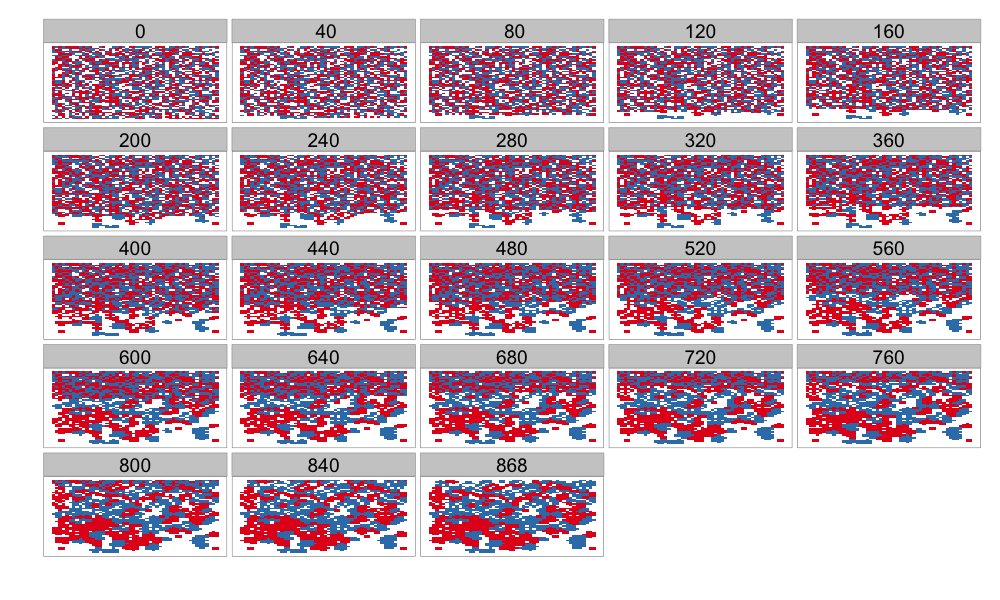
Rediscovering this concept while reading this wonderful book on Networks, Crowds and Markets yesterday, I decided to code it up on a whim. It’s nothing that’s not been done before – all you need to do is to search around and you’ll find plenty of code with the simulations. I just decided to code it myself from first principles as a challenge.

You can find the (rather badly written) code here. Here is some sample output:

Sample output

As you can see, people belong to two types – red and blue. Initially they start out randomly distributed (white spaces show empty areas). Then people start moving based on Schelling’s rule – if there are less than 3 neighbours of the same kind, you move to a new empty place (if one is available) which is more friendly to you. Over time, you see that you get a segregated city, with large-ish patterns of reds and blues.

The interesting thing to note is that there is no “complete segregation” – there is no one large red patch and one large blue patch. Secondly, segregation seems rather slow at first, but soon picks up pace. You might also notice that the white spaces expand over time.

This is for one specific input, where there are 2500 cells (50 by 50  grid), and we start off with 900 red and 900 blue people (meaning 700 cells are empty). If you change these numbers, the pattern of segregation changes. When there are too few empty cells, for example, the city remains mixed – people unhappy with their neighbourhood have no where to go. When there are too many empty cells, you’ll see that the city contracts. And so forth.

Play around with the code (I admit I haven’t written sufficient documentation), and you can figure out some more interesting patterns by yourself!

Evolution of strategy in sports

Yesterday ended with a bedtime argument about the merits of basketball player Stephen Curry. It was a bit of a weird discussion, because the wife hadn’t heard of Curry before the discussion started, and neither of us watches the NBA (I get put off by the random ad-breaks, also known as time outs).

I happened to be reading this piece by David Henderson, and asked the wife (who had represented her college in basketball) if she knew about Curry. When she replied in the negative, I showed her this montage of his 3-pointers and how that has made him controversial in the basketball community.

The wife, having greater domain knowledge (having played the game competitively) defended Curry’s critics, saying that his tactic of shooting threes had “killed the game” and made it more boring. “Basketball is a team game, and it is about penetration through passing. Three pointers is a last-ditch measure”, she said, “and Curry, by directly shooting threes, is killing the game”.

I disagreed, arguing from a game theory perspective. Every team will try to gain the maximum advantage based on the current set of rules, I argued, and that it was up to the opposition to find a response to this new way of play. While the Golden State Warriors’ three-point based play might be boring, I argued, it was effective, and being a new strategy it made the game more interesting.

She made arguments about the spirit of the game and how football would become boring and be ruined if, say, someone could shoot with high accuracy from his own goal area to the opposite goal. I responded that opponents would adapt to this, soon rendering this strategy irrelevant, and wondered why no one had figured a way yet to stop the Warriors.

I took the example of the Age of Empires, where each civilisation has a special force, and you need to adapt your strategy to that while playing against this civilisation. I pointed out about how when Stoke City came to the Premier League in 2008, they flummoxed opponents by use of their special force of “longthrowman” (also known as Rory Delap), but soon opponents adapted their strategy sufficiently to neutralise his throws.

This got me wondering whether strategy in basketball has evolved too homogeneously over time (again I must mention I hardly watch the game) – the five point zonal defence and attack, ball handling at the top, rebounds, dunks and so on – that when faced with a new strategy of using quick three-pointers, teams have struggled to react.

I was reminded of this Malcolm Gladwell piece on current Sacramento Kings owner Vivek Ranadive leading his daughter’s basketball team to success based on the “full court press” strategy which was then hardly used.

It got me thinking about football, with its diversity of playing styles (admittedly, it’s played in a larger number of countries, on a bigger court and with more players, giving more room for diverse strategies), where a team might be able to achieve short-term results with an innovative strategy or formation, but opponents soon learn to neutralise them.

Is it that basketball, dominated by a handful of teams (note that the NBA has a small number of teams and no concept of promotion and relegation unlike European leagues), hasn’t evolved diversely enough to react quickly enough to new strategies? And this is not the first time that basketball has reacted in a hostile fashion to a new strategy that is well within the rules – as this podcast on the evolution of basketball strategy explains, the NCAA (and also the NBA) actually outlawed the dunk after its effective use by Karim Abdul Jabbar.

The Yin and Yang of Basketball

The way I see it, Stephen Curry’s critics describing his and the Warriors’ tactics as unfair are no different from English footballers who described Scotland’s passing game as unfair (England was used to a dribbling-only no-passing style of football till then) after the first meeting of the two nations in 1872.

Making bus lanes work

Bus Rapid Transport, which is mass transport based on lanes dedicated to buses, is something that has been proposed in India for a very long time but has never really worked.

Delhi abandoned its efforts a few months back under the current state government, after experimenting with it on one road for a few years. Pune has BRT and  bus lanes, but that is also ridden with problems (no pun intended). Ahmedabad supposedly has a well-functioning BRT but the share of commuters using buses in that city is far below other cities.

Source: http://www.livemint.com/Politics/tPT6767pB5DSEEdZnBYcgP/Why-Delhis-bus-service-is-more-expensive-than-that-of-Chenn.html 

There have been proposals to introduce BRT in Bangalore, and some flyovers on Outer Ring Road were designed with the express purpose of maintaining bus lanes. Nothing has come to fruition so far.

In most cases, the problem has been with selling the scheme to the people – a lane exclusively reserved for buses adversely affects people who use private transport. Even though the latter are not numerous (data from the census shows that a very small proportion of urban Indians use private cars for their daily commute), their voice and clout means that it is a hard sell.

In my opinion, the reason BRT has been a hard sell is because of the way it has been implemented and sold. One problem has been that it has been implemented on only a small number of roads, rather than enabling a dense network on which one can travel by bus quickly. The bigger problem  has been implementing it on roads with low bus density, where the demarcated bus lane mostly appears empty while other lanes are clogged, giving incentives for motorists to cheat.

Instead, bus lanes should be demarcated only after bus density on the road has reached a certain density. There are several roads in Bangalore, for example, where buses already contribute to the lion’s share of traffic congestion (Nrupatunga Road, inner ring road in BTM layout and Hosur Road between Wilson Garden and Madivala come to mind – but there needs to be a more scientific study to identify such).

If such roads, with already existing high bus density, are chosen to mark off bus lanes, the bus lanes can be sold as a method to restrict all buses to one lane so that cars can move about freely on the rest of the road. While there might still be protests (thanks to such “reservation”), the fact that the reservation will not have much of an impact will mean that it is an easier sell.

Think about it! Meanwhile, here is a picture from Barcelona, which shows that even in supposedly rule-breaking Spain, bus lanes can work.

Respect for bus lane. In gracia, Barcelona

A photo posted by Karthik Shashidhar (@skthewimp) on