Categorisation and tagging

Tagging offers an efficient method to both searching and for identifying customer preferences on the axis most appropriate for the customer

The traditional way to organise a retail catalogue is by means of hierarchical categorisation. If you’re selling clothes, for example, you first divide it into men’s and women’s, then into formal and casual, and then into different items of clothing and so on. With a good categorisation, each SKU will have a unique “path” down the category tree. For traditional management purposes, this kind of categorisation might be useful, but it doesn’t lend itself well to both searching and pattern recognition.

To take a personal example (note that I’m going into anecdata territory here), I’m in the market for a hooded sweatshirt, and it has been extremely hard to find. Having given up on a number of “traditional retail” stores in the “High Street” (11th Main Road, 4th Block, Jayanagar, Bangalore) close to where I stay, I decided to check online sources and they’ve left me disappointed, too.

To be more precise, I’m looking for a grey sweatshirt made with a mix of cotton and wool (“traditional sweatshirt material”) with a zipper down the front, pockets large enough to keep my hands and a hood. Of size 42. This description is as specific as it gets and I don’t imagine any brand having more than a small number of SKUs that fit this specification.

In case I were shopping offline in a well-stocked store (perhaps a “well stocked offline store” is entering mythical territory nowadays), I would  repeat the above paragraph to a store attendant (good store attendants are also very hard to find nowadays) and he/she would pick out the sweatshirts that would conform to these specifications and I would buy one of them. The question is how one can replicate this experience in online shopping.

In other words, how can we set up our online customer catalog such that it becomes easy for shoppers to search specifically for what they’re looking for. Currently, most online stores follow a “categorisation” format, where you step into two or three levels of categorisation, where you’re shown a large assortment. This, however, doesn’t allow for efficient search. Let me illustrate by my own experience this morning.

1. Amazon.in : I hit “hoodies” in the search bar, and got shown a large assortment of hoodies. I can drill deeper in terms of sleeve length, material, colour and brand. My choice of material (which I’m particular about) is not there in the given list. There are too many colour choices and I can’t simply say “grey” and be shown all greys. There is no option to say i want a zip-open front, or a cotton-wool mix. My search ends there.

2. Jabong (rumoured to be bought by Amazon shortly): I hover over “Men’s”, click on “winter wear” and then on “hoodies”. There is a large assortment of both material (cotton-wool mix not here) and brand. There are several colours available, but no way for me to tell the system I’m looking for a zip-down hoodie. I can set my price-range and size, though. Search ends at a point when there’s too much choice.

3. Flipkart: Hover over “men’s”, click “winter wear” and then sweatshirt. Price, size and brand are the only axes on which I can drill down further. The least impressive of all the sites I’ve seen. Too much choice again at a point when I end search.

4. Myntra (recently bought by Flipkart, but not yet merged): The most impressive of all sites. I hover over “Men’s” and click on sweaters and sweatshirts (one less click than Jabong or Flipkart). After I click on “sweatshirts” it gives me a “closure” option (this is the part that impresses me) where I can say I want a zippered front. No option to indicate hood or material, though.

In each of the above, it seems like the catalog has been thought up in a hierarchical format, with little attention paid to tagging. There might be some tags attached such as “brand” but these are tags that are available to every item. The key to tagging is that not all tags need to be applicable for all items. For example, “closure” (zippered or buttoned or open) is applicable only to sweatshirts. Sleeve length is applicable only to tops.

In addition to search (as illustrated above), the purpose of tagging is to identify patterns in purchases and know more about customers. The basic idea is that people’s preferences could be along several axes, and at the time of segmentation and bucketing you are not sure which axis describes the person’s preferences best. So by having a large number of tags that you assign to each SKU (this sadly is a highly manual process), you give yourself a much superior chance of getting to know the customer.

In terms of technological capability, things have advanced much in terms of getting to know the customer. For example, it is now really quick to do a Market Basket Analysis based on large numbers of bills, which helps you identify patterns in purchase. With the technology bit being easy, the key to learning more about your customers is the framework you employ to “encase” the technology. And without efficient tagging, you are giving yourself a lesser chance of categorising the customer on the right axis.

Of course for someone used to relational databases, tagging requires non-trivial methods of storage. Firstly the number of tags varies widely by item. Secondly, tags can themselves have a hierarchy, and items might not necessarily be associated with the lowest level of tag. Thirdly, tagging is useless without efficient searching, at various levels, and it is a non-trivial technological problem to solve. But while the problems are non-trivial, the solutions are well-known and advantages large enough that whether to use tags or not is a no-brainer for an organisation that wants to use data in its decision-making.

 

A mistimed trip to Ayutthaya

This day (5th December) last year I went to Ayutthaya, near Bangkok in Thailand. It wasn’t meant to be that way. When we booked a vacation in Bangkok between the 4th and 8th of December, the assumption was that we would go to Ayutthaya, the “Ayodhya of Thailand” on the 6th of December. And for sheer troll value, I would pose in front of one of the temples there giving the RSS salute and upload it on social media. Just for kicks.

But then it didn’t happen that way. On the 5th of December last year, we reached the “victory monument” in Bangkok from where private minibuses are available to nearby locations. Our plan for the day was to go to Kanchanaburi, where we could see the Bridge on the River Kwai and the related museum. But then we reached the Victory Monument at a time when the previous bus to Kanchanaburi had just left and the next one wouldn’t leave for another 45 minutes. The bus to Ayutthaya was going to leave in another 10 minutes and we gladly hopped on!

We got dropped off somewhere in the middle of Ayutthaya town and we seemed to be the only tourists on the minibus. There wasn’t much of a choice for us in terms of tuk-tuks to take us sightseeing, and we tried to strike a bargain with the one tuk-tuk that was there where the bus dropped us. I remember it being a particularly hot day (it was December but Bangkok is close to the tropics). The tuk-tuk driver knew no English. Instead he had a laminated sheet of A4 paper on which pictures of monuments had been printed. He pointed us to some three or four of these and said he would take us there. We settled at THB 150 per hour (if I’m not wrong).

And you read that right – we engaged the tuk-tuk by the hour. In a place like Ayutthaya, where there is little traffic, roads are good and you can go as fast as the tuk-tuk takes you; and where the monuments are all located close enough to each other that distance is not too much, the biggest cost for the driver of the tuk-tuk is his time. Thus, hourly engagement means that tourists are likely to hurry up and not take too much time in seeing the monuments. And this results in faster “turnover” for the driver and he can hope to take around more batches of tourists each day. And considering that he spoke no English, there was little “guide role” that he could play.

As we got on to the back of the tuk-tuk, we saw a woman and baby climb into the front with the driver – he was bringing along his entire family to take us around! So at each monument we would get off and take a look around and they would just hang around the tuk-tuk. As soon as we returned, the three of them would squeeze into the front of the tuktuk and we would get into the back (this tuktuk was like a Piaggio Ape), and off we would go! Each time we reached a monument, the driver’s wife would hold up that printed sheet of A4 paper and point us to a picture which corresponded to the monument!

The monuments were themselves nothing too special to write about – especially since we had spent the earlier three days at Siem Reap. But the overall process itself was interesting. Some monuments were really crowded, though, for it was also King Bhumibol Adulyadej (Rama IX)’s birthday, and people had got together in all places that seemed marginally religious to celebrate his birthday. Monuments attached to such places were crowded. Others had no people at all.

I remember spending three hours seeing all of Ayutthaya thus. We then went to a restaurant close to the bus stand. I remember the football fan in me facing a dilemma as to what beer to drink. Obviously there was no Carlsberg available there, and Chang was out thanks to it being Everton’s sponsor. I settled for the other Thai beer Singha. It was only later I was to find that Singha was Chelsea’s official beer!

Later that evening we went out for dinner and got caught in a monumental traffic jam thanks to the King’s birthday celebrations. We got off the tuk-tuk and started walking, using the maps on my dying phone to find out the directions. My sense of direction held good, but sense of sight didn’t as I hit myself quite badly against a parked car, badly injuring my shin as I later found out. And later in the night we had trouble finding transport back to the hotel. Now that Uber has started operations in Bangkok, next time it shouldn’t be as hard!

Good things do happen to those who wait

So once again I’ve taken myself off Twitter and Facebook. After a three-month sabbatical which ended a month back, I was back on these two social networks in a “limited basis” – I had not installed the apps on my phone and would use them exclusively from my computer. But as days went by, I realised I was getting addicted once again, and losing plenty of time just checking if someone had replied to any of the wisecracks I had put on some of those. So I’ve taken myself off once again, this time for at least one month.

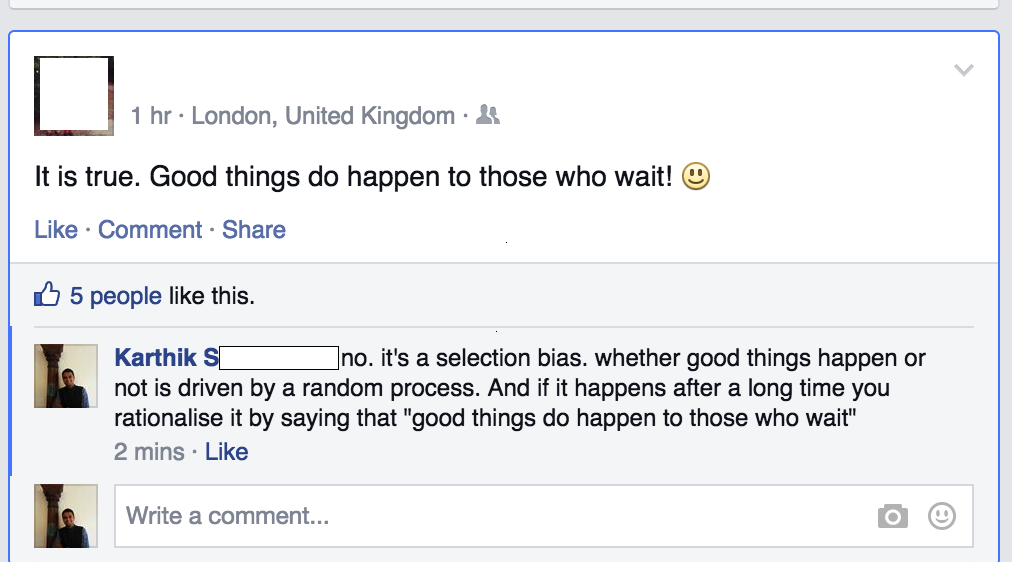
This post is about the last of my wisecracks on facebook before I left it. A facebook friend had put an update that said “good things do happen to those who wait”. I was in a particularly snarky mood, and decided to call out the fallacy and left the comment below.

Good things

In hindsight I’m not sure if it was a great decision – perhaps something good had happened to the poor guy after a really long time, and he had decided to celebrate it by means of putting this cryptic message. And I, in my finite wisdom, had decided to prick his balloon by spouting gyaan. Just before I logged out of facebook this morning, though, I checked and found that he had liked my comment, though I don’t know what to make of it.

Earlier this year I had met an old friend for dinner, and as we finished and were walking back to the mall parking lot, he asked for my views on religion. I took a while to answer, for I hadn’t given thought to the topic for a while. And then it hit me, and I told him, “once I started appreciating that correlation doesn’t imply causation, it’s very hard for me to believe in religion”. Thinking about it now, a lot of other common practices, which go beyond religion, are tied to mistaking correlation for causation.

Take, for example, the subject of the post. “Good things happen to those who wait”, they say. It is basically intended as encouragement for people who don’t succeed in the first few attempts. What it doesn’t take care of it that the failures in the first few attempts might be “random”, or that even success when it does happen is the result of a random process.

Say, for example, you are trying to get a head upon the toss of a coin. You expect half a chance of a head the first time. It disappoints. You assume the second time the chances should be better, since it didn’t work out the first time (you don’t realise the events are independent), and are disappointed again. A few more tails and disappointment turns to disillusionment, and you start wondering if the coin is fair at all. Finally, when you get a head, you think it is divine retribution for having waited, and say that “good things happen to those who wait”.

In your happiness that you finally got a head, what you assume is that repeated failure on the first few counts actually push up your chance of getting your head, and that led to your success on the Nth attempt. What you fail to take into account is that there was an equal chance (assuming a fair coin) of getting a tail on the Nth attempt also (which you would have brushed off, since you were used to it).

In my comment above I’ve said “selection bias” but I’m not sure if that’s the right terminology – essentially when things go the way you want them to, you take notice and ascribe credit, but when things don’t go the way you want you don’t notice.

How many times have you heard people going through a happy experience saying they’re going through it “by God’s grace?”. How many times have you heard people curse God for not listening to their prayers when they’re going through a bad patch? Hardly? Instead, how many times have you heard people tell you that God is “testing them” when they’re going through a bad patch?

It’s the same concept of letting your priors (you see God as a good guy who will never harm you) affect the way you see a certain event. So in my friend’s case above, after a few “tails” he had convinced himself that “good things do happen to those who wait” and was waiting for a few more coin tosses until he finally sprang a head and announced it to the world!

Now I remember: I think it’s called confirmation bias.

Batch Parity

From several sources I’ve heard of this bizarre concept called “batch parity”, where you assume that everyone who joined a particular school or company in a particular year is identical. This leads to people passing up on opportunities because they are not given such parity.

I’ve been hearing of this from way too many sources nowadays so I wrote off a rant, on LinkedIn. Here is an extract:

So while it might be tough for people to stomach, this whole concept of batch parity is, to put it simply, nonsense. At its heart is the assumption that the world is linear, and that after a certain arbitrarily chosen point in time, people ought to all run at the same place.


Communists and Chintamani

My grandmother Narasamma, who was my last surviving ancestor before she passed away earlier this year, used to make roasted red peanuts. I don’t know the exact process for making them but it basically consists of applying a mix of salt and chilli powder to peanuts and roasting them (or the other way). If there is one thing I’m unlikely to forget about this grandmother, it’s the red roasted peanuts she would make.

I had never eaten these peanuts until when I was about eight years old when this grandmother moved in with us. I can’t really say that I ever got along particularly well with her, but these peanuts more than made up for all of that. Interestingly it was after she moved out a few years later that the supplies of these peanuts started going up. Anyway, in due course of time I had come up with the phrase “ajji kaDlekai” (grandmother’s peanuts) to refer to these peanuts.

Source: Flickr

As she grew older the supplies of these peanuts started drying up and I had to look for other sources. I soon settled upon Srinivasa Condiment Stores (more popularly known as “Subbamma stores”) in Gandhi Bazaar for my supplies. On my first few visits I would just point at it and be told a price and would buy without bothering what the name was. It was less than a decade ago that I discovered that these “ajji kaDlekai” actually had a name.

It was at Subbamma stores that I once went to procure such peanuts and couldn’t find them on display. I asked the shopkeeper if he had “red peanuts” (kemp kaDlekai) and he shouted to his associate deep into the store “one communist!”. It was then that I realised that the popular name of these red peanuts is “communist”.

The etymology is not hard to guess – the yellow “split” peanuts are called Congress (thanks to the congress split around 1970), and they wanted to come up with a political name for other varieties of peanuts also. Thus, being red in colour these peanuts came to be called “communist” (some disambiguation was required here – for there is another variety of red peanuts which are fried rather than roasted. They’ve been named “Oil King”). I don’t know how popular the name is but in Subbamma stores at least these peanuts are called “Communist”. Similar peanuts roasted with green masala are called “green revolution” (unlikely the name ever caught on! ).

When I moved to North Bangalore two years back I no longer had access to Subbamma Stores for my Communist fix. And I had to find stores close to my home there that would supply it. It was hard enough to find so I cultivated several sources (somehow Communist is not as popular as Congress in condiment stores – perhaps reflecting political parallels). Sometimes it would be from Ganesh Condiments in Rajajinagar first block. On other occasions it was the Iyengar’s bakery at the end of my road (but he never got the difference between communist and oil king and so I stopped buying from him). And sometimes as far away as the Ace Iyengar store in Malleswaram.

There was one thing common to the communists procured from these sources though – the label. Each of them were manufactured by a different small scale industry named after a different god. But the place of manufacture was the same – Chintamani town in Chickballapur district. It was after I had seen similar labels several times that it all started coming together.

I remembered that my father was born in Chintamani, which means that Chintamani is my grandmother’s hometown (given how births were conducted back in the 1950s one could infer this). And this explained how she had picked up this skill for making these Communist peanuts – something most of my other relatives (none of whom were from Chintamani) lacked.

I was reminded of all this a while back when I was eating Communists, procured from Gayathri Stores in Jayanagar 4th block (incidentally run by actor Kashinath’s brother). This one came without a label, and when I had asked the shopkeeper (Kashinath’s brother) for the source, he had replied “naave maaDstivi” (we get them made). Maybe the communists I had for a snack a while back weren’t made in Chintamani, but they were crisp and perfectly spiced!

The communists have moved beyond Chintamani!

Educating at scale

You can’t run a high-quality business school with 20 faculty members

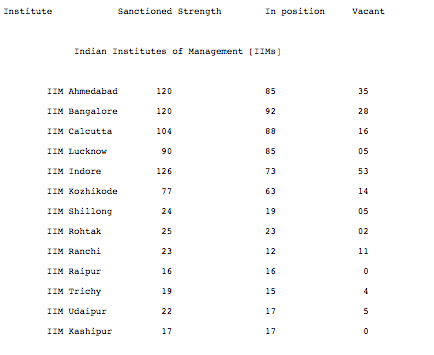
In the course of a twitter discussion yesterday, journalist Mathang Seshagiri quoted numbers from a parliamentary reply by the ministry of HRD (on the 24th of November 2014) on the sanctioned faculty strength and vacancies in “institutes of national importance”. While his purpose was to primarily show that even the older IITs and IIMs have massive vacancies, what struck me was the sanctioned faculty strength of the newer IIMs. Here is the picture posted by Mathang:

Source: Parliamentary Proceedings (Rajya Sabha). November 24th 2014. Reply by MHRD

Look at the second column which shows the sanctioned faculty strength in each IIM. Once you go beyond the six older IIMs, the drop is stark. The seven newer IIMs have a sanctioned faculty strength of about 20! The question is how one can run a business school with such a small faculty base.

About ten years back, when I was a student at IIM Bangalore, I had gone for an event where I met someone from another business school in Bangalore whose name I can’t remember now. During the course of the conversation he asked me how many electives he had. I replied that we had about 80-100 courses from which we had to pick about 15. This he found shocking for in his college (from what I remember) there were only three or four electives!

The purpose of an MBA is to provide broad-based education and broaden one’s horizons. Thus, after a set of core courses in the first year (usually about fifteen courses), one is exposed to a wide variety of electives in the second year. It is a standard practice among most top B-schools to fill the entire second year with electives. In fact, in IIM Bangalore, electives start towards the end of the first year itself.

With 20 faculty members, there are only so many electives that can be offered each year. For example, in the coming trimester, IIM Bangalore is offering students (about 400 in the batch) a choice of about 40-50 electives, of which each student can pick four to six. This gives students massive choice, and a good chance to tailor the second year of their MBA and mould themselves as per their requirements.

By having 20 faculty members, the number of electives that can be theoretically offered itself is smaller (given research requirements, most IIM professors have a requirement to teach no more than three courses a year, and they have core and graduate courses to teach, too), which gives students an extremely tiny bouquet of choices – if there is any choice at all. This significantly limits the scope of what a student in such a school can do. And the student has no option but to accept the straitjacket offered by the lack of choice in the school.

In the ensuing twitter conversation this morning, Mathang contended that it is okay to have a faculty strength of 20 in schools with 60 students per batch. While this points to an extremely healthy faculty-student ratio, the point is that for broad-based education such as MBA, faculty-student ratio is not a good metric. What makes sense is the choice that the student is offered and that comes only at scale.

Thus, the new IIMs (Shillong “onwards”) are flawed in their fundamental design. It is impossible to run a quality business school with only 20 faculty. One way to supplement this is by using visiting faculty and guest lectures, but some of the new IIMs are located in such obscure places (where there is little local business, and which are not easily accessible by flight) that this is also not an option.

Merging some of these smaller IIMs (a very hard decision politically) might be the only way to make them work.

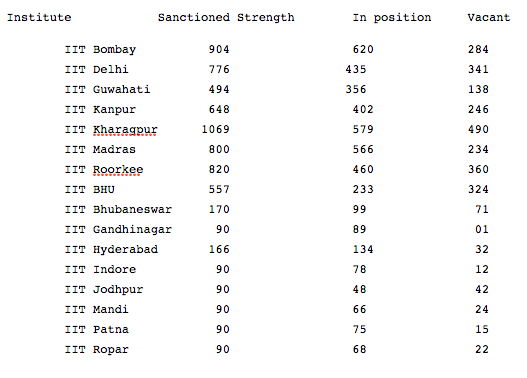
PS: Here is the sanctioned faculty strength and actual faculty strength numbers for IITs (same source as above). I might comment upon that at a later date.

Source: Parliamentary reply by Ministry of HRD; November 24th 2014

Why Petromax is Repugnant

Every time I talk about the concept of “Petromax”, people give me looks as if I’m from some other planet. Sometimes they shudder. Sometimes they think I’m uncouth. While I believe that the “problem” is just that I say things like they are (rather than couching them in niceties), given that everyone reacts in a negative way when I talk about Petromaxes implies that there’s something repugnant to it. And I think I’ve found the answer – the answer lies in Option Theory.

First of all, a recap on what petromax is all about. The concept was invented by Anant Nag in Golmaal Radhakrishna back in 1990. It goes “the wife is like the lamp you light in front of God. When the wife is not at home, the house plunges into darkness, and that’s when you need a petromax”. Those of you who understand Kannada might want to watch this youtube video from the movie:

Now that the definition is out of the way, let’s come to why the concept is repugnant. It is repugnant because being a petromax is like writing an option. And in the relationship business, nobody likes being a writer of options – it makes them look “cheap” and desperate. Let me explain.

I live in Bangalore. My wife lives abroad. So I’m in a long-distance marriage and going by the Petromax theory my house is “filled with darkness”. And the theory posits that I need a Petromax. Let’s say that you are interested in filling this gap and being “my Petromax”. So far so good. Where is the problem?

The problem happens when my wife comes home, and “fills it with light”. Remember that I’m still married to her, and deeply in love with her, and that I only took you on as a petromax. So for the duration when she is here, I don’t need you any more, and don’t bother about you! So in effect, I have an option of “being with you” whenever I want, while you don’t have the same option (unless you are also using me as a Petromax, but then I won’t be available whenever you want so I won’t be a reliable petromax). So under the petromax arrangement defined above, I have the right but not the obligation to be with you. You, the petromax, have the obligation but not the right to be with me. Effectively you’ve sold me an option!

Now, in the relationships business options don’t work. The writer of the option will start thinking that the “buyer” is using him/her. Being used is not a good thing in the relationship business. Among other things, showing the world that you are willing to be used reduces your “value” going forward. So you don’t want to do this. So you don’t like to be the petromax. So the deal doesn’t work for you. And so it doesn’t work for me, since when I’m looking for a Petromax I’m looking for optionality.

And so when you say that someone is someone else’s petromax, it is an implicit admission that the said person is willing to get “used”, and is thus willing to lower his/her value. Which is not a nice thing from the point of view of this person. And hence the term petromax is repugnant. And the concept of the petromax is also thus repugnant.

But the petromax concept has been seen to work in real life. How does it work then? Being part of a small community helps, since the valuation drop is seen only in that particular community. Then, there can be some restricted structuring where neither sells each other an option, and set up an “and condition” (being together if and only if both are available and interested at the same instant).

Ok I realise that this post itself might be repugnant to some of you but these things need to be explained!

LinkedIn, WhatsApp and Freaky Contact Lists

So one of the things I do when I’m bored is to open the “new conversation” (plus sign) thing on my WhatsApp and check which of my contacts are there in my WhatsApp social network. I do this periodically, without any particular reason. On the upside, I see people who I haven’t spoken to for a long time, and this results in a conversation. On the downside, this is freaky.

The problem with WhatsApp is that it automatically assumes that everyone in your phone book is someone you want to keep in touch with. And more likely than not, people make their WhatsApp profile pictures visible to all. And sometimes these profile pictures have to do with something personal, rather than a simple mugshot. Some people have pictures of their homes, of their kids, and of better halves. And suddenly, everyone who has their number on their phone book gets a peek into the part of their lives they’ve chosen to make public by way of their WhatsApp profile pictures!

Some examples of people on my phone book into whose lives I’ve thus got a peek includes a guy who repairs suitcases, a guy who once repaired my refrigerator, a real estate broker whose services I’d engaged five years back to rent out my house, and so forth. And then there are business clients – purely professional contacts, but who have chosen to expose through their WhatsApp profile pictures aspects of their personal lives! Thus, through the picture function (of course you can choose to not make your picture public), you end up knowing much more about random contacts in your phone book than you need to!

The next level of freakiness comes from people who have moved on from the numbers that they shared with you. So you see in the photo associated with an old friend someone who looks very very different and who is definitely not that friend! And thanks to their having put pictures on WhatsApp, you now get an insight into their personal lives (again I tell you that people put intensely personal pictures as their WhatsApp profile pictures). I haven’t tried messaging one of these assuming they are still the person who is my friend and used to once own their number!

Then there are friends who live abroad who gave you the numbers of close relatives when they were in town so that you could get in touch with them. These numbers have now duly passed back on to the said relatives (usually a parent or a sibling) of your overseas friends, and thanks to the pictures that they put on WhatsApp, you now get an insight into their lives! Then you start wondering why you still have these contacts in your phonebook, but then it’s so unintuitive to delete contacts that you just let it be.

The thing with Android is that it collects your contacts from all social media and puts them into your phone book – especially Facebook and LinkedIn. On Facebook people are unlikely to give out their phone numbers, and everyone on my facebook friends list is my friend anyway (today I began a purge to weed out unknown people from my friends list) it’s not freaky to see them on your whatsapp. But then thanks to the Android integration, you have your LinkedIn contacts popping up in your address books, and consequently whatsapp!

Again, LInkedIn has a lot of people who are known to you, though you have no reason to get to know their personal lives via the photos they put on WhatsApp. But on LinkedIn you also tend to accept connection requests from people you don’t really know but think might benefit from associating with them at a later date. And thanks to integration with WhatsApp, and profile pics, you now get an insight into the lives of your headhunters! It’s all bizarre.

So yes, you can conclude that I might be jobless enough to go through my full WhatsApp contacts list periodically. Guilty as charged. The problem, though, is that people don’t realise that their WhatsApp profile pictures are seen by just about anyone who has their number, irrespective of the kind of relationship. And thus people continue to put deeply personal pictures as their WhatsApp profile pictures, and thus bit by bit give themselves away to the world!

The solution is simple – put a mugshot or a “neutral” photo as your WhatsApp profile picture. You don’t know how many people can see that!

Certainty in monetary policy

Two big takeaways from today’s monetary policy review are the institution of a formal inflation target and a commitment to consistency in monetary policy

I found two major takeaways from RBI Governor Raghuram Rajan’s press conference this morning following the RBI policy review (where both the policy rate and the cash reserve ratio were held constant).

Firstly, Rajan used this opportunity to set for the bank a long-term inflation target. In a previous review, it had been announced that the RBI was focussed on targeting a 6% inflation rate by January 2016, and that conversations were on between the RBI and the Government regarding setting a formal inflation target.

In today’s review, Rajan took this one step further announcing that after January 2016, the RBI will set its policy rate targeting an inflation rate of 4% +/- 2%. This is extremely significant for for the first time it signifies a primarily inflation-targeting objective for the Reserve Bank of India. Over the last few months Rajan has made several attempts to explain that low and stable inflation is a necessary condition for a high and stable growth rate, and having primed us with this narrative, he has finally committed to a long-term inflation target.

The second important takeaway was the emphasis on consistency in policy. Rajan mentioned that while he is prepared to cut rates when the conditions are ripe, what he doesn’t want to do is to flip-flop on rates. This means he is likely to cut rates in this policy review only if he is confident that the requirement of having to raise rates in the next policy review is going to be low. This is extremely significant, as this kind of a direction is an implicit commitment to both savers and borrowers that they can expect the same direction for a significant amount of time, which means that they can plan better.

While some commentators might be disappointed that rates were not cut today, I think today’s policy review was extremely fruitful and some of the commitments made will have important consequences in the long run. Consistency in policy is an extremely important step, and the adoption of a formal inflation target at a time when global oil and food prices are dropping is excellent timing.

The press conference itself was quite insightful, and the way Rajan and his deputies handled the questions was extremely instructive. For example, one journalist mentioned that we’ve already hit 6% inflation which was the target for January 2016, and asked why rates weren’t cut on that account. Rajan replied that the fact that inflation is 6% today doesn’t imply that it will stay there a year later, and we need to work towards holding it there, and that the holding of rates in today’s review was a step in that direction.

Protocol and the human touch

A high Mata Amrita Index is like the mythical shepherd-boy crying “wolf”, and devalues the hug.

Recently I was discussing my recent blogpost on the Mata Amrita Index with the wife. Rather, when I had written the blog post, I had expected a response from her, and when none was forthcoming, I mentioned the post to her while talking to her and asked what she thought about it.

Now, before we proceed, I must mention that the wife considers herself to be an expert on relationships (she fancies herself as a “Marriage Broker Auntie“), and on hugging. In fact, if I remember right, one of our earliest intellectual conversations (way long back) was on what different kind of hugs mean in terms of the relationship between the huggers. This conversation had caused some confusion between us the first time we met, regarding protocol, and I had been later told that I had broken protocol.

So given that she’s a domain expert on the subject of hugging, and has a Mata Amrita Index which I think is on the upswing, I asked the wife what she thought about my post on enhancement of the Mata Amrita Index. I somehow expected a “very nice analysis” kind of comment from her, but she chided me. It was wrong that I had looked at something as “sacred” as a hug between two people as a protocol, she said. She went on to say that you hug someone if and only if you feel affectionate towards that person, and that every time I was faced with a question on whether to hug (this is going into Gandhiji’s Talisman territory here), I should ask myself if I feel affectionate, and if I do, go ahead an offer a hug!

So sometime last week I was thinking about this, and was thinking about this one person I know who has an extremely high Mata Amrita Index. Thinking about it, I realised how mechanical our greetings had become, and that though we hug every time we meet (sometimes twice – once when we meet, and once when we par), it has become so ingrained in protocol that it effectively means nothing!

The wife also told me about how the “cheek-peck” has gone the same way in her college. The cheek peck, also known as air kiss, is a weird form of greeting practiced in Western Europe, and which was reportedly invented so that you don’t leave lipstick marks on one another’s cheeks, as you would with a normal peck (the cheek peck is a common woman-woman and man-woman greeting. It’s seldom used between two men). To cheek peck, you touch your cheeks to each other (right cheek to right cheek or left cheek to left cheek) and then kiss the air in front of your lips, thus making a kissing sound! And since you’re leaning, for balance, you hold on to each other, perhaps at the shoulders.

Now, I’m told that the standard convention is that it’s not done every time you meet someone – you cheek peck only once in a while, or when at least one of the parties feels affection towards the other. In the wife’s college, on the other hand, it has reportedly become protocol and you almost have NC2 (N choose 2) cheek pecks every day, since the largely international student body has misunderstood it to be a protocol, while the Spanish themselves hardly cheek peck. So the wife argues that though she ends up touching plenty of shoulders and cheeks every day, it is done so much as part of protocol that it doesn’t count for human touch at all!

So the basic funda is this – when you elevate (or perhaps reduce) a particular form of greeting to protocol, you run the risk of devaluing the effect of the protocol. It is effectively like the shepherd boy crying “wolf”. If we have an unwritten protocol that we hug every time we meet, then soon our hug starts becoming meaningless, and does nothing to bring us closer (metaphorically that is), while a hug is intended to do that! If either of us feels affection towards the other, the hug is no more an instrument that can be used to express it! And restricting our discussion to non-romantic relationships, it becomes extremely difficult to find a means of affection-appreciation superior to the hug, and it becomes an unexpressable emotion!

On the other hand, if there is someone who you don’t hug as part  of protocol, but only do so when one of you feels affection towards the other, the hug retains value, and the touch thus introduced can work its magic (again note that we’re strictly leaving out romantic relationships from our discussion)!

So if you have a high Mata Amrita Index, it is actually not such a good thing, since it removes the hug as a means of conveying real human touch! I’m in full-on admiration to the wife right now for coming up with this theory! And since we’re leaving out romantic relationships out of this discussion, I’m not telling you how I’ll express my appreciation to her!