More on the Swiss Franc move

The always excellent Matt Levine has reported in Bloomberg (with respect to the recent removal of the cap on the price of the Swiss Franc) that:

Goldman Sachs Chief Financial Officer Harvey Schwartz said on this morning’s earnings call that this was something like a 20-standard-deviation event

While mathematically this might be true, the question is if it makes sense at all. Since it is mathematically easy to model, traders look at volatility of an instrument in terms of its standard deviation. However, standard deviation is a good descriptor of a distribution only if the distribution looks something like a normal distribution. For all other distributions, it is essentially meaningless.

The more important point here is that the movement of the Swiss Franc (CHF) against the Euro had been artificially suppressed in the last three odd years. So from that perspective, whatever Standard Deviation would have been used in order to make the calculation was artificially low and essentially meaningless.

Instead, the way banks ought to have modelled it was in terms of modelling where EUR/CHF would end up in case the cap on the CHF was actually lifted (looking at capital and current flows between Switzerland and the Euro Area, this wouldn’t be hard to model), and then model the probability with which the Swiss National Bank would lift the cap on the Franc, and use the combination of the two to assess the risk in the CHF position. This way the embedded risk of the cap lifting, which was borne out on Thursday, could have been monitored and controlled, and possibly hedged.

There are a couple of other interesting stories connected to the lifting of the cap on the value of the CHF. The first has to do with Alpari, a UK-based FX trading house. The firm has had to declare insolvency following losses from Thursday. And as the company was going insolvent, they put out some interesting quotes. As the Guardian reports:

In the immediate aftermath of Thursday’s move by the Swiss central bank, analysts at Alpari had described the decision as “idiotic” and by Friday the firm had announced it was insolvent. “The recent move on the Swiss franc caused by the Swiss National Bank’s unexpected policy reversal of capping the Swiss franc against the euro has resulted in exceptional volatility and extreme lack of liquidity,” said Alpari.

The second story has to do with homeowners in Hungary and Poland who borrowed their home loans in Swiss Franc, and are now faced with significantly higher payments. I have little sympathy for these homeowners and less sympathy for the bankers who sold them the loans denominated in a foreign currency. I mean, who borrows in a foreign currency to buy a house? I don’t even …

There is a story related to that which is interesting, though. Though Hungary is more exposed to these loans than Poland, it is the Polish banks which are likely to suffer more from the appreciation in the CHF. The irony is that the Hungarian market was initially much more loosely regulated compared to the Polish market, where only wealthier people were allowed to borrow in CHF. But in Hungary, the regulator took more liberties in terms of forcing banks to take the hit on the exchange rate movement, and the loans were swapped back into the local currency a while back.

In related reading, check out this post by my Takshashila colleague Anantha Nageswaran on the crisis. I agree with most of it.
 

Irreversible policies

Some policies are so badly designed that they become irreversible. Take, for example, the “5/20” rules for airlines in India. For an airline registered in India to fly abroad, it needs to have been in operation for 5 years and have at least 20 aircraft. The rule is silly, and the government wants to change it. But established players say that changing the rule will be unfair to them, for they have sunk costs in order to comply with the rule and want newer competitors to go through the same.

Now, given that the airline industry is dynamic in terms of firms going in and out of business, there will always be new firms and old firms in the market. And given that the rule is fundamentally senseless, there will be proposals to change it at many points in time. Now, notice that the arguments that today’s established players are making can be made at all those points in time! In other words, if you were to postpone changing the rule because older airlines are going  to be unhappy, you are giving reason to postpone the rule change indefinitely!

When you design a policy, you should keep in mind that there is a chance that changed market environments might render it useless/absurd (as for the 5/20 rule, it was absurd from inception!). Hence, you need to consider how easy the rule is going to be to dismantle when it goes past its use-by date. If such a “poison pill clause” doesn’t exist in the rule, then it will be very difficult to undo and the absurdity will propagate into perpetuity, causing much more damage than necessary!

Then again, if the rule has been framed due to the influence of bootleggers (the 5/20 rule definitely has indications of that, and it is hard to identify any “baptists” who could have backed the rule), then the bootleggers are likely to prevent any such “poison pill clause” from being put in. Such are life.

Op-Ed in Mint on Environmentalism, Baptists and Bootleggers

After a very long time (~7 months) I’ve written an Op-Ed in Mint. It got published in the physical paper this morning. I’ve used the “Baptists and Bootleggers” framework propounded by economist Bruce Yandle in 1983 to analyse the hijacking of the green cause in India. An excerpt:

In the context of Indian environmental regulation, bootleggers refers to the vast coalition that seeks to profit from curbing industrial growth and development. This includes but is not limited to industries seeking to stifle competition (by preventing competitors’ plants from being built), political parties that rely on people’s poverty and backwardness in order to come to power, and local politicians with vested interests.

The baptists are environmentalists, conservationists and people who are truly interested in the green cause and ensuring sustainable development. Their motivations are straightforward, in that they do not want any developments that could cause lasting damage to natural resources, and they believe that strong environmental regulations are necessary to guard natural resources and ensure sustainable development.

While I was writing the piece I found that Yandle himself has written about the application of the framework to climate change, Kyoto Protocol, etc. This paper (possibly paywall, I only read the abstract) and this one (I’ve read it, and it’s good) are some suggested readings if you want to know more of the concept.

The effect of fall in petroleum prices

As I was driving away after having filled petrol in my car, I was wondering about the steep drop in petrol prices. Not so long ago, you would get only about 12 litres for Rs. 1000 in Bangalore. Today I paid the same amount and got close to 15 litres – almost a fourth more than what I used to get not so long ago!

I started thinking of the economic impact of the fall in petroleum prices. The obvious effect is the direct effect in that products for which petroleum is an input (this includes pretty much any good that is transported) see a fall in prices to the extent of the contribution of petroleum to their final prices. That, however, is only a small part of the impact on the economy.

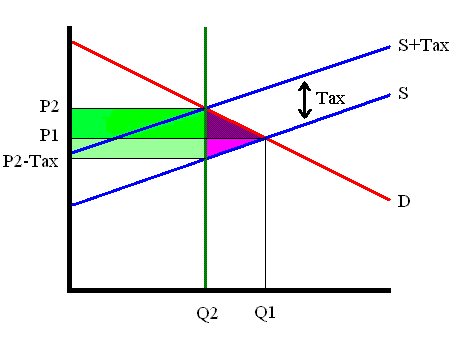
The more important impact on the economy from the fall in petroleum prices is that it results in a drop in transaction costs (costs borne by buyer of a good/service which don’t accrue to the seller)! This is because transporting anything now has become a lot cheaper (by about 20%, which is significant), so goods and services that were not being traded earlier because of the transportation cost being prohibitive have a good chance of being traded now!

This graph shows the impact of transaction costs (tax is a special case) on the clearing price and quantity. Notice that a fall in transaction cost (mentioned as “tax” in the figure) leads to both increase in traded quantity as well as lower prices

The fall in transaction costs means that economic activity will increase, and given that the fall in transaction costs in this case is rather sharp (20% is no joke), the corresponding increase in economic activity should be significant! My personal take is that analysts are grossly underestimating the impact of falling petroleum prices on GDP growth in India.

Coffee pricing at Bangalore airport

I had what I thought was a neat theory on coffee pricing at the Bangalore International Airport. However, on second thoughts, I think the theory is bunk. On third thoughts, however, I think I should publish it, even though I don’t believe it is true. So here goes.

There are two places where you get great filter coffee outside the terminal of the Kempegowda International Airport near Bangalore. At the Western edge, close to the departure gates, there is Maiya’s, which also sells South Indian snacks and food items apart from pre-mixed filter coffee (without sugar). The coffee here is priced at Rs. 30 per cup. At the Eastern edge, close to the arrival gates, there is an outlet of Hatti Kaapi. Now, this outlet has started selling snacks, too, and now sells coffee in cups and pots of various sizes. However, the “basic” filter coffee, which is mixed fresh on the spot (you can choose the level of sweetness, and strength) and is available in a paper cup the same size of that at Maiya’s, is priced at Rs. 15.

The argument I had in mind for this differential pricing was that the clientele of Maiya’s, it being at the departure gate, is mostly passengers on their way to board flights. Given that they can afford to fly, they can afford to pay a premium for good coffee. Hence it is good economics to charge a high price for the coffee. Also, given that departing passengers are usually short on time, it is unlikely that they will pay the additional time cost of walking down to the Hatti Kaapi outlet in order to save the Rs. 15 per cup monetary cost of coffee there.

At the other end, Hatti Kaapi is at the arrival gate, and its major clientele consists of drivers. Given the distance of the airport from Bangalore city, it has become almost unheard of for relatives and friends to go all the way to the airport to pick up people. So people waiting at the arrival gate are mostly drivers. And given that drivers are not particularly rich (not rich on an average as airline travellers at least), they are much more price-sensitive when it comes to their coffee. And so the coffee at this end of the airport is priced at a much more reasonable Rs. 15 per cup. This makes for a nice economic theory, right?

The theory falls apart, however, if you compare the prices at Maiya and Hatti kaapi outlets at the airport to their prices elsewhere in the city. A good parallel is in Jayanagar, where the same two establishments have outlets across the road from each other (intersection of 7th Main and 30th Cross).

The kind of service in the two establishments is similar. You stand in line, take a token and stand in line again to get your cup of coffee. Hatti serves its coffee in a paper cup while Maiya serves in a ceramic cup-and-saucer. Like at the airport, Hatti’s kaapi is mixed on the spot and you can set your sugar level. Unlike at the airport, Maiya also mixes coffee fresh on the spot, but like at the airport no sugar is added and you need to add it yourself. It must be mentioned here that the Maiya in question has been there for several years while the Hatti outlet across the road started only a few months back.

And how do Maiya and Hatti price their coffee in Jayanagar? Maiya is at Rs. 18 per cup, and Hatti at Rs. 10 per cup. So the ratio of prices of a cup of coffee between Maiya and Hatti at the airport (2:1) is not very different from the ratio of prices of a cup of coffee between Maiya and Hatti in the city (1.8:1). So the theory I mentioned above falls flat on its head.

Where the theory stands, perhaps, is in explaining why Maiya and Hatti are located at the airport at the ends where they are located – Maiya being a more premium brand in general captures the passenger crowd at the departure gate, while Hatti being a more price-sensitive brand captures the driver crowd at the arrival gate.

And regarding the coffee itself I’ve had coffee at all four outlets and can confirm that both in the city and the airport, the quality of Maiya’s coffee is much superior to Hatti’s. In fact in Jayanagar, where the two outlets are a 5-minute walk from where I live, I prefer to pay the price and time (the lines at Maiya are generally longer than at Hatti) premium to drink coffee at Maiya rather than to drink the more “reasonably priced” stuff at Hatti.

Inefficiencies in the auto rickshaw market and Uber

Taxi marketplaces such as Uber and Ola address inefficiencies and failures in the auto rickshaw / taxi market

Weary after a long cold night journey you get off the overnight bus from Chennai at Lalbagh’s Double Road gate, and look around for auto rickshaws. There are some ten of them around. The drivers are equally weary, having woken up early and left their homes to stand in the cold, hoping to find passengers alighting from buses. They want to get compensated for this, and quote you a fare that includes such compensation. All of them quote similar fares. You grudgingly bargain and agree, and conclude that Bangalore’s auto drivers are bastards.

Alternate scenario: as the bus reached Madivala, ten minutes away from Lalbagh Double Road gate at that time of the morning, you pull out your app and ask for a taxi to pick you up from Double Road gate in ten minutes’ time. The driver has been up, but resting at home. He leaves home now, just in time to be there at Double Road gate by the time you get off there. Off you get into the car and go.

You have to get to work and try catching an auto rickshaw. The guy asks for extra money for he has to take you through traffic-laden roads, which are a tax on his time, which the regulated fare doesn’t compensate him for. You bargain, get in, and conclude that auto drivers are bastards.

In an alternate scenario, you use an app-based taxi which calculates the fare as a linear combination of distance travelled and time taken, which means that the driver gets compensated for getting stuck in traffic without having to bargain for it. And without you having to think that the driver is a bastard.

In the evening you are trying to get an auto rickshaw from MG Road, and the guy asks for a premium. This premium is not reflective of costs, but the fact that demand for auto rickshaws in that area at that time is high, and that there will be customers willing to pay that premium. You conclude that the auto rickshaw driver is a bastard. Uber’s surge pricing (which can be steep at times) doesn’t evoke the same reaction from you. Uber has centralised knowledge of demand and supply so they can clear prices better, while the auto driver, lacking that knowledge, quotes a price that reflects his lack of market knowledge. And not having a good idea of what to charge, he might try to charge above market price.

What I’m trying to say here is that the local taxi/auto rickshaw market is inefficient, and ridden with failures. There is lack of information flow between demand and supply, which leads to inferior price negotiation, and the transaction cost of time and effort wasted on negotiation as opposed to using that time to travel! And when a market fails, the classic economic response is regulation, but in the case of taxi markets regulation is so poor (regulated prices do not reflect costs) that it enhances the market failure. The (badly) regulated prices anchor into people’s minds unrealistic expectations, and when auto drivers nudge them towards more realistic market prices, passengers assume that they (drivers) are bastards.

It is in this context that players like Uber and Ola (I’m not a fan of Ola’s pricing model, though) step in and try to resolve the market failure by improving flow of demand-supply information and setting “clearing prices” that compensate the driver in line with his costs. If you look closely, these companies are actually rescuing the local taxi market from its inherent inefficiencies and failures and bad regulation!

It is important, however, that no one market place ends up becoming a monopoly. As long as we have two or three different marketplaces, both customers and drivers have the choice of moving between one and the other, and this will ensure that these market places face market pressures from the two sides of the market, and if they “regulate” in an unfair manner, their participants will move to a competing marketplace, resulting in loss of business for the marketplace.

But then, considering the inherent network effects of the marketplace model, I don’t know how we can ensure that competition exists!


Natural monopoly in package delivery

I’ve never got a call from a postman asking for the route to my home. I’m assuming none of you have, either. In fact, it is extremely unlikely that anyone even writes the recipient’s phone numbers on any letter or package that is being sent by ordinary post. It is assumed that the address uniquely identifies your house and the postman knows how to get there.

However, every time I get a courier or any other package delivered I’m faced with a constant barrage of calls from the delivery person. And this after living in Jayanagar, which apart from a few dead ends and diagonal roads is like Manhattan in that mains and crosses can be easily used to identify approximate locations of addresses beyond which door numbers uniquely identify houses. The problem is that most delivery persons of “private” courier companies have as their domains areas much larger than Jayanagar, because of which they have little domain knowledge of Jayanagar.

The reason why delivery persons of “private” courier companies have large domain areas is the number of packages that these companies deliver – the market is generally quite fragmented and so the number of packages that a single company has to deliver in a particular area is low, because of which the area assigned to each delivery person is large, because of which the delivery person is unable to “figure out” his complete area, which makes the entire delivery process inefficient.

Package delivery can hence be considered to be a “natural monopoly“, in that it is more efficient for one provider to deliver packages in a particular area than for several providers to deliver in the same area. A single provider delivering packages in an area can have delivery persons who are knowledgeable about the area and can hence deliver with low transaction cost.

Hence there is scope for setting up a company that specialises in last mile delivery of packages, with delivery persons with intimate knowledge of small areas delivering packages in that area. This company can then take over the responsibility for delivery in that area from a large number of courier companies, e-commece companies which have their own logistics, etc. But then that will completely defeat the purpose of a “courier service”!

If only India Post increases reliability to a level where e-commerce players start using it rather than their own delivery services.

(Companies such as Uber, which sends you a different cab each time you call for one and thus has no way to exploit this “natural monopoly”, solve the problem by providing their drivers with GPS and turn by turn navigation. Perhaps courier companies can learn from this?)

The trigger for this post was this Amazon delivery person who kept calling me every two minutes asking me to provide him directions to my house. As if I don’t have any better job. I told him that figuring out addresses is a part of his job and he can’t outsource it to me. I’m not at home so I don’t know if he’s even delivered the package. 

Weak ties and job hunting

As the more perceptive of you would have figured out by now, the wife is in her first year of business school, and looking for an internship. I’m at a life stage where I have friends in most companies she is interested in who are in roles that are at a level where it is possible for them to make a decision to hire her.

Yet, so far I’ve made few recommendations. I’ve made the odd connection but that’s been mostly of the “she is applying to your company and wants to get to know the company better. Can you speak to her about it?” variety. I don’t think there’s a single person to whom I’ve written saying that the wife is in the market for an internship and they should consider hiring her.

I initially thought it was some inherent meanness in me, or lack of desire to help, that prevented me from recommending my wife to potential hirers who I know well. But then a little bit of literature survey pointed out an economic rationale to my behaviour – it is the phenomenon of “weak ties”. Now I was aware of this weak ties research earlier – but I had assumed that it had only referred to the phenomenon where acquaintances are more likely to help than friends because the former’s networks are much more disjoint from yours than the latter’s.

Anyway, in a vain attempt at defence, I hit “weak ties and job hunting” into google, and that led me to this wonderful post on the social capital blog that contained exactly what I was looking for. Here is the money quote:

It turns out, that people generally don’t refer their close friends to jobs for two reasons: 1) they are more worried that it will reflect badly on them if it doesn’t work out; and 2) they are more likely to know of the warts and foibles of their close friends and believe these could interfere with being a good worker (e.g., Jim stays up late to watch sports, or Charles has too much of an attitude, or Jane is too involved with her sick father).  Weak friends one can more easily project good attributes onto and believe this will work out.

So if I were to request you to hire my wife and it doesn’t work out, it can affect the relationship between you and me, so I wouldn’t risk that. When I’m recommending someone very close to me, I’m putting my own reputation on the line and I don’t like that. I’m happy referring cousins or other slightly distant acquaintances because there I have no skin in the game and hopefully some good karma can get created.

Now, while I’m loathe to recommend my wife to people I know well,  I wouldn’t be so hesitant recommending her to people I don’t know that well! For while my tie with my wife is strong, my tie with these people is weak enough that it not working out won’t affect me, and there is little reputational risk also. The problem is when the ties on both sides are strong!


What a vegetarian missed out on

image

This is the menu card that I was given on my flight from Paris to Bangalore on Thursday. Lets look at what all a vegetarian would have missed out on:

1. Mashed potatoes with vegetables
2. Camembert cheese
3. Pineapple
4. Chocolate Tartlet

I ate all of the above and can attest that they were all most excellent – even if I were to judge them by standards not normally applied to airline food.

But someone who asked got a vegetarian platter (or had a vegetarian meal pre-booked) would have had none of the above. They would’ve instead had to make do with a sealed cup of yogurt, and a saffron semolina cake with almonds. Sounds rather sad, even if it were part of a special menu created by the oberoi group.

The problem is that the number of travelers who are vegetarian and foodies is quite small – so small that it makes no sense for the airline to career specifically to them.

Serving food on board is expensive business for airlines, and the less the number of choices they offer the better it is for them in terms of slack they have to build into their system. Hence they offer only what they believe are popular choices and hope that people’s preferences are within one of the choices they offer.

There are special meals on offer though for people with special dietary requirements but they are on offer only for those who have specifically pre booked them – this restriction means airlines don’t need to carry slack on this count. But for everyone else it’s a choice between one of the main meals on offer, and for vegetarians who like to eat well it’s a rather sad choice.

If I were offered this menu three years back when I was still vegetarian there’s a high probability I would have asked for the French cuisine. And eaten everything but for the chicken (and perhaps the mashed potatoes since they came in the same container as the chicken).

Or better I might have tried to negotiate with the airline staff to give me everything from the French menu but for the hot stuff – which would come from the vegetarian option. Given its air France I don’t know if I would’ve succeeded but would’ve tried.

I remember this fight in 2011 on Aegean airways from Rome to Athens when we had pre booked vegetarian meals and were given sad looking fruit bowls in lieu of pastries. We has asked the staff if they could give us pastries instead of our fruit. And they ended up giving us both! But then not all airline staff are so empowered!

It’s not easy being a minority, on whatever axis. Markets are too illiquid to cater to you.

Bakeries

One thing that I’ve fallen in love with in my last one week in Europe is the concept of the breakfast bakery. Every few hundred metres both in Barcelona and Amsterdam you have bakeries. These bakeries offer a large variety of bread products that are to be consumed as breakfast. Apart from this, the bakeries also offer coffee and tea so that one can have a complete breakfast in some of them.

And I say “breakfast” only figuratively – I’ve had lunch on three days of my trip so far in such bakeries – again it’s with bakery products such as pizza slices or sandwiches, followed by coffee (which I must say hasn’t been bad for most of the trip). If I’ve to move to Europe, the presence of such bakeries would be one very strong reason to do so!

I was wondering why we don’t have such bakeries in India. The problem is one of liquidity – a very small portion of India’s population wants to have croissants and doughnuts for breakfast – most people in Bangalore, for example, prefer idli-vada and dosa instead. And so you still have the “fast food” places in Bangalore (lots of them) that offer such foods and coffee. And you have plenty of them – all of which are very reasonably priced and offer excellent quality!

As I try to write more and more about economic concepts, I get further drawn to this whole concept of liquidity. And each time I write about it I claim that it’s an underappreciated concept in economics outside of financial economics!

Perhaps I should make a better effort in changing that!