Would you want a free membership card?

Last weekend I was at Cafe Coffee Day on MG Road, waiting to meet a prospective client, when one of the store staff walked up to me with a card. “This is a free loyalty card, Sir”, he said, going on to tell me that if I were to buy three coffees using the card I would stand to get a free additional coffee. Considering that Cafe Coffee Day is my favourite meeting room, I thought it might make sense to use the card.

You might have noticed this in supermarkets, too. Invariably you get asked if you want a free membership card. In case you tell them that you had taken a card but are not carrying it, they offer to find your card number for you based on your phone number. Given that it probably costs the store to issue these cards (cost of cards, maintenance, staff time, cost of rewards), there must be a good reason that they are so eager to give it to you for free.

What separates traditional retail from modern is that in the latter, there are way too many customers who visit a store, and way too many store staff who attend to them. Consequently, it is hard for store staff to know who is a regular, and what the regular customers want. You might go up to your regular “single store” bar, and the barman might start mixing your favourite drink as soon as he sees you pop in. In a chain such as Cafe Coffee Day, however, such information is not forthcoming.

What loyalty cards enable stores to do is to track repeat purchases. You might be buying a kilo of rice every week at the neighbourhood supermarket, but in most cases there is no way for the supermarket to know it is you who bought the rice each time. Once you have a card and your sales are logged to that each week, the store knows how often you visit and what kind of items you are likely to buy together. Loyalty cards allow the store to “profile” you and thus hope to serve you better. The cost of the card is small compared to the value of the information the store gets about you.

A new trend in loyalty cards is “third party cards” that work across stores. These cards are issued by independent third party vendors and multiple stores subscribe to them. The advantage with these cards is that the third party has information about the customer across retailers. So for example, it makes it possible for the vendor to know the brand of formal shirts that people who buy Levi’s Jeans buy.

While this is a dream from an analyst’s viewpoint, the uptake of such cards so far has been low. I know of at least one company in this area that folded up and another that is not doing too well. Hopefully this trend will reverse soon and we will find one player who manages to scale up and issue cards at lots of retailers.

Indigo’s Food Policy

My last few flights on Indigo Airlines have not been pleasant, at least from a food perspective. It is said about the airline that they put a great amount of thought into each of their processes, but while it might have been working earlier (I used to positively prefer Indigo’s food experience a while back) of late it doesn’t seem to be doing too well.

Firstly, I don’t have a problem with the food itself. I most definitely prefer Indigo’s cold sandwiches and Real Activ fruit juice to the reheated omelette/pulao that Jet Airways serves. It is much lighter on the stomach and feels healthier, and doesn’t give you that usual bad aftertaste of “airline food”. I also understand that it makes sense from the company’s perspective, since the lack of hot food reduces their cost of serving it and also makes the plane easier to clean.

The problem, however, is with the process. Firstly, Indigo has these “corporate program customers” (I’ve never understood how to get into one of these), whose meal is pre-paid. So you have stewardesses walking around with printouts to know who is eligible for a free meal. I’ve also noticed some kind of priority in terms of service – that the corporate program customers are served before others (which is logical, since they’ve already paid), which disrupts the flow.

Then there is the problem of cash management. For whatever reasons the price points are not in multiples of 50 (sandwiches cost Rs. 170, fruit juice Rs. 70), so change management (!!) is a huge problem. While they have credit card machines they don’t work uniformly, and end up causing further delays.

The biggest issue, however, is the choice! For probably good reason Indigo serves a variety of meals, enough variety that the menu runs up to a full page in their in flight “retail therapy magazine”. There are two problems that result from this – firstly, there is a problem of inventory. When you offer so much choice, how much of each type do you carry? I know there must be some science going into how many packets of ready-to-make Uppit they carry and how many chicken sandwiches. However, on days when I’m (unfortunately from a food perspective) seated in the vicinity of Row 14 or Row 30, it is reasonably unlikely that I don’t end up getting my preferred choice.

The second problem with the variety in food is the time lost in decision-making. “Give me a chicken sandwich. Oh, it isn’t there? Then give me biryani! Oh, but that’s a Ramen kind of thing? No I don’t want that. Give me cashew nuts. Not pepper flavour, give me chilli”. The amount of time it takes for a passenger on Indigo to decide on what to eat is significantly more than the corresponding time it takes for a passenger in a so-called full-service carrier (veg/non-veg). Again, it doesn’t help (from this perspective), that an Indigo flight operates with four stewards, as opposed to six in a “full-service” carrier of the same size.

Overall, it makes the entire process of ordering for, paying and getting a meal rather unpleasant for significant proportions of passengers. My solution to this would be two-fold. Firstly, include the cost of the meal in every ticket. The current cost of an Indigo meal is Rs. 240 (170 for sandwich, 70 for juice). With economies of scale (everyone ordering a meal) I’m sure this can be brought down to about Rs. 200. When I’m paying Rs. 5000 for a flight, I wouldn’t mind the extra Rs. 200. I may not eat (note that half the time I fly Jet I don’t eat), but the point here is that given the brand Indigo has built I may not change my decision on flying Indigo because it costs Rs. 200 more.

The second idea is to drastically reduce the choice. Yes,  I know that might end up pissing off some customers who have their own favourites from the Indigo menu (mine is spinach-corn-cheese sandwich) but it makes the logistics much easier to handle. Imagine having just two choices of sandwich and two choices of juice (and no more, maybe less) and you think of how much quicker the service will get then. Going even more drastic is also an option (this is something Jetlite used to do in 2008, and I’ve noticed the same with Turkish Airline’s low-cost brand Anadolujet). Give absolutely no choice and just deposit one sandwich and one can of juice on every single tray-table. They could even.

The point of this post is that uncertainty hurts, and sometimes even those that it is intended to benefit. The choice in the Indigo menu is meant to be a boon for the passengers, but it has significant costs attached – in terms of availability and timeliness.

PS: There are no good food stalls in the airport terminal (Mumbai 1B) also that one can peacefully carry on to flights. Last two times I carried muffins from Cafe Coffee Day and Cafeccino respectively and both were downright horrible. I miss Delhi’s terminal 1D and the double chocolate chip muffin at the Costa there.

Market makers and executionists

There are two kinds of people in the world – market makers and executionists. Market makers are great at spotting gaps in markets, and deriving business ideas out of them. They could also be great at finding and executing solutions, but their primary skill is in identifying the gaps in the market and framing the problem.

Executionists are great at execution and problem-solving. However, they need the problem to have been defined in the first place. Their ability to spot gaps in markets and thus lay out problem statements is questionable, though.

Executionists fall under different levels. It has to do with how much ambiguity they can handle. There are some for whom the problem must be defined as well as the method to solve the problem. “here is a problem. Do a logistic regression and solve it”, you need to tell them and they will use logistic regression (assuming they are trained in the subject) to solve the problem. At the next level you have people whom you can ask to find patterns in some data, but then they will figure out that the problem can be framed as a logistic regression problem and will then proceed to solve it. Further up, you just give them a business problem, and then they will figure out what data set can be used ot solve it, figure out that doing a logistic regression will solve the problem and then they will solve it. And so forth.

Then again, the first line of this blog post is wrong. There is no real barrier between market makers and executionists. There are people who are both (good for them) and those who are good at neither. However, you realize that if you are an executionist of level i, you will need the guidance of an executionist of level i+1 or above. And that if you are a highest level executionist you will need the guidance of a market maker.

Levi’s Price Discrimination

So I’ve never managed to buy jeans on discount. Let me explain. Unlike most other people (if you go by what the store assistants tell you), I don’t like to wear faded jeans. It is perhaps an inherited hangover since my father used to consider jeans to be inherently dirty and would make me discard jeans as soon as they faded a little bit. It could also be more practical – since I sometimes like to wear jeans to official meetings, I want to wear jeans that look neat.

Now I’ve managed to drive my wife crazy with my shopping (and we’ve known each other for barely four years, shopped together for three maybe). She thinks I’m way too fussy about clothes, and can’t make up my mind easily. I’ve explained earlier on this blog why I take a long time over shoes (my sandals are now wearing out, so I’m getting ready for another ordeal). But the more fundamental differences that my wife and I have is with respect to jeans.

The problem is that we fundamentally disagree on what purpose jeans serve. I have traditionally looked at jeans as comfort wear. Trousers I’m absolutely comfortable in (I sometimes even sleep in my jeans), which I don’t need to wash too frequently, and which can be worn even after they get torn in non-strategic places. I’ve always bought “comfort fit” jeans, and after I graduated to branded jeans towards the end of my teens, my staple had been the comfort-fit Lee Chicago.

The problem is that my wife thinks of jeans as fashion-wear – things you need to necessarily look good in. Some of the jeans she owns are so skinny that sometimes she takes a really long time to change. She looks great in them, no doubt, but the problem is that she expects that I too wear such jeans. And so after some ten years, I have given up my loyalty towards Lee Chicago, and instead have to try out various skinny fits (as things stand now, I own only one pair of Lee Chicago, bought in 2009).

Ok all this is besides the point of this post (and the point of another post which I never wrote). Coming back to the point of this post, the deal is that nowadays I find it extremely hard to shop for jeans. Of course it doesn’t help that I don’t live in Kathriguppe (with its dozens of factory outlets) any more, and that in my part of town (Malleswaram-Rajajinagar) the only place you can find decent branded clothes is in malls, which are a pain. The bigger problem, though, is that it is very hard to find stores that stock my kind of jeans.

In the last couple of years, our strategy for shopping clothes has been to visit a multi-brand outlet in one of the two malls near our place, so that we have a wide variety of choice. Except that I have no choice. Because stores such as Lifestyle or Shopper’s Stop or Westside (which now mostly stocks private labels) or Central don’t stock my kind of jeans. At all. If you happen to locate a store clerk and ask him for “mid blue straight cut non-faded jeans” he will look at you as if you have just landed from another planet. He can be excused for giving you those looks, for his store simply doesn’t stock non-faded jeans, because of which he has never sold them!

So I happened to be on Brigade road over the weekend, and I had a small gap of about half an hour between two meetings, and thought I should visit the Levi’s flagship store there. I must mention that the salespeople there were definitely significantly more polite than I’ve ever seen at a multi=brand store. However, as soon as I repeated my mantra (mid blue straight cut non-faded jeans), the first thing the salesperson who approached me told me  was “oh Sir, but there’s not discount on that!”.

It’s clever price discrimination by Levi’s, to not sell non-faded jeans on discount. For they know that people who buy non-faded jeans tend to be older (hey I’m only thirty), or will be buying them for office wear, and they are less price elastic than the typical college kid who buys faded stuff. So while the college kid needs discounts to be attracted during the “discount season”, the “formal jeans” buyer needs no such attractions, and will pay full price for his stuff.

It is interesting to note, however, that companies that make formal clothes (not Levi’s) also offer massive discounts during the “discount seassons” (one of which is on now). That, though, can be explained by the fact that most people need a few sets of formal clothes (even those that normally wear faded jeans), and discounts are necessary to attract customers.

Now I’m beginning to think that the market for “formal jeans” in India is extremely niche, and if I”m acting above my age because I prefer such jeans. I half-expect my wife to call me an “uncle” be cause of this.

Inefficiency of Restaurant Reservations

Quartz reports that restaurant reservations have been taken over by bots in San Francisco. Certain restaurants in that city are incredibly hard to get reservations at, so people have started letting lose bots that check for availability every minute and grab the table as soon as it’s available. In fact, there are enough bots out there that at a particular restaurant which opens reservations at 4 am, all tables are taken by 4:01. Every day.

In Kannada, there is an idiom that says “gubbi mEle brahmAstra”, which means using the weapon of Brahma (widely recognized in Hindu epics are the most powerful weapon) to annihilate a sparrow. Using a bot for restaurant reservations is a solution that falls under this category. However, that someone had to think up of this solution shows that there is something wrong with the restaurant reservation market. And it is not just in San Francisco (I guess this solution was first implemented there thanks to the penetration of online restaurant reservations and the high number of techies in the city. Bangalore fails on the first count).

The problem with the way restaurant reservations currently work is that the option is priced at zero. And thus gets allocated on a first come first served basis. Suppose I want to go out on a date tonight but am not sure what cuisine my wife is craving today. Anticipating crowds, given that it is a Saturday, I will make reservations in four different restaurants serving four different cuisines. There is nothing that currently prevents me from doing that. And it costs me nothing (apart from the cost of four phone calls).

A restaurant reservation is essentially an option to occupy a table of a certain size at a certain restaurant in a particular time period. If you show up at the restaurant at the appointed time, the restaurant is obliged to offer you a table. However, the way it is currently implemented is that you are not obliged to show up at that restaurant at that particular time. If you don’t show up, the table the restaurant had “reserved” for you will go empty for that evening, thus resulting in loss of business.

How can a restaurant handle this? One idea is to overbook. If you have 10 tables, allow 12 people to make reservations, in the hope that on an average day, 10 or less will show up. While this may lead to higher occupancy, problem is when all 12 show up. You then run the reputational risk of making a reserved guest wait, or worse, turning them away. Another option is to book only a fraction of the tables. If you have 10 tables, give out reservations only for 8, and let people know that you are open to walkins (if someone calls after the 8 are taken, you can say “I’m sorry, but we can’t take any reservations. However, we have some unreserved tables. You can come and check it out. If you’re lucky you’ll get it”). That way, by keeping yourself open for walkins, you can prevent loss of inventory- except that if you are a high end restaurant you are unlikely to get too many walk in customers.

Another option (which I believe is a method online retailers in India use for cash-on-delivery customers) is to maintain a list of people who called you along with their phone numbers and whether they showed up. That way, you can deny habitual offenders a reservation. However, considering that if you are a high end restaurant people are unlikely to visit you very often this may not work either.

The ideal economic solution, of course, would be to charge for reservations. People pay a small deposit when they make a reservation. If they do show up, this amount gets adjusted against their bill. However, given that most reservations happen over the phone (except in SF), you have no way to charge for it. So is the solution that you move your reservations exclusively online, so that you can charge for it? Then you could lose out on customers who are uncomfortable with making reservations online.

Even if all your reservations were online (like in SF), there is a problem in charging for reservations – you wouldn’t want to be the first restaurant doing that. One thing high end restaurants pride themselves on is their reputation, and charging for reservations can make them appear “cheap”, and they wouldn’t want to do that unless it is the done thing.

So how are restaurants managing the situation now? My take is that they are adjusting for it in the price. They are not overbooking, but assuming the cost of empty tables (as a result of no shows) in their overall pricing. This way, customers who are honouring reservations are effectively subsidizing those that don’t. While the market “clears”, the implicit subsidy towards customers who don’t honour their reservations leads to dead weight loss. There is also moral hazard – since desirable customers (the ones who show up) are subsidizing the un-desirable (the ones that don’t).

Is there a solution to this? One way to look at this would be for restaurants to centralize their reservations. I’m surprised no one has done it yet. You can have a website and a call centre from which you can take reservations for a large number of restaurants. The restaurants will pay for it since it will mean that they don’t need to have someone by the phone taking and managing reservations. And given that the same call centre manages bookings for multiple restaurants, they can identify duplicate bookings and overbook accordingly. Customers can be incentivized to use the same ID for booking for multiple restaurants by introducing a multi-restaurant loyalty card. And then – once there is a large number of restaurants that have moved their reservations to this call centre, they can start thinking of collectively moving towards a system of penalizing for unfulfilled reservations.

There – I’m giving a business idea away for free!
Should you have an analytics team?

In an earlier post a couple of weeks back, I had talked about the importance of business people knowing numbers and numbers people knowing business, and had put in a small advertisement for my consulting services by mentioning that I know both business and numbers and work at their cusp. In this post, I take that further and analyze if it makes sense to have a dedicated analytics team.

Following the data boom, most companies have decided (rightly) that they need to do something to take advantage of all the data that they have and have created dedicated analytics teams. These teams, normally staffed with people from a quantitative or statistical background, with perhaps a few MBAs, is in charge of taking care of all the data the company has along with doing some rudimentary analysis. The question is if having such dedicated teams is effective or if it is better to have numbers-enabled people across the firm.

Having an analytics team makes sense from the point of view of economies of scale. People who are conversant with numbers are hard to come by, and when you find some, it makes sense to put them together and get them to work exclusively on numerical problems. That also ensures collaboration and knowledge sharing and that can have positive externalities.

Then, there is the data aspect. Anyone doing business analytics within a firm needs access to data from all over the firm, and if the firm doesn’t have a centralized data warehouse which houses all its data, one task of each analytics person would be to get together the data that they need for their analysis. Here again, the economies of scale of having an integrated analytics team work. The job of putting together data from multiple parts of the firm is not solved multiple times, and thus the analysts can spend more time on analyzing rather than collecting data.

So far so good. However, writing a while back I had explained that investment banks’ policies of having exclusive quant teams have doomed them to long-term failure. My contention there (including an insider view) was that an exclusive quant team whose only job is to model and which doesn’t have a view of the market can quickly get insular, and can lead to groupthink. People are more likely to solve for problems as defined by their models rather than problems posed by the market. This, I had mentioned can soon lead to a disconnect between the bank’s models and the markets, and ultimately lead to trading losses.

Extending that argument, it works the same way with non-banking firms as well. When you put together a group of numbers people and call them the analytics group, and only give them the job of building models rather than looking at actual business issues, they are likely to get similarly insular and opaque. While initially they might do well, soon they start getting disconnected from the actual business the firm is doing, and soon fall in love with their models. Soon, like the quants at big investment banks, they too will start solving for their models rather than for the actual business, and that prevents the rest of the firm from getting the best out of them.

Then there is the jargon. You say “I fitted a multinomial logistic regression and it gave me a p-value of 0.05 so this model is correct”, the business manager without much clue of numbers can be bulldozed into submission. By talking a language which most of the firm understands you are obscuring yourself, which leads to two responses from the rest. Either they deem the analytics team to be incapable (since they fail to talk the language of business, in which case the purpose of existence of the analytics team may be lost), or they assume the analytics team to be fundamentally superior (thanks to the obscurity in the language), in which case there is the risk of incorrect and possibly inappropriate models being adopted.

I can think of several solutions for this – but irrespective of what solution you ultimately adopt –  whether you go completely centralized or completely distributed or a hybrid like above – the key step in getting the best out of your analytics is to have your senior and senior-middle management team conversant with numbers. By that I don’t mean that they all go for a course in statistics. What I mean is that your middle and senior management should know how to solve problems using numbers. When they see data, they should have the ability to ask the right kind of questions. Irrespective of how the analytics team is placed, as long as you ask them the right kind of questions, you are likely to benefit from their work (assuming basic levels of competence of course). This way, they can remain conversant with the analytics people, and a middle ground can be established so that insights from numbers can actually flow into business.

So here is the plug for this post – shortly I’ll be launching short (1-day) workshops for middle and senior level managers in analytics. Keep watching this space 🙂


Sales and marketing

On Saturday evening, I drank a Pepsi.

You might wonder why I’m making such a big deal about it. Because it is a big deal. Because I don’t normally drink pepsi. My preferred choice of cola is Thums Up, and if it’s not available I have a Coke. The only time when I have a pepsi is when both Thums Up and Coke are not available. There are times when I end up at PepsiFoods only stores, and sometimes I even have dew instead of pepsi.

You might think I’m extrapolating based on one data point. But I know more people who swear by thums up. For whom Pepsi is only a third choice cola.

The reason I’m bringing this up now is that Pepsi has spent a bombshell on sponsoring the IPL. Yes, despite being on HD, I managed to see a number of their ads. Pepsi Atom seems cool but they didn’t seem to have had its distribution in place when I wanted to try one. I reverted to my old faithful thums up. Now, I hear news that the India head of Pepsi has been sacked because he was deemed to have over spent on the IPL.

Why someone like Pepsi would spend so much on advertising is beyond me. Yes, they need to be on the top of people’s minds. But considering that everyone they advertise to has tried each of the major colas once, and loyalties to cola brands being rather heavy, I don’t see how they seek to influence sales by advertising. That Shah Rukh Khan drinks pepsi doesn’t alter my opinion one bit – I’m loyal to my thums up. I would think the same to be true to a loyal pepsi fan.

After having said so many times that I’m a loyal Thums Up customer, you might want to know why I drank Pepsi on Saturday. Because that little shop in Malleswaram I went to stocked only pepsi products. And he didn’t have dew. Faced with the choice of Pepsi or Mirinda or 7Up, I opted for the first. It was that exclusive agreement that PepsiCo had with that shopkeeper that made me consume their product.

Pepsi should invest more in this. Give higher margins to retailers who are willing to stock only pepsi products. Cola is something in which people have loyalties, but those loyalties are typically not so strong that the shop tends to lose business if the customer’s favourite brand is not available. Given lack of choice, customers will switch.

But then I guess the problem is that Pepsi is a “marketing-driven” rather than “sales-driven” company (we used to hear a lot about this distinction during recruitment time at business school). And the thing with marketing everywhere is that they are not measured. Like this friend who markets phones once gleefully told me that an advertisement he put out had a million likes on facebook. I asked him how many extra phones his company sold as a function of that ad. He had no answer. Marketing is like that everywhere. It is not judged based on real tangible numbers. And I hear that marketers like to keep it that way!

The last time I was in this guru mode I had commented that Nokia’s strategy of promoting Lumia by the strength of its camera was doomed to fail – for people don’t buy phones because they want a camera. Nokia seems to have learnt. The latest ad for the 520 talks about the apps that are available. This time they seem to have got it right.


The Problem with Unbundled Air Fares

Normally I would welcome a move like the recent one by the Directorate General of Civil Aviation (DGCA) that allows airlines to decrease baggage limit and allows them to charge for seat allocation. While I’m a fan of checking in early and getting in a seat towards the front of the flight (I usually don’t carry much luggage on my business trips), under normal circumstances I wouldn’t mind the extra charge as I would believe it would be offset by a corresponding decrease in the base fare.

However, I have a problem. I don’t pay for most of my flights – I charge them to my client. And this is true of all business travelers – who charge it to either their own or to some other company. And when you want to charge your air fare to someone else, one nice bundled fare makes sense. For example (especially since I charge my flights to my client) I would be embarrassed to add line items in my invoice to ask for reimbursements of the Rs. 200 I paid for an aisle seat, or the Rs. 160 I paid for the sandwich. A nice bundled fare would spare me of all such embarrassment.

Which probably explains why most airlines that primarily depend on business travelers for their business don’t unbundle their fares – that their baggage allocations remain high, that they give free food on board and they don’t charge you extra for lounge access (instead using your loyalty tier to give that to you). Business travelers, as I explained above, don’t like unbundled fares.

Which makes it intriguing that Jet Airways, which prides itself as being a “full service carrier” has decided to cut baggage limits and charge for seat allocation (they continue to not charge for food, though). Perhaps they have recognized that a large number of business travelers have already migrated to the so-called low-cost Indigo (it’s impossible for Indigo to have a 30% market share if they don’t get any business travelers at all), because of which Indian business travelers may not actually mind the unbundling.

Currently, Indigo flights have a “corporate program”, where the price of your sandwich and drink is bundled into the price of the ticket. I normally book my tickets on Cleartrip, so have never been eligible for this, but I can see why this program is popular – it prevents corporates from adding petty line items such as sandwiches to their invoices. On a similar note, I predict that soon all airlines will have a “corporate program” where the price of the allocated seat and a certain amount of baggage (over and above the standard 15kg) will be  bundled into the base price of the ticket. Now that I charge my flights to a client, I hope this happens soon.

Fundraising

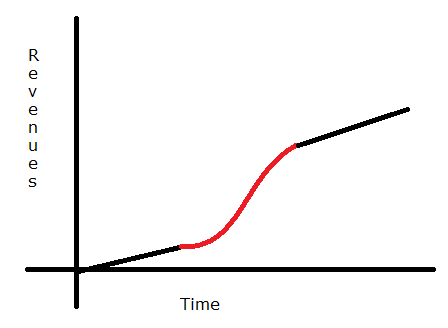
The growth of a new company usually consists of one short period of high growth preceded and followed by rather long periods of steady growth. Sometimes there might be more than one period of high growth, but for most companies, it is that one period when there is a point of inflexion and growth goes to a new trajectory.

Now, my point is that if you want to raise venture funding, you better do it when you think you are on the cusp of one such inflexion. Usually points of inflexion are associated with some increase in “leading” investment, and a small chance that the company will get on to a new trajectory, and a big chance that the company will go under.

This crude chart shows the typical trajectory of a young company. The beginning of the red zone is when you should raise venture money

If you look at the picture here, the beginning of the red region is the state where you need to get venture funding. The thing with the black regions is that irrespective of how you fund those, at best you can expect steady growth. Now, venture capital funds, the way they are structured, are not set out to fund steady growth. The way venture funds make money is when one out of a number of their investments makes shockingly great returns, while the rest go under. They are not in the business of funding steady returns.

Hence, when they fund your company they value you assuming that in case your company is successful there will be steep growth, which will enable them to recover their investment. And if your company is in steady growth phase, it is never going to be able to do that. And you will have a case of your investors pushing you to do more or something different from what you had planned doing. The problem here lies in the fact that you raised the wrong kind of funding!

In times like this or at the turn of the millennium, when venture capital is big, it can sometimes become the preferred mode of fundraising for a lot of companies. The problem, however, is that most of them don’t realize that venture funding is probably not the best form of funding for them at their size and scale, and then get weighed down by investors.

On a similar note, you should go public once you know that there are no really big points of inflexion coming up, and that your company is set on a path to steady growth. Again that follows from the fact that investors in the stock market (where they pick up tiny shares in each company) are usually in it for long-term steady growth. And if you happen to take undue risks and they don’t pay off, your stock will get hammered unnecessarily.

Nokia Lumia: Phone or Camera?

If you look at all the Nokia Lumia 920 advertisements you might be forgiven for thinking that it’s a camera and not a phone. Ads talk about “optical image stabilization”, low light imaging and stuff that might make sense to a geeky photographer but not to someone who wants a nice phone with such apps.

Nokia Lumia 920 ad

The communication suggests that Nokia’s perception of the problem with its phones is the lack of camera power. What it absolutely fails to address is that the primary reason people don’t buy Nokia phones any more is the perceived lack of apps on the Nokia-Windows8 ecosystem.

I wouldn’t be surprised if the company continues to not do well in India.