Customised Google Doodle

I’m very impressed with Google for having customised a Doodle for my birthday. I’m always logged in to Chrome, and I’ve told Google Plus when my birthday is, so it’s rather trivial to do this. However, that they have done this is rather impressive, and I’m happy with them.

Customised Google Doodle

I’m also happy with most financial institutions I have a relationship with, for since morning my mailbox has been flooded with messages from all these institutions wishing me a happy birthday. I don’t know what information other e-commerce sites have about be, but not many of them have bothered to wish me so far  (not that I’m complaining). The only exception is FabFurnish (which is bizarre since I’ve never bought from them) which has not only wished me but also sent me a discount code!

This whole business of Customer Relationship Management is bizarre, I tell you!

Communists and Chintamani

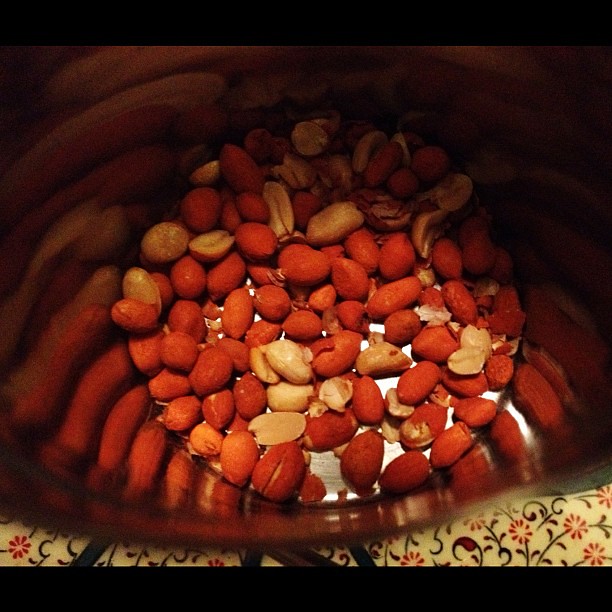
My grandmother Narasamma, who was my last surviving ancestor before she passed away earlier this year, used to make roasted red peanuts. I don’t know the exact process for making them but it basically consists of applying a mix of salt and chilli powder to peanuts and roasting them (or the other way). If there is one thing I’m unlikely to forget about this grandmother, it’s the red roasted peanuts she would make.

I had never eaten these peanuts until when I was about eight years old when this grandmother moved in with us. I can’t really say that I ever got along particularly well with her, but these peanuts more than made up for all of that. Interestingly it was after she moved out a few years later that the supplies of these peanuts started going up. Anyway, in due course of time I had come up with the phrase “ajji kaDlekai” (grandmother’s peanuts) to refer to these peanuts.

Source: Flickr

As she grew older the supplies of these peanuts started drying up and I had to look for other sources. I soon settled upon Srinivasa Condiment Stores (more popularly known as “Subbamma stores”) in Gandhi Bazaar for my supplies. On my first few visits I would just point at it and be told a price and would buy without bothering what the name was. It was less than a decade ago that I discovered that these “ajji kaDlekai” actually had a name.

It was at Subbamma stores that I once went to procure such peanuts and couldn’t find them on display. I asked the shopkeeper if he had “red peanuts” (kemp kaDlekai) and he shouted to his associate deep into the store “one communist!”. It was then that I realised that the popular name of these red peanuts is “communist”.

The etymology is not hard to guess – the yellow “split” peanuts are called Congress (thanks to the congress split around 1970), and they wanted to come up with a political name for other varieties of peanuts also. Thus, being red in colour these peanuts came to be called “communist” (some disambiguation was required here – for there is another variety of red peanuts which are fried rather than roasted. They’ve been named “Oil King”). I don’t know how popular the name is but in Subbamma stores at least these peanuts are called “Communist”. Similar peanuts roasted with green masala are called “green revolution” (unlikely the name ever caught on! ).

When I moved to North Bangalore two years back I no longer had access to Subbamma Stores for my Communist fix. And I had to find stores close to my home there that would supply it. It was hard enough to find so I cultivated several sources (somehow Communist is not as popular as Congress in condiment stores – perhaps reflecting political parallels). Sometimes it would be from Ganesh Condiments in Rajajinagar first block. On other occasions it was the Iyengar’s bakery at the end of my road (but he never got the difference between communist and oil king and so I stopped buying from him). And sometimes as far away as the Ace Iyengar store in Malleswaram.

There was one thing common to the communists procured from these sources though – the label. Each of them were manufactured by a different small scale industry named after a different god. But the place of manufacture was the same – Chintamani town in Chickballapur district. It was after I had seen similar labels several times that it all started coming together.

I remembered that my father was born in Chintamani, which means that Chintamani is my grandmother’s hometown (given how births were conducted back in the 1950s one could infer this). And this explained how she had picked up this skill for making these Communist peanuts – something most of my other relatives (none of whom were from Chintamani) lacked.

I was reminded of all this a while back when I was eating Communists, procured from Gayathri Stores in Jayanagar 4th block (incidentally run by actor Kashinath’s brother). This one came without a label, and when I had asked the shopkeeper (Kashinath’s brother) for the source, he had replied “naave maaDstivi” (we get them made). Maybe the communists I had for a snack a while back weren’t made in Chintamani, but they were crisp and perfectly spiced!

The communists have moved beyond Chintamani!

Why Petromax is Repugnant

Every time I talk about the concept of “Petromax”, people give me looks as if I’m from some other planet. Sometimes they shudder. Sometimes they think I’m uncouth. While I believe that the “problem” is just that I say things like they are (rather than couching them in niceties), given that everyone reacts in a negative way when I talk about Petromaxes implies that there’s something repugnant to it. And I think I’ve found the answer – the answer lies in Option Theory.

First of all, a recap on what petromax is all about. The concept was invented by Anant Nag in Golmaal Radhakrishna back in 1990. It goes “the wife is like the lamp you light in front of God. When the wife is not at home, the house plunges into darkness, and that’s when you need a petromax”. Those of you who understand Kannada might want to watch this youtube video from the movie:

Now that the definition is out of the way, let’s come to why the concept is repugnant. It is repugnant because being a petromax is like writing an option. And in the relationship business, nobody likes being a writer of options – it makes them look “cheap” and desperate. Let me explain.

I live in Bangalore. My wife lives abroad. So I’m in a long-distance marriage and going by the Petromax theory my house is “filled with darkness”. And the theory posits that I need a Petromax. Let’s say that you are interested in filling this gap and being “my Petromax”. So far so good. Where is the problem?

The problem happens when my wife comes home, and “fills it with light”. Remember that I’m still married to her, and deeply in love with her, and that I only took you on as a petromax. So for the duration when she is here, I don’t need you any more, and don’t bother about you! So in effect, I have an option of “being with you” whenever I want, while you don’t have the same option (unless you are also using me as a Petromax, but then I won’t be available whenever you want so I won’t be a reliable petromax). So under the petromax arrangement defined above, I have the right but not the obligation to be with you. You, the petromax, have the obligation but not the right to be with me. Effectively you’ve sold me an option!

Now, in the relationships business options don’t work. The writer of the option will start thinking that the “buyer” is using him/her. Being used is not a good thing in the relationship business. Among other things, showing the world that you are willing to be used reduces your “value” going forward. So you don’t want to do this. So you don’t like to be the petromax. So the deal doesn’t work for you. And so it doesn’t work for me, since when I’m looking for a Petromax I’m looking for optionality.

And so when you say that someone is someone else’s petromax, it is an implicit admission that the said person is willing to get “used”, and is thus willing to lower his/her value. Which is not a nice thing from the point of view of this person. And hence the term petromax is repugnant. And the concept of the petromax is also thus repugnant.

But the petromax concept has been seen to work in real life. How does it work then? Being part of a small community helps, since the valuation drop is seen only in that particular community. Then, there can be some restricted structuring where neither sells each other an option, and set up an “and condition” (being together if and only if both are available and interested at the same instant).

Ok I realise that this post itself might be repugnant to some of you but these things need to be explained!

Protocol and the human touch

A high Mata Amrita Index is like the mythical shepherd-boy crying “wolf”, and devalues the hug.

Recently I was discussing my recent blogpost on the Mata Amrita Index with the wife. Rather, when I had written the blog post, I had expected a response from her, and when none was forthcoming, I mentioned the post to her while talking to her and asked what she thought about it.

Now, before we proceed, I must mention that the wife considers herself to be an expert on relationships (she fancies herself as a “Marriage Broker Auntie“), and on hugging. In fact, if I remember right, one of our earliest intellectual conversations (way long back) was on what different kind of hugs mean in terms of the relationship between the huggers. This conversation had caused some confusion between us the first time we met, regarding protocol, and I had been later told that I had broken protocol.

So given that she’s a domain expert on the subject of hugging, and has a Mata Amrita Index which I think is on the upswing, I asked the wife what she thought about my post on enhancement of the Mata Amrita Index. I somehow expected a “very nice analysis” kind of comment from her, but she chided me. It was wrong that I had looked at something as “sacred” as a hug between two people as a protocol, she said. She went on to say that you hug someone if and only if you feel affectionate towards that person, and that every time I was faced with a question on whether to hug (this is going into Gandhiji’s Talisman territory here), I should ask myself if I feel affectionate, and if I do, go ahead an offer a hug!

So sometime last week I was thinking about this, and was thinking about this one person I know who has an extremely high Mata Amrita Index. Thinking about it, I realised how mechanical our greetings had become, and that though we hug every time we meet (sometimes twice – once when we meet, and once when we par), it has become so ingrained in protocol that it effectively means nothing!

The wife also told me about how the “cheek-peck” has gone the same way in her college. The cheek peck, also known as air kiss, is a weird form of greeting practiced in Western Europe, and which was reportedly invented so that you don’t leave lipstick marks on one another’s cheeks, as you would with a normal peck (the cheek peck is a common woman-woman and man-woman greeting. It’s seldom used between two men). To cheek peck, you touch your cheeks to each other (right cheek to right cheek or left cheek to left cheek) and then kiss the air in front of your lips, thus making a kissing sound! And since you’re leaning, for balance, you hold on to each other, perhaps at the shoulders.

Now, I’m told that the standard convention is that it’s not done every time you meet someone – you cheek peck only once in a while, or when at least one of the parties feels affection towards the other. In the wife’s college, on the other hand, it has reportedly become protocol and you almost have NC2 (N choose 2) cheek pecks every day, since the largely international student body has misunderstood it to be a protocol, while the Spanish themselves hardly cheek peck. So the wife argues that though she ends up touching plenty of shoulders and cheeks every day, it is done so much as part of protocol that it doesn’t count for human touch at all!

So the basic funda is this – when you elevate (or perhaps reduce) a particular form of greeting to protocol, you run the risk of devaluing the effect of the protocol. It is effectively like the shepherd boy crying “wolf”. If we have an unwritten protocol that we hug every time we meet, then soon our hug starts becoming meaningless, and does nothing to bring us closer (metaphorically that is), while a hug is intended to do that! If either of us feels affection towards the other, the hug is no more an instrument that can be used to express it! And restricting our discussion to non-romantic relationships, it becomes extremely difficult to find a means of affection-appreciation superior to the hug, and it becomes an unexpressable emotion!

On the other hand, if there is someone who you don’t hug as part  of protocol, but only do so when one of you feels affection towards the other, the hug retains value, and the touch thus introduced can work its magic (again note that we’re strictly leaving out romantic relationships from our discussion)!

So if you have a high Mata Amrita Index, it is actually not such a good thing, since it removes the hug as a means of conveying real human touch! I’m in full-on admiration to the wife right now for coming up with this theory! And since we’re leaving out romantic relationships out of this discussion, I’m not telling you how I’ll express my appreciation to her!

Coasters are evil

I asked my cook to make me a cup of tea. He did so and placed the steel tumbler full of tea on a coaster on my dining table. I went to pick it up. As I picked up, the bottom of the tumbler seemed to get stuck to the coaster, because of which I couldn’t pick up the tumbler cleanly. And the tumbler came up along with the coaster, and toppled, spilling tea all over the dining table.

And so I had the task of cleaning up the dining table of all the tea spilt on it. Thankfully there was no tea on the floor, and I didn’t lose too much tea. Yet, none of this happens on most days when the cook places my teacup directly on the dining table without an intermediating coaster.

So it is all the coaster’s fault, I tell you. Coasters are evil.

Speaking of coasters, Monkee had once commented that coasters are the ultimate sign of domestication – curtains being an intermediate sign of domestication. And thinking about it, these coasters (one of which was responsible for the spilled tea today) were bought during my honeymoon!

What is the feminine of Amit?

“Amit” is a word that is commonly used, often pejoratively, to refer to men from the North of India. The reason for the usage of “Amit” in this context is that while it is an extremely common name for men from North India, it is not as common in other parts of India, and thus it characterises men from North India.

A question that has been floating around in social media circles for a long time in this connection is what the feminine form of “Amit” is. If Amit characterises the median North Indian male, what name characterises the median North Indian female? Popular candidates for this are Neha, Isha and Pooja. Pooja suffers from the fact that is is also a fairly common name in other parts of India. Isha, while it might be strongly North Indian, is too obscure. And for some reason, people are loathe to accept Neha as the feminine Amit. So how do we resolve this?

I, being a stud, am a big follower of the Hanuman principle. If you have to solve a problem, and it takes no more effort to solve a generic problem, then solve the generic problem and apply it to this problem as a special instance rather than spending time to solve each instance. Hence, we will rephrase this problem as “What first name uniquely identifies a particular ethnicity?”. I, being a quant, am going to use the quantitative hammer to hammer down this nail. So we can rephrase as “how can we quantitatively characterise ethnicities by first names?”

The first thing to notice is that we need a frame of reference. Amit is a good name to characterise a North Indian man among the universe of Indian men. However, if we define the universe differently, as “Asian” for example, or “men living in Delhi”, Amit may not be as characteristic at all. Hence, any formula that we develop needs to take into account the frame of reference.

Secondly, what makes a name ethnically characteristic? I argue that there are two factors, and these two will be used in deriving the final formula. Firstly, the name should be common among the particular ethnicity – for example, Murugaselvan is extremely characteristic of Tamil men, but its occurrence is so low that using Murugaselvan as the median Tamil man among all Indian men is futile. Secondly, the name should be distinctive for that particular community. For example, a possible competitor to Amit is Rahul, a name that is possibly as common among North Indians as Amit is (I haven’t seen the statistics). The problem with Rahul, however, is that it is a fairly common name in South India also! So it does a bad job in terms of discrimination. So basically what we are looking for is a name that is both popular in the ethnicity we want to characterise, and also characteristic to that particular ethnicity in comparison to the universe.

These two requirements lead to the following rather simple formula (I’m not claiming that this is the best formula – if there is a way to objectively evaluate such formulas, that is – but it is sufficiently good and simple to understand and evaluate). Let our universe by U and the community we are trying to characterise by C. C’ is {U – C} (I’m assuming all of you know set theoretic notation). The first name N that characterises the community C is the one that maximises P(N|C) – P(N|C’). That’s it. Simple.

To explain in English, for each first name, we calculate the incidence of that particular name in the community C. That is, for example, what proportion of North Indian girls are named Neha, Pooja, Isha, Nidhi, etc. Next, we calculate the incidence of the name in the “complement of C”, that is how likely is it that someone in the rest of the “universe” we have defined has the same name. In our above example, we calculate what proportion of Indian but NOT North Indian girls (taking Indian women as the universe) are named Neha, Pooja, Isha, Nidhi, etc. Then, for each name, we subtract the latter quantity from the former quantity and then select the name for which this difference is maximum! Rather simple, I would think!

Now, we need data. Unfortunately I can’t seem to find any publicly available data sets that contain long lists of names along with markers of ethnicity (address or city or state or language preference or some such). If you can help me with some data sets, we can actually run the above formula for different ethnicities and characterise them. It is going to be a fun exercise, I promise! So pour in the data. And I request you to share publicly available data and not proprietary data.

And then we can for once and for all finish this debate of what the feminine form of Amit is, along with many other fun ethnic classifications.

R, Windows, Mac, and Bangalore and Chennai Auto Rickshaws

R on Windows is like a Bangalore auto rickshaw, R on Mac is a Chennai auto rickshaw. Let me explain.

For a long time now I’ve been using R for all my data management and manipulation and analysis and what not. Till two months back I did so on a Windows laptop and a desktop. The laptop had 8 GB RAM and the desktop had 16GB RAM. I would handle large datasets, and sometimes when I would try to do something complicated that required the use of more memory space than the computer had, the process would fail, saying “fail to allocate X GB of memory”. On Windows R would not creep into the hard disk, into virtual memory territory.

In other words it was like a Bangalore auto rickshaw, which plies mostly on meter but refuses to come to areas that are outside the driver’s “zone”. A binary decision. A yes or a no. No concept of price discrimination.

The Mac, which I’ve been using for the last two months, behaves differently. This one has only 8GB of RAM, but I’m able to handle large datasets without ever running out of memory. How is this achieved? By means of using the system’s Virtual Memory. This means the system doesn’t run out of memory, I haven’t received the “can’t allocate memory” error even once on this Mac.

So the catch here is that the virtual memory (despite having a SSD hard disk) is painfully slow, and it takes a much longer time for the program to read and write from the memory than it does with the main memory. This means that processes that need more than 8 GB of RAM (I frequently end up running such queries) execute, but take a really long time to do so.

This is like Chennai auto rickshaws, who never say “no” but make sure they charge a price that will well compensate them for the distance and time and trouble and effort, and a bit more.

How do you change Mata Amrita Index?

Over five years ago, I had introduced the concept of the Mata Amrita Index on this blog. Just to refresh your memories, it refers to the probability that a person will hug any random person she meets. You can also define bilateral Mata Amrita Index, which is the probability that a given pair of people hug when they meet.

Now, after I wrote that post I realise that the Mata Amrita Index is a rather cultural thing – some cultures are more predisposed to hugging than others. I, for example, for whatever reason, am quite queasy about hugging and won’t do so unless I know the counterparty quite well. More importantly than the queasiness, I want to avoid the awkwardness when I offer a hug which makes the other person queasy because they are not prepared for it (this happened the very first time I met the person who is now my wife,btw). For others, hugging comes much more naturally, and if such people initiate a hug to me, I’m happy to continue with the process. But with some others I’ve noticed that both of us are not sure if it’s okay to hug and it ends up in a weird handshake while it might have been a hug!

Anyway, the point of this post is whether the bilateral Mata Amrita Index between a pair of people can change over time, and if so, what the conditions are under which it changes. We will leave romantic or hopefully-romantic or possibly-romantic relationships out of this discussion – the human touch works in those situations in completely different ways. So the question is under what circumstances can the bilateral Mata Amrita Index between a pair of people change over time? And let’s be nice on this blog, and discuss only about increase in MAI, not decrease.

So what are the circumstances under which the bilateral MAI between a pair of people increase over time? One is the frequency of meeting. If you meet someone very regularly, you get into a particular routine on how you greet each other – be it a handshake or a hug or a namaste or a feet-touch or a cheek-peck. Since you are meeting each other regularly, both of you remember the established protocol. And both instinctively go for it. Even if you want to change protocol, the other person is so used to it that they continue. And considering that you can’t command someone to hug you (unless you are an “aunty”) you end up sticking to protocol!

If you meet each other infrequently, on the other hand, you are likely to have forgotten whatever protocol existed, and so there is a higher probability of changing protocol, and so there is a chance that you can enhance your Mata Amrita Index. It helps if it’s been so long since you last met that either of you has undergone a culture-changing experience (like moving to a new country, or a new job, or a new school, for example), which can change the way you greet and can use as an excuse if the counterparty objects to your way of greeting.

Then, if you are meeting after a long time and for some reason you have got closer in the interval (in terms of things you’ve spoken about with each other since the last time you met, for example), it is again okay to explore an enhancement of the Mata Amrita Index the next time you meet.

There is also the company you keep. Let’s say A, B and C are meeting. Whether it’s due to their past bilateral MAI, or individual MAI, A and B hug, and then B and C hug. Now it becomes socially awkward for A and C not to hug, so they end up hugging each other, and enhancing their MAI. The next time they meet, this enhancement will be in their mind, and can lead to further enhancement in MAI. This can also work the other way – if you are in a large group and only two of you in that group have a high bilateral MAI, then it becomes awkward for you to hug when everyone else is being all prude and shaking hands. That can decrease MAI.

There is another way the company you keep can end up decreasing MAI. Again, if A,B and C meet, and A-B have a high bilateral MAI. Let’s say that A is meeting C for the first time. Before A hugs B, she evaluates is she is also okay hugging C (since not doing so might be awkward), and that might lead A to not hug B!

This is complicated business! Do you know any way in which the Mata Amrita Index can be enhanced? Or diminished? Do write in!

Extended Munroe Protocol

Last Monday three of us were drinking beer at Arbor. One of us got up for a bathroom break. Like a pack of dogs, or a classroom of coughing students, the other two took the cue within a couple of seconds. And we trudged in a line to the bathroom.

The thing with Arbor is that it might be very crowded and very loud on weekends, but on rainy Monday evenings it’s remarkably empty and quiet (the music was very pleasant there, for the first time when I’ve been there). A consequence of this is that there are very few people in the bathroom at any given point of time. And last Monday, when the first of us (it wasn’t me) entered the bathroom it was absolutely empty (I was about to say “when we entered the bathroom”, but since we were walking in a line and not abreast, the bathroom wouldn’t have been empty when the second of us entered! (it’s an old Tenali Rama story that was once published in Tinkle) ).

The urinal at Arbor has five stalls, and the first guy who entered took the stall at one corner (let’s call it 1). The second guy (again not me, things are coming back to mind now) took the stall at the other corner (number 5). I go in, and see that it makes most logical sense for me to take 3, and I go. At almost the same instant, the other two guys shout “Munroe Protocol“.

Without realising it, or maybe those guys did but I surely didn’t, we had followed the Munroe protocol precisely. First guy took one corner, second took the other corner and third took the farthest away from both. As perfect as it gets. One of the benefits of the discussion that followed was that I got acquainted with the Munroe Protocol (I was aware of the protocol but not the name). And since then it’s been embedded in my head.

On Saturday at the Landmark Quiz, I went for a leak between the time the prelims finished and the answers were to be given. Again, since the answers were yet to be given, most people were in their seats, and the toilet was not too full. I approached a line of five stalls (this was a big bathroom) and found people in positions 2 and 4. “Bastards”, I thought, thinking about their utter disregard of the Munroe Protocol, and took my stand at the now uncomfortable stall 3.

As I was doing my business it occurred to my mind that the clown to the left of me and the joker to my right may not have been so evil after all. They might have been occupying stalls 2 and 4 despite following the Munroe Protocol, and for no fault of theirs. This leads us to the Extended Munroe Protocol, which can follow as an extension of the Munroe Protocol.

So here is how it could have happened. Let’s assume that people take a constant amount of time to pee. Let’s assume that the bathroom has precisely five stalls, numbered 1 to 5. First guy enters and takes 1 (as per the Munroe Protocol). Second guy takes 5. Third guy takes 3. All going well according to the protocol.

Now the fourth guy enters. What does he do? If he is of the extremely decent types, he will wait for one of the three (most likely 1, given our assumption) to finish and take his place. But most people are not that way, and so the fourth guy is likely to take one of the two empty stalls. Without loss of generality, let’s say he takes 2. The fifth guy now enters and seeing only one stall (4) empty, takes that. We have a full house now.

Let’s assume that it’s a while before the sixth guy enters. In the meantime, the first guy finishes his business, and exits stage left. The second guy (position 5) follows him soon, and he is then followed by the third guy (position 3). And at this precise moment the sixth guy enters. And what does he see?

Positions 2 and 4 taken in a five-stall urinal. “Bastards”, he thinks, without realising that this setup came about via diligent practice of the Munroe Protocol.

Neal Stephenson is Amibah the Formless One

Close to ten years ago, some of us had imagined ourselves to be Gods, and thus created a Pantheon. I was War, for whatever reason. Madness was Madness. Kodhi was Disease. Spunky was Death, because, you know, Death looks like Spunky.

And then there was a whole host of “minor Gods”, most of who I don’t remember right now, but most of who were also modelled after real people that we (Madness, Disease and I – the creators of the Pantheon) were very well acquainted with. If I’m not wrong, there was a point in time when we tried fitting every significant person around us into the Pantheon. Anyway.

So as far as Pantheons are concerned a flat organisation is not desirable. There can be minor quibbles among the Gods, which can only be resolved by a higher power. Then, there can be conflicts in judgments of Gods, for which a hierarchy is necessary to determine whose Will will prevail.

One way of doing this is to establish a hierarchical structure, where there is some kind of well-formed ordering among the Gods of the Pantheon. The downside of this, of course, is that there can be quibbles among the Gods regarding their positions in the Pantheon itself, and if they can’t agree on the hierarchy itself, there is very little they can achieve by being Gods.

So a standard solution for this is to have a mostly flat organisational structure, but have a head at the head of it – a King of Gods, or perhaps a God of Gods. So in Indian mythology you have Indra. The Greeks have Zeus, whom the Romans call Jupiter and whom the Norse call Thor (it is interesting, though, that when it comes to days of the week, it is Brhaspati and not Indra who is mapped to Jupiter and Thor. But that is another matter). Given that most of the Pantheonic religions have a King of Gods, it seems like a rather sustainable organisational structure!

And so we decided to have a King of Gods for our Pantheon also. Now, within our peer group we wanted to avoid unsavoury competition, and didn’t want to impose a hierarchy. So we had to get someone from outside the peer group to head the Pantheon (like the Kodhis have Manoj Kumar at the head of their Pantheon). So we created a King of Gods, and called him/her (it wasn’t clear then) Amibah the Formless One. Amibah wasn’t mapped to anyone we knew.

So as I’d mentioned in these pages last month, I recently finished reading Neal Stephenson’s Cryptonomicon. Earlier in October, two days before I was due a day-long flight, I started reading the prequel to that, The Baroque Cycle (this book is so long that at the end of the flight, most of which I spent reading, I was at 6% in the book). I’m now through about a quarter of the book, and it has been absolutely awesome. I’ve learnt much more about late Medieval European history by reading this book than by reading all the other history books I’ve read in the last several years.

That, however, is besides the point. As I have been going through the two books of Stephenson, I’m amazed at how much of Madness’s talking and writing and style is derived from Stephenson. In almost every page, there is something that I read that reminds me of Madness. The similarity in styles is unmistakable. Considering that Madness had finished reading the two books before he wrote all the stuff in which the same style was seen, the causation can only run one way – everything Madness says and does is heavily influenced by Stephenson’s writings.

Madness channels Stephenson in everything that he writes, says and does. If you were to remove the elements of Stephenson from Madness, he gets reduced to virtually nothing. By thus channeling Stephenson, Madness can be considered an ambassador of Stephenson. Nay, he should be considered to be a Prophet of Stephenson.

So if Madness is a Prophet of Stephenson, that implies that Stephenson is a God. But Madness is no ordinary prophet – he is also a member of the Pantheon. That a member of the Pantheon is Stephenson’s prophet can mean only one thing – that Stephenson is a higher member of the Pantheon. Which means he is none other than the King of Gods.

Which means that Neal Stephenson is actually Amibah the Formless ONe.