Gamification and finite and infinite games

Ok here I’m integrating a few concepts that I learnt via Venkatesh Guru Rao. The first is that of Finite and Infinite games, a classic if hard to read book written by philosopher James Carse (which I initially discovered thanks to his Breaking Smart Season 1 compilation). The second is of “playflow”, which again I discovered through a recent edition of his newsletter.

A lot of companies try to “gamify” the experiences for their employees in order to make work more fun, and to possibly make them more efficient.

For example, sales organisations offer complicated incentives (one of my historically favourite work assignments has been to help a large client optimise these incentives). These incentives are offered at multiple “slabs”, and used to drive multiple objectives (customer acquisition, retention, cross-sell, etc.). And by offering employees incentives for achieving some combination of these objectives, the experience is being “gamified”. It’s like the employee is gaining points by achieving each of these objectives, and the points together lead to some “reward”.

This is just one example. There are several other ways in which organisations try to gamify the experience for their employees. All of them involve some sort of award of “points” for things that people do, and then a combination of points leading to some “reward”.

The problem with gamification is that the games organisations design are usually finite games. “Sell 10 more widgets in the next month”. “Limit your emails to a maximum of 200 words in the next fifteen days”. “Visit at least one client each day”. And so on.

Running an organisation, however, is an infinite game. At the basic level, the objective of an organisation is to remain a going concern, and keep on running. Growth and dividends and shareholder returns are secondary to that – if the organisation is not a going concern, none of that matters.

And there is the contradiction – the organisation is fundamentally playing an infinite game. The employees, thanks to the gamified experience, are playing finite games. And they aren’t always compatible.

Of course, there are situations where finite games can be designed in a way that their objectives align with the objectives of the overarching infinite game. This, however, is not always possible. Hence, gamification is not always a good strategy for organisations.

Organisations have figured out the solution to this, of course. There is a simple way to make employees play the same infinite game as the organisation – by offering employees equity in the company. Except that employees have the option of converting that to a finite game by selling the said equity.

Whoever said incentive alignment is an easy task..


Marginalised communities and success

Yesterday I was listening to this podcast where Tyler Cowen interviews Neal Stephenson, who is perhaps the only Science Fiction author whose books I’ve read. Cowen talks about the characters in Stephenson’s The Baroque Cycle, a masterful 3000-page work which I polished off in a month in 2014.

The key part of the conversation for me is this:

COWEN: Given your focus on the Puritans and the Baroque Cycle, do you think Christianity was a fundamental driver of the Industrial Revolution and the Scientific Revolution, and that’s why it occurred in northwestern Europe? Or not?

STEPHENSON: One of the things that comes up in the books you’re talking about is the existence of a certain kind of out-communities that were weirdly overrepresented among people who created new economic systems, opened up new trade routes, and so on.

I’m talking about Huguenots, who were the Protestants in France who suffered a lot of oppression. I’m talking about the Puritans in England, who were not part of the established church and so also came in for a lot of oppression. Armenians, Jews, Parsis, various other minority communities that, precisely because of their outsider minority status, were forced to form long-range networks and go about things in an unconventional, innovative way.

So when we think about communities such as Jews or Parsis, and think about their outsized contribution to business or culture, it is this point that Stephenson makes that we should keep in mind. Because Jews and Parsis and Armenians were outsiders, they were “forced to form long-range networks”.

In most cases, for most people of these communities, these long-range networks and unconventional way of doing things didn’t pay off, and they ended up being worse off compared to comparable people from the majority communities in wherever they lived.

However, in the few cases where these long-range networks and innovative ways of doing things succeeded, they succeeded spectacularly. And these incidents are cases that we have in mind when we think about the spectacular success or outsized contributions of these communities.

Another way to think of this is – denied “normal life”, people from marginalised communities were forced to take on much more risk in life. The expected value of this risk might have been negative, but this higher risk meant that these communities had a much better “upper tail” than the majority communities that suppressed and oppressed them.

Given that in terms of long-term contributions and impact and public visibility it is only the tails of the distribution that matter (mediocrity doesn’t make news), we think of these communities as having been extraordinary, and wonder if they have “better genes” and so on.

It’s a simple case of risk, and oppression. This, of course, is no justification for oppressing swathes of people and forcing them to take more risks than necessary. People need to decide on their own risk preferences.

10X Studs and Fighters

Tech twitter, for the last week, has been inundated with unending debate on this tweetstorm by a VC about “10X engineers”. The tweetstorm was engineered by Shekhar Kirani, a Partner at Accel Partners.

I have friends and twitter-followees on both sides of the debate. There isn’t much to describe more about the “paksh” side of the debate. Read Shekhar’s tweetstorm I’ve put above, and you’ll know all there is to this side.

The vipaksh side argues that this normalises “toxicity” and “bad behaviour” among engineers (about “10X engineers”‘s hatred for meetings, and their not adhering to processes etc.). Someone I follow went to the extent to say that this kind of behaviour among engineers is a sign of privilege and lack of empathy.

This is just the gist of the argument. You can just do a search of “10X engineer”, ignore the jokes (most of them are pretty bad) and read people’s actual arguments for and against “10X engineers”.

Regular readers of this blog might be familiar with the “studs and fighters” framework, which I used so often in the 2007-9 period that several people threatened to stop reading me unless I stopped using the framework. I put it on a temporary hiatus and then revived it a couple of years back because I decided it’s too useful a framework to ignore.

One of the fundamental features of the studs and fighters framework is that studs and fighters respectively think that everyone else is like themselves. And this can create problems at the organisational level. I’d spoken about this in the introductory post on the framework.

To me this debate about 10X engineers and whether they are good or bad reminds me of the conflict between studs and fighters. Studs want to work their way. They are really good at what they’re competent at, and absolutely suck at pretty much everything else. So they try to avoid things they’re bad at, can sometimes be individualistic and prefer to work alone, and hope that how good they are at the things they’re good at will compensate for all that they suck elsewhere.

Fighters, on the other hand, are process driven, methodical, patient and sticklers for rules. They believe that output is proportional to input, and that it is impossible for anyone to have a 10X impact, even 1/10th of the time (:P). They believe that everyone needs to “come together as a group and go through a process”.

I can go on but won’t.

So should your organisation employ 10X engineers or not? Do you tolerate the odd “10X engineer” who may not follow company policy and all that in return for their superior contributions? There is no easy answer to this but overall I think companies together will follow a “mixed strategy”.

Some companies will be encouraging of 10X behaviour, and you will see 10X people gravitating towards such companies. Others will dissuade such behaviour and the 10X people there, not seeing any upside, will leave to join the 10X companies (again I’ve written about how you can have “stud organisations” and “fighter organisations”.

Note that it’s difficult to run an organisation with solely 10X people (they’re bad at managing stuff), so organisations that engage 10X people will also employ “fighters” who are cognisant that 10X people exist and know how they should be managed. In fact, being a fighter while recognising and being able to manage 10X behaviour is, I think, an important skill.

As for myself, I don’t like one part of Shekhar Kirani’s definition – that he restricts it to “engineers”. I think the sort of behaviour he describes is present in other fields and skills as well. Some people see the point in that. Others don’t.

Life is a mixed strategy.

Ride Sharing and Goodbyes

Ride sharing apps such as Uber and Ola have destroyed the art of the goodbye. Given that we can’t be sure how long our ride takes to arrive, and that we better ‘catch’ the ride as soon as it arrives, the use of the apps means that most of the time goodbyes are either abrupt or too prolonged.

Back in the day before we had these apps once the guests told the hosts they were leaving, they could be reliably expected to leave in a certain amount of time. And they would leave, take out their car or scooter or walk to get an auto, and after a nice goodbye, off they would go.

Ride sharing apps have changed the workflow here. It can work two ways. One way is that you say that you’re leaving, and then take out your phone to hail an Uber or Ola. And then you find that a cab is 20 minutes away. And so after having said all the goodbyes you sit down again. The host who was waiting to clean up and get on with life sits down with you. And then your cab arrives presently and you pack up and dash off.

And the opposite can happen as well. You might think it might take a while before the cab arrives and so you book the cab before you start the goodbye process. And then as your luck (good or bad I don’t know) would have it, there is a cab right round the corner, and it is just a minute or two away. And then you say goodbye hurriedly, maybe leave behind an item or two, and dash off.

A combination of the two happened at a party last night. A friend and I decided to leave around the same time. And we took out our phones to book our respective rides home before we informed the hosts. I made a mental note at that time that we should take a picture with the hosts before we leave.

Then as it happened, I tried Uber and it was some 20 minutes away (my friend got one that was only 5 minutes away). I first thought I’ll get another drink but then I got bugged and decided to try Ola Auto, and I found one right outside (1 minute away). And I didn’t want to miss that, and so that meant a quick goodbye. And I forgot to take that photo that I wanted to take.

So it goes.

Periodicals and Dashboards

The purpose of a dashboard is to give you a live view of what is happening with the system. Take for example the instrument it is named after – the car dashboard. It tells you at the moment what the speed of the car is, along with other indicators such as which lights are on, the engine temperature, fuel levels, etc.

Not all reports, however, need to be dashboards. Some reports can be periodicals. These periodicals don’t tell you what’s happening at a moment, but give you a view of what happened in or at the end of a certain period. Think, for example, of classic periodicals such as newspapers or magazines, in contrast to online newspapers or magazines.

Periodicals tell you the state of a system at a certain point in time, and also give information of what happened to the system in the preceding time. So the financial daily, for example, tells you what the stock market closed at the previous day, and how the market had moved in the preceding day, month, year, etc.

Doing away with metaphors, business reporting can be classified into periodicals and dashboards. And they work exactly like their metaphorical counterparts. Periodical reports are produced periodically and tell you what happened in a certain period or point of time in the past. A good example are company financials – they produce an income statement and balance sheet to respectively describe what happened in a period and at a point in time for the company.

Once a periodical is produced, it is frozen in time for posterity. Another edition will be produced at the end of the next period, but it is a new edition. It adds to the earlier periodical rather than replacing it. Periodicals thus have historical value and because they are preserved they need to be designed more carefully.

Dashboards on the other hand are fleeting, and not usually preserved for posterity. They are on the other hand overwritten. So whether all systems are up this minute doesn’t matter a minute later if you haven’t reacted to the report this minute, and thus ceases to be of importance the next minute (of course there might be some aspects that might be important at the later date, and they will be captured in the next periodical).

When we are designing business reports and other “business intelligence systems” we need to be cognisant of whether we are producing a dashboard or a periodical. The fashion nowadays is to produce everything as a dashboard, perhaps because there are popular dashboarding tools available.

However, dashboards are expensive. For one, they need a constant connection to be maintained to the “system” (database or data warehouse or data lake or whatever other storage unit in the business report sense). Also, by definition they are not stored, and if you need to store then you have to decide upon a frequency of storage which makes it a periodical anyway.

So companies can save significantly on resources (compute and storage) by switching from dashboards (which everyone seems to think in terms of) to periodicals. The key here is to get the frequency of the periodical right – too frequent and people will get bugged. Not frequent enough, and people will get bugged again due to lack of information. Given the tools and technologies at hand, we can even make reports “on demand” (for stuff not used by too many people).

Good vodka and bad chicken

When I studied Artificial Intelligence, back in 2002, neural networks weren’t a thing. The limited compute capacity and storage available at that point in time meant that most artificial intelligence consisted of what is called “rule based methods”.

And as part of the course we learnt about machine translation, and the difficulty of getting the implicit meaning across. The favourite example by computer scientists in that time was the story of how some scientists translated “the spirit is willing but the flesh is weak” into Russian using an English-Russian translation software, and then converted it back into English using a Russian-English translation software.

The result was “the vodka is excellent but the chicken is not good”.

While this joke may not be valid any more thanks to the advances in machine translation, aided by big data and neural networks, the issue of translation is useful in other contexts.

Firstly, speaking in a language that is not your “technical first language” makes you eschew jargon. If you have been struggling to get rid of jargon from your professional vocabulary, one way to get around it is to speak more in your native language (which, if you’re Indian, is unlikely to be your technical first language). Devoid of the idioms and acronyms that you normally fill your official conversation with, you are forced to think, and this practice of talking technical stuff in a non-usual language will help you cut your jargon.

There is another use case for using non-standard languages – dealing with extremely verbose prose. A number of commentators, a large number of whom are rather well-reputed, have this habit of filling their columns with flowery language, GRE words, repetition and rhetoric. While there is usually some useful content in these columns, it gets lost in the language and idioms and other things that would make the columnist’s high school English teacher happy.

I suggest that these columns be given the spirit-flesh treatment. Translate them into a non-English language, get rid of redundancies in sentences and then  translate them back into English. This process, if the translators are good at producing simple language, will remove the bluster and make the column much more readable.

Speaking in a non-standard language can also make you get out of your comfort zone and think harder. Earlier this week, I spent two hours recording a podcast in Hindi on cricket analytics. My Hindi is so bad that I usually think in Kannada or English and then translate the sentence “live” in my head. And as you can hear, I sometimes struggle for words. Anyway here is the thing. Listen to this if you can bear to hear my Hindi for over an hour.

Gruffaloes and Finite Games

One story that my daughter knows well, rather too well, is the story of the Gruffalo. This is a story of a mouse told in two parts.

In the first part, the mouse fools a fox, an owl and a snake from eating him by convincing them that he’s having lunch, tea and dinner respectively with a supposedly imaginary creature named “Gruffalo”. And when they each ask him what the Gruffalo is like, he makes up stuff fantastically (terrible teeth in terrible jaws, turned out paws, etc.).

Except that midway through the story there is a kahaani mein twist, and the mouse actually encounters the gruffalo. In the second part of the story, the mouse tells the gruffalo that he is going to have lunch, tea and dinner with the fox, owl and snake, and prevents the gruffalo from eating him. And the mouse lives another day.

It is evidently a nice story, and the rhyme means that the daughter had mugged up the entire story enough when she was barely two years old that she could “read” it when shown the book (she can’t read a word yet). However, I don’t like it because I don’t like the plot.

One of the most influential books I’ve read is James Carse’s Finite and Infinite Games. Finite Games are artificial games where we play to “win”. There is a defined finish, and there is a set of tasks that we need to achieve that constitutes “victory”. Most real-life games are on the other hand are “infinite games” where the objective is to simply ensure that the game simply goes on.

From the point of stories, the best stories are ones which represent finite games, where there is a clear objective, and the story ends in “victory” or “lack of victory” (in the case of a tragedy). The Good, The Bad and the Ugly has the finite aim of finding the treasure buried in the graveyard. Ganeshana Maduve has the finite aim of YG Rao marrying “Shruti”. Gangs of Wasseypur has the finite aim of the Khan family taking revenge on Ramadhir Singh. Odyssey has the finite aim of Odysseus returning home to Penelope. And so forth.

Putting it another way, finite games make for nice stories, since stories are themselves finite, with a beginning and an end. A story that represents an infinite game is necessarily left incomplete, and you don’t know what happens just outside the slice of action that the story covers. So infinite games, which is how life is lived, make for lousy stories.

And the gruffalo story is an infinite game, since the “game” that the mouse is playing in the story is survival – by definition an infinite game. There is no “victory” by being alive at the end of the day the story covers – like there is no she-mouse to marry, or a baby mouse to see for the first time, or a party to go to. It is just another day in the life of the mouse, and the events of the day are unlikely to be that much more spectacular than the days not covered by the story.

That is what makes the gruffalo story so unsatisfying. Yes, the mouse played off the fox, owl and snake against the gruffalo to ensure his survival, but what about the next day? Would he have to invent another creature to ensure his survival? Would the predators buy the same story another time?

I don’t know, and so the story rings hollow. But the rhyme is good, and so my daughter loves the story!

Correlation and causation

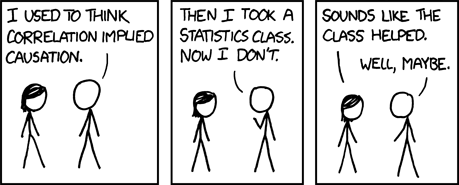
So I have this lecture on “smelling (statistical) bullshit” that I’ve delivered in several places, which I inevitably start with a lesson on how correlation doesn’t imply causation. I give a large number of examples of people mistaking correlation for causation, the class makes fun of everything that doesn’t apply to them, then everyone sees this wonderful XKCD cartoon and then we move on.

One of my favourite examples of correlation-causation (which I don’t normally include in my slides) has to do with religion. Praying before an exam in which one did well doesn’t necessarily imply that the prayer resulted in the good performance in the exam, I explain. So far, there has been no outward outrage at my lectures, but this does visibly make people uncomfortable.

Going off on a tangent, the time in life when I discovered to myself that I’m not religious was when I pondered over the correlation-causation issue some six or seven years back. Until then I’d had this irrational need to draw a relationship between seemingly unrelated things that had happened together once or twice, and that had given me a lot of mental stress. Looking at things from a correlation-causation perspective, however, helped clear up my mind on those things, and also made me believe that most religious activity is pointless. This was a time in life when I got immense mental peace.

Yet, for most of the world, it is not freedom from religion but religion itself that gives them mental peace. People do absurd activities only because they think these activities lead to other good things happening, thanks to a small number of occasions when these things have coincided, either in their own lives or in the lives of their ancestors or gurus.

In one of my lectures a few years back I had remarked that one reason why humans still mistake correlation for causation is religion – for if correlation did not imply causation then most of religious rituals would be rendered meaningless and that would render people’s lives meaningless. Based on what I observed today, however, I think I’ve got this causality wrong.

It’s not because of religion that people mistake correlation for causation. Instead, we’ve evolved to recognise patterns whenever we observe them, and a side effect of that is that we immediately assume causation whenever we see things happening together. Religion is just a special case of application of this correlation-causation second nature to things in real life.

So my daughter (who is two and a half) and I were standing in our balcony this evening, observing that it had rained heavily last night. Heavy rain reminded my daughter of this time when we had visited a particular aunt last week – she clearly remembered watching the heavy rain from this aunt’s window. Perhaps none of our other visits to this aunt’s house really registered in the daughter’s imagination (it’s barely two months since we returned to Bangalore, so admittedly there aren’t that many data points), so this aunt’s house is inextricably linked in her mind to rain.

And this evening because she wanted it to rain heavily again, the daughter suggested that we go visit this aunt once again. “We’ll go to Inna Ajji’s house and then it will start raining”, she kept saying. “Yes, it rained the last time it went there, but it was random. It wasn’t because we went there”, I kept saying. It wasn’t easy to explain it.

You know when you are about to have a kid you develop visions of how you’ll bring her up, and what you’ll teach her, and what she’ll say to “jack” the world. Back then I’d decided that I’d teach my yet-unborn daughter that “correlation does not imply causation” and she could use it use it against “elders” who were telling her absurd stuff.

I hadn’t imagined that mistaking correlation for causation is so fundamental to human nature that it would be a fairly difficult task to actually teach my daughter that correlation does not imply causation! Hopefully in the next one year I can convince her.

Ramayana and Weight Training

There are several interpretations of the Ramayana. As AK Ramanujan compiled, there are more than “three hundred ramayanas“. In some versions, Ravana is Sita’s father. In others, he is her brother. Yet others have been written from Sita’s point of view. And some from Hanumantha’s. And some from Ravanas.

In fact, the Ramayana (contrary to the sanitised Ramanand Sagar version we were fed by Doordarshan) is a fascinating enough epic that there can be millions of interpretations of the story. So let me add mine.

In my opinion, the Ramayana is a shining example of the virtues of Strength Training, especially barbell training. I’ll illustrate this with two key episodes from the epic.

The first is Sita’s swayamvara, where Rama beats off all competition to be able to marry Sita. The test is rather simple. There is a rather heavy bow that the suitors should lift and then string. My interpretation is that most other suitors who had come to the swayamvara were “convenational gymmers” who spent hours every week honing their biceps and triceps and ignoring training their large muscles.

Basically, like most “gym rats” you see at most conventional gyms, these suitors focussed on the lifts that made them look good rather than those that gave them real strength. Rama, on the other hand, practiced simple barbell lifts, and was especially adept at the deadlift. So after all the shower-offs had failed, Rama walked up and deadlifted the bow (the weight was such that no other lift was possible) and strung it. And married Sita.

The other episode comes much later in the epic, when the scene of action has shifted to Sri Lanka. Angada, the monkey prince, has gone to Ravana’s court in the form of an advance party to negotiate Sita’s release before Rama declared war on Lanka. Ravana insulted him, and so Angada refused to budge until he had had an audience. Various members of Ravana’s court tried to physically dislodge him (as Angada had challenged them to do so), but Angada remained firm, with his feet firmly planted in the ground.

Clearly, Angada did squats, and members of Ravana’s army who fooled themselves into strength by solely concentrating on the arms didn’t realise that someone (who squatted) could have such heavy and firm feet. And so they failed to dislodge him.

Now to find episodes from the epic that show the virtues of the press and the bench press.

Liverpool FC: 2014 vs 2019

Last night I watched the first half of the Champions League semifinal between FC Barcelona and Liverpool FC, going off to bed when the score was 1-0 in favour of Barcelona. I woke up this morning to much dismay to see that Liverpool lost 3-0, but I’d constructed this post in my head when Liverpool was trailing 1-0, and so executing now.

It’s about the difference between the title-challenging Liverpool of 2014 and the title-challenging Liverpool of this season. Luis Suarez, in a brilliant interview with Sid Lowe, had mentioned that the current team is much better than the 2014 team, but last night’s Champions League game suggests that the two teams five years apart are simply two very different teams.

Last night Barcelona went ahead with a goal from Suarez in the 25th minute. It wasn’t an easy goal. There was a cross from the left by Jordi Alba, and Suarez got ahead, and managed to get the precise touch required to put it past Alisson into Liverpool’s goal. Liverpool had dominated the game until then, but with that one little half chance Suarez had converted.

Ten minutes later Sadio Mane got a chance to equalise, from a broadly similar chance. It was another ball above the defence from Mo Salah, but Mane hit it to the sky. And that was representative of Liverpool this season – both Mane and Salah have required lots of chances to score.

In that sense, Liverpool’s defence and midfield this season is far superior to the title-challenging side of 2014, when Suarez led the line. Back then few chances were created, but Suarez and an in-form Daniel Sturridge would take most of them, meaning that even with the midfield creating few chances and the defence leaking lots of goals, Liverpool could mount a challenge.

One could only imagine how this season’s team would have performed with someone of Suarez’s finishing ability leading the line. Salah, Mane and Firmino are no doubt a brilliant front three, but their conversion rate is low. If only one of them had a higher conversion rate, we wouldn’t have been struggling in both the League and the Champions League this season.