Matt Levine describes my business idea

When I was leaving the big bank I was working for (I keep forgetting whether this blog is anonymous or not, but considering that I’ve now mentioned it on my LinkedIn profile (and had people congratulate me “on the new job”), I suppose it’s not anonymous any more) in 2011, I didn’t bother looking for a new job.

I was going into business, I declared. The philosophy (that’s a word I’ve learnt to use in this context by talking to Venture Capitalists) was that while Quant in investment banking was already fairly saturated, there was virgin territory in other industries, and I’d use my bank-honed quant skills to improve the level of reasoning in these other industries.

Since then things have more or less gone well. I’ve worked in several sectors, and done a lot of interesting work. While a lot of it has been fairly challenging, very little of it has technically been of a level that would be considered challenging by an investment banking quant. And all this is by design.

I’ve long admired Matt Levine for the way in which he clearly explains fairly complicated finance stuff in his daily newsletter (that you can get delivered to your inbox for free),  and more or less talking about finance in an entertaining model. I’ve sometimes mentioned that I’ve wanted to grow up to be like him, to write like him, to analyse like him and all that.

And I find that in yesterday’s newsletter he clearly encapsulates the idea with which I started off when I quit banking in 2011. He writes:

A good trick is, find an industry where the words “Monte Carlo model” make you sound brilliant and mysterious, then go to town.

This is exactly what I set out to do in 2011, and have continued to do since then. And you’d be amazed to find the number of industries where “Monte Carlo model” makes you sound brilliant and mysterious.

Considering the difficulties I’ve occasionally had in communicating to people what exactly I do, I think I should adopt Levine’s line to describe my work. I clearly can’t go wrong that way.


Letters to my wife

As I turned Thirty Three yesterday, my wife dug up some letters (emails to be precise) I’d written to her over the years and compiled them for me, urging me to create at “Project Thirty Four” (on the lines of my Project Thirty). What is pleasantly surprising is that I’ve actually managed to make a life plan for myself, and execute it (surprising considering I don’t consider myself to be too good a planner in general).

In February 2011, after having returned from a rather strenuous work trip to New York, this is what I had to say (emphasis added later, typos as in original):

For me steady state is when I’ll be doing lots of part-time jobs, consulting gigs, where I’m mostly owrking from home, getting out only to meet people, getting to meet a lot of people (somethign taht doesn’t happen in this job), having fun in the evenings and all that

I wrote this six months before I exited my last job, and it is interesting that it almost perfectly reflects my life nowadays (except for the “have fun in the evenings” bit, but that can be put down to being long distance).

I’ve just started a part time job. I have a couple of consulting gigs going. I write for a newspaper (and get paid for it). I mostly work from home. I’ve had one “general catch up” a day on an average (this data is from this Quantified Life sheet my wife set up for me).

A week later I had already started planning what I wanted to do next. Some excerpts from a letter I wrote in March 2011:

Ok so I plan to start a business. I don’t know when I’ll start, but I’m targeting sometime mid 2012.

I want to offer data consultancy services.

Basically companies will have shitloads of data that they can’t make sense of. They need someone who is well-versed in working with and looking at data, who can help them make sense of all that they’ve got. And I’m going to be that person.

Too many people think of data analysis as a science and just through at data all the analytical and statistical weapons that they’ve got. I believe that is the wrong approach and leads to spurious results that can be harmful for the client’s business.

However, I think it is an art. Making sense of data is like taming a pet dog. There is a way you communicate with it. There is a way you make it do tricks (give you the required information). And one needs to proceed slowly and cautiously in order to get the desired results.

I think of myself as a “semi-quant”. While I am well-versed in all the quantitative techniques in data analysis and financial modeling, I’m also deeply aware that using quantitative tools indiscriminately can lead to mismanagement of risks, which can be harmful to the client. I believe in limited and “sustainable” use of quantitative tools, so that it can lead without misleading.


My past experience with working with data is that data analysis can be disruptive. I don’t promise results that will be of particular liking for the client – but I promise that what I diagnose is good for the client’s business. When you dig through mountains of data, you are bound to get some bitter pills. I expect my clients to handle the bad news professionally and not shoot the messenger.

I don’t promise to find a “signal” in every data set that I’m given. There are chances that what I’m working with is pure noise, and in case I find that, I’ll make efforts to prove that to the client (I think that is also valuable information).

And these paragraphs, written a full year before I started out doing what I’m doing now, pretty much encapsulate what I’m doing now. Very little has changed over nearly five years! I feel rather proud of myself!

And a thousand thanks to my wife for picking out these emails I had sent her and showing me that I can work to a plan.

Now on to making Project Thirty Four, which I hope to publish by the end of today, and hope to execute by the end of next year.

The Chamrajpet model of leadership

When you are doing a group assignment (assuming you’re in college) and you get assigned your share of the work, the assumption is that the allocation of work across team members has been fair. Good group leaders try to ensure this, and also to split work according to the relative interests and strengths of different team members.

Except that there are times when team members get the sneaking suspicion that the group leader is pulling a fast one on them, by following the “Chamrajpet model” of leadership. To understand what the Chamrajpet model is, watch this video, from the beginning of the Kannada movie Gowri Ganesha (the video below has the full movie. Watch it if you can. It’s fantastic).

For those who couldn’t understand, Lambodar (played by Anant Nag) needs to get to Chamrajpet but doesn’t have the money. He befriends two guys (who also want to get to Chamrajpet) and convinces them to share an auto rickshaw with him. He convinces each of them that the “other” guy is his (Lambodar’s) friend, and that they should split the fare equally. This way, he collects the full fare (and a bit more ) from them put together.

It is a fairly common occurrence in group assignments for one of your teammates to tell you “you do part 1. This guy and I will do part 2”. There are times when this is a fair allocation (when part 2 requires twice the effort as part 1). If the teammate is a Lambodar, however, he might have pulled a similar allocation with the third teammate (telling him “you do part 1. I’ll do part 1 with this guy”).

In a way, these are the perks that sometimes come with leadership.

The only way you can deal with it is to follow the advice at the end of the movie – “Beware of Lambodars”.

Using all available information

In “real-life” problems, it is not necessary to use all the given data. 

My mind goes back eleven years, to the first exam in the Quantitative Methods course at IIMB. The exam contained a monster probability problem. It was so monstrous that only some two or three out of my batch of 180 could solve it. And it was monstrous because it required you to use every given piece of information (most people missed out the “X and Y are independent” statement, since this bit of information was in words, while everything else was in numbers).

In school, you get used to solving problems where you are required to use all the given information and only the given information to solve the given problem. Taken out of the school setting, however, this is not true any more. Sometimes in “real life”, you have problems where next to no data is available, for which you need to make assumptions (hopefully intelligent) and solve the problem.

And there are times  in “real life” when you are flooded with so much data that a large part of the problem solving process is in the identification of what data is actually relevant and what you can ignore. And it can often happen that different pieces of given information contradict each other and deciding upon what to use and what to ignore is critical to efficient solution, and the decision is an art form.

Yet, in the past I’ve observed that people are not happy when you don’t use all the information at your disposal. The general feeling is that ignoring information leads to a suboptimal model – one which could be bettered by including the additional information. There are several reasons, though, that one might choose to leave out information while solving a real-life problem:

  • Some pieces of available information are mutually contradictory, so taking them both into account will lead to no solution.
  • A piece of data may not add any value after taking into account the other data at hand
  • The incremental impact of a particular piece of information is so marginal that you don’t lose much by ignoring it
  • Making use of all available information can lead to increased complexity in the model, and the incremental impact of the information may not warrant this complexity
  • It might be possible to use established models if you were to use part of the information. So we lose precision for a known model. Not always recommended but done.

The important takeaway, though, is that knowing what information to use is an art, and this forms a massive difference between textbook problems and real-life problems.

Genetic Algorithms

I first learnt about Genetic Algorithms almost exactly thirteen years ago, when it was taught to me by Prof. Deepak Khemani as part of a course on “artificial intelligence”. I remember liking the course a fair bit, and took a liking to the heuristics and “approximate solutions” after the mathematically intensive algorithms course of the previous semester.

The problem with the course, however, was that it didn’t require us to code the algorithms we had learnt (for which we were extremely thankful back then, since in term 5 of Computer Science at IIT Madras, this was pretty much the only course that didn’t involve too many programming assignments).

As a result, while I had learnt all these heuristics (hill climbing, simulated annealing, taboo search, genetic algorithms, etc.) fairly well in theory, I had been at a complete loss as to how to implement any of them. And so far, during the course of my work, I had never had an opportunity to use any of these techniques. Until today that is.

I can’t describe the problem here since this is a client assignment, but when I had to pick a subset from a large set that satisfied certain properties, I knew I needed a method that would reach the best subset quickly. A “fitness function” quickly came to mind and it was obvious that I should use genetic algorithms to solve the problem.

The key with using genetic algorithms is that you need to be able to code the solution in the form of a string, and then define functions such as “crossover” and “mutation”. Given that I was looking for a subset, coding it as a string was rather easy, and since I had unordered subsets, the crossover was also easy – basic random number generation. Within fifteen minutes of deciding I should use GA, the entire algorithm was in my head. It was only a question of implementing it.

As I started writing the code, I started getting fantasies of being able to finish it in an hour and then write a blog post about it. As it happened, it took much longer. The first cut took some three hours (including some breaks), and it wasn’t particularly good, and was slow to converge.  I tweaked things around a bit but things didn’t improve by much.

And that was when I realise that I had done the crossover wrong – when two strings have elements in common and need to be crossed over, I had to take care that elements in common did not repeat into the same “child” (needed the subsets to be of a certain length). So that needed some twist in the code. That done, the code still seemed inefficient.

I had been doing the crossover wrong. If I started off with 10 strings, I would form 5 pairs from them (each participating in exactly one pair) which would result in 10 new strings. And then I would put these 20 (original 10 and new 10) strings through a fitness test and discard the weakest 10. And iterate. The problem was that the strongest strings had as much of a chance of reproducing as the weakest. This was clearly not right.

So I tweaked the code so that the fitter strings had a higher chance of reproducing than the less fit. This required me to put the fitness test at the beginning of each iteration rather than the end. I had to refactor the code a little bit to make sure I didn’t repeat computations. Now I was drawing pairs of strings from the original “basket” and randomly crossing them over. And putting them through the fitness test. And so forth.

I’m extremely happy with the results of the algorithm. I’ve got just the kind of output that I had expected. More importantly, I was extremely happy with the process of coding the whole thing in. I did the entire coding in R, which is what I use for my data analysis (data size meant I didn’t need anything quicker).

The more interesting part is that this only solved a very small part of the problem I’m trying to solve for my client. Tomorrow I’m back to solving a different part of the problem. Genetic algorithms have served their purpose. Back when I started this assignment I had no clue I would be using genetic algorithms. In fact, I had no clue what techniques I might use.

Which is why I get annoyed when people ask me what kind of techniques I use in my problem solving. Given the kind of problems I take on, most will involve a large variety of math, CS and statistics techniques, each of which will only play a small role in the entire solution. This is also the reason I get annoyed when people put methods they are going to use to solve the problem on their pitch-decks. To me, that gives an impression that they are solving a toy version of the problem and not the real problem – or that the consultants are grossly oversimplifying the problem to be solved.

PS: Much as some people might describe it that way, I wouldn’t describe Genetic Algorithms as “machine learning”. I think there’s way too much intervention on the part of the programmer for it to be described thus.

Axes of diversity

Companies and educational institutions, especially those that have a global footprint and a reputation to protect, make a big deal about diversity policies. It is almost impossible to sit through a recruitment or admissions talk by one such entity without a mention to their diversity policies, which they are proud of.

And they have good reasons to have a diverse workforce. It has been shown, for example, that diversity leads to better decision-making and overall better performance. Having a diverse workforce brings together people with different backgrounds, and since backgrounds influence opinion, a more diverse team is more likely to have more diversity of opinion which results in better decision making. And so forth.

The problem, however, is that it is not easy to simultaneously achieve diversity on all possible axes. Let’s say that we have defined a number of axes, and are looking to recruit an incoming MBA class. If we want diversity on each of these axes, selection of each candidate is going to rule out a large number of other candidates and we will need a really large pool to choose from. In other words, it is akin to the eight queens problem (where you have to place eight queens on a chessboard such that no two of them are on the same row, column or diagonal). For those of you not familiar with chess, think of it like a Sudoku puzzle.

Since the pool of candidates large enough to achieve diversity on all axes is simply not feasible, firms and schools choose to prioritise certain axes over others, and seek to achieve diversity in these chosen axes. And since they can arbitrarily choose axes that they can prioritise, the incentive is to pick out those axes where diversity is most visible.

And so when you go to a global organisation or school that preaches diversity, you will notice that they indeed have a very diverse workforce/student body in terms of gender, race, and nationality, which are fairly visible dimensions. Beyond this, the choice of dimensions to impose diversity on is a matter of discretion. So you have organisations which seek diversity in sexual orientation. Others seek diversity in age profile. Yet others in educational backgrounds. And so forth.

The result of prioritising more “visible” dimensions to ensure diversity is that organisations end up becoming horribly similar in the “sacrificed dimensions”. Check out this excerpt from Peter Thiel’s Zero to One, for example, on the founding members of paypal:

The early PayPal team worked well together because we were all the same kind of nerd. We all loved science fiction: Cryptonomicon was required reading, and we preferred the capitalist Star Wars to the communist Star Trek

Now, remember that this was a fairly diverse team when it came to ethnicity, nationality and sexuality. But in a less visible dimension, the team was not diverse at all. And Thiel mentions it in his book as if it’s a good thing that they all thought so similarly.

On a similar note, I once worked for an organisation that made great shakes of its diversity policy, and the organisation was pretty diverse in terms pretty much every visible axis of diversity. And the seminars (some compulsory) they organised helped me significantly broaden my outlook on issues such as race or sexual orientation. But when it came to work, the (fairly large) team was horribly similar. Quoting from an earlier blogpost (a bit ranty, I admit):

First, a large number of guys building models come from similar backgrounds, so they think similarly. Because so many people think similarly, the rest train themselves to think similarly (or else get nudged out, by whatever means). So you have massive organizations full of massively talented brilliant minds which all think similarly! Who is to ask the uncomfortable questions?

So essentially because you had a large organisation of people from basically similar educational backgrounds (masters and PhDs in similar subjects), their way of thinking became dominant, and others were forced to conform, leading to groupthink, which might have potentially led to mishaps (but didn’t, at least not in my time).

And what of the Ivy League schools that again pride themselves on (visible forms of) diversity? Here is an excerpt from William Deresiewicz’s excellent 2008 essay:

Elite schools pride themselves on their diversity, but that diversity is almost entirely a matter of ethnicity and race. With respect to class, these schools are largely—indeed increasingly—homogeneous. Visit any elite campus in our great nation and you can thrill to the heartwarming spectacle of the children of white businesspeople and professionals studying and playing alongside the children of black, Asian, and Latino businesspeople and professionals. At the same time, because these schools tend to cultivate liberal attitudes, they leave their students in the paradoxical position of wanting to advocate on behalf of the working class while being unable to hold a simple conversation with anyone in it.

So the next time you want to make your organisation diverse, think of which axes you want diversity on. If you are public-minded and want to brag about your diversity, the obvious way to go would be to be diverse on visible axes, but that leaves other issues. On the other hand you could put together a team of people that look the same but think different!

It’s entirely up to you!


Brainstorming

I was never a big fan of “brainstorming”. I’m referring to those meetings where everyone gets together and thinks aloud, in order to converge to a solution. In the past, when I’ve been involved in such exercises, they’ve mostly come to nothing, and mostly ended with a list of to-dos which got never done (this was mostly in a corporate context). As a consequence, I started hating large meetings also (either most people wouldn’t add value or it would end up like a group discussion with everyone shouting), and have been trying to avoid them.

This time, though, it was different. The context was not corporate. The agenda did not involve an item of day to day work. None of us had a firm stand on the topic at the beginning of the meeting, with each of us having our own apprehensions of either stand (when people come with preconceived ideas and biases, there usually is nothing to storm our brains about).

And so we got together. And we talked. There were times when no one spoke. There were times when it actually turned out to be like a group discussion (I actually said, “ok I have ten points which I haven’t been able to make in the last one hour. I’ve written them down and let me shoot now”). But the situation never got out of hand. Mutual respect meant that cross-talk quickly died out, and we listened to each other. And it was extremely civil.

And then things started crystallising. Soon, some of us had an opinion. Later, others did. Some were ultimately not convinced, but had an opinion anyway. In a period of about twenty minutes somewhere in the third hour of the session, we all seemed to have an “aha moment” (apologies for that consultantspeak). But such moments occurred at different times for each of us.

And then we did the usual thing of “going round the table” for each of us to express our opinions. And then we did. And as each of us expressed our opinions, we discussed it further. Things crystallised better. And we ended the meeting asking everyone who was there to blog about it.

This is what I wrote:

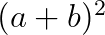
given that these two internets are independent, the total value is a^2 + b^2. Now, if we were to tear down the walls, and combine the two internets into one, what will be the total value? Now that we have one network of (a+b) users, the value of the network is (a+b)^2 or a^2 + 2 ab + b^2 . So what is the additional benefit that we can get by imposing net neutrality, which means that we will have one internet? 2 ab, of course!

This is what Nitin wrote:

If the government opens up the telecom service market to greater competition, perhaps by issuing unlimited licenses, then there is a case to allow them the freedom to discriminate among customers. As the state-owned carrier, BSNL can provide a neutral internet. However, if the government does not open the sector to further competition, therefore shielding the telecom service providers from more competition, then mandating net neutrality provides a reasonable approach to promoting the public interest.

Varun wrote this:

the regulator’s two major tasks are to enhance social welfare by protecting the consumer interest and to create an environment that is conducive for business — that will further enhance social welfare. A neutral internet will definitely benefit the consumers interest; but since the regulatory framework is not conducive for business, it appears that net-neutrality is in conflict with business interests. The situation can change if the regulatory framework is eased and the markets are opened up.

And Pranay wrote this:

net neutrality as a principle must be upheld. This is because communication network providers should not have the unfair advantage of being able to price internet content differently. Once the communication networks are setup, costs do not change with consumers accessing different content. In any case, the communication service providers are free to have fair internet usage policies to prevent induced demand effects

Gautam went down approximately the same path as me, and wrote this:

This is exactly why I oppose Zero Rating as well, whether paid or unpaid – it tends towards creating pockets of disconnected users per telecom company and while this is valuable for the telecom company and the applications and sites that are zero-rated, it reduces the total utility of the public internet, as a whole.

Devika deviated a bit from the crowd. This is what she said:

That said, it does not mean that ISPs should be restricted from entering into contracts with content providers. If Flipkart wants to undertake a joint marketing initiative with Bharti Airtel, it should be allowed to so. For example, Flipkart can give benefits to Airtel from sharing their customer base. To be extremely clear, such collaborations should not hinder access to any other internet sites. This will maintain a level playing field for all content providers.

Anupam, too, differed, and argued that customers need to be given choice:

If a person runs his business solely based on international VoIP calls and doesn’t mind paying extra for ensuring reliability and speed, he should be able to access that privilege. Or, for that matter, a Facebook or Twitter addict who wants these apps to be quick such that they can post real time selfies, should be able to choose these apps over say, apps which give real time updates on political happening in Nicaragua. Thus, people can be given a choice as to which data packets have to be prioritized within their limited bandwidth

And Pavan argued that competition is alone not sufficient:

However, if  the internet is a public good – will competition ever be sufficient to ensure the vibrancy of the network? Will competition be sufficient to improve the effective network size? I would argue that it might fall short of the mark. Thus, regulations that enforce net neutrality may be necessary to prevent ‘walled gardens’ from springing up.

As you can see, our opinions at the end of the meetings all differ. But you can also see that the posts are all well-argued, implying that at the end of the meeting we all had a reasonable degree of clarity. And that is what made it a brilliant brainstorming session.

Now if only all other brainstorming sessions were to be as good! Oh, and it’s a long post already but here are some #learnings on what makes for a successful brainstorming session:

  • Open minds on behalf of participants
  • Mutual respect, and giving everyone a chance to speak
  • No overbearing participants or moderators, leading to a freewheeling debate

As you can see, all these are similar to what makes a multiplayer gencu successful! But brainstorming has a specific agenda, so it’s not a gencu!

The Ramayana and the Mahabharata principles

An army of monkeys can’t win you a complex war like the Mahabharata. For that you need a clever charioteer.

A business development meeting didn’t go well. The potential client indicated his preference for a different kind of organisation to solve his problem. I was about to say “why would you go for an army of monkeys to solve this problem when you can.. ” but I couldn’t think of a clever end to the sentence. So I ended up not saying it.

Later on I was thinking of the line and good ways to end it. The mind went back to Hindu mythology. The Ramayana war was won with an army of monkeys, of course. The Mahabharata war was won with the support of a clever and skilled consultant (Krishna didn’t actually fight the war, did he?). “Why would you go for an army of monkeys to solve this problem when you can hire a studmax charioteer”, I phrased. Still doesn’t have that ring. But it’s a useful concept anyway.

Extending the analogy, the Ramayana was was different from the Mahabharata war. In the former, the enemy was a ten-headed demon who had abducted the hero’s wife. Despite what alternate retellings say, it was all mostly black and white. A simple war made complex with the special prowess of the enemy (ten heads, special weaponry, etc.). The army of monkeys proved decisive, and the war was won.

The Mahabharata war was, on the other hand, much more complex. Even mainstream retellings talk about the “shades of grey” in the war, and both sides had their share of pluses and minuses. The enemy here was a bunch of cousins, who had snatched away the protagonists’ kingdom. Special weaponry existed on both sides. Sheer brute force, however, wouldn’t do. The Mahabharata war couldn’t be won with an army of monkeys. Its complexity meant it needed was skilled strategic guidance, and a bit of cunning, which is what Krishna provided when he was hired by Arjuna ostensibly as a charioteer. Krishna’s entire army (highly trained and skilled, but footsoldiers mostly) fought on opposite side, but couldn’t influence the outcome.

So when the problem at hand is simple, and the only complexity is in size or volume or complexity of the enemy, you will do well to hire an army of monkeys. They’ll work best for you there. But when faced with a complex situation and complexity that goes well beyond the enemy’s prowess, you need a charioteer. So make the choice based on the kind of problem you are facing.


Weak ties and job hunting

As the more perceptive of you would have figured out by now, the wife is in her first year of business school, and looking for an internship. I’m at a life stage where I have friends in most companies she is interested in who are in roles that are at a level where it is possible for them to make a decision to hire her.

Yet, so far I’ve made few recommendations. I’ve made the odd connection but that’s been mostly of the “she is applying to your company and wants to get to know the company better. Can you speak to her about it?” variety. I don’t think there’s a single person to whom I’ve written saying that the wife is in the market for an internship and they should consider hiring her.

I initially thought it was some inherent meanness in me, or lack of desire to help, that prevented me from recommending my wife to potential hirers who I know well. But then a little bit of literature survey pointed out an economic rationale to my behaviour – it is the phenomenon of “weak ties”. Now I was aware of this weak ties research earlier – but I had assumed that it had only referred to the phenomenon where acquaintances are more likely to help than friends because the former’s networks are much more disjoint from yours than the latter’s.

Anyway, in a vain attempt at defence, I hit “weak ties and job hunting” into google, and that led me to this wonderful post on the social capital blog that contained exactly what I was looking for. Here is the money quote:

It turns out, that people generally don’t refer their close friends to jobs for two reasons: 1) they are more worried that it will reflect badly on them if it doesn’t work out; and 2) they are more likely to know of the warts and foibles of their close friends and believe these could interfere with being a good worker (e.g., Jim stays up late to watch sports, or Charles has too much of an attitude, or Jane is too involved with her sick father).  Weak friends one can more easily project good attributes onto and believe this will work out.

So if I were to request you to hire my wife and it doesn’t work out, it can affect the relationship between you and me, so I wouldn’t risk that. When I’m recommending someone very close to me, I’m putting my own reputation on the line and I don’t like that. I’m happy referring cousins or other slightly distant acquaintances because there I have no skin in the game and hopefully some good karma can get created.

Now, while I’m loathe to recommend my wife to people I know well,  I wouldn’t be so hesitant recommending her to people I don’t know that well! For while my tie with my wife is strong, my tie with these people is weak enough that it not working out won’t affect me, and there is little reputational risk also. The problem is when the ties on both sides are strong!


Startup salary survey

I think I’ve come up with what I think is a really cool metric to value the tradeoff between your salary at a startup and the equity stake that you are given. For lack of a better name, I call this “multiple of foregone income”:

Let’s say that your “market salary” is $ 100,000 (pulling this number out of thin air), and since you are joining an early stage company which 1. cannot afford your market salary and 2. wants you to have some skin in the game, let’s say that you agree for $80,000. Now, your “foregone income” is $80,000 per year since that is the cut you are taking from what you think is your “market income”.

Let’s say the company is worth 10 million dollars (as per the latest round of funding before you join, assuming there has been one) and they give you a 1% stake (which amounts to $100,000), then the “multiple of foregone income” is 5 years ($100,000/$20,000 per year). If the company gives you equity that is worth $200,000, then your “multiple of foregone income” is 10 years.

Now I’m trying to figure out what the “normal” range of this multiple is. For this purpose I’ve created this form that I request you to fill out. I’m not asking for any personal details, the survey is completely anonymous and it will only take a minute of your time.

Thanks in advance! In return for your participation in the survey, I’ll publish aggregated results on the measure!