Parents, IITJEE and arranged marriage 

For a few years after I did well in IITJEE and joined IIT madras there was a steady stream of acquaintances and acquaintances of acquantances who came home to get “gyaan” about the exam. Initially I was fun to spout gyaan but later I got bored. 

By then, though, my father and I had come up with a formula to assess the chances of the person who came home in cracking the exam. Usually they’d come in pairs, a candidate along with a parent. If the candidate spoke more than the parent, my father and I would think there was some chance that the candidate would be successful. In case the parent spoke more, though, it was a clear case of the candidate having next to no chance and going through the motions because of parental pressures. 

As I watch the wife broker marriages as part of her marriage broker auntie venture, I see something similar there as well. Some candidates represent themselves and talk to her directly. Others are mostly inaccessible and use their parents as brokers in the market. 

What the marriage broker auntie has found is that the candidates who represent themselves show far more promise in being matched in the market than those that are represented by their parents. And having being stung by candidates’ inflexibility in cases where parents represent them, the marriage broker auntie has stopped working with parents. 

Sometimes, this happens. 

“We’re looking for a boy for my sister. Anyone you know?”

“Ask your sister to call me”

“Oh but why? what will you gain by talking to her?”

A few minutes later the candidates mother calls. “Oh we’re looking for a boy for my daughter ” 

“Ask her to call me. I don’t work with parents” 

“Oh but why?” 

And that one gets marked as a case with little chances. 

do you remember this blog post I’d written a long long time back, soon after I’d met the person who is now my wife, about how being in a relationship is like going to IIT

Truly Madly: Review

So the wife and I both decided to sign up on the dating app TrulyMadly, she to conduct research for her matchmaking service, and me as part of my research for the book that I’m currently revising. Based on our collective usage of our respective apps for about an hour, here are some pertinent observations.

  • Sexism: The wife can see salaries of men she is getting matched with, while I don’t get to see salaries of women being recommended to me. Moreover, women are allowed to “lurk” (and not have a public profile) on the platform, but no such thing for men. I’m surprised no one has called out TrulyMadly on their sexism
  • Job board: To list on the app you need to indicate your profession and job, and how much you are making. So if you are a woman on this site, apart from getting to check out men, you get to check out what jobs pay how much, and it’s not inconceivable that you use the app to find yourself a job.
  • Judgments: This should possibly go down under sexism again. Anyway, the wife has mentioned her qualifications as “MBA”, and she is only being shown men who are graduates of top B-schools in India. No such thing for me – women shown to me had all kinds of qualifications. It’s like TrulyMadly has decided that women should only date men who are at least as well qualified as them. Moreover, the app also decides that men can only date women who are shorter than them, though there’s a setting somewhere to change this.
  • Age bar: Based on my age (which I entered as 34), the app decided that I should only be allowed to check out women between the ages of 26 and 34. These can be moved around, in case I have fetishes outside this age range, but I’m shocked that they are not aware of the N/2+7 rule – based on which the lower limit should’ve been set at 24 (34/2+7) and not 26.
  • Gender imbalance: The app gave up on me after I rejected some half a dozen women, after which I deactivated my account and deleted the app. The wife’s app, however, continues to go strong, as she might have rejected some two or three dozen men by now (apart from having done research on what jobs pay how much). Just goes to show the gender imbalance on the app. I can imagine this leading to a lot of frustrated people, of both genders.

Ok that’s it for now. Any more insights you can read in my book (I hope to get it out in the next month or two)!

Moral of the story: Product management pays better than category leader.

Using my cook as an ATM

This happened ten days before high value notes were withdrawn, and suggests nothing about my cook’s political opinions or views. 

On 30th October 2016, I paid my cook his salary for October. As it was the usual practice, I paid him in cash. He asked me if I could do an online transfer instead.

It was the first day of Diwali, and he needed to send money to his wife in Bihar. And it being Diwali, all banks were closed, and there was no way he could send money to her. So he asked me if I could do that. And if I were anyway transferring money to his wife’s account, could I send her a bit more, he asked – he would compensate me for the extra amount in cash.

And so like that I used my cook as an ATM. He gave me his wife’s account details (it was such an obscure branch that I’d to google it to find the IFSC code – wasn’t in citibank’s lookup list). I added her as a “payee” and immediately IMPSd the amount to her. And my cook gave me the extra funds I’d transferred in cash.

Later on, I told him to install his bank’s app on his newly acquired fancy phone (with a Reliance Jio sim). I’m not sure he’s done that but considering how resourceful he is, it wouldn’t be long before he does that. And more of the Bihari cooks network in Bangalore do likewise.

Nandan Nilekani, in his championing of the UPI, likes to talk about how “anybody can be an ATM” with the new technology. This was an exemplary example of that.

The only fly in the ointment was that I didn’t need cash that day – after all I’d been to the ATM earlier that morning just so that I could get cash to pay my cook – so I ended up with a lot of cash that I didn’t need. Thankfully I was able to spend it productively before the ceased to be legal tender.

Following the withdrawal of high currency notes, I told my cook I would pay his subsequent salaries by bank transfer. He gladly agreed.

Damming the Nile and diapers

One of the greatest engineering problems in the last century was to determine the patterns in the flow of the Nile. It had been clear for at least a couple of millennia that the flow of the river was not regular, and the annual flow did not follow something like a normal distribution.

The matter gained importance in the late 1800s when the British colonial government decided to dam the Nile. Understanding accurately the pattern of flows of the river was important to determine the capacity of the reservoir being built, so that both floods and droughts could be contained.

The problem was solved by Harold Edwin Hurst, a British hydrologist who was posted in Egypt for over 60 years in the 20th Century. Hurst defined his model as one of “long-range dependence”, and managed to accurately predict the variation in the flow of the river. In recognition of his services, Egyptians gave him the moniker “Abu Nil” (father of the Nile). Later on, Benoit Mandelbrot named a quantity that determines the long-range dependence of a time series after Hurst.

I’ve written about Hurst once before, in the context of financial markets, but I invoke him here with respect to a problem closer to me – the pattern of my daughter’s poop.

It is rather well known that poop, even among babies, is not a continuous process. If someone were to poop 100ml of poop a day (easier to use volume rather than weight in the context of babies), it doesn’t mean they poop 4ml every hour. Poop happens in discrete bursts, and the number of such bursts per day depends upon age, decreasing over time into adulthood.

One might think that a reasonable way to model poop is to assume that the amount of poop in each burst follows a normal distribution, and each burst is independent of the ones around it. However, based on a little over two months’ experience of changing my daughter’s diapers, I declare this kind of a model to be wholly inaccurate.

For, what I’ve determined is that far from being normal, pooping patterns follow long-range dependence. There are long time periods (spanning a few diaper changes) when there is no, or very little, poop. Then there are times when it flows at such a high rate that we need to change diapers at a far higher frequency than normal. And such periods are usually followed by other high-poop periods. And so on.

In other words, the amount of poop has positive serial correlation. And to use the index that Mandelbrot lovingly constructed and named in honour of Hurst, the Hurst exponent of my daughter’s (and other babies’) poop is much higher than 0.5.

This makes me wonder if diaper manufacturers have taken this long-range dependence into account while determining diaper capacity. Or I wonder if, instead, they simply assume that parents will take care of this by adjusting the inter-diaper-change time period.

As Mandelbrot describes towards the end of his excellent Misbehaviour of markets , you can  use so-called “multifractal models” which combine normal price increments with irregular time increments to get an accurate (fractal) representation of the movement of stock prices.

PS: Apologies to those who got disgusted by the post. Until a massive burst a few minutes ago I’d never imagined I’d be comparing the flows of poop and the Nile!

Extremes and equilibria

Not long ago, I was chiding an elderly aunt who lives alone about the lack of protein in her diet (she was mostly subsisting on rice and thin rasam). She hit back citing some research she’d seen on TV which showed that too much protein can result in uric acid related complications, so it’s ok she isn’t eating much protein.

Over the last couple of years, efforts to encourage non-cash payments in India have been redoubled. The Unified Payments Interface (UPI) has come in, payments banks are being set up, and financial inclusion is being pursued. And you already have people writing about the privacy and other perils of a completely cashless economy.

Then you have index funds. This is a category of funds that is 40 years old now, but has gained so much currency (pun intended) in the recent past that the traditional asset management industry is shitting bricks. And so you have articles that compare indexing to being “worse than Marxism” and dystopian fiction about a future where there is only one active investor left.

All these are cases of people reacting to suggestions with the perils of the suggestion taken to the extreme. My aunt needs more protein in her diet, but I’m not telling her to eat steak for every meal (which she anyway won’t since she’s a strict vegetarian). The current level of usage of cash is too high, and there might be more efficiencies by moving more transactions to electronic media. That doesn’t imply that cash in itself needs to be banned.

And as I mentioned in another blogpost recently, we probably need more indexing, but assuming that everyone will index is a stupid idea. As I wrote then,

In that sense, there is an optimal “mixed strategy” that the universe of investors can play between indexing and active management (depending upon each person’s beliefs and risk preferences). As more and more investors move to indexing, the returns from active management improve, and this “negative feedback” keeps the market in equilibrium!

In other words, what more people moving to indexing means is that the current mixed strategy is not optimal, and we need more indexing. To construct scary scenarios of where everyone is indexing in response is silly.

Effectively, what we need is thinking at the margin – analysing situations in terms of what will happen if there is a small change in the prevailing situation. Constructing scare scenarios around what will happen if this small change is taken to the extreme is as silly as trying to find the position of a curve by indefinitely extending its tangent from the current point!

Bayesian recognition in baby similarity

When people come to see small babies, it’s almost like they’re obliged to offer their opinions on who the child looks like. Most of the time it’s an immediate ancestor – either a parent or grandparent. Sometimes it could be a cousin or aunt or uncle as well. Thankfully it’s uncommon to compare babies’ looks to those who they don’t share genes with.

So as people have come up and offered their opinions on who our daughter looks like (I’m top seed, I must mention), I’ve been trying to analyse how they come up with their predictions. And as I observe the connections between people making the observations, and who they mention, I realise that this too follows some kind of Bayesian Recognition.

Basically different people who come to see the baby have different amounts of information on how each of the baby’s ancestors looked like. A recent friend of mine, for example, will only know how my wife and I look. An older friend might have some idea of how my parents looked. A relative might have a better judgment of how one of my parents looked than how I looked.

So based on their experiences in recognising different people in and around the baby’s immediate ancestry, they effectively start with a prior distribution of who the baby looks like. And then when they see the baby, they update their priors, and then mention the person with the highest posterior probability of matching the baby’s face and features.

Given that posterior probability is a function of prior probability, there is no surprise that different people will disagree on who the baby looks like. After all, each of their private knowledge of the baby’s ancestry’s idiosyncratic faces, and thus their priors, will be different!

Unrelated, but staying on Bayesian reasoning, I recently read this fairly stud piece in Aeon on why stereotyping is not necessarily a bad thing. The article argues that in the absence of further information, stereotypes help us form a good first prior, and that stereotypes only become a problem if we fail to update our priors with any additional information we get.

The one bit machine

My daughter is two weeks old today and she continues to be a “one bit machine”. The extent of her outward communication is restricted to a maximum of one bit of information. There are basically two states her outward communication can fall under – “cry” and “not cry”, and given that the two are not equally probable, the amount of information she gives out is strictly less than one bit.

I had planned to write this post two weeks back, the day she was born, and wanted to speculate how long it would take for her to expand her repertoire of communication and provide us with more information on what she wants. Two weeks in, I hereby report that the complexity of communication hasn’t improved.

Soon (I don’t know how soon) I expect her to start providing us more information – maybe there will be one kind of cry when she’s hungry, and another when she wants her diaper changed. Maybe she’ll start displaying other methods of outward communication – using her facial muscles, for example (right now, while she contorts her face in a zillion ways, there is absolutely no information conveyed), and we can figure out with greater certainty what she wants to convey.

I’m thinking about drawing a graph with age of the person on the X axis, and the complexity of outward information on the Y axis. It starts off with X = 0 and Y = 1 (I haven’t bothered measuring the frequency of cry/no-cry responses so let’s assume it’s equiprobable and she conveys one bit). It goes on to X = 14 days and Y = 1 (today’s state). And then increases with time (I’m hoping).

While I’m sure research exists some place on the information content per syllable in adult communication, I hope to draw this graph sometime based on personal observation of my specimen (though that would limit it to one data point).

Right now, though, I speculate what kind of shape this graph might take. Considering it has so far failed to take off at all, I hope that it’ll be either an exponential (short-term good but long-term I don’t know ) or a sigmoid (more likely I’d think).

Let’s wait and see.

Andhra Meals in Religious Rituals

A long time back I’d compared massage parlours in Bangkok to Andhra meals, where there is a “basic menu” (the core massage itself) which everyone orders, on top of which other add-ons (such as happy endings) can get tagged on.

Today, while performing a religious ritual (it’s 10 days since my daughter was born, so there was some ceremony I’d to perform), I realised that every religious ritual, happy or sad, also follows the “Andhra meals” principle.

So the “meals” part is the stuff they teach you to do as part of your daily “sandhyavandane” ritual immediately after your thread ceremony. Starting with the aachamana (keshavaaya swaaha, narayanaaya swaaha etc), going on to reciting the Gayatri mantra, repeating the aachamana several times in the middle, and then ending by apologising and atoning for all the mistakes in the course of the ritual (achutaayanamaha, anantaayanamaha, govindayanamaha, achutanantagovindebho namaha).

This is the basic sandhyaavandane you’re supposed to perform three times every day, and the interesting thing is that most other rituals are add-ons to this. Be it a wedding ceremony, worship of a particular god on a particular festival or even a death ceremony, all these parts remain and don’t go away. What changes from ritual to ritual are the add-ons, like the meats you might order during Andhra meals.

And so in the wedding ceremony, there is the wedding itself. In a death ceremony, there’s all the part where you wear the sacred thread the wrong way round (praacheenaavEti) and build rice-til balls (piNDa – have you noticed how similar they are to sushi?). While worshipping a particular god, you perform the worship in the middle of the regular sandhyaavandane ritual. And so forth.

I must say I’m fairly impressed with our ancestors who devised this “modular form” of performing rituals. What rocks about this practice is that pretty much everyone who wants to perform these rituals will know these rituals (the “basic Andhra meals”) bit, which makes it that much easier to “consume” the “extra fittings” appropriate to the occasion.

Acknowledgements

As I continue my progress towards publishing the book whose manuscript I’ve completed, I’ve started to think about the acknowledgements section, which I’m yet to write. Each time I read a new book now, I make sure I read the acknowledgements, and see who all people have thanked. I’ve not gone to the extent of formally collecting data from these acknowledgements, but I must say the effort is underway.

Based on a recent discovery, though, I think all this research is moot. Recently I was cleaning up an old cupboard (the kind that comes embedded in a cot) in my grandfather’s house, and happened to stumble upon my B.Tech. project. I’d brought it home and kept it aside, and happened to open it today.

Overall, in hindsight, I seem to have done a better job of my project than I’d imagined. I’ve always remembered that rather than solving the problem I’d taken up, I’d constructed a proof to show why it couldn’t be solved (something my mother always made fun of). But reading the report, it appears that I’ve gone beyond that, and constructed some approximate and randomised heuristics to tackle the problem – so I’m happy about that.

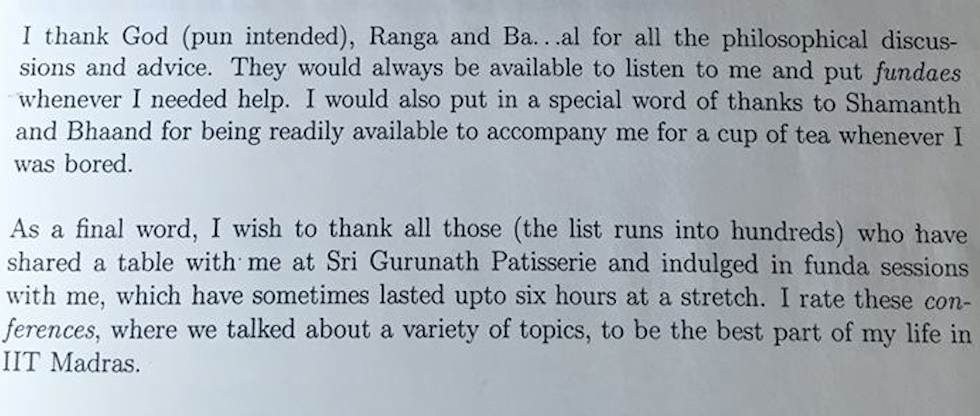
The more interesting bit is the acknowledgements section. It pretty much encapsulates my life at IITM. Again, I remember having done some research looking at other people’s acknowledgements to see who all they’d thanked, and I followed the same process – guides, professors, lab mates, etc. And then I’ve mentioned some friends.

The first part of the acknowledgements section is not particularly insightful so I’m not pasting it here. The second part makes for fun reading though, in hindsight. I like the way I’ve been fairly informal (in such a “formal” document as my B.Tech. project report), with puns and all.

screen-shot-2016-09-10-at-9-04-04-pm

The key thing to note is the last paragraph. I seriously mean it (even now) when I say that the best part of my life at IITM was the time spent at Patisserie, and all the discussions I had there. The discussions were diverse, with lots of different people, and we spoke about different things on different days.

It may not be a stretch to claim that I learnt more during my discussions there than during the time spent in classrooms. And if I today considered well-networked in my batch (and surrounding batches) at IITM, it’s again due to the time I spent there.

Now to think about how to adapt this acknowledgements section to something that makes sense for the manuscript I’ve written!

Wedding videos and optimising reception queue lengths

In the past I’ve dissed wedding videos, claiming that they don’t add any value (as no one ever watches them) and only serve to slow down the queues during receptions. While I maintain that the way they are currently shot still hold up reception queues, I’ve revised my opinion about their general usefulness.

So my in-laws are preparing for the wedding of their second daughter (my sister-in-law), and in order to “revise” what needs to be done, my wife suggested we watch our wedding video. So since last night we’ve been watching our wedding videos, and I must say it’s been quite useful.

For not only are wedding videos inherently entertaining, they also capture nuances of the wedding that still photographs cannot capture. It was pertinent, for example, to observe the order in which my relatives were garlanded as we were being welcomed into the wedding ceremony.

We also got to observe how bad the crowd was immediately after the wedding when people rushed to wish us and hand over their gifts (bad but not that bad). And rather embarrassingly for me, the video showed my failed attempt at cutting the ceremonial ribbon to enter the wedding hall (I have astigmatism which my contact lenses don’t correct, which affects my perception of depth). The video also allowed me to note that the scissor to cut the ribbon was handed to me by a bureaucrat aunt, someone who I guess is well used to handing over scissors in that fashion!

Having watched the reception part of the video, though, I continue to maintain that video recordings hold up the reception procedure, and result in inordinately long queues. Moreover, the way videos are currently shot cause severe embarrassment and discomfort for the guests.

For those that are unfamiliar with south indian wedding receptions, this is what happens – you join a (typically long and wide) queue, and when you get to the head of the queue, walk on stage to greet the couple and hand over your gift. Then you all line up for the photo. So far so good.

Then you hear the click of the photographer’s shutter, and start moving, and the videographer instructs you to stay. For he is taking a “panning shot” across the width of the stage. Some 30 seconds later, the videographer instructs you to move, and the bride and groom ask you to have dinner and show you the way off stage.

The embarrassing bit for the guests, in my opinion, is that having struck a photogenic pose for the photo, they are forced to hold this pose for the duration that the videographer pans. Considering that photogenic poses are seldom comfortable, this is an unpleasant process. Moreover, guests aren’t aware when exactly the videographer is covering them, so there’s a chance they might be caught on camera making awkward body movements (possibly due to the discomfort).

Thus, I propose that rather than having the video camera straight on (next to the principal photographer) and getting a panning shot taken, the videographer should position himself on one side of the stage (the opposite side from which the guests are entering), and take a profile view of the guests wishing the bride.

This way, they capture on camera guests in more natural gestures, and the “best” front view would have anyway been captured by the still photographer. The guests can then be asked to move on as soon as the photographer’s shutter clicks (a more natural exit moment), and the time spent by each group of guests on stage could come down by more than 50% (thanks to panning time saved). And this can result in a drastic reduction in expected waiting time for a guest!

While I’d like to implement this procedure at my sister-in-law’s wedding (so what if I thoroughly failed to keep the queue length under control at my own wedding? At least I should use my learnings elsewhere!), the problem would be in finding videographers who are willing to reposition themselves.

In some sense, the videographer standing straight on, and guests waiting for a long time is a kind of a Nash equilibrium, and videographers won’t move to side on unless there’s sufficient demand from hosts to cut queue lengths at their weddings! And since moving videographers to side on is not an intuitive solution, the demand for this move from hosts will also be small.

So I guess unless we can find a videographer who is willing to experiment (not too easy), we will be stuck with front-on videos, uncomfortable guests in front of the camera, and impatient guests in the line!