Bubbles and acquisition valuation

By all accounts, the Indian “startup scene” seems to be highly overvalued, and in a bubble. VCs, flush with cash, and chasing similar opportunities, are said to be overpaying significantly in terms of valuations. Check out this piece by iSpirt’s Sharad Sharma (HT: Saurabh Chandra), for example, where he hopes for a “soft landing” from the bubble:

In the soft-landing scenario, e-commerce companies are able to raise money but at near flat valuations. This allows the fundamentals to catch-up with the inflated valuation. Here the pain is localized. It’s only the early stage investors who are unable to participate in the new rounds that see rapid dilution. The rest of the ecosystem remains relatively unaffected.

An obvious  things for companies to do when they are overvalued is to use their balance sheets – use the overvalued stock price to make acquisitions. This can help explain some of the LBOs done by Indian companies in 2007 (Tata Steel buying Corus; Tata Motors buying Jaguar LandRover come to mind). And some of the startups seem to have internalised this principle, and are making use of their overvalued valuations to buy up other startups. It also helps that the acquiring startups are rich in cash, following fund raises, which helps them to even do part-stock part-cash deals.

The point is that if you are a company that has a takeover offer from a funded startup, you need to keep in mind that you are going to be mostly paid in “bubbled stock” and put an appropriate haircut on that account. I can’t advise on what this haircut percentage has to be, but if you are in the startup world, I guess you can take a guess!

Extending this argument further, if you are an employee who has just been offered a job in a startup, and are going to be part-compensated in equity, remember that the equity that you are being offered is “bubbled equity” and possibly overvalued, and once again you need to impose an appropriate haircut. I might go to the extent of asking to examine the books of a private company part-compensating in stock, but that’s likely to lead to breakdown of talks!

Writing on the Facebook-WhatsApp deal in 2014, valuation guru Aswath Damodaran wrote:

First, it is possible (and perhaps even probable) that the market is over estimating the value of users at social media companies across the board. However, Facebook has buffered the blowback from this problem by paying for the bulk of the deal with its own shares. Thus, if it turns out that a year or two from now that reality brings social media companies back down to earth, Facebook would have overpaid for Whatsapp but the shares it used on the overpayment were also over priced.

Keep the bubble in mind while accepting payment of any kind in stock!
Cross-posted on LinkedIn

How to improve regulation of utilities – comparing Delhi and DC

The Business Standard reports that the Delhi government has rejected the license applications of Uber, Ola and TaxiForSure. The snippet doesn’t say much more.

Contrast this with Washington D.C. which has passed a law that Uber has hailed as “model”. So what gives between the two capitals?

The answer is simple – it is the privileges accorded to the politicians. As a result of colonial hangover, Indian politicians have been mollycoddled with all kinds of perks such as houses in prime localities, chauffeured cars and the like. Thanks to such perks, bureaucrats are cut off from the market in general, and thus fail to understand any market failures.

The solution is simple in theory but hard to implement – basically cut the perks for government officers and instead compensate them further in cash, with the market value of the facilities that are now being provided for them. Clever structuring can make this cash-neutral. On the one hand, the bureaucrat now has a choice with respect to the kind of facilities he requires, leading to a more efficient allocation of resources.

More importantly, the bureaucrat is now part of the broader market, and thus exposed to the same market failures that plague the common man. If the transport commissioner of Delhi had to catch an auto rickshaw to get to work every day, we might have seen a completely different response in the Uber case.

Mumbai breakfasts

Mumbai does breakfast like nobody else in India, or so my limited data points tell me. No, I’m not talking about the vada pav places here. I’m not even talking about the “Udipis” (sic, for that is how Mumbaikars spell and pronounce “Udupi”). I’m talking about the kind of places where you get poached eggs with yoghurt. Yes, really, that is a thing, and the number of such breakfast places in Mumbai is not funny.

I’d been to Cafe Zoe in Parel once before, a couple of years back when I met a friend for drinks and dinner there. I remember it as this “happening” place in the middle of this old mill complex, with loud dhinchak music and a rather youngish crowd. So when it was suggested that we begin our series of meetings with breakfast at Zoe, I wasn’t sure it was a great idea.

But the place inside was different (I have very hazy memories of my first visit there, thanks to the quality of its alcohol, I guess!). The skylight meant that it was rather well lit, and the music was soft and of the pleasing variety. The tables had been sparsely occupied (it’s a large place), but among those that were there, it seemed like people were working there. Laptops were out, though it was hard to find a single one not made by Apple. The place had a leisurely unhurried feel to it, and I could wait for a while without being hassled to place my order.

And the menu card told me that the place opens at seven thirty! Seven thirty! Nothing save the Darshinis are open in Bangalore at that hour. Even the Egg Factory, that wonderful set of breakfast places here, opens only at eight. And thinking back, Zoe is hardly alone. I’ve been to at least two or three similar places in Bandra that serve “hipster breakfast” well-at-a-leisurely-pace. It seems like such breakfast places are more like the norm in Mumbai.

And it is not hard to reason why – simple revenue management explains it. Real estate in Mumbai is so prohibitively expensive that rents form a huge part of restaurants’ costs. And given that it is a fixed cost (you pay the same rent irrespective of how many customers you serve), a good strategy is to “amortise” it – across a larger number of customers. Other costs of running a restaurant, like labour and cost of food, pale when compared to the cost of rent.

In a situation with high fixed costs, it makes no sense to utilise your resource only part of the time. Whether your restaurant is open for four hours a day (as some are) or for all the time local regulations permit you to be, the rent you pay is the same. And in the latter case, you are making much greater use of the fixed-cost resource at hand, which is a prudent strategy!

Opening for breakfast probably means adding an extra shift (or half a shift) for staff. It means running the restaurant at a time when there is no chance it is going to be full. It means keeping the kitchen open all the time, and “normal” principles of restaurant management probably suggest it’s not a good idea. But when your fixed costs are as high as they are in Mumbai, it makes sense to marginally increase the fixed costs (by paying for additional staff cost) in exchange for making significantly superior revenues.  And that is what the likes of Cafe Zoe do!

Utilisation at non-peak (non-lunch, non-dinner) hours is never high (except maybe on Sundays), but what matters is it being strictly positive. Low utilisation means it gives a leisurely feel to the place, and customers can be allowed to linger. People use the place as a meeting spot (coffee is very reasonably priced there, and you can get beer to fuel your meetings!). From the looks of it, some others use it as a workplace. And all this results in revenues for the restaurant, valuable when real estate costs are so high!

Surely other cities, such as Bangalore, can do with such places. In Bangalore, for example, there is a severe paucity of places to do breakfast meetings at. Traditional South Indian places are too hurried, and buffets are never a great place to do meetings (five star buffets have turned out to become a kind of “standard” place for breakfast meetings). There is the egg factory, of course, but there is none else! We could surely do with some of our “lunch restaurants” opening up for breakfast. Just that real estate costs here don’t offer as compelling a reason as they do in Mumbai!

And for the record, the poached eggs with yoghurt was absolutely outstanding. At least I hope the Egg Factory manages to replicate that here!

Analysts, competition and Wall Street deaths

Yet another investment banking analyst has died. Sarvshreshth Gupta, a first year Analyst at Goldman Sachs’s San Francisco office reportedly killed himself after not being able to handle the workload. Reporting and commenting on this, Andrew Ross Sorkin writes:

Some banks, like Goldman, are also taking new steps, like introducing more efficient software and technology to help young analysts do their work more quickly. And investment banks say they are hiring more analysts to help balance the workload.

I simply fail to understand how these measures help balance the workload. I mean having more analysts is good in that the same work now gets split between a larger number of analysts. However, that there are more analysts doesn’t mean that the demand for Associates or Vice Presidents has actually gone up – that might go up only with deal flow.

In other words, what the above measure has done is to actually make the organisational structure “more pyramidal” (i.e. reduced the slope of the “pyramid’s walls”). So now you have a larger number of analysts competing for the same number of associate and VP positions. I don’t see how it makes things better at all!

On another note, I wonder if the number of deaths among Wall Street analysts has actually gone up, or if they have only started being reported more in recent times, after Wall Street got into trouble. Based on my limited understanding, I think it is the case of the former, and I attribute it to the lack of choice.

Back in 2004, I attended a talk by a Goldman Sachs MD (who worked in the Investment Banking Division, which does Mergers and Acquisitions, IPOs, etc.) in IIMB where he told me about the lifestyle in his division. That was the day I swore never to apply to that kind of a role. Given that the sales and trading side was doing rather well then, however, I had a choice to take up another equally lucrative, but less stressful-on-lifestyle career. That I chose not to (in 2006) is another matter.

The way I see it, following the crash of 2008, sales and trading have never recovered and don’t recruit as many as they used to. That takes care of one “competitor” of investment banking division. The other “competitor” is consulting, but they don’t pay just as well. In fact, with banking on the downswing, the supply of quality candidates to consulting firms has improved to the extent that they haven’t had to raise salaries as much. For example, starting salaries of IIM graduates at top-tier consulting firms in India have only grown at a CAGR of 6.5% since the time I graduated in 2006.

What this means is that few jobs can match the pay of investment banking, and that reduces the number of exit options. A few years back, anyone who found it too stressful had the option to move out to another job that was less demanding in terms of number of hours (though still stressful) without a cut in pay. This option has expired now, with the effect that people soldier on in investment banking jobs even if they’re not completely cut out for them.

And then some don’t make it. And so they go..

Dispassionate blogging and Wife Bonus

So I’ve figured out that the key to being a good and interesting blogger is to be able to look at things dispassionately and not let your value judgments crowd out your reasoning abilities. Of course, while saying this I’m assuming that I’m a reasonably good blogger (based on feedback, implicit and explicit, that I’ve received over the last decade, and given that I’m coming close to 2000 posts here).

So earlier this morning I was talking to a friend about long distance relationships and careers and marriages and responsibility sharing, and he sent me a link to this rather fascinating concept called the “wife bonus“. The money paragraph:

A wife bonus, I was told, might be hammered out in a pre-nup or post-nup, and distributed on the basis of not only how well her husband’s fund had done but her own performance — how well she managed the home budget, whether the kids got into a “good” school — the same way their husbands were rewarded at investment banks. In turn these bonuses were a ticket to a modicum of financial independence and participation in a social sphere where you don’t just go to lunch, you buy a $10,000 table at the benefit luncheon a friend is hosting.

So I responded that this looks like a rather interesting concept, and started my own analysis of why this works and these bonuses have been structured in the fashion that they have. Unfortunately the discussion went nowhere.

Because my friend who sent me the link found the concept disgusting and abhorrent and demeaning to women, and he was fascinated that I had managed to actually analyse it without feeling the same kind of emotions. As I write this, the conversation continues (as the old Coffy Bite ad went). Ok I googled and found that it’s actually “the argument continues”. Here is the ad:

So based on this one data point, and a few other data points from my and my wife’s blogging past, I figured out that such dispassionate analysis (I’ll present my dispassionate analysis on wife bonuses later in the post) is key if you are to be a good blogger. Because such dispassion allows you to not get swayed by the emotion or repugnancy of a concept, and instead analyse it to its full merit.

In this case you start wondering why these highly qualified women don’t work, but are “interested in art”. You start wondering about how a family’s finances would work if the qualified wife doesn’t work. You start wondering who controls the budgets, and considering that one half is not contributing financially, how stable such marriages are.

So my hypothesis, which I’ve never bothered to test, is that people who have access to funds but don’t have an independent source of income are less careful about spending it optimally than those who have access to funds on account of their own sources of income. To be less politically correct, the hypothesis is that housewives (and househusbands, to be more politically correct) are less careful about their money than people who work.

So now if you have a spouse with no independent income source, but want to make sure she has access to sufficient funds while making sure she doesn’t fritter away the wealth, the best way of achieving this is to ringfence the money under her control. Which means that giving her control of your bank account is not optimal, but creating a separate purse which is under her control is superior! And thus you create what can be classified as a “wife bonus”. As simple as that.

Now I realise many of my readers will find this blog post repugnant, for it is not politically correct, and they will allow their emotions to take over and brand me as a misogynist or a chauvinist or whatever else. All because I looked at an existing phenomenon logically without attaching a value judgment to it. And by doing so, they deny themselves the opportunity of reading my analysis. But there are others who are happy that there is someone doing this dispassionate analysis, and they will like such analysis. And my blog popularity grows on that front.

My wife has been blogging heavily through her life in business school (coincidentally I started blogging a decade ago when I was in business school; and we met each other through LiveJournal), and has already got to the stage where her professors read her blog. And while a lot of her classmates read her blog, there are some who have problems with it, that she writes dispassionately about everything without value judgments.

Anyway, I sent her the NYTimes piece on the wife bonus. She replied that she also wants one now!

Cabs to airports

Early yesterday morning I had a minor scare when Mega Cabs stood me up. I had a flight to catch at 7 am to Mumbai, and had booked a Mega Cab for 5am. This was after consulting a few friends who are frequent travellers on Monday mornings, who advised that finding an Uber or Ola at 5am is not particularly straightforward. I must mention that I haven’t done business trips for a while, which means I haven’t had to catch 7am flights, so the last time I took one such flight was before Ola/Uber became big in Bangalore (October 2014). And I’ve always preferred Mega to Meru since their cabs are relatively better maintained and more prompt.
And then Mega stood me up. The assigned driver Nagesh N never called me, and when I called him, didn’t pick up. I didn’t panic, since I knew I could get a cab on Uber or Ola, except that neither had any cabs available. I called Mega customer care, who promised an alternate cab at 5:15 (still leaving enough time to get to the airport and catch my flight). But then I received an SMS saying that I’ll get a cab at 6:15. Rather than arguing with Mega, I tried Uber once again, and this time I was in luck, finding a cab that would take me to the airport at a surge of 1.8X (80% more than the “normal” fare).
So on the way to the airport I got talking to Kumar, my Uber driver, about the economics of cab rides in Bangalore, and airport trips. As I had mentioned in my earlier post on Uber’s new pricing model, the reduction in per kilometer fare and increase in per rupee fare has meant that an airport run is normally not remunerative for an Uber driver. Add to this the fact that Uber’s bonus payments to drivers are on a “per trip” basis rather than a percentage or distance basis, that a driver reaching the airport at around 6am has to wait for at least a couple of hours to get a passenger to ride back to the city, and that Uber’s new bonus structures that began today not paying much incentives for trips before 7 am (this was told to me by Kumar), drivers have responded by simply not switching on their Uber systems at 5 in the morning, when the likelihood that any trip is an airport run approaches 1.
This is clearly inefficient, and  consequence of bad pricing on behalf of Uber. On the one hand, drivers are denied opportunities to carry customers over long distances, which is an airport run. On the other, customers are inconvenienced thanks to the lack of cabs, and have to rely on the otherwise rather unreliable and mostly unused Meru or Mega cabs, whose cars are of poor quality and drivers unresponsive. A lose-lose situation. All thanks to bad regulation (read my post in Pragati on how Uber is like a parallel regulator).
The solution is rather simple – an airport surcharge. Any trips to or from the airport on Uber can be slapped a further surcharge (of Rs. 200, perhaps). Such a surcharge will make the ride remunerative for drivers, while at the same time still keeping Uber much cheaper than the likes of Meru or Mega. In fact, this morning’s trip, after the 1.8X surge, cost me Rs. 780, which is cheaper than what it would have cost me if Nagesh N of Mega Cabs had not ditched me, and I could pay in a “cashless” manner, directly from my Paytm account. It’s a surprise that Uber hasn’t yet figured this out, given all their “data science” prowess!
Update: 
A friend who I met on the flight told me that in his town (Whitefield) it’s not hard to find an Uber/Ola cab at 5am on Mondays, except that the drivers cancel rides once they figure out it’s for an airport drop. Again pointing to the fact that incentives are not aligned for maximum throughput

Parks and Urban Safety

On Wednesday evening, I walked to Gandhi Bazaar for an evening snack. It’s not often that I do that, for it’s not a pleasant walk. Firstly, there is the Tagore circle underpass which was built after much controversy. The underpass has had the desired effect of clearing the traffic bottleneck at Tagore circle, but it has become a nightmare for pedestrians, for there is now unmitigated flow of traffic and footpaths are non-existent.

The second reason I don’t like walking to Gandhi Bazaar is Krishna Rao Park. Yes, you read that right. It’s a rather nice large park, and fairly well maintained. But the problem is that the structure of the park means that the roads around it don’t appear particularly safe to walk on, especially after dark. The presence of the park means that there aren’t enough “eyes on the street”. There is a third reason, too – the roundabout at Armugam Circle. Roundabouts are inherently pedestrian unfriendly.

If you ask anyone who grew up in or around Jayanagar what their favourite street is to drive on, the answer is likely to be one of “Rose Garden Road” or “4th Main Road” or “That nice road with Lakshman Rau park on both sides” or “The road where the metro has been built”. All of them refer to the same road, btw. However, if you were to ask the same people about their favourite road to walk on, you are unlikely to get that answer. For 4th Main (or Rose Garden Road or whatever else you call it) is simply unwalkable. The park on either side means that there are not enough eyes on the street, and for this reason, people prefer to not walk on this road, choosing one of the parallel roads instead.

While presence of parks is generally seen as desirable and creates valuable green space and makes the area more beautiful, careless design can mean that the roads around can be rendered unsafe. It mainly has to do with the entrances. In Bangalore, parks are usually fenced, with only the odd small gate here and there allowing for entry (a design element that is imperative due to stray cows). What this means is that while the area around the park entrance is usually crowded and well populated (and thus safe), there is little human traffic around the rest of the perimeter since there is nowhere to go to from there!

So the hypothesis is that for a road to be walkable, it needs to have a large number of “doors”, that is exits that get you somewhere – either a house or an office building or a park or a shop or whatever. Presence of a door means that users of the door have an incentive to step out of the door and walk along, which increases human traffic. Which makes the stretch a wee bit more walkable.

Absence of doors means that the only people who will want to walk along that stretch are those that intend to go from one end to the other, which means that there aren’t as many people. Absence of doors also means vehicles can move much faster along the stretch, making driving a more pleasant experience, but making walking even more unpleasant. And then you have positive feedback and network effects and all that, making such roads even less conducive for walking on!


Our cities here are simply not designed for walking, and features that ostensibly promote walking, such as parks, are so badly designed that they make walking even less pleasant!

Intellectual discussions

So this afternoon a friend came home and we had a nice long discussion on a lot of things. And then it was time for him to leave. But by then, I was in the frame of mind where I was craving intellectual discussions, but there were no avenues for me to execute!

I remember this time five years or so ago, when each day when I would come back home from work, I would open Google Talk and initiate five or six conversations with friends who were online. Some would be stillborn, as the counterparty wouldn’t reply, but my carpet bombing would work and there would be 2-3 conversations that would fructify, and I would have a nice time talking!

Unfortunately, with the decline of Google Talk, there are no avenues for such discussions now. In fact, what killed it was the move to mobile – the original point of Google Talk was that you could signal that you were available by logging on. And so when you signalled thus, someone would ping you, and you would have a conversation.

By moving Google Talk to the mobile phone, where you were online by default, it meant that you were shown online even when you weren’t in a mood to chat. People would occasionally ping you, but then give up. It was like the case of the shepherd boy crying “wolf”. So a green button next to someone’s name on Google Talk means nothing now, in terms of their availability to chat!

Other chatting mechanisms, such as WhatsApp are no better, being “mobile first” and thus “always logged in”. You don’t know who is available when, and who you can possibly ping to have a good conversation.

And then five years back, I stopped logging on to Google Talk and initiating five different conversations. I started logging on to Twitter, instead, and making conversation with people on my timeline . Unfortunately, twitter has been ruined, too. It is so full of outrage, and some of such outrage conducted by otherwise smart people, that I’ve radically cut down on the number of people I follow.

As the world solves some problems, it un-solves others, and creates yet others. And there was a time when I would blog, and visit other blogs, to have intellectual discussions. And now people have stopped commenting on blogs, also!

Indian Americans and the Selection Bias

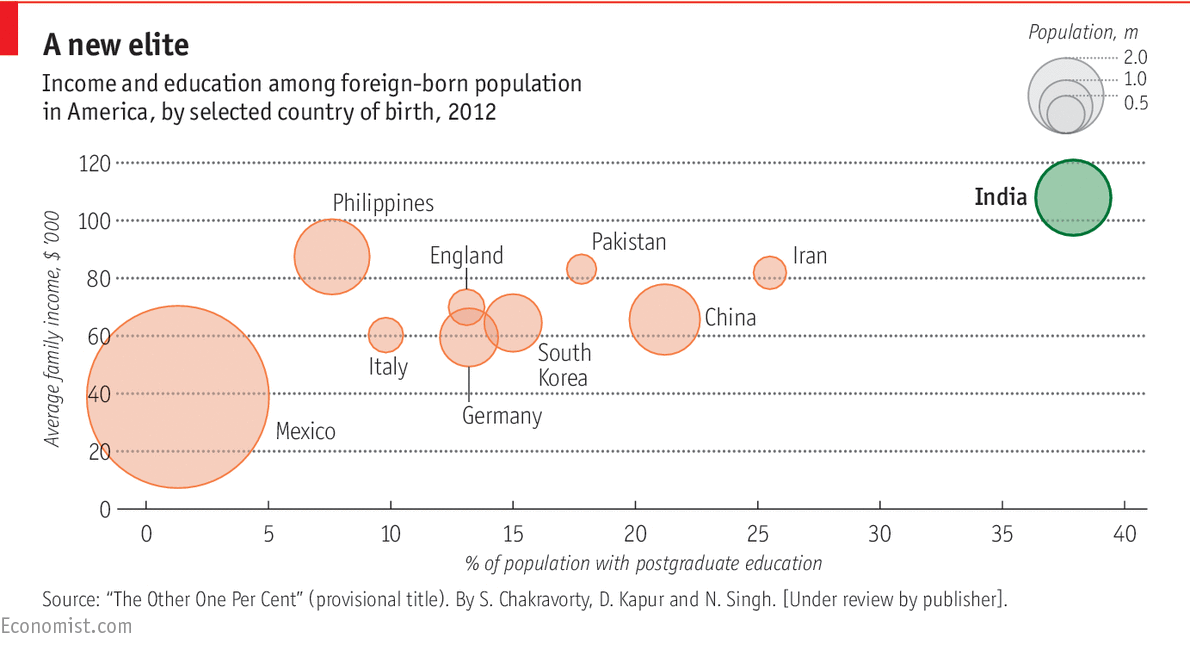
There is this one chart from the Economist that has been doing its rounds over the interwebs over the last few days:

Basically it shows that Indian Americans are much more accomplished academically and professionally compared to other immigrants. And there are many theories floating around as to why Indians are so successful.

The answer, however, is rather simple – selection bias. Migrating from India to the US was an extremely difficult task till the 1960s – there were some quotas that the US had for immigration under which the Indians had nothing. And when Indians did finally start migrating in the 1960s, it was mostly for education.

Most people who migrated from India to the US even in the 1960s and 70s did so to go to graduate school. And this meant that they already had 16 years of education in India, which either meant an engineering or medical degree, or a masters in one of the other fields. So basically most Indians migrating to the US were highly accomplished already.

And considering the kind of foreign exchange controls imposed by the Indian government, the only Indians who could afford to go to the US for an education were those that received a fellowship or support from their universities. Thus increasing the seelection bias! (Now that I’ve mentioned foreign exchange controls, you should listen to this song, which was apparently meant to parody such policies)

Yes, you had the odd Patel without much education who made it to open a “Potel” (Patel run Motel), but that is probably the reason that the Indian bubble in the above chart is not farther out!

So that Indians have done better than other migrating communities in the US is not about innate Indian intelligence, or innate Indian ability to work hard, or because the Americans took in the Indians much better than other nationality. It is simple selection bias, based on tight immigration controls and tight emigration controls and stupid foreign exchange policy on the part of Indian government (which, at one point of time, only allowed citizens to take out eight dollars from the country).

To illustrate this point, look at the country that is “second” (quotes since we are looking at two dimensions here, so second is subjective) in this list – Iran.

Investing in dabbil-dabbi startups

So the wife has come up with this new concept – “dabbil-dabbi startups“. Check out this scene from yedurmane ganDa, pakkadmane henDthi where miser Shashikumar is looking for the money that he has stored inside a series of boxes (watch at 3:48 here).

So the wife’s point is that startups nowadays are not adding value by themselves but instead simply offering an additional layer around an already existing product/idea. This, she says is similar to Shashikumar in the above scene putting one box inside the other – basically no real value is added.

I take this analogy further, perhaps distorting it in the process, like any analogy taken too far. Basically in the above scene, Shashikumar, after opening all the boxes inside boxes, retrieves money from the innermost box and rhetorically cribs that the money hasn’t grown.

Similarly, when an investor invests in a “dabbil-dabbi” startup, his money meets the same fate as Shashikumar’s in the movie – there is no growth!

So think twice before investing in a dabbil-dabbi startup.