The Johan Cruijff Derby

That’s the name I’m giving to my tour that starts tonight, and will last eighteen days. I’ll be spending 2-3 days in Amsterdam, after which I fly to Barcelona where I’ll spend two weeks (as you know, the wife lives there).

There are primarily two reasons I’ve given the tour this name. The first is Cruijff himself. Cruijff made his name as a footballer in the decade he played for Ajax, where Rinus Michels developed the Total Football paradigm (which incidentally is named after a “total architecture” paradigm that was popular in Holland in those days). After that he followed Michels to FC Barcelona, where he had another successful spell. While he didn’t play for Barcelona as long as he did for Ajax, he has continued to live in Barcelona. Hence, a short tour of Amsterdam followed by a much longer tour of Barcelona can be named after Johan Cruijff!

The other reason for nomenclature makes more sense – I have a ticket for a football match, to be played on the 21st of October. The ticket has set me back by more than ten thousand rupees, but it’s going to be my first stadium football experience (coming after nine years of football-watching, on TV), and so I’m quite excited. The game is at the Camp Nou, where FC Barcelona will be taking on – you guessed it – Ajax (in the UEFA Champions League). And if there is anything that deserves to be named after Cruijff, it is the game between Barcelona and Ajax!

If you’re in either of those parts and want to meet, do leave a comment. If you have any recommendations of dos and don’ts, let me know that also! I’ll keep this blog updated through the tour!

PS: I’ve downloaded Dr. Sid Lowe’s Fear and loathing in La Liga to read on my way to Barcelona – in flights, airports and all that!

The big deal about the half-girlfriend

When all of twitter outraged about Chetan Bhagat’s latest masterpiece “half girlfriend” I didn’t know what the big deal was. Given that concepts such as ladder theory, friendzone, GBF (Gay Best Friend), FGB (Foremost Girl Buddy), Goalkeeper Theory and Petromax are all so well documented and accepted, it doesn’t take much of a leap to get to the concept of “half-girlfriend”, as described in the flipkart summary of the book. 

It seemed to me that the people that were outraging were all pseud-types who had hardly been single in their youth and how looked down upon IITs and IITians (for lacking social skills; and guilty as charged on that count). That they were people who subscribed to a certain view of how friendships and romances and relationships should function, and who were incapable of appreciating any alternate mechanisms. I could think of them as the people who got madly outraged when I put out my now classic blog post on petromaxing in business schools nine Deepavalis ago.

But now that the book has already come out (I have no plans to read it since I don’t read fiction. Moreover, considering myself an authority on alternate mechanisms of romantic relationships, and am married to someone who considers herself an authority on conventional mechanisms of romantic relationships, I don’t think I can bear being lectured upon on such topics), and people that I know, or people that know people that I know have started reading it, I realise why the outrage is all about. Consider this sample which I got on one WhatsApp group this morning:

image


The first reaction is that the quality of writing is horrible, but then that’s how Chetan Bhagat writes, and that’s how the audience he writes for wants him to write. And then the whole crassness of the implementation of the concept in the book hits me – while the concept of half-girlfriend might be a bloody good one, with wide-ranging implications and mechanism designs, it seems like (based on the above limited sample) the concept as instantiated by Bhagat doesn’t hold a candle to its potential!

I’ve now crossed the floor. I’m now in the camp of the people who believe that Chetan Bhagat’s Half Girlfriend is cringeworthy – and I find it cringeworthy not because of the concept (which I think is rather worthy), but because of the way that Bhagat seems to have butchered it and made it appear crass and “LS”. By writing this book, Bhagat has nipped in the bud what might have been a phenomenal alternative relationship concept. And that is unforgivable.

I don’t normally quote sitcoms, and I don’t normally watch sitcoms, but given we are on the topic of alternative relationships mechanisms, I can’t help but put a short video featuring perhaps the greatest purveyor of alternative relationship mechanisms of all time – Jeffery Murdoch from Coupling. I couldn’t find an extract from the episode, so here is the full first episode of the first season of Coupling in all its glory! May you be able to get rid of your unflushables!

https://www.youtube.com/watch?v=yvFs5S6A6LM

Dear Brendan Rodgers

I’m beginning to write this at 64 minutes played in Basel-Liverpool. Basel is leading 1-0, not undeservedly. Liverpool have so far been extremely poor, and deserve to have gone behind. We started well in the first ten minutes, and it seemed like an eminently winnable game, but after the tactical substitution made by Paulo Sousa, we’ve never been in it. Some pertinent observations so far.

  • I understand our need to have wanted to buy a world class striker to replace Luis Suarez. One might have thought the purchase of Mario Balotelli, no doubt a world class striker, was vindicated when Sturridge got injured. But Balotelli just doesn’t suit Liverpool. He is too slow. He just doesn’t move.

    I don’t have the statistics (football statistics are extremely hard to come by, unlike cricket), but we need to look at the number of off sides conceded between last season and this one. Balotelli gives away too many of those. Most of them come about because of his slow movement

  • Raheem Sterling was due a poor game, and we are seeing one now. His touch has been poor all day today. In his defence, he was due one bad day. Except that you had no clue how to handle that.
  • Sousa saw the weakness in Liverpool’s left back zone with Jose Enrique, and thus decided to double up on his right wingers to attack that zone. Now, this ended up pushing Raheem Sterling back, and he has had more defending to do than what he thought would have been his share. That is understandable.

    But then you need to realise that when you double up on one zone, you end up weakening yourself in another. Basel have played almost the entire night without a left back, or anyone on their left side apart from their left winger Hamoudi. They are playing a very lopsided 3-4-3. And you have done nothing so far to exploit that. Markovic has played all evening, but hasn’t been leading attacks down that wing as would be optimal. Manquillo has been leading the attacks there, with Markovic drifting inside. What we needed was Manquillo and Markovic doubling down in that unguarded zone. Haven’t seen that at all.

  • Then there is the centre of midfield. The two of Gerrard and Henderson isn’t simply working. Even when playing out from the back, they have consistently been stopped at the halfway line. Ok there is Gerrard and Henderson, but they haven’t had a forward pass to play! Coutinho has been lost in the crowd. And Balotelli, unlike Suarez doesn’t come back to pick the ball there. So how do we go forward from there?
  • Liverpool simply haven’t been picking up the second balls in the middle of the pitch today. They’ve been thoroughly outnumbered in that area – with only Gerrard and Henderson against three central midfielders of Basel. When we demolished Tottenham last December, the key was in our picking up all these second balls and keeping attacks flowing. That’s been sorely missing all day today.
  • Lallana’s introduction was good, but it should have been Sterling who should have come off. He is evidently extremely tired, and nowhere close to his best. We can see that in the two clear chances he’s missed since I started writing this post.
  • Markovic shouldn’t start. He’s not enough of a lone ranger for that. With his pace you should look to him as a super-sub. A plan B to be introduced along with Balotelli and Lambert. I just don’t see him gelling with the rest of the team. And please – someone along with Gerrard and Henderson there. I know Allen and Can are injured, but even someone like Lallana along with Gerrard and Henderson would help. The World Cup showed us how those two together in a 4-2-3-1 are ineffectual. You haven’t learnt from that.
  • It’s been a scrappy game so far, but a great tactical battle. There was one big question that Sousa posed – by putting on Gonzales for Safari, but you have thoroughly failed to answer that. After two moves by Gonzales, you went into a shell, and didn’t attack enough in the newly posed gap. I’m absolutely disappointed with you for that. I expected you of all people to be more tactically sound.
  • The best formation Liverpool has played with the available players this season was in the second half against Everton. With Gerrard-Henderson-Lallana-Coutinho-(not out of form)Sterling-Balotelli. You never even tried that in this game, while I expected you to start that way.
  • The game has ended as I finish this post. We have lost. Deservedly.
  • Maybe a you could use the services of a statistical analyst to help you figure out the gaps in play and how Liverpool should structure themselves given the available players. You can leave me a comment if you think you need one (you surely do!), and I’ll come over to help!

Geek Talk

So I was talking to the wife using Viber when Viber acted up and disconnected. This happened a couple of times. Then I moved to FaceTime, but that too had problems, and started acting up. Finally I got irritated and decided I wouldn’t mind spending some money for uninterrupted conversation, so picked up my phone and dialled ISD.

And I told the wife, “I was getting damn irritated with packet switching, so I moved to circuit switching”. And then we got talking on why Viber was so irritating, and we talked about Tanenbaum (both of us really loved that textbook of Networking) and acknowledgements and transmission of messages on unreliable channels – which can only happen by introducing redundancy – which becomes painful in a human-to-human direct conversation.

I have an engineering degree, and am fairly good at maths, and read a fair bit of economics and history, so keep popping up concepts from these in my regular conversation. Some people find it abhorrent, and wonder if I’ve landed from another planet, given that I talk this way. For example, I remember using  the word “incentivise” while answering a question at a quiz (which had nothing to do with economics). I often rationalise purchases saying they offer “option value” – real options are one thing that I think I understand. And so forth.

From this perspective I think it’s really wonderful that I’m married to someone who not only tolerates this geek talk but actively encourages and participates in it! Like the wife has now become a big proponent of the concept of option value (though admittedly she has just joined B-school so is yet to appreciate the finer points of the Black-Scholes-Merton model). I’m not sure if before she met me she would quote as regularly from Harry Potter as she does now (or maybe I’m taking too much credit). And she keeps peppering examples from physics and astronomy and electrical engineering in her normal day-to-day conversation.

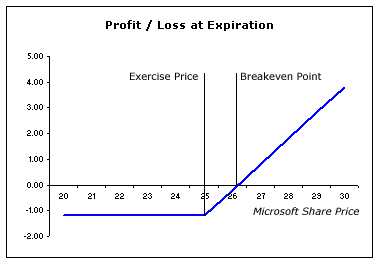
And speaking of physics and option theory and sporting analogies, I get damn irritated when people describe curves as the one below as “hockey sticks”.

I’m Indian, and the only hockey I know is “field hockey”, whose stick looks like a J. So whenever someone mentions “hockey stick” I start imagining a J-shaped curve. As for the above curve, I sometimes (especially when I’m hanging out with banker types) describe it as “call option payoff”. When I’m hanging out with more scientific types, I describe it as “photoelectric effect”.

I wonder how our kids will turn out!

Second factor authentication

Ever since I wrote my Pragati piece on the two bad recent pieces of regulation by the Reserve Bank of India, and since I had a long conversation with Deepak Shenoy about them, and since (I believe) Raghuram Rajan replied to my Pragati piece in a subsequent speech, and since I got a mail from Citibank that starting next month I can’t use my internet password as a second factor authentication and must instead use a One Time Password, and since I realised I’m traveling abroad next month, and am not planning to use international roaming to be able to receive the One Time Password, I’ve been thinking of ways in which a bank or a credit card company can securely use a second factor of authentication without really inconveniencing the customer.

Essentially, a second factor of authentication is the provision of a piece of information that is not stored on the magnetic strip or pin of your credit/debit card. This ensures that the possession of your card alone will not allow a fraudster to defraud you, unless he is also in possession with the second factor of authentication. This makes is much less likely for  credit card fraud to happen (but not entirely foolproof – what if the same guy steals both your credit card and your phone? – but it is impossible to design systems to that degree of security).

The four digit PIN that you have to enter when you use an ATM is one such second factor authentication (remember the note the bank sends you along with your card telling you to not write down the PIN anywhere close to the card). Similarly, the four digit PIN you have to enter to authenticate a CHIP transaction on your credit card is a second factor. Earlier credit cards would require you to sign as a second factor, but that was done post payment processing, so that is not seen as a reliable second factor – and hence they are being phased out. In the United States, for example, your ZIP code (a piece of information not available on your card) is your second factor (in the rare case it is asked for – the US is among the last major countries to move to two factor credit card transactions).

Given that it could be just about any piece of information not available on your card that can be a second factor, it is puzzling that most banks and credit card providers insist on a One Time Password sent over SMS or email as being the second factor. It is as if they believe that telecom networks are far more secure than any other way to disseminate a second factor of authentication. A friend who was visiting from the US, for example, was unable to transact online in India since his Verizon package didn’t provide him SMS services – it has gone out of fashion there.

Earlier today I was reading this excellent piece on how the US’s move towards Chip and PIN cards (will take half a decade for the transition to be complete – interestingly India made this transition in less than a year) is going to lead to higher security for credit card transactions worldwide. Among other things, the piece mentions a “Visa Token Service” where a dynamic token will replace the static credit card number.

I have had a trading account with Kotak for a few years now, and they have provided me with a physical token. Upon pressing the only key on the token, a six figure number is displayed, which is my additional factor of authentication that I need to log on to the website and transact securities. The algorithm of my token is synced with my account (basically it’s to do with the seed of the random number generator that operates on my token), and thus I get authenticated.

My last employer had issued us Blackberrys for work email (this was in 2009, when they were in fashion). They had also issued us tokens that we could use to log on to the corporate network from home – in the rare case when we had to login from home. And since I got the token after I’d got my blackberry, the token simply sat as an app in my blackberry. Considering that this second factor authentication is just a six digit random number set to a certain seed, why can’t my second factor of authentication be tied to one such token that resides in the Citibank app on my phone (which is already authenticated), rather than being sent to me by SMS?

This is only one possible method in which the second factor could be authorised. For transactions on taxi services, for example, your credit card details can still be stored with the taxi service, but at the end of the service on your way out you simply enter a four digit passcode into the driver’s app (the passcode could be generated by your app, or your phone and the driver’s phone can do an NFC handshake).

As I had mentioned, the opportunities for a second factor authentication are endless, but for some reason banks seem to be hell-bent on using a SMS-based One Time Password. Could it be a conspiracy by the telecom companies to maintain at least some of their SMS revenues?

And I think we need a statement from the RBI Governor stating that banks are not obliged to use a SMS-based OTP as second factor authentication, and they can be creative with it!

Deresiewicz, Pinker and the IIT JEE

A few months back, William Deresiewicz, formerly of Yale, wrote a long piece advising people why they should not send their kids to Ivy League schools. He talked about students in Ivy League schools becoming single dimensioned, hyper-competitive, and less appreciative of the finer things in life. He spoke of the Ivy League system being broken, and not close to what it used to be once upon a time.

Now, Steven Pinker (he of the Stuff of Thought and Language Instinct fame) of Harvard has responded, and he has the opposite problem with Ivy League students. Halfway though the semester, the class is half-empty, he cribs, with students more involved in extra curricular activities rather than attending class. This implies that all the effort the university puts in building world-class libraries and laboratories and other facilities go waste. Pinker’s diagnosis is different – he blames the “well roundedness” criteria that universities use for admissions (supposedly initially put in place to restrict the number of jewish students, and then kept in place to restrict the number of asians).

I’m about halfway through Pinker’s article, and I remember reading Deresiewicz’s article in full, and my reaction to both is the same – “IIT JEE rocks”. By having a standardised exam to admit students, the IITs actually take pressure off high school students rather than imposing more pressure – since the criteria for admission are clear – that one examination, a student of class 11 or 12 has her objectives clear in front of her in case she wants to go to IIT – single-minded mugging of Maths, Physics and Chemistry.

With a more “well-rounded” criterion – say one that includes social service and extra curricular activities and sport and all such, the objective function is not that clear, and the student needs to slog towards an uncertain objective function, which is significantly inferior to slogging towards a known objective function.

Some of the cribs that Pinker puts in his post is true of IITs as well – I’ve had several professors lecture to me about the lack of seriousness on the part of IIT students, and how they would prefer students who might be less brilliant but more serious about their learning (an oft touted solution to this was to jack up the fees and make students dependent on education loans they had to repay. Not sure if the IITs have implemented this, but the IIMs have, for sure).

But then IIT Madras, where I studied for four years, and where everyone had come in after passing a rigorous standardised test, had no shortage of characters. While everyone who was in had necessarily shown single-minded devotion to mugging maths physics and chemistry in the preceding year or two, a large number of students there had interests that went much beyond those three scientific subjects. In that sense, if the Ivy League schools want to see a system where standardised admissions process actually lead to a fairly diverse class, they need not look beyond the IITs (a system they are no doubt familiar with since the IITs contribute generously to the grad student population of the Ivy League schools).

One of the frequent criticisms of the IIT JEE is that it can easily be gamed – rather than selecting the “brightest” students or those that have the best understanding of maths, physics and chemistry, the IITs end up selecting students who are best prepared for the standardised exam. An oft-touted solution to this is to make the entry process more “holistic” (in India that means including board exam marks (??!!) ), to make it less game-able. However, evidence from the Deresiewicz and Pinker pieces suggests that even the “holistic” admissions process that the Ivy League schools follow are easily gamed, and that the gaming of those systems is in fact biased towards kids with rich parents.

A while back I was looking at the admissions process of some Ivy League schools – both undergrad and MBA programs. Now, all these schools tout diversity as one of their drawing criteria. But if you look a little deeper, you will notice that this purported diversity is only skin-deep (literally!). While these schools might do a fantastic job of getting students from different nationalities, skin colour, undergraduate backgrounds and work experience, the way their essays are structured implies that the students they get are largely similar in thought – students should have done some social work, they should have exhibited a particular kind of leadership, they should be politically correct, and so forth.

The reason I mention this is that “holistic” admissions criteria need not actually produce a student body that is necessarily more diverse than that produced by a standardised test – it all depends upon the axis that you look along!

PS: I happened to have a good day on 7th May 2000, when I wrote the IIT JEE and did rather well, so this post might be biased by that. I don’t know if I would have taken such a charitable view towards standardised tests if I hadn’t done so well in them.

A misspent career in finance

I spent three years doing finance – not counting any internships or consulting assignments. Between 2008 and 2009 I worked for one of India’s first High Frequency Trading firms. I worked as a quant, designing intra-day trading strategies based primarily on statistical arbitrage.

Then in 2009, I got an opportunity to work for the big daddy of them all in finance – the Giant Squid. Again I worked as a quant, designing strategies for selling off large blocks of shares, among others. I learnt a lot in my first year there, and for the first time I worked with a bunch of super-smart people. Had a lot of fun, went to New York, played around with data, figured that being good at math wasn’t the same as being good at data – which led me to my current “venture”.

But looking back, I think I mis-spent my career in finance. While quant is kinda sexy, and lets you do lots of cool stuff, I wasn’t anywhere close to the coolest stuff that my employers were doing. Check out this, for example, written by Matt Levine in relation to some tapes regarding Goldman Sachs and the Fed that were published yesterday:

The thing is:

  • Before this deal, Santander had received cash (from Qatar), and agreed to sell common shares (to Qatar), but wasn’t getting capital credit from its regulators.
  • After this deal, Santander had received cash (from Qatar), and agreed to sell common shares (to Qatar), and was getting capital credit from its regulators, and Goldman was floating around vaguely getting $40 million.

This is such brilliantly devious stuff. Essentially, every bad piece of regulation leads to a genius trade. You had Basel 2 that had lesser capital requirements for holding AAA bonds rather than holding mortgages, so banks had mortgages converted into Mortgage Backed Securities, a lot of which was rated AAA. In the 1980s, there were limits on how much the World Bank could borrow in Switzerland and Germany, but none on how much it could borrow in the United States. So it borrowed in the United States (at an astronomical interest rate – it was the era of Paul Volcker, remember) and promptly swapped out the loan with IBM, creating the concept of the interest rate swap in that period.

In fact, apart form the ATM (which Volcker famously termed as the last financial innovation that was useful to mankind, or something), most financial innovations that you have seen in the last few decades would have come about as a result of some stupid regulation somewhere.

Reading articles such as this one (the one by Levine quoted above) wants me to get back to finance. To get back to finance and work for one of the big boys there. And to be able to design these brilliantly devious trades that smack stupid regulations in the arse! Or maybe I should find myself a job as some kind of a “codebreaker” in a regulatory organisation where I try and find opportunities for arbitrage in any potentially stupid rules that they design (disclosure: I just finished reading Cryptonomicon).

Looking back, while my three years in finance taught me much, and have put me on course for my current career, I think I didn’t do the kind of finance that would give me the most kick. Maybe I’m not too old and I should give it another shot? I won’t rule that one out!

PS: back when I worked for the Giant Squid, a bond trader from Bombay had come down to give a talk. I asked him a question about regulatory arbitrage. He didn’t seem to know what that meant. At that point in time I lost all respect for him.

Marrying out of caste – 2

We stay with our analysis of the National Family Health Survey data on marrying out of caste. In this edition we look at factors that lead to higher rate of inter-caste marriage.

Based on the data given, age definitely has an impact on the rate of inter-caste marriage. To put it in another way, considering the entire survey was conducted at a particular point in time, what this means is that the incidence of inter-caste marriages in India has been steadily increasing, though at a glacial pace.

Women aged 45-49 at the time of survey were only 8.5% likely to marry someone outside their caste, while women aged 15-19 at the time of survey were 11.75% likely to marry outside their caste. This shows there is definitely a shift in rate of inter-caste marriage, but it is a very slow shift.

The other factors that have been examined, however, seem to give fairly contradictory results (compared to “conventional wisdom”, that is), and that forms an important factor in the survey. For example, only 11.6% of rural women surveyed married out of caste while only 10.6% of urban women surveyed did so (while the difference looks small, the sample size makes it statistically significant), turning on its head the conventional wisdom that urbanisation might lead to higher incidence of inter-caste marriages.

Education shows a bizarre pattern, though. Women educated at the school (primary or secondary) level are more likely to marry out of caste than uneducated women (the difference is small, though), but this trend “regresses” as the women get further educated – women with higher education are less likely to marry out of caste than even uneducated women! The pattern is the same with respect to the woman’s husband’s education level also.

intercaste4

There are more sources of contradiction – working women are as likely to marry within caste compared to non-working women (while there is a small difference it is hardly statistically significant, despite the large sample sizes). Standard of living also has no impact on likelihood of marrying within caste (difference too small to be statistically significant).

The most surprising result, though is regarding “exposure to media” (I don’t know how they have measured it). The likelihood of marrying out of caste is highest among women who have declared their access to mass media as “partial exposure”, followed by women whose declared access to mass media is “no exposure”. Women with highest access to mass media (“full exposure”) have, quite counterintuitively, the smallest chance of marrying outside of caste (this is a statistically significant result with high degree of confidence)!

A reasonably dominant discourse nowadays in certain circles is that exposure to media, urbanisation and women going out to work are responsible for destroying “our culture”. If we take likelihood of marrying within caste as a proxy for “culture” (the one that must be preserved as per these worthies), it turns out that urbanisation, access to higher education and exposure to mass media actually help preserve this “culture”, while access to employment for women and nuclear families do little to “destroy” this culture!

Now if we assume the above correlation to imply causation, and incidence of same-caste marriages as preservation of “culture”, what we need to do to preserve our culture is to increase exposure to mass media, access to higher education for women and urbanisation. While we are at it, we can promote nuclear families and access to employment for women also!

If only the Khaps and other self-proclaimed preservers of culture were to look at hard data before making their pronouncements!


Marrying out of caste – 1

This is the first in what is going to hopefully be a long series of posts on inter-caste marriages. As you might have figured out, I’ve stumbled upon a nice data set with lots of data on this topic (Hat tip: Nitin Pai and Rohit Pradhan), and there are some beautiful insights in the data.

The data is based on a National Family Health Survey which was conducted in 2005-06. The sample size of the survey itself was massive – close to a lakh respondents for the entire survey, and about 43,000 women who were surveyed on the inter-caste marriage question alone. So the survey, which was carried out in all states in India, asked “ever-married” women whether they were married to someone from the same caste, or to someone from a higher caste, or to someone from a lower caste. There was also some demographic data collected which leads to some interesting cross-tabs we can explore in either this post or one other of the series.

If there is one single piece of information that can summarise the survey, it is that the national average for the percentage of women who are married to someone of their own caste is 89%, and this number doesn’t vary by much across demographics or region or any other socio-economic indicators.

Of course, there are differences, and some regional differences are vast. For example, 97% of women surveyed in Tamil Nadu were married to someone from the same caste, while the corresponding figure in Punjab is only 80%. Figure 1 here shows the distribution across states of the percentage of women married to men of the same caste.

intercaste1


Different colours here represent different regions of India, and considering that the data in the above graph has been sorted by the value, the reasonably random distribution of colour in this graph (anyone notice a pattern anywhere?) shows that there is no real regional trend. But the inter-state differences represented in this graph are stark (80% to 97%). It raises the question regarding the homogeneity of castes and possibly differing definitions of castes in different states.

For example, some people might define caste as their “varna”, while some might go deeper into the family’s traditional occupation. Others might go further deeper – there is no end to the level you can reach in the caste hierarchy. Might it be possible that the stark regional differences can be explained by the varying definitions of caste?

Another interesting piece of data given is the percentage of women in each state married to either men of a higher or a lower caste. Now, in the interest of natural balance and matching, these two numbers ought to be equal (the paper notices a surprise that these two numbers are equal in most states – but there is no reason to be surprised). Actually we can create an “imbalance index” for each state – the difference between the percentage of women married to men of a higher caste and the percentage of women married to men of a lower caste.

A positive index indicates that women in the state prefer to “marry up” (men of higher caste) than “marry down”. It also indicates that in the absence of inter-state “trade” of marital partners, there will be large numbers of unmarried men of the lowest caste and women of the highest caste in that state! A negative index implies an excess of single men of the highest caste and single women of the lowest caste (both these calculations assume, of course, that the sex ratio is the same across castes). The second figure here plots this index across states. The  colouring scheme is the same.

intercaste2

This shows that there are states with massive imbalances – Maharashtra, for example will end up having a large number of single men of the lowest caste and single women of the highest caste unless they get “cleared” in “trade” with other states. Kerala has the opposite problem. It is interesting to notice that Punjab, which has the highest percentage of inter-caste marriages, also has a reasonably balanced market.

So should we explore if there exists a relationship between the proportion of women married to men of the same caste and how balanced the marriage market is in the state with respect to caste? The hypothesis, based on the example of Punjab in the above two graphs, is that the greater the incidence of inter-caste marriage in a state, the smaller the imbalance in terms of caste in the market. Let’s do a scatter plot which includes the above two bar plots and see for ourselves:

intercaste3

On the X axis we have the percentage of women married to men of the same caste. On the Y axis, we have the absolute value of the imbalance index (in other words, we don’t care which way it is imbalanced, we only want to know how imbalanced the caste dynamics in marriage is in each state). The blue line is the line of best fit. Notice that it slopes downward. In other words, the greater the number of same caste marriages, the smaller is the imbalance between women marrying above and below their own caste, which is interesting. Notice that Punjab sits all alone as an outlier at the bottom left of the above graph! Kerala is an outlier at the top left corner!

Now you might posit that if fewer people are available for inter-caste marriage, the difference between those “marrying up” and those “marrying down” is bound to be lower, since the sum is lower. However, if we normalise the index for each state by the proportion of inter-caste marriages in that state, the above graph will still look pretty much the same!

Caste and marriage are more complicated than we think!

Reading fiction

In the semester of January-May 2004, I took a course on Indian Fiction in English. This was in order to satisfy the quota for “humanities” credits at IIT Madras. The course was mostly good, and taught well, and we got a glimpse of how Indian writing in English developed, and the motifs that have been unique to such writing. There are a number of short stories we read as part of the course that I still remember vividly. But then there was the book.

For a one semester course, having lots of short stories makes sense, but no course is complete without analysing a novel, and so we were asked to read Jaishree Misra’s Ancient Promises, a truly depressing and mindfucking piece of literature. I don’t know if it was a consequence of that, or that I didn’t read much anyway, that the number of books of fiction I’ve read since then can be counted on the fingers of one hand.

Soon after graduating from IIT (after some wrangling – I had attendance issues in the said Indian Fiction in English course, thanks to all the IIM interviews and some casual bunking), I paid Rs. 95 for Chetan Bhagat’s Five Point Someone and devoured it. Fresh out of IIT (and having spent a summer at IIT Delhi, I could relate to the settings in the book), I must say I loved it. A few days later I borrowed To Kill A Mockingbird from God. Loved that, too. Then I borrowed (from God, again) Gabriel Garcia Marquez’s One Hundred Years of Solitude. Never got past the initial pages. I don’t think I even returned the book to God.

Then I bought Catch 22 and didn’t read it (the book was soon in tatters and I gave it away). Through IIM, I was too busy reading the Business Standard and blogging and indulging in unsavoury activities to have any time for reading. And after graduation I turned to non-fiction (I started with Duncan Watts’s Six Degrees, then James Suroweicki’s The Wisdom of Crowds, Freakonomics, Jared Diamond’s Guns, Germs and Steel, James Gleick’s Chaos, etc.) – mostly books on science and history and economics. I was hooked and for the last eight years this is what I’ve mostly read. The only book of fiction I remember reading in this intervening time period was Amit Varma’s My Friend Sancho. I had gone for the book’s launch in Delhi (more of an excuse to meet Amit and other friends who were going to turn up there), bought it out of sheer social pressure at the occasion and read it. I must say I quite liked it (though I like Amit’s recent writings on risk and ancient writings on freedom much better).

So scroll back (or forward – depending on which frame of reference you are in ) to about a month back, after I had left twitter and facebook when I decided I must use the now available time to read some fiction. I started off with Joseph Conrad’s Heart of Darkness (free Kindle edition), struggled though to about 50% and promptly gave up. I needed some fiction that would inspire me.

Some ten years back Madness had recommended that I read Neal Stephenson’s Cryptonomicon. I promptly ignored him. Eight years back he made the same recommendation. I ignored him again. In 2008 I decided to read the book, but couldn’t find a copy (pre-Kindle days, remember). Sometime in 2009 or 2010 I found a copy in Blossom, and bought it, and it was sitting in the back of my bookshelf till two weeks back. I didn’t start reading from that, though.

When I had my accident in Rajasthan back in 2012, I had injured the ligament in my left thumb, and the greater injury of my fourth right metacarpal had meant that I had ignored this ligament injury until it was too late. So I have a weak left thumb. And that means it is hard for me to hold open a paperback with my left hand – it has to be placed somewhere. This means most of my reading in the last two years has been on the Kindle.

And so I got a sample on my Kindle. The first scene involving movement of currency in Shanghai had me hooked. Soon I was through the sample. Before I hit that “buy” button on my Kindle, though, I checked the bookshelf to see if the physical copy still existed. It did, though it was yellow (perhaps it was already yellow by the time I bought it). So I picked up the physical copy. And over the last ten or twelve days I’ve read it. All 918 pages of it.

It’s been a fabulous book (if a work of fiction has to hold my attention for this long it ought to be fabulous – my ADHD makes me a very good judge of books and movies). Insane fundaes on cryptography, privacy, the second world war, American legal system and just about everything else. It’s been so insanely full of fundaes that I actually sat through 918 pages of it! Can’t recommend the book enough!

I wonder if I would have read it had I still been on Twitter and Facebook. I probably would have – despite being on these media I did read a sufficient quantity of non fiction in the last 2-3 years. But I had the kind of mental space I didn’t for a long time (possibly in part with living alone). And so I read. It’s been fabulous.

The next two books I plan to read are Kurt Vonnegut’s Slaughterhouse Five (I’d begun reading it two years back and liked it before I had a problem with that Kindle and had to exchange it) and Dr. Sid Lowe’s Fear and Loathing in La Liga (considering I’m traveling to Catalunya next month). I still don’t know which one I’ll pick up next (figuratively – both books are on my kindle).