Arranged Scissors 16: Liquidity

Ok so the last time I wrote about Arranged Scissors was more than five and a half years back, when the person who is now my wife had just about started on her journey towards ending up as my wife. And today she made a very interesting observation on arranged marriage markets, which made me revisit the concept. She tweeted:

It is a rather profound concept, well summarised into one tweet. Yet, it doesn’t tell the full picture because of which I’m writing this blog (more permanence than tweet, can explain better and all that).

Reading the above tweet by the wife makes you believe that the arranged marriage market is becoming less liquid, because of which people are experiencing more trouble in finding a potential partner on that market. And there is a positive feedback loop in play here – the more illiquid the arranged marriage market becomes, the more the likelihood for people to exit the market, which results in making the market even more illiquid!

But this makes you believe that there was a time when the arranged marriage market was rather liquid, when people were happy finding spice there, and then it all went downhill from there. The fact, however, is that there are two countervailing forces that have been acting on the liquidity of the arranged marriage market.

On the one hand, more people are nowadays marrying “for love”, and are hence removing themselves from the arranged marriage market. This is an increasing trend and has resulted in the vicious circle I pointed to two paragraphs earlier. Countervailing this, however, is globalisation, and the fact that the world is becoming a more connected place, which is actually increasing the liquidity of the market.

Consider the situation a century back, when most marriages in India were “arranged”, and when it was the norm to pick a spouse through this market. While that in theory should have made the market liquid, the fact remained that people’s networks back in those days was extremely limited, and more importantly, local. Which meant that if you lived in a village, you could get married to someone from a village in a small radius, for example. Your search space was perhaps larger in a city, but even then, networks were hardly as dense as they are today. And so there was a limited pool you could pick from, which meant it was rather illiquid.

And over time, the market has actually become more liquid, with the world becoming a more connected place. Even a generation ago, for example, it was quite possible (and not uncommon) to get “arranged married” to someone living in a far-off city (as long as caste and other such factors matched). In that sense, the market actually got better for a while.

But it coincided with the time when social norms started getting liberalised, and more and more people found it okay to actually exit the arranged marriage market. And that was when the illiquidity-vicious-circle effect started coming into play.

In recent times, connectedness has hit a peak (though it can be argued that online social networking has helped extend people’s connections further), and the vicious circle continues unabated, and this is the reason that we are observing that the arranged marriage market is becoming less liquid.

Oh, and if you’re in the market, do get in touch with the wife. She might be able to help you!

On dealing with good and bad news

So I was having a rough time an hour or so back and called the wife, and told her so, and that I’d been stuck in this vicious circle of negativity for a while now. In response, she said there was this nice TED talk that she had seen on the topic recently, and I should watch it too. And so she sent me this:

It’s a nice TED talk, but I think she uses too many words to describe what she needs to describe. It’s just not “quick enough” (check out the wife’s blog post on distractions caused by professors being too slow in class. She only talked about the throughput of words here, but I think it’s deeper and extends to throughput of information content) and it doesn’t need ten minutes to communicate what she has said here.

And so I thought about how I could convey the message better. I realised that the entire talk above could be condensed into one little finite automaton. And then I drew it (using the Paintbrush App on my Mac).

Goodandbadnews

I must say I’m feeling much better already! Tell me if this is a good representation, though!

On Sony Six telecasting Pacquiao-Mayweather

Summarising the blog post:

1. Having paid for the rights to the fight, the incremental cost of showing the fight to a customer is negligible, making this a great case for “revenue management”.
2. Each television market is independent, and in each the holder of the rights indulges in “monopoly pricing”. The monopoly price for the US is $~100. For India, it is close to zero. 
3. Television is a two sided market, and by offering the content at Zero rupees in India, the rights holders are maximising the sum total of what they can earn from viewers (subscription fees) and what they can earn from advertisers. 

Now for the harikathe:

So the much-awaited bout between Manny Pacquiao and Floyd Mayweather is going to be telecast on Sony Six tomorrow, as per this tweet:

Some people are surprised that this fight is being telecast on a “normal” sports channel in India, considering that elsewhere in the world it is being mostly telecast on pay-per-view channels, with the payment for one connection running close to a hundred dollars. Yet, in India, we will get to see this without shelling out any incremental cost over what we have already shelled out to receive Sony Six (and most people who are interested in the fight are likely to have already subscribed to the channel since it telecasts the ongoing IPL. The difference between {people who want to watch Pacquiao-Mayweather} and {people who want to watch IPL} is infinitesimal and can be ignored).

So why is it that a fight that is being sold at an exorbitant premium in most places in the world, and billed as the most sought after boxing bout in over twenty years, is being shown at a throwaway price (close to zero) in India? The answer is simple – revenue management.

For the holder of the telecast rights of this fight, having paid for global telecast rights, any further costs of telecasting to an additional television set are marginal. In that sense, any marginal revenue that they make from the further sale of these rights goes directly to their bottom line. Hence, this is a classic case for “revenue management”, where they will try to maximise the revenues from the rights they hold.

Given that they hold monopoly rights over telecast of the bout, we can expect them to follow “monopoly pricing” to price their product. Monopoly pricing, as the name says, is how a monopoly would price a product, which is literally true in this case. For every price point, there is a certain demand, and monopoly pricing prices the product at a level that maximises revenue (price x quantity). And considering that television rights are usually at a national (or even sub-national) level, monopoly pricing can mean that there are different prices in different markets.

The US, for example, is a market that has an established model of pay-per-view, and the price they’ve arrived at there (of USD 90 per connection, or whatever) is a function of this history. Based on historical responses to such events, and what people have indicated as their willingness to pay, this rate has been arrived, and from what I notice on social media, it has probably been successful in terms of raising revenues.

In a market like India, however, firstly there is no established pay per view model, and no “channels” for exhibitors to show pay per view content (Tata Sky Showcase might be an exception but it’s too niche). Moreover, boxing is also not that big in India – while Indians (like me) might be interested in big fights like this one, it is not as big for us to actually pay money to watch. In that sense, even if the channels had offered this fight at a low (but non-zero) price, the uptake would have been small.

In other words, for an event like this one, the “monopoly price” that the owner of the content could charge in India would be extremely small, and even at that price, the number of people watching would have been small, leading to small revenues.

But then television is a “two-sided market”. The content is simply a platform to bring together the advertiser and the viewer, and the amount that an advertiser will be willing to pay for an advertisement can be considered to be proportional to the viewership. In India, where the volumes for a non-zero price will be low, the price that the broadcaster can command from the advertiser will also be similarly low, leading to low revenues all along.

Instead, by offering the rights to Sony Six, which will offer the content for “free” for all its currently existing viewers, the owners of the rights are ensuring that a significantly positive section of the population is going to watch the fight. Which in turn means that a significant premium can be extracted from advertisers, which will form strictly positive revenues for Sony Six, a part of which will go to the global rights holders. And these revenues are significantly greater than what the rights holders would have achieved in case the content had not been offered at all in India.


More on IPOs

In the past I’ve written on this blog that IPOs that open with a pop are actually unfair to the existing shareholders of the company, and are not as “successful” as reported by the media. To this, people from the industry have pointed out that the “pop” (increase in share price on the day of listing) actually increases the value of the shares held by the existing shareholders and hence this is a good deal.

I’ve always been unsure about this kind of analysis, and have held it suspiciously as one of those views held by people who accept “received wisdom” without much questioning and so much of such wisdom gets received that it becomes a thing. While investment bankers are usually incentivised on a percentage of the money raised by the IPO, considering that they are a platform for trading, they choose to forego some of that income by transferring money to the other side of the market – the “buy side” who are their more consistent customers.

In the aftermath of the LinkedIn IPO which I had written about in a similar context a few years back,  Facebook went public and it seems like they had put immense pressure on their bankers (Morgan Stanley if I’m not wrong) to “not leave money on the table”. And the IPO had opened rather flat. Not great for investors but excellent for Mark Zuckerberg and other old shareholders in Facebook.

Anyway, the reason I revisit this topic is this IPO by this Chinese company called Beijing Baofeng. Check out its share price movement:

The reason you see the neat step graph is that on each trading day following its IPO the share has hit the upper circuit breaker (at which point trading in the security is closed for the day). The inimitable Matt Levine has mentioned in his daily newsletter (which I subscribe to, and you should, too) that the stock has gained 1600% after the IPO, which makes LinkedIn’s doubling of share price on IPO day look like child’s play!

A takeaway from this is that investment banking remains strong as an industry, and bankers continue to shaft their hapless clients (or, if we should give them more credit, are so inept that they consistently underprice IPOs). It would be a great industry to get into except that they’re not hiring (a straw poll I conducted in the IIMB class I taught showed that hardly anyone had got a banking job)!

I continue to wonder how the IPO industry can be disrupted!

Making Zero Rating work without disruption

The Net Neutrality debate in India has seen a large number of analogies being raised, in order to help people understand and frame the debate. Internet services have been variously compared to television, postal services, highways, markets and what not. Things got so bad that that at some point in time people had to collectively denounce all analogies, for they were simply taking away from the debate.

One of the analogies that were being drawn in an argument in favour of Zero Rating was to compare it to e-commerce companies that provide free shipping, for example, or the deep discounts provided by services such as Uber or Ola. If you ban zero rating, other legitimate activities such as free shipping will be next, critics of net neutrality argued, arguing that there would be no end to this. The counter-argument is that free shipping doesn’t disrupt the basic structure of the market while zero rating does. Here is a way in which zero rating can be made to work without disrupting the market.

And it is a rather simple one – cash transfers. Rather than an e-commerce company subsidising your browsing of their website directly (by paying the telecom provider to make your access free), they can instead refund your costs of browsing their sites in terms of a discount. Going back into the analogy space, this is similar to malls that charge you heavily for parking but then offset your parking fees against any purchase you make in the mall.

So Flipkart, for example, can estimate the amount of bandwidth a particular user would have spent in browsing their app (not hard to track at all, especially if the user uses the app), and any purchase on their site can be appropriately discounted to that extent (and maybe a little more to cover for browsing that didn’t lead to a purchase).

This works in several ways. In the current proposed model of Zero Rating, the e-commerce company doesn’t know how many users will access it, using each ISP, so there is uncertainty in the amount that they have to pay the ISPs for such access. By moving to a user-wise subsidy model, they know exactly what users are using how much, and this enables them to target the subsidies much better. Another way in which it helps the retailer is that it doesn’t waste money spending on bandwidth for people who only browse the website without buying (of course, if they wish to, they can subsidise such usage also, but since it can be so obviously gamed, they won’t do it).

More importantly, what such a system ensures is that the internet is not broken. You might recall my earlier post on this topic that zero rating results in “walled gardens” that leads to a broken internet which reduces the overall value of the internet. With a cash transfer scheme (rather than direct subsidy), such distortions are avoided, and the internet remains “free” (of any barriers, not free of cost) and maximum value of the internetwork is realised.

So as described above it is well possible for e-commerce players to subsidise users’ browsing of their apps without distorting the internet, and without using zero rating. And as shown above, doing so is in their interest.

PS: This post also came out of the same discussions from which my earlier post on 2ab had come out.

How Long Tail affects pricing

My late mother never shopped for fruits and vegetables in the Gandhi Bazaar market. She found that the market was in general consistently overpriced, and if we look at the items that she would buy, it is still the case. For “normal” stuff, you are better off going to nearby “downmarkets” like the one at NR Colony, or even Jayanagar Fourth Block.

So why is the Gandhi Bazaar market overpriced? The answer lies in the long tail. In the book of the same name, Chris Anderson talks about products that are not the most popular, but which has a niche demand. In that he talks about companies such as Amazon or Netflix which are successful not because they do a better job of selling the “bestsellers” but because they are able to service well the “long tail” – items that are not found elsewhere thanks to the high cost of selling.

In other words, it is a liquidity story. If the neighbourhood kirana, for example, wants to sell olives, his costs are going to be high as the rate at which he sells olive bottles is going to be so low that his inventory costs are going to increase, and the risks of ageing and spoilage of inventory also goes up. And he has to spend that much more manpower and effort in managing this extra item, so he decides to not sell this item at all (he will have to charge such a high premium to sell such goods that it doesn’t make sense for the customer to buy it).

Yesterday I bought an “imam pasand” mango in Gandhi Bazaar. Now, this is not one of the “standard” mango varieties that are available in Bangalore. In fact, I had never in my life eaten this variety of mango until yesterday, for the simple reason that it is not generally available in Bangalore. The fruit stall in Gandhi Bazaar, however, stocked it. A neighbouring fruit stall was where I used to source the Dashehri mangoes (common in North India but rare in Bangalore) a couple of mango seasons back. Avocados, which are generally hard to find in “traditional” retailers in Bangalore were also available in every fruit stall in Gandhi Bazaar, as were other not-so-common fruits.

So why did my mother find Gandhi Bazaar expensive? The answer is that the fruit sellers at Gandhi Bazaar stock the “long tail” because of which their general costs of inventory are high compared to competitors who don’t. Thanks to the range, they will have a large number of customers who come to them to buy specifically these “long tail” items. And while they are at it (buying the long tail items), they also end up buying some “normal” items. Customers who come seeking the long tail are usually those that are willing to pay a premium, and thus the shops in Gandhi Bazaar are able to charge a premium for the non long tail items also.


Thus, if you purely look at rates of “common” items, Gandhi Bazaar, a market which offers the “long tail” will always be more expensive than other markets. Anecdotally, along with the Imam Pasand yesterday, I also bought a kilo of “vanilla” Raspuri mangoes, at the rate of Rs. 100 per kg. At the shop down the road, Raspuri was available for Rs. 90 per kg. The shop down the road, however, doesn’t stock Imam Pasand, which means that the price of Imam Pasand in that shop is infinity.

So if you are only looking to buy Raspuri, you are better off going to the shop down the road. If you either want only Imam Pasand, or both Imam Pasand and Raspuri, though, you should go to Gandhi Bazaar! In other words, the “range” that the fruit seller in Gandhi Bazaar offers implies that he can get away without discounting. Theoretically speaking, though, we can say that the fruit seller in Gandhi Bazaar actually discounts on the long tail items by the sheer act of stocking them (thus dropping their price from infinity to a finite number), and he is using this discount to sell his “normal” goods at “full price”. Ruminate on it, while I go off to devour a mango!


The Cooling Effect of Bangalore Rains

So it is “well known” that whenever it rains heavily in Bangalore, the city cools down like crazy. However, all these days, thanks to dodgy data from the Met department, it’s just been an (multiple) anecdotal observation, and not really backed by data.

However, thanks to the efforts of Pavan and Saurabh and the Yuktix team, we have “citizen weather monitoring centres” in several places across Bangalore. These are simple devices that have been installed on terraces or gardens of people, and they contain a rain gauge, a hygrometer, a thermometer and a wind gauge (or whatever it is that measures wind). And they have an embedded SIM card and transmit data every few minutes to the central server (for all you VCs, this is both “cloud-based” and “Internet of things”, so fund them already!).

The web interface isn’t great yet, and the data download is a bit dodgy, but hey, it works for now and we have actual data to show the weather conditions in Bangalore. And there are several stations all over the city (all installed by volunteers who have paid to have one such device in their homes. If you are interested, you can get one, too. Contact Pavan for this), so we can actually test popular hypothesis like how it can rain in one part of Bangalore and not in the other, etc.

Anyway, given the dodgy interface I’m unable plug a weather widget here (how cool would that have been?) so I’ve to shamelessly take screenshots and paste it. This one shows the temperature as measured by the device in Pavan’s house in 4th T Block (the station closest to my home) in the last one week:

Screen Shot 2015-04-24 at 9.49.10 am


Notice the nice sawtooth pattern of Bangalroe summer temperature. Temperatures rise steadily till about 2:30 pm and then fall steadily (but at a lower rate) till about 5:30 am. It is rather steady and repetitive as the graph shows. And then look at what happened yesterday! A steep plunge between 4:30 and 6:30 pm yesterday, and remember that the hailstorm started around 6!

I’ve noticed this on other days also (again by looking at Pavan’s data), and the same pattern holds. The hypothesis that rains do have an instant effect on the city’s temperature definitely holds!

For more interactivity with the data, you can check out Pavan’s station. Or whichever station that is closest to where you are! if there is none close to where you are, maybe it’s time for you to set up one such station!

Ganesha, wine and vodka

I know the wife has been intending to blog about this for a while now, but in this big bad blogosphere, intent counts for nothing, and given that she hasn’t written so far, I should go ahead and write this blog post. The basic funda is that Ganesha idols in “traditional” Indian culture, wine in European culture and smirnoff plain vodka in “modren” (sic) Indian culture are all similar.

So two days back I got invited to a “bring your own liquor” party. Now, there were other attendees who mentioned they were bringing stuff that I knew I was interested in drinking, like Desmondji Agave and Amrut Two Indies Rum. From that perspective, I knew that I wouldn’t be drinking whatever I carried. Yet, not carrying anything would make me look like a cheap guy, and this is one circle where I want to preserve my reputation. So what did I do? I picked up a bottle of Smirnoff plain vodka, simply because it is the most “fungible” drink. I’ll explain later.

Similarly, when you go for a function in India and don’t know what to gift, and are “too traditional” to gift gift cards, and think it’s not appropriate to give cash, you give a Ganesha idol. So for example after our wedding we had tonnes of Ganesha idols at home (similarly after our housewarming last year). Why did people gift Ganeshas? Because it is the most “fungible”. Again I’ll expect later.

And the wife reliably informs me that in Spain, when you have to go for a party but don’t know what to take, you take a bottle of wine. I don’t know about the fungibility of wine, but the fact that it is universally drunk, can be shared widely and is seen as a classy symbol makes it a popular choice of gift. So what connects these three?

So what connects? Fungibility of course. Economists have long argued that the best gift is cash, for the recipient can utilise that cash to buy the item that gives her maximum utility. Any non-cash gift decreases utility from the maximum that can be achieved by giving cash. This is a different discussion and I’ll not touch upon that now.

When you are going to a party, you can’t take along cash, so since the top choice is not available you take the “second best” option. What is the “second best” option in this case? Something that is close to cash, or something whose general utility is so high that the recipient values it as much as she would value the equivalent amount of cash. Of course you don’t assume that the recipient will sell your gift for cash, so you gift something that is a “safe option”, that you think they will have the least chance of rejecting.

So why did I take vodka? It is a universally popular, colourless odourless tasteless liquid, and I estimated that there was a good probability that the demand for that is going to be high. So even if I don’t drink what I carried, I posited, someone else will, and that will help me deliver maximal utility to the party.

With wine in Spain, you know everyone drinks and appreciates it, and there is a chance that it might be opened at the party itself. Even if it isn’t, wine in a sealed bottle doesn’t “depreciate”, and the host can then pass on some of the unused bottles at a party  that she attends! And soon there will be the virtuous wine circle. So essentially wine doesn’t disappoint, and is put to good use.

And it is exactly the same story with Ganesha idols. Like wine, it has intrinsic value. Who doesn’t like idols of a cute elephant-headed God? Maybe people who already have too many such idols? But then Ganesha idols don’t depreciate either, so all you need to do is to keep it in a safe place and pull it out the next time you’re going to a function! And thus the virtuous circle of Ganeshas will continue!

As it happened, at the end of Tuesday’s party, the bottles of Desmondji and Amrut Two Indies were empty. The Smirnoff I took remained unopened, as did another similar bottle which was possibly brought by another safe player. But I’m not concerned. I’m sure the hosts will consume it in due course, and even if they don’t, it will come of good use when they go to a party next!

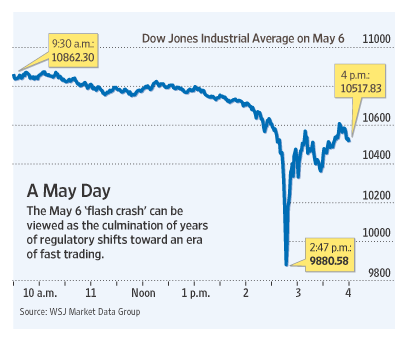
Correlation hits finance again; Flash crash edition

So the curious case of the “flash crash” of 2010 is allegedly solved. A suspect has been named, and arrested. No it’s not one of the usual suspects. This is a guy named Navinder Singh Sarao, day-trading from his home near London. Yes, you saw that right. One guy caused the flash crash it seems. Read this excellent Matt Levine (wish I could write like him!!) piece on this.

Maybe it’s a biased sample that I follow on twitter, but the general discourse there is that this guy has probably been framed. Yes, he did “spoof”, that is, place orders on the markets without intending to execute them, and Levine explains in this post as to why that is a problem (not a very straightforward piece, this, but very insightful if you can “get it”). But in the earlier link you can see that Sarao actually switched off his (spoofing) algorithm before the flash crash happened. So it goes.

I had written glowingly about the “correlation term” in this post last week. But we had seen earlier that it was underestimation of correlation (between homeowners defaulting on mortgages) that led to the 2008 financial crisis. Based on my reading of the story so far, the flash crash was also caused due to some kind of correlation, but of a different kind – correlation between interacting algorithms. Or perhaps I should call this one “resonance”, since it was some kind of freaky frequency match that led to disastrous effects.

So as the more perceptive of you might already know, a large part of the volume of trading in most financial markets is now done by algorithms, without a human touch. On the upside, these result in highly efficient markets (sometimes too efficient, as Levine writes in this piece), and high price discovery. On the downside, this results in a large number of extremely dumb (for that is what algorithms are!) traders overcrowding the market, leading sometimes to extraordinarily dumb decisions by the market itself (like the flash crash). So high frequency trading is controversial, and there is this massive discourse that it is actually harmful to markets, liquidity be damned (Disclosure: I worked for a year at a high frequency trading hedge fund in India).

The thing with spoofing (placing orders and withdrawing them just before they can be executed, to move markets in a specific way) is that it doesn’t work on humans. At least not nowadays, given electronic markets and a high degree of algorithmic trading. The reason is that time scales don’t match – the time scale at which an order is placed, and then removed is much smaller than the time in which a human can react. And humans are usually intelligent enough to see through some of the more common spoofs.

In other words, spoofing is exclusively in place to trick “dumb” trading algorithms to move in a particular manner, which the spoofing algorithm spots and profits from. In other words, spoofing algorithms are some kind of “second degree algorithms” in that they try to profit by tricking other algorithms. And you have anti-spoofing algorithms that are in place to profit from snooping algorithms. And it is all pretty normal stuff.

So what caused that flash crash was a coming together of algorithms that shouldn’t have come together. A set of spoofs were designed to fool a particular class of algorithms, but instead ended up trapping another class of algorithms, which were possibly dumber and over-reacted to the spoof. This over-reaction triggered other algorithms which were possibly in place to detect quick market movements, and trade on the “momentum” to make a profit, and this led to a further drop in prices. And that triggered off a self-fulfilling thing among algorithms, and before the human overlords could react, the markets had crashed some 10%.

\

So the problem with algorithmic trading is that it creates dumb traders, and new traders are designed to take advantage of these dumb traders. Add a few more meta layers to this and you have more complexity than in a CDO Squared. As with most complex systems, such complexity is quite okay in normal times, as these multilayered algorithms usually cancel each other out and make each other more efficient. But once in a while, like on May 6th 2010, their frequencies resonate, and the system blows up.

Back when I was a HFT trader (that’s an AER redundancy), I was told that SEBI (the Securities and Exchange Board of India) mandated that our algorithms be “audited”, so that they are not malicious and don’t cause trouble. While I appreciate the principle behind the regulation, the problem is that most algorithms are harmless for the most parts, and by themselves, definitely harmless. It is only when they come together with other algorithms, and in very rare cases (like this one), that they create havoc, and a statutory audit can in no way pick this up.

The SEBI regulation is good in spirit but practically wholly useless!

Startup equity and the ultimatum game

The Ultimatum Game is a fairly commonly used game to study people’s behaviour, cooperation, social capital, etc. Participants are divided into pairs, and one half of the pair is given a sum of money, say Rs. 100. The objective of this player (let’s call her A) is to divide this money between herself and her partner for the game (whom we shall call B). There are no rules in terms of how A can divide the money, except that both sums need to be non-negative and add up to the total (Rs. 100 here).

After A has decided the division, B has an option to either accept or reject it. If B accepts the division, then both players get the amounts as per the division. If B rejects the division, both players get nothing.

Now, classical economics dictates that as long as B gets any amount that is strictly greater than zero, she should accept it, for she is strictly better off in such a circumstance than if she rejects it (by the amount that A has offered her). Yet, several studies have found that B often rejects the offer. This is to do with a sense of “unfairness”, that A has been unfair to her. Sociologists have found that certain societies are much more likely to accept an “unfair division” than others. And so forth.

The analogy isn’t perfect, but the way co-foundes of a startup split equity can be likened to a kind of an ultimatum game. Let’s say that there are two people with complementary and reasonably unique skills (the latter condition implies that such people are not easily replaceable), who are looking to get together to start a business. Right up front, there is the issue of who gets how much equity in the venture.

The thing with equity divisions between co-founders is that there is usually not much room for negotiation – if you end up negotiating too hard, it creates unnecessary bad blood up front between the founders which can affect the performance of the company, so you would want to get done with the negotiations as soon as possible. It should also be kept in mind that if one of the two parties is unhappy about his ownership, it can affect company performance later on.

So how do the founders decide the equity split in this light? Initially there will be feelers they send to each other on how much they are expecting. After that let us say that one of the founders (call him the proposer) proposes an equity division. Now it is up to the other founder (call him the acceptor) to either accept or reject this division. Considering that too much negotiation is not ideal, and that the proposer’s offer is an indication of his approximate demand, we can assume that there will be no further negotiation. If the acceptor doesn’t accept the division that the proposer has proposed, based on the above (wholly reasonable) conditions we can assume that the deal has fallen through.

So now it is clear how this is like an ultimatum game. We have a total sum of equity (100% – this is the very founding of the company, so we can assume that equity for venture investors, ESOPs, etc. will come later), which the proposer needs to split between himself and the acceptor, and in a way that the acceptor is happy with the offer that he has got. If the acceptor accepts, the company gets formed and the respective parties get their respective equity shares (of course both parties will then have to put in significant work to make that equity share worth something – this is where this “game” differs from the ultimatum game). If the acceptor rejects, however, the company doesn’t get formed (we had assumed that neither founder is perfectly replaceable, so whatever either of them starts is something completely different).

Some pairs of founders simply decide to split equally (the “fairest”) to avoid the deal falling through. The more replaceable a founder or commoditised his skill set is, the less he can be offered (demand-supply). But there are not too many such rules in place. Finally it all boils down to a rather hard behavioural problem!

Thinking about it, can we model pre-nuptial agreements also as ultimatum games? Think about it!