Resorts

We spent the last three days at a resort, here in Karnataka. The first day went off very peacefully. On the second day, a rather loud group checked in. However, our meal times generally didn’t intersect with theirs and they weren’t too much of a bother.

Yesterday, a bigger and louder (and rather obnoxious – they were generally extremely rude to the resort staff) group checked in. Unfortunately their meal times overlapped with ours, and their unpleasantness had a bearing on us. Our holiday would have been far better had this group not checked in to our resort, but there was no way we could have anticipated, or controlled for that.

The moral of the story, basically, is that your experience at a resort is highly dependent on who else is checked in to the resort at the same time.

The thing with resorts is that unlike “regular hotels”, you end up spending all your time during your holiday in the resort itself, so the likelihood of bumping into or otherwise encountering others who are staying at the resort is far higher. And this means that if you don’t want to interact with some of the people there, you sometimes don’t really have a choice.

Of course, it helped that the resort we were in had private swimming pools attached to each room, and was rather large. So the only times we encountered the other groups at the resort was at meal times. However, as we found during our last day there, that itself was enough to make the experience somewhat unpleasant.

My wife and I had a long conversation last night on what we could do to mitigate this risk. We wondered if the resorts we have been going to are “not premium enough” (then again, a resort with private swimming pools in each room can be considered to be as premium as it gets). However, we quickly realised that ability to pay for a holiday is not at all correlated with pleasantness.

We wondered if resorts that are out of the way or in otherwise not so popular places are a better hedge against this. Now, with smaller or less popular resorts, the risk of having unpleasant co-guests is smaller (since the number of co-guests is lower). However, if one or more of the co-guests happens to be unpleasant, it will impact you a lot more. And that’s a bit of a risk.

Maybe the problem is with India, we thought, since one of the nice resort holidays we’ve had in the last couple of years was in Maldives. Then again, we quickly remembered the time at Taj Bentota (on our honeymoon) where the swimming pool had been taken over by a rather loud tour group, driving us nuts (and driving us away to the beach).

We thought of weekday vs weekend. Peak season vs off season. School holidays vs exam season. We were unable to draw any meaningful correlations.

There is no solution, it seemed. Then we spent time analysing why we didn’t get bugged by fellow-guests at Maldives (my wife helpfully remembered that the family at the table next to ours at one of the dinners was rather loud and obnoxious). It had to do with size. It was a massive resort. Because the resort was so massive, there would be other guests who were obnoxious. However, in the size of the resort, they would “become white noise”.

So, for now, we’ve taken a policy decision that for our further travel in India, we’ll either go to really large resorts, or we’ll do a “tourist tour” (seeing places, basically) while staying at “business hotels”. This also means that we’re unlikely to do another multi-day holiday until Covid-19 is well under control.

Postscript: Having spent a considerable amount of time in the swimming pool attached to our room, I now have a good idea on why public swimming pools haven’t yet been opened up post covid-19. Basically, I found myself blowing my nose and spitting into the pool a fair bit during the time when I was there. Since the only others using it at that time were my immediate family, it didn’t matter, but this tells you why public swimming pools may not be particularly safe.

Postscript 2: One other problem we have with Indian resorts is the late dinner. At home, we adults eat at 6pm (and our daughter before that). Pretty much every resort we’ve stayed in over the last year and half has started serving dinner only by 8, or sometimes at 9pm. And this has sort of messed with our “systems”.


Ten pertinent observations, ten years later

It’s been ten years since this happened:

So we spent the morning watching our wedding video (yes, you might think wedding videos are useless, but they do come in useful once in a while, so you better get them taken) with our daughter. Here are ten pertinent observations about our wedding after watching this video, in no particular order.

  1. The whole thing seems way too long drawn out (the official wedding itself lasted seven sessions, or three days and a half). I remember being incredibly tired and stressed out by the end of it. A lot of things we did seem rather meaningless, in hindsight, as well.

    Given a choice now, I’d do it in a registrar’s office, followed by a party.

  2. For our reception, my niece, who was then barely a teenager, was wearing a “cold shoulder” dress. I had no clue that cold shoulder tops/dresses were already a thing in India in 2010, or that it had already gotten popular with teenagers.
  3. We had invited lots of people. It was absolute chaos at our wedding, especially since it was on a Sunday morning. Guests at the wedding included aunt’s school friends, my grandfather’s cousins (some of whom I didn’t know at all), the priest at a temple near my wife’s house, the bhelpuri guy with a cart down the road from my wife’s house, parents of a friend I’d long lost touch with, the  guy who supplies coffee powder to my in-laws, etc. Now you know why Indian weddings (pre covid-19, at least) are big and fat.
  4. Some of the guests whom neither of us know well – we have over the years tagged them by the gift they gave us at the wedding. “This is my dad’s cousin who gave us that clock”, or “this is the family that gave the plate”, etc. Sometimes we think that if we don’t know the hosts well, what gifts we give doesn’t matter. Not always true.

    On the other hand, you don’t remember the gifts that people close to you gave you. Your relationship with them goes far beyond a wedding gift.

  5. The funniest part of reception photos is when groups get mixed together. Given that we had long lines (see 3 above), taking a photo with just one guest was a sort of waste of time. So in some cases, people were arbitrarily (based on their position in line) clubbed together for photos. It’s fun to see these combinations, in hindsight.
  6. The only way we know that someone attended our wedding is if they gave us a gift (they’re all tabulated in a diary), or if they came up on stage (braving the crowds) to wish us during the wedding or the reception. So if you think that your “presence is itself a present”, then you need to make sure that you clearly register your presence.

    The evening of my wedding, I saw two emails, from friends saying “I was there at your wedding. I’m not sure if you saw me”. Smartphones weren’t a thing in 2010, but if you’re going to do this now, you better attach a selfie as well.

  7. There’s a reason I’ve put a picture from our wedding, and not from our reception, as part of this post. We both look absolutely atrocious at our reception. Both heavily over-made-up. Every time we look at our reception photos, we end up laughing loudly at each other.
  8. I’ve worn my wedding suit only once in the last 10 years – for my wife’s MBA graduation. My wife hasn’t worn her reception sari even once after the wedding (I had completed my MBA before we got married). At the time we bought them, they were our costliest ever suit and costliest ever sari respectively.
  9. It’s fun to watch these photos and videos to see how some people have changed over the years. A lot of people have visibly gotten older in the last 10 years. Many others look exactly the same. And some people actually look younger now than they did at our wedding (maybe a function of fitness?).

    The funnest to look at are those who were kids at the time of our wedding, but who are adults now. And those who had hair at the time of our wedding, and don’t now.

  10. Over the years, the influence of Bollywood has meant that South Indian weddings have borrowed a lot from North Indian weddings. Like mehndi is a common thing in South Indian weddings now. Maybe shoe hiding as well. However, we’re extremely proud of the one thing we “imported”, and which not too many others have done (even ten years down the line).

    On the eve of our wedding, at the wedding hall itself, we had a dance party. Yes, really. We had a DJ. No choreography nonsense. Just a good old post-dinner dance party. Among other things, we got to see a side of some relatives that we hadn’t otherwise seen. It was great fun overall.


Re-gifting for rebel girls

On the occasion of her birthday a couple of months back, the daughter received a copy of “Goodnight stories for rebel girls“. As you might have guessed, this was not the first time she had received this book – we had bought it for her earlier this year.

Interestingly, barely a week or two before, some friends who were visiting had gifted her “goodnight stories for rebel girls – 2“, saying that they were pretty confident that she will have this first book already.

In any case, once you have a second copy of a book, the honourable thing to do is to gift it to someone. So the copy of goodnight stories (1) that was received for the daughter’s birthday immediately went into our “regifting cupboard”. It continues to sit there.

The question is who to regift it to. It is a fair hypothesis that most girls will already have the book. So regifting it to another girl will only send it on an endless orbit of regifting. The logical corollary is that we need to regift it to a boy.

Here is where it gets a bit complicated. We’re pretty sure that any boy being brought up by a “feminist mother” (or “feminist parents”) will already have a copy of the book. And if we were to gift the book to a boy whose parents aren’t feminist, we’ll only end up pissing off the boy’s parents.

Who said giving a gift is easy?

Number fourteen

I killed another rat this morning. The fourteenth of my life. This came six years after my thirteenth. And it was also the hardest, forcing me to take the help of “unnatural support” to trap and kill it.

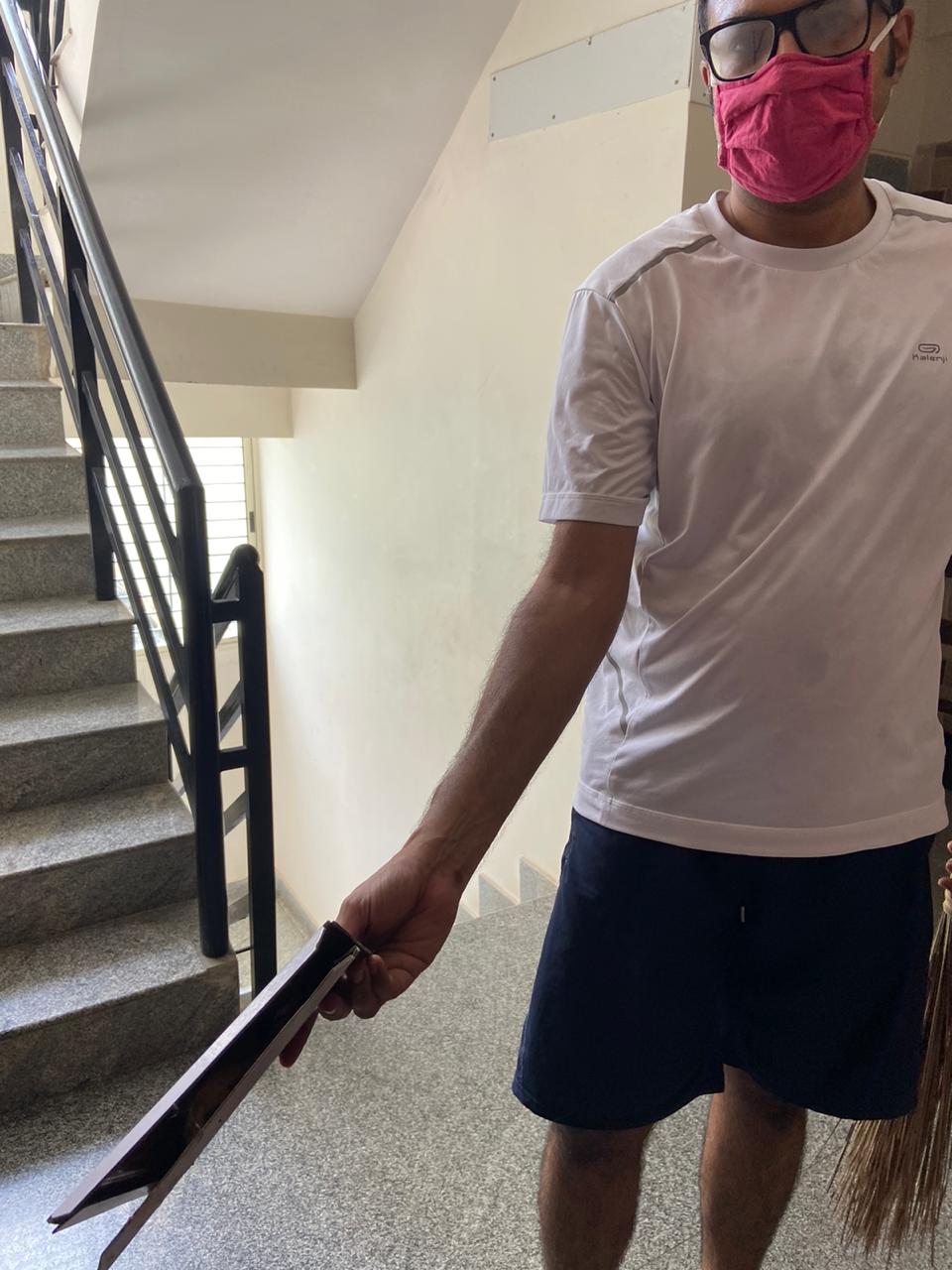
Unfortunately this was the best picture we could get, since I had decided to close the sticky mat after killing the rat on it

I first noticed the rat on Monday night when I was talking to a friend. I had stepped out of the bedroom to take the call, and we were barely done with pleasantaries when I said, “shit, there is a rat in my house”. “Oops, do you need to go? Are you scared?”, he asked. “Not scared, but I need to kill it”, I said, and ran.

As it happened, I was wearing my AirPods, and I ended up running too far away from my phone, and the call got cut. I had seen the rat going under the dining table, and then into the kitchen. By the time I fetched a stick broom (the one usually used to sweep outdoors – they are excellent for killing rats – see my left hand in the picture above), the rat had disappeared.

The fundamental principle of killing rats is to isolate it in one room, that is preferably “open” (without too many nooks and corners where it can hide). Our living room in this house is especially unsuited for this purpose since it has too many orifices, and many of these orifices can’t be shut.

In any case, I saw the rat hiding inside the back of the refrigerator. The idea was to move the refrigerator and whack it as soon as it ran out. Unfortunately, with my reflexes not being what they used to be, I wasn’t able to whack it adequately and the rat ran into my daughter’s room (she doesn’t sleep there yet).

This was both a good and a bad thing. The good thing was that the rat could be isolated inside this room. The bad thing was that there are too many things in this room, making it impossible to trap a rat there. I tried anyway, with a broom and a stick, for twenty minutes before giving up and calling back my friend.

Yesterday was an attritional battle. We woke up to the sight of the rat having tried to gnaw at the room door. It was nowhere to be found, though. I went to a nearby shop and got some rat poison (in the form of “cakes”), and for good measure also got a rat sticky board.

Representative image of a rat glue trap

I left some old potato chips in the middle of this pad, and spread the poison cakes throughout the room. Every two or three hours through yesterday I kept going in to check if the rat had eaten the cakes or otherwise been trapped. There was no luck.

This morning there was evidence once again that the rat had tried to gnaw the bottom of the room door. It was time for more proactive measures. The first step was to empty out the room. The amount of stuff (toys, dolls, games, etc.) that my daughter has is insane. Having made a mental note to “Marie Kondo her stuff” later today, I went on to finding the rat.

Despite mostly emptying the room, the rat was nowhere to be found. This reminded me of computer programming. Sometimes you know there is a bug, but you just aren’t able to find it. Finally, after more than an hour of search, I found that the rat had made itself cosy in the window curtains.

In computer programming, once you’ve found a bug, fixing it is relatively easy. With physical rodents, it’s not so straightforward. The rat started giving me a hard time.

Out (of the room) came the curtains. Out (of the room) came these boxes in which my daughter stores her toys. It was to no avail, as the rat cleverly used the mattress as a shield (irrespective of how I placed the mattress – horizontal / vertical / whatever). Finally, having made sure that the rat wasn’t in the mattress, that was pushed out of the room as well.

In general, catching a rat needs two people. One person prods from one side and the other person whacks from the other. My first ever experience of killing a rat (it’s counted in the 14) came as an assistant to my father, who had handed me a cricket bat when a rat had dared to come to our bathroom.

On subsequent occasions, I’ve used my aunt, my aunt’s housekeeper, my mother-in-law and others as my assistants. Today, there was no such help coming. My wife was too scared, and she had convinced the daughter as well that rats can be scary, so I was left to my own devices.

And it was my devices – one that I had purchased yesterday, to be precise – that came of use. I had noticed that the rat kept running under a chest of drawers every time I attacked it. So I strategically left the sticky mat under the chest of drawers, and kept chasing the rat under it. And one time, it stuck.

A couple of whacks with the broom finished it off. “Fourteen”, I shouted. I admit I sort of “cheated”, by using “unnatural aids” (the sticky mat) in this process. In my defence, I didn’t have any human support so was forced to use this.

Start the game already!

69 is the answer

The IDFC-Duke-Chicago survey that concluded that 50% of Bangalore had covid-19 in late June only surveyed 69 people in the city. 

When it comes to most things in life, the answer is 42. However, if you are trying to rationalise the IDFC-Duke-Chicago survey that found that over 50% of people in Bangalore had had covid-19 by end-June, then the answer is not 42. It is 69.

For that is the sample size that the survey used in Bangalore.

Initially I had missed this as well. However, this evening I attended half of a webinar where some of the authors of the survey spoke about the survey and the paper, and there they let the penny drop. And then I found – it’s in one small table in the paper.

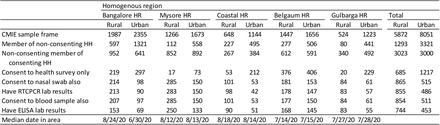
The IDFC-Duke-Chicago survey only surveyed 69 people in Bangalore

The above is the table in its glorious full size. It takes effort to read the numbers. Look at the second last line. In Bangalore Urban, the ELISA results (for antibodies) were available for only 69 people.

And if you look at the appendix, you find that 52.5% of respondents in Bangalore had antibodies to covid-19 (that is 36 people). So in late June, they surveyed 69 people and found that 36 had antibodies for covid-19. That’s it.

To their credit, they didn’t highlight this result (I sort of dug through their paper to find these numbers and call the survey into question). And they mentioned in tonight’s webinar as well that their objective was to get an idea of the prevalence in the state, and not just in one particular region (even if it be as important as Bangalore).

That said, two things that they said during the webinar in defence of the paper that I thought I should point out here.

First, Anu Acharya of MapMyGenome (also a co-author of the survey) said “people have said that a lot of people we approached refused consent to be surveyed. That’s a standard of all surveying”. That’s absolutely correct. In any random survey, you will always have an implicit bias because the sort of people who will refuse to get surveyed will show a pattern.

However, in this particular case, the point to note is the extremely high number of people who refused to be surveyed – over half the households in the panel refused to be surveyed, and in a further quarter of the panel households, the identified person refused to be surveyed (despite the family giving clearance).

One of the things with covid-19 in India is that in the early days of the pandemic, anyone found having the disease would be force-hospitalised. I had said back then (not sure where) that hospitalising asymptomatic people was similar to the “precogs” in Minority Report – you confine the people because they MIGHT INFECT OTHERS.

For this reason, people didn’t want to get tested for covid-19. If you accidentally tested positive, you would be institutionalised for a week or two (and be made to pay for it, if you demanded a private hospital). Rather, unless you had clear symptoms or were ill, you were afraid of being tested for covid-19 (whether RT-PCR or antibodies, a “representative sample” won’t understand).

However, if you had already got covid-19 and “served your sentence”, you would be far less likely to be “afraid of being tested”. This, in conjunction with the rather high proportion of the panel that refused to get tested, suggests that there was a clear bias in the sample. And since the numbers for Bangalore clearly don’t make sense, it lends credence to the sampling bias.

And sample size apart, there is nothing Bangalore-specific about this bias (apart from that in some parts of the state, the survey happened after people had sort of lost their fear of testing). This further suggests that overall state numbers are also an overestimate (which fits in with my conclusion in the previous blogpost).

The other thing that was mentioned in the webinar that sort of cracked me up was the reason why the sample size was so low in Bangalore – a lockdown got announced while the survey was on, and the sampling team fled. In today’s webinar, the paper authors went off on a rant about how surveying should be classified as an “essential activity”.

In any case, none of this matters. All that matters is that 69 is the answer.


Join a boss or join a company?

“You don’t quit your job. You quit your boss”.

Versions of this keep popping up on my LinkedIn with amazing regularity. People have told me this in a non-ironic way in personal conversations as well, so I assume that it is true.

And now that I’m back in the job market, I’ve been thinking of a corollary to this – basically, if you apply “backward induction” to the above statement, then it essentially means that you “join a boss” rather than “join a company”?

I mean – if the boss is the reason why you quit a particular job, then shouldn’t you be thinking about this at the time when you’re joining as well? And so, while you’re interviewing and having these conversations, shouldn’t you be on the lookout for potential bad bosses as well?

In that sense, as I go through my hunt, I’ve been evaluating companies not just on the basis of what they do and what they might expect me to do, but also on the basis of what I feel about the people I talk to. In some places, I have an idea on who I could potentially report to, and in some I don’t. However, I treat pretty much everyone I talk to as people I have to potentially report to or work with at some point of time or the other, and evaluate the company based on these conversations.

Sometimes I think this might be too conservative, but at other times I think that this conservatism now is worth any potential trouble later.

What do you think about this approach?

Upgrade effect in action

So the workflow goes like this. Sometime a week to 10 days back, I read about the “upgrade effect“. It has to do with why people upgrade their iPhones every 1-2 years even though an iPhone is designed to last much longer (mine is 5 years old and going strong).

The theory is that once you know an “exciting upgrade” is available, you start becoming careless with your device. And then when the device suffers a small amount of damage, you seize the chance to upgrade.

I’m typing this on a MacBook Pro that is 6 years old. It is one of the last “old Macbooks” with the “good keyboard” (the one with keys that travel. I’ve forgotten if this is “butterfly” or “scissor”).

With consistently bad feedback about the other keyboard (the one where keys didn’t travel), I was very concerned about having to replace my Mac. And so I took extra good care of it. Though, this is what the keyboard has come to look like.

Last year I dropped a cup of milk tea on it, and panicked. Two days of drying it out helped, and the computer continued to work as it did (though around the same time the battery life dropped). Last year Apple reintroduced the old keyboard (with keys that travel), and I made a mental note to get a new laptop presently.

However, with this year having been locked down, battery life has ceased to be a problem for me (I don’t have to work in cafes or other places without charging points any more). And so I have soldiered on with my old Mac. And I’ve continued to be happy with it (I continue to be happy with my iPhone 6S as well).

And then on Wednesday I saw the announcement of the new M1 chip in the new Macbook Pro, with much enhanced battery and performance. I got really excited and thought this is a good time to upgrade my computer. And that I will “presently do it”.

I don’t know if I had the article about the “upgrade effect” but the same afternoon, sitting with my laptop on my lap and watching TV at the same time, I dropped it (I forget how exactly that happened. I was juggling multiple things and my daughter, and the computer dropped). I dropped it right on the screen.

Immediately it seemed fine. However, since yesterday, some black bands have appeared on the screen. Thankfully this is at one edge so it doesn’t affect “regular work”  (though last 3-4 months I’ve been using an external monitor at home). Yet, now I have a good reason to replace my laptop sooner than usual..

Based on the reviews so far (all of them have come before the actual hardware has shipped), I’m excited about finally upgrading my Mac. And this computer will then get donated to my daughter (she has figured out to type even on a keyboard that looks like the above).

I hadn’t imagined that soon after learning about the “upgrade effect” I would fall for it. Woresht.

Is handwriting hereditary?

I don’t know the answer to that question. However, I have a theory on how handwriting passes on down the generations.

So my daughter goes to a montessori. There they don’t teach them to read and write at a very early age (I could read by the time I was 2.5, but she learnt to read only recently, when she was nearing 4). And there is a structured process to recognising letters (or “sounds” as they call them) and to be able to draw them.

There are these sandpaper letters that the school has, and children are encouraged to “trace” them, using two fingers, so they know how the letters “flow”. And then this tracing helps first in identifying the sounds, and later writing them.

With school having been washed out pretty much all of this year, we have been starved of these resources. Instead, over a 2 hour Zoom call one Saturday in July, the teachers helped parents make “sound cards” by writing using a marker on handmade paper (another feature of Montessori is the introduction of cursive sounds at a young age. Children learn to write cursive before they learn to write print, if at all).

So when Berry has to learn how a particular sound is to be written, it is these cards that I have written that she has to turn to (she knows that different fonts exist in terms of reading, but that she should write in cursive when writing). She essentially traces the sounds that I have written with two fingers.

And then in the next step, I write the sounds on a slate (apparently it’s important to do this before graduating to pencil), and then she uses a different coloured chalk and traces over them. Once again she effectively traces my handwriting. Then earlier this week, during a “parent and child zoom class” organised by her school, she wanted to write a word and wasn’t able to write the full word in cursive and asked for my help. I held her hand and made her write it. My handwriting again!

Now that I realise why she seems to be getting influenced by my handwriting, I should maybe hand over full responsibility of teaching writing to the wife, whose handwriting is far superior to mine.

The trigger for this post was my opening of a notebook in which I had made notes during a meeting earlier this week (I usually use the notes app on the computer but had made an exception). Two things struck me before I started reading my notes – that my handwriting is similar to my father’s, and my handwriting is horrible (easily much worse than my father’s). And then I was reminded of earlier this week when I held my daughter’s hand and made her write.

This is how handwriting runs in the family.

Record of my publicly available work

A few people who I’ve spoken to as part of my job hunt have asked to see some “detailed descriptions” of work that I’ve done. The other day, I put together an email with some of these descriptions. I thought it might make sense to “document” it in one place (and for me, the “obvious one place” is this blog). So here it is. As you might notice, this takes the form of an email.


I’m putting together links to some of the publicly available work that i’ve done.
1. Cricket
I have a model to evaluate and “tell the story of a cricket match”. This works for all limited overs games, and is based on a dynamic programming algorithm similar to the WASP. The basic idea is to estimate the odds of each team winning at the end of each ball, and then chart that out to come up with a “match story”.
And through some simple rules-based intelligence, the key periods in the game are marked out.
The model can also be used to evaluate the contributions of individual batsmen and bowlers towards their teams’ cause, and when aggregated across games and seasons, can be used to evaluate players’ overall contributions.
Here is a video where I explain the model and how to interpret it:
The algorithm runs live during a game. You can evaluate the latest T20 game here:
Here is a more interactive version , including a larger selection of matches going back in time.
Related to this is a cricket analytics newsletter I actively wrote during the World Cup last year. Most Indians might find this post from the newsletter interesting:
2. Covid-19
At the beginning of the pandemic (when we had just gone under a national lockdown), I had built a few agent based models to evaluate the risk associated with different kinds of commercial activities. They are described here.
Every morning, a script that I have written parses the day’s data from covid19india.org and puts out some graphs to my twitter account  This is a daily fully automated feature.
Here is another agent based model that I had built to model the impact of social distancing on covid-19.
tweetstorm based on Bayes Theorem that I wrote during the pandemic went viral enough that I got invited to a prime time news show (I didn’t go).
3. Visualisations
I used to collect bad visualisations.
I also briefly wrote a newsletter analysing “good and bad visualisations”.
4. I have an “app” to predict which single malts you might like based on your existing likes. This blogpost explains the process behind (a predecessor of ) this model.
5. I had some fun with machine learning, using different techniques to see how they perform in terms of predicting different kinds of simple patterns.
6. I used to write a newsletter on “the art of data science”.
In addition to this, you can find my articles for Mint here. Also, this page on my website  as links to some anonymised case studies.

I guess that’s a lot? In any case, now I’m wondering if I did the right thing by choosing “skthewimp” as my Github username.

Core quants and desk quants on main street

The more perceptive of you might have realised that I’m in the job market.

Over the last one month, my search has mostly be “breadth first” (lots of exploratory conversations with lots of companies), and I’m only now starting to “go deep” into some of them. As part of this process, I need to send out a pitch to a company I’ve been in conversation with regarding what I can do for them.

So I’ve been thinking of how to craft my mandate while keeping in mind that they have an existing data science team. And while I was thinking about this problem, I realised that I can model it like how investment banks (at least one that I worked for) do – in terms of “core quants” and “desk quants”.

I have written about this on my blog before – most “data scientists” in industry are equivalent to what investment banks call “core quants”. They are usually highly technically accomplished people; in many cases they are people who were on an academic path that they left to turn to industry. They do very well in “researchy” environments.

They’re great at running long-gestation-period assignments, working on well defined technical problems and expressing their ideas in code. In general, though (I know I’m massively generalising), they are not particularly close to the business and struggle to deal with the ambiguities that business throws at them from time to time.

What I had mentioned in my earlier post is that “main street” (the American word for “general industry”) lacks “desk quants”. In investment banks, desk quants are attached to trading desks and work significantly closer to the business. They may work less on firmwide or long term strategic projects, but their strength is in blending the models and the markets, and building and making simple tweaks to models so that they remain relevant to the business.

And this is the sort of role in which I’m planning to pitch myself – to all potential employers. That while I’m rather comfortable technically, and all sorts of different modelling techniques, I’m not “deep into tech” and like to work close to the markets. I realise that this analogy will be lost on most people, so I need to figure out a better way of marketing myself. Any ideas will be appreciated.

Over the last month or so I’ve been fairly liberal and using my network to get introductions and references. The one thing I’ve struggled with there is how they describe me as. Most people end up describing me as a “data scientist”, and I’m not sure that’s an accurate description of what I do. Then again, it’s my responsibility to help them figure out how best to describe me. And that’s another thing I’m struggling in. “Desk quant” doesn’t translate well.