I completed the manuscript of my book

I had set myself an April 15 deadline to finish the first draft of my book, and I’m happy to let you know that I’ve achieved it. This draft weighs in at around 75,000 words, which is probably longer than I’d expected.

Now the hard part begins – of finding publishers, editing, promotions and all that jazz. I don’t even know where to start and which publishers to approach. This is a popular economics book where I use the concept of market liquidity (from finance) to explain why certain markets are structured the way they are, and how markets can be made more efficient.

Here is a brief introduction of the book that I’ve written. I’m yet to give it a name, but the subtitle is “How financial markets explain life”:

Why do people with specialised skills find it hard to switch jobs? Why do transfer fees for footballers always seem either too high or too low? Why are real estate brokers still in business despite the large number of online portals that have sought to replace them?

The answer to all this lies in liquidity. Broadly speaking, market liquidity refers to the ease with which a product or service can be bought or sold in a particular market. With its origins in financial markets, the concept has far-reaching implications in a large number of markets.

In this book, Karthik Shashidhar, a management consultant and public policy researcher, explores a large number of markets, financial and otherwise, and explains why they are structured the way they are. From relationships to property rights, from big macs to public transport, a large number of markets are dissected to show why liquidity remains a useful concept well beyond financial markets where it originated.

Now, while many of the examples are from India, I’ve written this book with a global audience in mind. Hopefully I should be able to publish and sell this book internationally.

There is a full chapter on the economics of Uber, and how surge pricing is critical to creating liquidity in the rides marketplace. There are also chapters on matchmaking, obsolete technologies, agricultural markets and why most Indians cook at home.

I haven’t really seen any other popular economics books from India, so don’t know where to start my publisher hunt. Any leads will be welcome. I’m currently in Barcelona, but will be returning to Bangalore in mid-May.

Oh, and there is very little intersection with this blog, or anything I’ve published so far. One chapter intersects one blogpost here, and another draws from a Mint piece I’ve written, but the rest is all fresh material. So, you people have no excuse but to buy the book when it does come out!

Wish me luck!
Water, IPL and the ease of doing business

The latest controversy surrounding the just-about-to-start ninth edition of the IPL (a court case challenging its staging in Maharashtra while farmers are dying in Vidarbha) is a clear illustration of why the ease of doing business in India doesn’t look like it will improve.

At the bottom of it, the IPL is a business, with the IPL and teams having invested heavily in team building and marketing and infrastructure. They have made these investments so far hoping to recover them through the tournament, by way of television rights, gate receipts, etc.

Now if the courts were to suddenly decide that the IPL should not take place in Maharashtra, it will mean that alternate arrangements will have to be found in terms of venues and logistics, teams which have prepared grounds in Nagpur, Pune and Mumbai will have to recalibrate strategies, and most importantly, the people of these cities who have bought tickets (they clearly believe that the value of these tickets is higher than the price) will also end up losing.

Farmers dying for lack of water is a real, and emotive, issue. Yet, to go after a high-profile event such as the IPL while not taking other simpler measures to curb fresh water wastage is a knee-jerk reaction which will at best have optical effects, while curbing the ability of businesspersons to conduct legitimate business.

There has been much talk about how policy measures such as the retrospective taxation on Vodafone or Cairn have been detrimental to investor sentiment and curbed fresh investments in India. This court case against the IPL days before it began is no different, and a strong signal that India’s policy uncertainty is not going away quickly.

Unless the political class manages to fix this, and provide businesses more stable environments to operate in, it is unlikely we’ll see significant increase in investments into India.

Mike Hesson and cricket statistics

While a lot is made of the use of statistics in cricket, my broad view based on presentation of statistics in the media and the odd player/coach interview is that cricket hasn’t really learnt how to use statistics as it should. A lot of so-called insights are based on small samples, and coaches such as Peter Moores have been pilloried for their excess focus on data.

In this context, I found this interview with New Zealand coach Mike Hesson in ESPNCricinfo rather interesting. From my reading of the interview, he seems to “get” data and how to use it, and helps explain the general over-performance to expectations of the New Zealand cricket team in the last few years.

Some snippets:

You’re trying to look at trends rather than chuck a whole heap of numbers at players.

For example, if you look at someone like Shikhar Dhawan, against offspin, he’s struggled. But you’ve only really got a nine or ten-ball sample – so you’ve got to make a decision on whether it’s too small to be a pattern

Also, players take a little while to develop. You’re trying to select the player for what they are now, rather than what their stats suggest over a two or three-year period.

And there are times when you have to revise your score downwards. In our first World T20 match, in Nagpur, we knew it would slow up,


Go ahead and read the whole thing.

The problem with premium ad-free television

I watched snippets of the just-concluded ICC WorldT20 final using an illegal streaming service, which streamed content drawn from SkySports2.  The horrible quality of the streaming aside (the server seemed to have terrible bandwidth issues), the interesting thing to note was that it was completely devoid of advertisements.

With the quality of cricket coverage in India currently being abysmal due to the frequent cutting for advertisements (I remember getting thoroughly pissed off with the cuts for advertisements before the replay of a wicket was shown during the India-Australia series earlier this year), it made me think about the economics of a separate premium service that is ad-free.

The infrastructure for delivery is in place, given that internet-based legal streaming services are fairly common now (the likes of HotStar). Internet-based delivery also makes it easy to charge pay per view, so payment is also not a problem. This raises the question of whether it is a good idea for channels to monetise the demand for ad-free cricket by providing the service through online streaming, leaving the mainstream broadcast to be monetised via advertisements.

While in theory this appears like a good idea, the problem is with the kind of people who will migrate to the new service – they will be people who have the ability and willingness to pay for a higher quality broadcast. Such people are likely to belong to two overlapping categories – loyal fans of the game and people who can afford to pay a premium.

It is unlikely that the union of these two sets will comprise of too high a proportion of the overall viewership of the game, but the point is that these are the two groups who are likely to be most lucrative to advertisers – the loyal fans watch regularly and the people who are able to pay have more disposable income.

Moving such customers to an ad-free online channel might reduce the supply of advertisements which can be used to reach them, and this might not make advertisers happy. And given that television channels have cosy relationships with advertisers (or at least media buyers), they are unlikely to piss them off by moving the most lucrative customers to a premium platform.

Of course if this segmentation (between ad-free and free broadcasts) is implemented, it will also impact the price of advertisements in the free broadcast. That will need to be taken as an input while setting prices for the ad-free service. In other words, pricing is going to be a challenge!

If some television channel wants to work on this, I’m available for hire as a consultant. I’ve done a fair amount of prior work on pricing and dynamic pricing, am pretty good at quantitative methods and am in the course of writing a popular economics book.

Seasons

This day eleven years back I travelled to London to intern at an investment bank, in the middle of my MBA. The internship was an academic requirement and popularly referred to as “summer internship” at our school. The term confused people in London, though, with the common reaction being “it isn’t summer now”. Over time I learnt to respond to that with “but it’s summer in Bangalore”.

Back when I was a kid I dutifully learnt from textbooks that there were four seasons – “summer, winter, autumn and spring”. Despite efforts of multiple teachers to explain, I could never understand what autumn (there is no mass shedding of leaves in Bangalore) meant. Some Indian books we had substituted “monsoon” for “autumn” and I started assuming that “autumn” referred to the rainy season.

Over time I have understood that the monsoons are a uniquely India-and-around phenomenon, and they don’t exist elsewhere in the world. What’s taken longer for me to understand, however, is how that has affected my understanding of seasons.

Coming from Bangalore, where April is the hottest month, I’ve always assumed “summer” as lasting from March to May. “Mango showers” start coming in in the beginning of May, cooling down things a bit, and by the time we are in June, the monsoon is in full flow and you might even need a light sweater along with your umbrella.

Things heat up mildly again in October, after the South West monsoon has gone, but the sporadic cyclones of the North-East monsoon aren’t too far away, and there’s a graceful transition to winter. And February is the sole month of “spring” before things quickly heat up again.

It’s April already and things are still cold in Barcelona. It’s not as cold on average as a month earlier – I can occasionally dispense with my scarf, and pavement cafes are more full than before. I still need both a sweater and an overcoat, though, and the winds from the Mediterranean mean that the temperature you feel is much lower than what the thermometer suggests.

While I know that things will heat up in Barcelona in the next month (by which time I’ll be preparing to move back to Bangalore), the fact that things are so cold in April, the month I consider to be the peak of summer, is something that makes me terribly uncomfortable. I also find it quite funny that Barcelona was rather warm in October 2014 (when I first visited, and could walk around in shorts) and is so cold now.

This goes to show how much the monsoons affect the seasons in India, and in South India in particular. In fact, the definition of “summer” (as defined by school holidays) is itself different in different parts of India – South India breaks in April and May, and the North (where the monsoon hits much later) in May and June.

And yet, we continue to teach schoolkids that the “four seasons” are “summer, winter, autumn and spring”

PS: I find it hard to reconcile with the six seasons according to the Hindu calendar as well – maybe those have a North Indian bias

On cricket writing

This piece where Suveen Sinha of the Hindustan Times calls out Dhoni’s “joke” with respect to retirement has an interesting tailpiece:

When Dhoni was bantering with the Australian, the other journalists in the hall were laughing. They would, no sports journalist would want to be anything but nice to the formidable Indian captain. That’s why this piece had to be written by someone whose day job is to write on business and economy.

Looking at the reports of the incidents from both Sinha and EspnCricinfo’s standpoints, it is clear to me that Sinha’s view is more logical. That Dhoni’s calling of the journalist to the press conference table and cross-questioning him was unprofessional on the one hand and showed his lack of defences on the other.

Yet, the ending to Sinha’s piece also explains why other sports journalists have taken to lauding Dhoni’s view rather than critisicing him – for them, access to the Indian limited overs captain is important, and they wouldn’t like to damage that by taking an Australian colleague’s side.

The problem with a lot of sports journalism in general, and Indian cricket journalism in particular, is that jingoism and support for one’s team trumps objective reporting and analysis. One example of this was coverage from Indian and Australian newspapers of the Monkeygate scandal in 2007-08 (when Harbhajan Singh called Andrew Symonds a monkey).

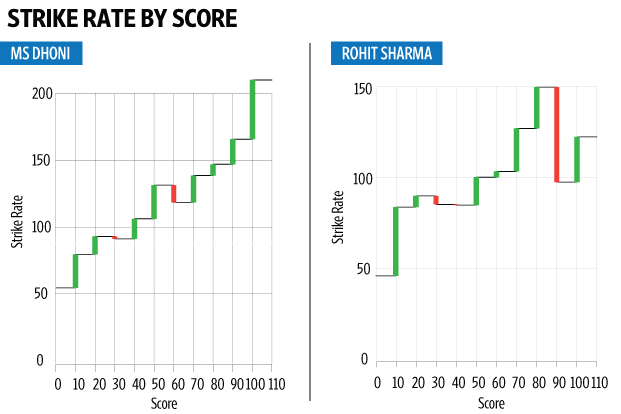
More recently, there was the controversy about India losing games because of the tendency of Rohit Sharma (and Indian batsmen in general) to slow down in their 90s. Again, commentary about that took jingoistic tones, with the Indian sports media coming out strongly in favour of Sharma. There were reports defending his “commitment” and “grit” and all such flowery language sports journalists love, and that Glenn Maxwell’s comment was entirely unwarranted. Maxwell even backed down on his comments.

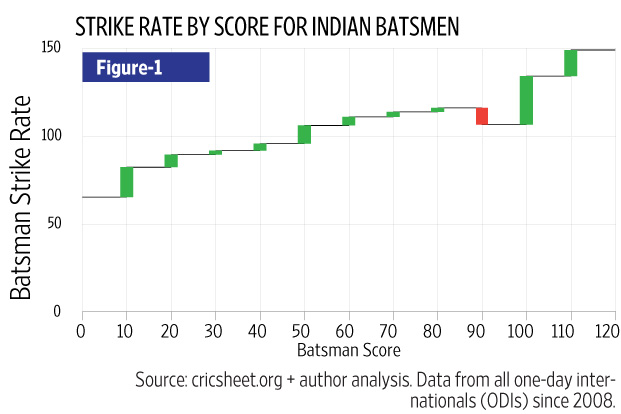
Data, however, showed that Maxwell need not have backed down on his comments. Some analysis based on ball-by-ball data that I published in Mint showed clearly that Indian batsmen do slow down in their 90s, and of all recent players, Sharma was the biggest culprit.

Indian batsmen slowing down in their 90s. My analysis for Mint
Rohit Sharma is among the biggest culprits in terms of slowing down in the 90s

The piece was a hit and was widely shared on social media. What was more interesting, however, was the patterns in which it was shared. For one, the editors at Mint loved it and shared it widely. It was also shared widely by mango people and people with a general interest in cricket.

The class of people which was conspicuous by its absence of commentary on my piece was sports journalists. While it could be reasoned that they didn’t see the piece (appearing as it did in a business publication, though I did send emails to some of them), my reasoning is that this piece didn’t gain much traction among them because it didn’t fit their priors, and didn’t fit the jingoistic narrative they had been building.

It is not necessary, though, that someone only shares pieces that they completely agree with – it is a fairly common practice to share (and abuse) pieces which you vehemently disagree with. The commentary I found about this piece was broadly positive – few people who had shared the piece disagreed with it.

My (untested) hypothesis on this is that this analysis flew in the face of all that mainstream sports journalists had been defending over the previous few days – that Maxwell’s comments were simply not true, or that Sharma was a committed cricketer, and all such hyperbole. With data being harder to refute (only option being to poke holes in the analysis, but this analysis was rather straightforward), they chose to not give it further publicity.

Of course, I might be taking too much credit here, but that doesn’t take away from the fact that there is a problem with sports (and more specifically, cricket) writing. Oh, and as for the ultra-flowery language, I’ll save my comments for another day and another post.