Narendra Modi and the Correlation Term

In a speech in Canada last night, Prime Minister Narendra Modi said that the relationship between India and Canada is like the “2ab term” in the formula for expansion of (a+b)^2.

Unfortunately for him, this has been widely lampooned on twitter, with some people seemingly not getting the mathematical reference, and others making up some unintended consequences of it.

In my opinion, however, it is a masterstroke, and brings to notice something that people commonly ignore – what I call as the “correlation term”. When any kind of break up or disagreement happens – like someone quitting a job, or a couple breaking up, or a band disbanding, people are bound to ask the question of whose fault it was. The general assumption is that if two entities did not agree, it was because both of them sucked.

However, considering the frequency at which such events (breakups or disagreements ) happen, and that people who are generally “good” are involved in such events, the badness of one of the parties involve simply cannot explain them. So the question arises – if both parties were flawless why did the relationship go wrong? And this is where the correlation term comes in!

It is rather easy to explain using vector calculus. If you have two vectors A and B, the magnitude of the sum of the two vectors is given by \sqrt{|A|^2 + |B|^2 + 2 |A||B| cos \theta} where |A|,|B| are the magnitudes of the two vectors respectively and \theta is the angle between them. It is easy to see from the above formula that the magnitude of the sum of the vectors is dependent not only on the magnitudes of the individual vectors, but also on the angle between them.

To illustrate with some examples, if A and B are perfectly aligned (\theta = 0, cos \theta = 1), then the magnitude of their vector sum is the sum of their magnitudes. If they oppose each other, then the magnitude of their vector sum is the difference of their magnitudes. And if A and B are orthogonal, then cos \theta = 0 or the magnitude of their vector sum is \sqrt{|A|^2 + |B|^2}.

And if we move from vector algebra to statistics, then if A and B represent two datasets, the “cos \theta” is nothing but the correlation between A and B. And in the investing world, correlation is a fairly important and widely used concept!

So essentially, the concept that the Prime Minister alluded to in his lecture in Canada is rather important, and while it is commonly used in both science and finance, it is something people generally disregard in their daily lives. From this point of view, kudos to the Prime Minister for bringing up this concept of the correlation term! And here is my interpretation of it:

At first I was a bit upset with Modi because he only mentioned “2ab” and left out the correlation term (\theta). Thinking about it some more, I reasoned that the reason he left it out was to imply that it was equal to 1, or that the angle between the a and b in this case (i.e. India and Canada’s interests) is zero, or in other words, that India and Canada’s interests are perfectly aligned! There could have been no better way of putting it!

So thanks to the Prime Minister for bringing up this rather important concept of correlation to public notice, and I hope that people start appreciating the nuances of the concept rather than brainlessly lampooning him!

How 2ab explains net neutrality

I’ve temporarily resurrected my blog on the Indian National Interest, and this post is mirrored from there. This is a serious argument, btw. After a prolonged discussion at Takshashila this morning, I convinced myself that net neutrality is a good idea.

So Prime Minister Narendra Modi has set off this little storm on Twitter by talking about the relationship between India and Canada being similar to the “2ab term” in the expansion of (a+b)^2 .

Essentially, Modi was trying to communicate that the whole of the relationship between India and Canada is greater than the sum of parts, and it can be argued that the lack of a “cos \theta” term there implies that he thinks India and Canada’s interests are perfectly aligned (assuming a vector sum).

But that is for another day, for this post is about net neutrality. So how does 2ab explain net neutrality? The fundamental principle of the utility of the Internet is Metcalfe’s law which states that the value of a telecommunications network is proportional to the square of the number of entities in the network. In other words, if a network has n entities, the value of these n entities being connected is given by the formula k n^2 . We can choose the unit in which we express utility such that we can set k = 1, which means that the value of the network is n^2.

Now, the problem with not having net neutrality is that it can divide the internet into a set of “walled gardens”. If your internet service provider charges you differentially to access different sites, then you are likely to use more of the sites that are cheaper and less of the more expensive sites. Now, if different internet service providers will charge different websites and apps differently, then it is reasonable assume that the sites that customers of different internet services access are going to be different?

Let us take this to an extreme, and to the hypothetical case where there are two internet service providers, and they are not compatible with each other, in that the network that you can access through one of these providers is completely disjoint from the network that you can access through the other provider (this is a thought experiment and an extreme hypothetical case). Effectively, we can think of them as being two “separate internets” (since they don’t “talk to” each other at all).

Now, let us assume that there are a users on the first internet, and b users on the second (this is bad nomenclature according to mathematical convention, where a and b are not used for integer variables, but there is a specific purpose here, as we can see). What is the total value of the internet(s)?

Based on the formula described earlier in the post, given that these two internets are independent, the total value is a^2 + b^2. Now, if we were to tear down the walls, and combine the two internets into one, what will be the total value? Now that we have one network of (a+b) users, the value of the network is (a+b)^2 or a^2 + 2 ab + b^2 . So what is the additional benefit that we can get by imposing net neutrality, which means that we will have one internet? 2 ab, of course!

In other words, while allowing internet service providers to charge users based on specific services might lead to additional private benefits to both the providers (higher fees) and users (higher quality of service), it results in turning the internet into some kind of a walled garden, where the aggregate value of the internet itself is diminished, as explained above. Hence, while differential pricing (based on service) might be locally optimal (at the level of the individual user or internet service provider), it is suboptimal at the aggregate level, and has significant negative externalities.

#thatswhy we need net neutrality.

The Prime Minister has lunch

Much has been made of the fact that Prime Minister Narendra Modi had lunch at the parliamentary canteen a few days back. The “event” has been covered by newspapers in excruciating detail, and the opposition Congress has taken a jibe at the PM for “eating subsidised food”.

That something like the PM having lunch at the parliamentary canteen being news suggests that something is seriously wrong. I mean, I know that the PM is a busy man and may not have time to socialise during lunch and all that, but considering that he’s also an MP and that parliament is in session, the parliamentary canteen is possibly the most logical place for him to have lunch if he didn’t have any other plans!

Some of the reports also talk about the fact that no prime minister in the last <numbers vary> years had done this, and reports also go on to make a big deal that Modi paid for his own lunch. The amount he paid and the amount he got back as change is also well noted. It is possible that there may not be much news happening, but the footage this event has received is definitely overblown.

Anyway, apart from the fact that this shouldn’t have been news, I have one other quibble with the whole episode. The Indian Express writes:

“As is standard operating procedure, the security personnel accompanying the PM tasted the food before it was served to him. They also took samples of all that was served to him — which is also the standard drill,” a senior catering official said, adding that these samples would be preserved for 72 hours during which they would be sent for testing.

Now, I know that we need to take utmost care for our Prime Minister’s health and safety and all that, but I found this bit a little weird. I mean, while it might be standard operating procedure, this event discloses a level of distrust in the food prepared by the government (IRCTC to be precise) run parliamentary canteen, and that cannot be good signalling!

Why AAP should win Delhi

Though I frequently write analytical pieces about elections, this is NOT one of them. It’s pure unbridled opinion.

I had mentioned this a couple of years back before the elections in 2013, and I mention it again now. The Aam Aadmi Party (AAP) should win Delhi. To rephrase, Delhi should be “sacrificed” to them. If only to illustrate how ridiculous some of their policy ideas are, and why them having a larger role in Indian politics is a terrible idea.

Now, from my timelines on twitter and facebook, I see that a lot of people I know are big fans of AAP. What attracts them to the party is their image of being “clean” and “beyond corruption”. There is also the TINA factor – the Congress has proved time and again that it is incapable of governance and the BJP has this looney fringe with ridiculous social ideas which they actually pay attention to. Given such worthy alternatives, people are plumping for AAP as a party that can provide superior governance.

Except that they seem incredibly commie, except perhaps in name. Look at some of their policy prescriptions (free power, free water, etc.) and you can imagine one of the communist parties coming up with the same. They want to bring back big government in areas where government interference has been cut down after significant effort. They believe that the solution to corruption is more layers of bureaucracy (Jan Lok Pal, etc.). And as the Somnath Bharti incident showed, they are not paragons of virtue when it comes to social freedom, either.

The problem with the AAP is that they haven’t got enough opportunity to show their incompetence, which is why people worship them. They got an opportunity last year, when the Congress supported their minority government in Delhi, but they perhaps wisely saw that their incompetence was being shown up, and Kejriwal resigned in a hurry. And from what opinion polls show, this gambit seems to be working for them. The problem with gambits is that they are tactical weapons, and usually don’t work over a long-drawn period.

So it is time to give the AAP another opportunity to show off their incompetence and bad ideas. Delhi is in that unique position where there is the central government and the municipal government that tread on over one foot of the state government, so the state government can’t do too much damage. And Delhi is also a small state, so any damage will have limited scope.

From this perspective, it is a great idea to “sacrifice” Delhi to the Aam Aadmi Party. I hereby call upon voters in Delhi to vote for the muffler broom.

Grassroots of middle fingers

Note: This post is being written immediately after a trip to Kolkata, where I was greeted by the photo of Mamta Banerjee pretty much everywhere in the city. When I first saw those photos on Thursday night, I thought I’ll liken them to the photos and cutouts of Mahinda Rajapaksa that I saw all over Colombo on my visits there in 2010 and 2014, but then yesterday’s election result perhaps makes that comparison moot. 

There is a special relationship between Mamta Banerjee’s Trinamool Congress and the middle finger. First, almost a decade back, quizmaster Derek O’Brien, who is now a Rajya Sabha member and a spokesperson for the Trinamool congress, held up his middle finger in the middle of Landmark Quiz, Bangalore, in response to some negative feedback from bloggers following his handling of the same quiz in Chennai earlier that year.

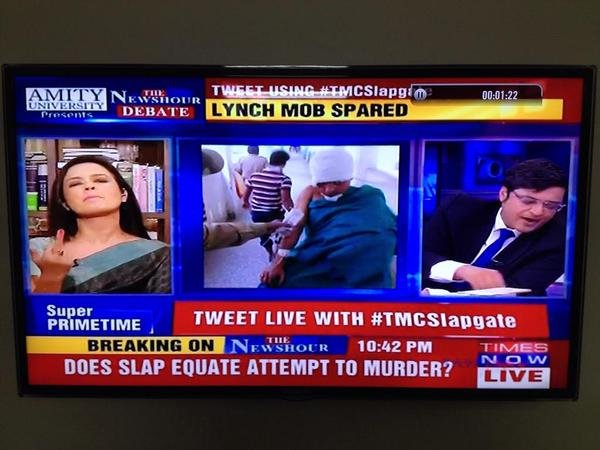
Now, another spokesperson of the same party, Mohua Moitra, has shown that she is not one to be left behind. On Arnab Goswami’s Newshour show last week, she held up her middle finger. And I must say that this is one level better than Derek, for while Derek used his middle finger on a bunch of hapless unsuspecting quizzers, Mohua used hers on Arnab, the greater news anchor of them all, and on prime time television.

Considering that the Trinamool Congress is a breakaway of the Indian National Congress (the name gives it away), it is appropriate that the party chooses an election symbol that reflects that it was one part of the INC’s “Hand”. Considering its spokespeople’s fondness of display of this body part, may I humbly suggest that the Trinamool Congress adopt the “middle finger” as its party symbol? The flower-and-grass symbol the party currently uses seems too tame for it!


Election Metrics goes international

For those of you who are not particularly aware of it, for the last year and a half I’ve been writing this column called Election Metrics for Mint. It’s basically a quantitative take on elections, and in my estimate I should’ve written over 50 pieces for them so far.

The last two pieces, however, have been different in the sense that I have now moved beyond covering Indian elections to look at elections abroad. In my last but one post, published last month,  i took a look at potential cheating in Afghan elections. (Now I remember linking to that piece from here).

Now, in the latest piece that was published today I look at the forthcoming Scottish referendum, and a recent poll by YouGov in which 47% of respondents said they wanted to vote in favour of independence. I use some binomial jugglery that shows that this translates to a 2.5% chance of a Yes vote, which while insignificant, is an order of magnitude higher than the 0.0004% chance of “Yes” that can be implied from an earlier poll.

I then use the “possible, plausible and probable” framework made famous by Bill Gurley and Aswath Damodaran in their “exchange” in July to show why this poll is significant (it shows that a “Yes” vote is “plausible”, while earlier it was possible but definitely not plausible).

The Afghan elections were rigged

That’s what I conclude in a piece I’ve written for Mint which got published today.

I analyze the last digit of the vote tally of different contestants in different provinces, and find an unusually large number of numbers that end in zero – the odds of this happening at random are at most 2.25%, I conclude.

You might be aware that I’ve been doing this series on elections for Mint for over a year now. Since the Indian elections are over, and steam is yet to pick up for state elections in Maharashtra, Haryana and Jharkhand I’m dabbling a bit in analysis of international elections. If there’s something potentially interesting that you want me to analyze, do drop a note here.

So much for Nandan Nilekani’s big data campaign

I got a call a couple of hours back on my landline. The wife picked and was asked to transfer the call to me. When she mentioned that I was busy she was asked about what we think of Nandan Nilekani and whether we are considering voting for him. She told them that we are registered to vote in Bangalore North and hence our opinion of Nilekani doesn’t matter.

I don’t know how the Nilekani campaign team got hold of our phone number. Even if they got from some database I don’t know how they assumed we are registered to vote in Bangalore South. For ours is a bsnl landline and bsnl landlines in Bangalore have a definite pattern that most people in Bangalore are aware of.

Back before 2002 or so when landline numbers in Bangalore got their eighth digit (a leading two) the leading digit of a Bangalore number gave away the broad area.

Numbers in South Bangalore started with 6. A leading 2 meant the number was from the government office dominated areas. A leading 5 was for mg road and the north and east of the city (he cantonment area, indiranagar, koramangala etc) and a leading 3 meant it was a northwest bangalore (malleswaram to vijayanagar) number. 8 was reserved for the outskirts.

Now while Bangalore has expanded significantly these patterns are broadly in place. All you need to do to know where a number is located is to look at the second digit – a 3 there still refers to the north and west sides of the city.

Among the areas of Bangalore that make up Nilekani’s constituency the only one that has a second digit of 3 is vijayanagar (and surrounding areas including the govindrajnagar constituency). From that perspective the likelihood of a number with second digit 2 being in Nilekani’s constituency is really low. Clearly their supposed big data algorithm hasn’t picked that!!

Forget just the second digit – look further down the number. It is public information that 2352 is one of the codes of the Rajajinagar telephone exchange, and all numbers covered by that exchange lie in either bangalore north or Central!!

I wasn’t particularly convinced about Nilekani’s use of big data in the first place – it seemed like the usual media hype – now I think that while his campaign team does use data their use of it is not particularly good. The case that the team in charge of the data analysis for Nilekani lacks any domain knowledge of the city.

Dictatorships and primaries

In their excellent book “the dictator’s handbook” Bruno bueno de Mesquita and Alastair smith talk about why dictatorships usually put on a garb of democracy and hold (mostly) sham elections.

According to bueno de Mesquita and smith the reason is not to appear good in front of the international community, as the general discourse goes. Dictators are extremely rational actors, they say, and reputation in the international community didn’t usually give enough benefit to compensate for the cost of the garb of democracy and elections.

Instead, bueno de Mesquita and smith say that the real purpose of the elections is to keep followers in check. If a member of the dictator’s team “misbehaves” for example, getting rid of him is normally a difficult process. Essentially sacking is a hard job for anyone, even for hard nosed dictators. In the context of dictatorships sackings can get controversial and often bloody and is not a particularly pleasant process.

By putting in a garb of democracy, however, there is an easy way to sack an official. Assuming that in a dictatorship most citizens vote according to the fancies of the dictator, all a dictator needs to do to sack an official is to instruct the electorate to vote against the official the next time he is up for reelection. The sacking having been effected by “popular mandate”, the process is easier and likely to be less bloody and troublesome for the dictator.

Now, the question is if we can use this framework to understand the new US-style primary elections that the Indian national congress has been using for candidate selection in some constituencies in the forthcoming elections.

Normally in the congress, like in most other parties in India, candidates for elections are determined top-down, by the party “high command”. The risk with this however is that candidates who did not get a ticket to contest the elections know that for whatever reason the party high command is not in favour of them contesting. This can lead to disillusionment and can lead to defections to rival parties.

In this context a primary election acts as a facade through which the party high command can get its choice of candidates without pissing off those applicants who did not get the ticket. Now the purported message to these unsuccessful applicants is that the next time they should work of getting the support of the party rank and file in their constituency.

In reality however, with the party being high command driven, the rank and file has voted as per the instructions of the high command! The high command thus gets its choice of candidates without losing the support of the unsuccessful candidates.

So why is it that primaries work in the US? For the same reasons that elections work in democracies! In the US parties are truly democratic and organised bottom up. There is no high command there to (credibly) dictate the choices for the rank and file. So the results of the primaries are truly reflective of the opinion of the party rank and file.

In conclusion, given the high command based structure of political parties in India, primaries will not work. Instead they will only end up as instruments in the hands of the party high commands, just like the sham elections on dictatorships.

Narendra Modi should short the Nifty

The common discourse is that businesses like Gujarat chief minister Narendra Modi, and that India’s economic growth would get back on track if he were to become PM following the elections this summer. For example, this view was articulated well by my Takshashila colleague V Anantha Nageswaran in an Op-Ed he wrote for Mint last Tuesday, where he spoke of a “binary outlook for India” – either economic growth under Modi or further populism and stagnation under a Third Front.

Based on this view being the consensus, one can expect that the Indian stock market would go up significantly in case of a Narendra Modi victory, and would tank in case the Modi (and/or his party BJP) ends up doing badly. So what should Modi do?

He should short the stock markets, and fast. He needs money to run his campaigns, and he might be taking funds from friends and well-wishers, who expect some kind of payback in kind if/when Modi becomes PM. The question, however, is how he will pay them back in case he fails to become PM!

He will not have the power to pay back in kind. There is only so much he will be able to do as the Chief Minister of Gujarat. And given that he has got a lot of fair weather friends over the last couple of years, some of them might be disappointed that he didn’t become PM, and will ask for immediate payment. So how does Modi service these debts?

A part of his campaign budget should go into shorting the Nifty – perhaps by means of buying puts (with a May expiry – not sure they’re traded yet). This way, in case of his victory, he will end up losing his premium, but he will be able to pay back his creditors in kind, since he will be PM. In case he loses? The markets will tank anyway, and he will end up making a packet on these puts, which can then be used to pay back his current well=wishers!

Easy, no?