Water privatization in Kundapur

A couple of years back, in a blog post (part of which also went into a project report), I’d talked about water privatization. I had said that it is a good thing even if it pushes up costs, because it now offers people the option to get piped water supply. The analysis went something like:

1. People who don’t currently have connections will now get connected. And once they are on the network, they have an option to get clean piped water.
2. For people who already have connections, their monthly costs will shoot up. Maybe double. However, given that the average water bill amount is quite low, and is an extremely small proportion of monthly expenditure. So small that even a 100% increase won’t have much of an impact.

It’s time to revisit that case, given that Kundapur, a coastal town in Karnataka has decided to privatize it’s water supply. To summarize, so far, this town was dependent on ground water. Now, they are getting water from the river Varahi. Residents have to pay Rs. 4000 for the connection (half of that refundable), and the monthly bill will come within Rs. 100, they’ve said.

There are two points to note here. Firstly, this is the first time that Kundapur is getting piped water supply. The second is that there is a huge up-front cost.

When I had talked about privatization giving the option of water supply to everyone, I had said that the costs should be structured such that the fixed charge is low or non-existent, and only usage is charged. This way, I had said, there won’t be any adverse impact on the poor (who are outside the system in the first place).

In this context, a financial restructuring of the Kundapur plan might be necessary. The TMC and the water supply firm will have to work out a scheme where they heavily subsidize the up front fee (to say about Rs. 500) in exchange for a higher per-unit charge for water. That kind of a structure would have several benefits.

Firstly, it would be far more inclusive and more people would be brought into the safe water plan. More people would be able to buy the option to get safe drinking water. Secondly, a higher variable charge will also result in more judicious consumption, which is critical for a limited resource such as fresh water. Thirdly, due to the changed payment structure, the heavy users of water (more likely to be the rich and upper middle classes) will end up cross-subsidizing the low volume users (usually the poor). Thus, the adverse impact on the poor can be brought down, and the people who wil have to pay more would be those who won’t mind paying a bit extra.

Of course, there is still a long way to go. The private partner who will handle the operation and maintenance is yet to be selected. There are also bound to be a large number of protests against the privatization itself. The TMC needs to get past that. Also, it seems to be the first time when such an exercise is being conducted in the country. So, other hurdles also can’t be ruled out.

Nevertheless, this outsourcing of operation and maintenance of water supply is a welcome concept, and if implemented and priced in the right way, might become a model to emulate in the rest of the country.

Cross posted at the Indian Economy Blog

Sugarcane Markets

Ah, no. Don’t get psyched by the title. This is not about agriculture, and will not be cross-posted on the Indian Economy Blog. This is more to do with the festival today. Sankranthi.

The basic activity during the festival is that you visit some N houses and give them a stick of sugarcane each (along with “side dishes” such as bananas, occasionally oranges, ellu (til i think it’s called; mixed with small cut pieces of coconut, jaggery, groundnuts, etc.) and figures made out of sugar). And you get back a stick of sugarcane in return (along with similar accompaniments).

Anyways, the point I’m trying to make is that there is very little chance that the sugarcane you buy will end up in your house. Unless of course you buy some “extra stuff” for yourself. And the market encourages recycling. Each piece of sugarcane usually changes hands at least four-five times. Thus, there is a very good chance that you don’t know at all the person who originally purchased the piece of sugarcane you are going to eat.

Another result of the high churn is that it’s difficult for people to keep track of the sugarcane pieces (they don’t have DHL stickers, do they?). There’s no way anyone can remember who gave them the sugarcane that they are now eating. And so there isn’t much of a reputational risk also, in giving poor sugarcane. The only thing is the size of the sugarcane stick. Since the “quality” on that measure can be measured easily. in one glance, as long as you don’t give too short a stick (you’ll definitely be classified as cheap then), you’re ok.

Ok, so, given that the nature of the market is such, what is the incentive to buy good quality sugarcane? What is the incentive to pay more to get better sugarcane? After all after you’ve given someone a piece of sugarcane it’s unlikely she checks for the quality of what you’ve given and then picks the stick to return to you based on that. So why should you even bother about buying good sugarcane?

The other day I’d been to the market, and most of the sugarcane on display seemed to be mediocre. And now, thinking about it, I’m not surprised. Unless you are highly ethical (and the proportion of such people is small, and falling) you’ll just buy whatever you can get cheapest. Simple. And the demand for good sugarcane is so low that the market itself doesn’t exist there, and so everyone is forced to buy mediocre sugarcane. Doesn’t this remind you in some way of the Tragedy of the Commons?

Our festivals should be better designed, I say!

Coffee segmentation and take away and food courts

I really like the way the coffee market in India is segmented. You have a clear distinction of cafe and coffee shop. If you just want a quick tasty caffeine kick, you just go to one of the cafes (Darshini types) and for some 6-7 rupees you’ll get excellent steaming and strong filter coffee. However, there is only standing room there and you can’t really hang around.

Continue reading “Coffee segmentation and take away and food courts”

Teaching Economics: Part Two

Madman Aadisht has extended my earlier post to talk about why Economics toppers from DU don’t necessarily need to clear in their concepts. He talks about the admission process and the internal examination process and the course content to arrive at this particular conclusion. So what could be done to fix it? There is no dearth of enthu for the study of economics in India. And I get the feeling that a lot of people are put off from it due to absence of quality colleges (apart from a couple of colleges in Delhi, and one in Bombay, nothing really stands out).

Continue reading “Teaching Economics: Part Two”

The Bus Sensor

Waiting endlessly for a bus on my way to office, I was thinking about what might make the life of bus travelers better, and make them wait less. I was thinking if there?s anything that can be done in order to help people plan their bus journeys on a real-time basis. Here are my thoughts on the same. It might have been implemented somewhere, but still, please let me know your views on this.

Continue reading “The Bus Sensor”

The Sugarcane Mess

The situation with the sugar industry has gotten more bizarre, with the Allahabad HC stepping in and mandating that the mills buy sugarcane at Rs. 110 per kilo and start processing. While on first thought, it seems quite funny that the high court is getting into matters it shouldn’t get into, such as fixing of a market price, the situation on the ground is quite grim.

Continue reading “The Sugarcane Mess”

More on studs and fighters

My recent post on studs and fighters was generally well-received. However, there were a few issues that people raised regarding the framework. Some of them were

  • Stud and fighter are not mutually exclusive – some people are both
  • You can’t categorize those that are not stud or fighter as losers
  • All studs are not similar, and all fighters are also not equally similar

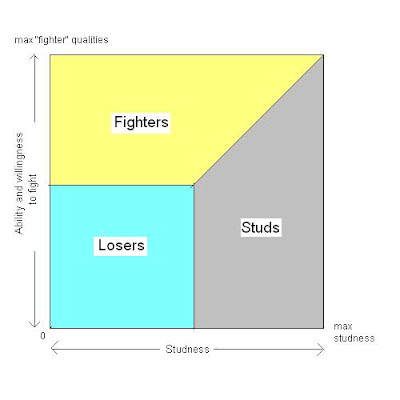
To address some of these, and to further enrich the model, I came up with the following. The basic concept is that everyone (I mean everyone) is both a stud and a fighter. Rather, everyone some bit of studness and some bit of ability to fight, the extent of course varies. And thus, based on their stud and fighter levels, all the people in the world can be mapped on to the following rectangle:

Left bottom is of course the absolute loser. Who has absolutely no talent and also has zero ability to fight. There is a stud cutoff and a fighter cutoff (haven’t marked them explicitly on the graph). All those whose studness exceeds the stud cutoff qualifies to be a stud. Similarly for fighters. If you clear both cutoffs, then you look at the diagonal line to see which category you fall.

Using this, I think we can include a larger number of people into the analysis, compare people, and still retain the old framework of studs and fighters. ?

Studs and Fighters

There are basically two kinds of people in the world – studs and fighters. At the outset, let me clarify that they are neither mutually exclusive nor exhaustive. Those that are neither stud nor fighter usually end up as losers, so let’s leave them out of the analysis. People who are both stud and fighter are special. Found extremely rarely. Hence let’s leave them out too.

Continue reading “Studs and Fighters”

A framework to understand quality of life

Trying to analyze the NED which had hit me a few weeks back, and has partially stayed on, I think I’ve come up with a framework (yes I was a management consultant for three months) to try explain how life can get messed up. It’s some kind of a building structure (insert whatever is appropriate here – skyscraper or pyramid or whatever).

Continue reading “A framework to understand quality of life”