New line of business

I’m considering a new line of business. This is basically advising startups on option valuation and how to account for different conditions and optionalities that venture capitalists put in in term-sheets.

Aswath Damodaran has an extremely interesting piece on valuation of the so-called “unicorns” and how such valuations are inflated on account of optionality in favour of investors. He takes a stab at valuing such optionality, but I think there’s scope for going deeper and helping companies figure out the valuations in each individual case. Money quote from the piece:

As an outsider with an interest in valuation, I find venture capital deals to be jaw-droppingly complex and not always intuitive, and I am not sure whether this is by design, or by accident. When it comes to investor protection, the stories that I read for the most part are framed as warnings to owners about “vulture capital” investors who will use these protection clauses to strip founders of their ownership rights. I think the story is a far more complex one, where both investors and owners see benefits in these arrangements, and where both can expose themselves to dangers, if they over reach.

Do you think this is a good line of business to get into? Will startups be willing to pay for a service that allows founders to get value for money for the equity they are giving away? Or will they be so focussed on execution that trifles such as a change in valuation by a few percentage points don’t matter to them any more?

And what are the odds that if I get into this business and do a good job of it, a VC will want to hire me just so that I stop damaging their carefully designed ratchets?

Analysts, competition and Wall Street deaths

Yet another investment banking analyst has died. Sarvshreshth Gupta, a first year Analyst at Goldman Sachs’s San Francisco office reportedly killed himself after not being able to handle the workload. Reporting and commenting on this, Andrew Ross Sorkin writes:

Some banks, like Goldman, are also taking new steps, like introducing more efficient software and technology to help young analysts do their work more quickly. And investment banks say they are hiring more analysts to help balance the workload.

I simply fail to understand how these measures help balance the workload. I mean having more analysts is good in that the same work now gets split between a larger number of analysts. However, that there are more analysts doesn’t mean that the demand for Associates or Vice Presidents has actually gone up – that might go up only with deal flow.

In other words, what the above measure has done is to actually make the organisational structure “more pyramidal” (i.e. reduced the slope of the “pyramid’s walls”). So now you have a larger number of analysts competing for the same number of associate and VP positions. I don’t see how it makes things better at all!

On another note, I wonder if the number of deaths among Wall Street analysts has actually gone up, or if they have only started being reported more in recent times, after Wall Street got into trouble. Based on my limited understanding, I think it is the case of the former, and I attribute it to the lack of choice.

Back in 2004, I attended a talk by a Goldman Sachs MD (who worked in the Investment Banking Division, which does Mergers and Acquisitions, IPOs, etc.) in IIMB where he told me about the lifestyle in his division. That was the day I swore never to apply to that kind of a role. Given that the sales and trading side was doing rather well then, however, I had a choice to take up another equally lucrative, but less stressful-on-lifestyle career. That I chose not to (in 2006) is another matter.

The way I see it, following the crash of 2008, sales and trading have never recovered and don’t recruit as many as they used to. That takes care of one “competitor” of investment banking division. The other “competitor” is consulting, but they don’t pay just as well. In fact, with banking on the downswing, the supply of quality candidates to consulting firms has improved to the extent that they haven’t had to raise salaries as much. For example, starting salaries of IIM graduates at top-tier consulting firms in India have only grown at a CAGR of 6.5% since the time I graduated in 2006.

What this means is that few jobs can match the pay of investment banking, and that reduces the number of exit options. A few years back, anyone who found it too stressful had the option to move out to another job that was less demanding in terms of number of hours (though still stressful) without a cut in pay. This option has expired now, with the effect that people soldier on in investment banking jobs even if they’re not completely cut out for them.

And then some don’t make it. And so they go..

Probability of accidental death

So I’ve received two separate SMSs from my bankers over the last few days. One of them asks me to sign up for the Pradhan Mantri Suraksha Bima Yojana at Rs. 12 per annum for an insurance against accidental worth Rs. 2 lakhs. The other SMS asks me to sign up for a more general life insurance scheme (the Pradhan Mantri Jeevan Jyoti Yojana) by paying a premium of Rs. 330 per annum. Here is a poster that describes the two schemes:

Considering that you can insure yourself against all kinds of death for a premium of Rs. 330 per annum, and you can insure yourself against accidental death alone for a premium of Rs. 12 per annum, what this implies is that the probability of death by accident given death is 12/330 or 3.6%. Which seems rather low considering that it’s mostly the younger population that is covered by these insurance schemes!

That aside, it’s a good move by the government to increase insurance penetration. I don’t know about accidental death, but the rate on the life insurance is pretty good, and there is a reasonable cut for the banks too for distributing this instrument. And going by the principle that you should be insured for about 5-7 years’ of annual income, Rs. 2 lakhs is a decent amount (India’s mean income is USD 1500 (~INR 90,000) per head. But the median income is likely to be much lower ).

Moreover, the implementation of these schemes is rather simple, since the premium directly goes from your bank account and you can sign up with a SMS, and there are no medical tests. Hopefully this scheme will take off and the insurance penetration in India will increase significantly.

As an aside, I wonder what impact this will have on the life insurance industry which thrives in selling plans that are a combination of insurance and investment. Now that this scheme shows off the real cost of insurance (Rs. 330 for a Rs. 2 lakh insurance), customers might become more discerning about these combo plans and see through the margins the insurers are making, and this may not be all that good for the insurers. Though this might be offset by these insurers themselves becoming underwriters to the government plan itself.

Disclosure: I’ve worked as a consultant with a leading Indian life insurance firm.


More on IPOs

In the past I’ve written on this blog that IPOs that open with a pop are actually unfair to the existing shareholders of the company, and are not as “successful” as reported by the media. To this, people from the industry have pointed out that the “pop” (increase in share price on the day of listing) actually increases the value of the shares held by the existing shareholders and hence this is a good deal.

I’ve always been unsure about this kind of analysis, and have held it suspiciously as one of those views held by people who accept “received wisdom” without much questioning and so much of such wisdom gets received that it becomes a thing. While investment bankers are usually incentivised on a percentage of the money raised by the IPO, considering that they are a platform for trading, they choose to forego some of that income by transferring money to the other side of the market – the “buy side” who are their more consistent customers.

In the aftermath of the LinkedIn IPO which I had written about in a similar context a few years back,  Facebook went public and it seems like they had put immense pressure on their bankers (Morgan Stanley if I’m not wrong) to “not leave money on the table”. And the IPO had opened rather flat. Not great for investors but excellent for Mark Zuckerberg and other old shareholders in Facebook.

Anyway, the reason I revisit this topic is this IPO by this Chinese company called Beijing Baofeng. Check out its share price movement:

The reason you see the neat step graph is that on each trading day following its IPO the share has hit the upper circuit breaker (at which point trading in the security is closed for the day). The inimitable Matt Levine has mentioned in his daily newsletter (which I subscribe to, and you should, too) that the stock has gained 1600% after the IPO, which makes LinkedIn’s doubling of share price on IPO day look like child’s play!

A takeaway from this is that investment banking remains strong as an industry, and bankers continue to shaft their hapless clients (or, if we should give them more credit, are so inept that they consistently underprice IPOs). It would be a great industry to get into except that they’re not hiring (a straw poll I conducted in the IIMB class I taught showed that hardly anyone had got a banking job)!

I continue to wonder how the IPO industry can be disrupted!

Correlation hits finance again; Flash crash edition

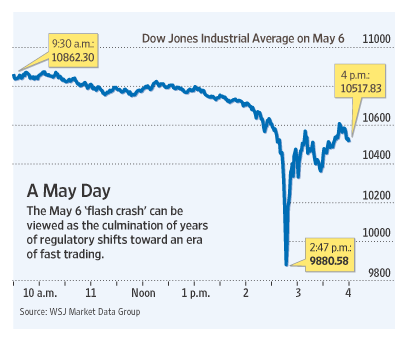
So the curious case of the “flash crash” of 2010 is allegedly solved. A suspect has been named, and arrested. No it’s not one of the usual suspects. This is a guy named Navinder Singh Sarao, day-trading from his home near London. Yes, you saw that right. One guy caused the flash crash it seems. Read this excellent Matt Levine (wish I could write like him!!) piece on this.

Maybe it’s a biased sample that I follow on twitter, but the general discourse there is that this guy has probably been framed. Yes, he did “spoof”, that is, place orders on the markets without intending to execute them, and Levine explains in this post as to why that is a problem (not a very straightforward piece, this, but very insightful if you can “get it”). But in the earlier link you can see that Sarao actually switched off his (spoofing) algorithm before the flash crash happened. So it goes.

I had written glowingly about the “correlation term” in this post last week. But we had seen earlier that it was underestimation of correlation (between homeowners defaulting on mortgages) that led to the 2008 financial crisis. Based on my reading of the story so far, the flash crash was also caused due to some kind of correlation, but of a different kind – correlation between interacting algorithms. Or perhaps I should call this one “resonance”, since it was some kind of freaky frequency match that led to disastrous effects.

So as the more perceptive of you might already know, a large part of the volume of trading in most financial markets is now done by algorithms, without a human touch. On the upside, these result in highly efficient markets (sometimes too efficient, as Levine writes in this piece), and high price discovery. On the downside, this results in a large number of extremely dumb (for that is what algorithms are!) traders overcrowding the market, leading sometimes to extraordinarily dumb decisions by the market itself (like the flash crash). So high frequency trading is controversial, and there is this massive discourse that it is actually harmful to markets, liquidity be damned (Disclosure: I worked for a year at a high frequency trading hedge fund in India).

The thing with spoofing (placing orders and withdrawing them just before they can be executed, to move markets in a specific way) is that it doesn’t work on humans. At least not nowadays, given electronic markets and a high degree of algorithmic trading. The reason is that time scales don’t match – the time scale at which an order is placed, and then removed is much smaller than the time in which a human can react. And humans are usually intelligent enough to see through some of the more common spoofs.

In other words, spoofing is exclusively in place to trick “dumb” trading algorithms to move in a particular manner, which the spoofing algorithm spots and profits from. In other words, spoofing algorithms are some kind of “second degree algorithms” in that they try to profit by tricking other algorithms. And you have anti-spoofing algorithms that are in place to profit from snooping algorithms. And it is all pretty normal stuff.

So what caused that flash crash was a coming together of algorithms that shouldn’t have come together. A set of spoofs were designed to fool a particular class of algorithms, but instead ended up trapping another class of algorithms, which were possibly dumber and over-reacted to the spoof. This over-reaction triggered other algorithms which were possibly in place to detect quick market movements, and trade on the “momentum” to make a profit, and this led to a further drop in prices. And that triggered off a self-fulfilling thing among algorithms, and before the human overlords could react, the markets had crashed some 10%.

\

So the problem with algorithmic trading is that it creates dumb traders, and new traders are designed to take advantage of these dumb traders. Add a few more meta layers to this and you have more complexity than in a CDO Squared. As with most complex systems, such complexity is quite okay in normal times, as these multilayered algorithms usually cancel each other out and make each other more efficient. But once in a while, like on May 6th 2010, their frequencies resonate, and the system blows up.

Back when I was a HFT trader (that’s an AER redundancy), I was told that SEBI (the Securities and Exchange Board of India) mandated that our algorithms be “audited”, so that they are not malicious and don’t cause trouble. While I appreciate the principle behind the regulation, the problem is that most algorithms are harmless for the most parts, and by themselves, definitely harmless. It is only when they come together with other algorithms, and in very rare cases (like this one), that they create havoc, and a statutory audit can in no way pick this up.

The SEBI regulation is good in spirit but practically wholly useless!

The problem with Indian agriculture, and government

The problem with the Indian agriculture sector is that the government takes a very “cash view” of the sector while what is required is a “derivative view”. 

So Congress VP Rahul Gandhi railed on in a rally about how the current Narendra Modi government is anti-farmer, and pointed out at the land acquisition amendment bill and the lack of raising of “minimum support price” as key points of failure. Gandhi was joined at the rally by a large number of farmers, who reports say were primarily very pissed off about the failure of their rabi crops thanks to unseasonal rains in the last month and a bit.

If the government were to take Gandhi’s criticism seriously, what are they expected to do? Not amend the land acquisition act, or amend it in a different way? Perhaps, and we will not address that in this post, since it is “out of syllabus”. Increase the Minimum Support Price (MSP)? They might do that, but it will do nothing to solve the problem.

As I had pointed out in this post written after a field trip to a farm, what policymakers need understand is that farming is fundamentally a business, and like any other business, there is risk. In fact, given the number of sources of uncertainty that exist, it can be argued that farming is a much riskier business than a lot of other “conventional” businesses.

So there is the risk of high prices of inputs, there is risk of bad weather, there is risk of a glut in supply that leads to low prices, there is a risk that the crop wasn’t harvested at the right time, there is a risk that elephants trampled the field, or there is a risk that there might be a new strain of bugs that might destroy the crops. And so forth. And given that most farmers in India are “small”, with limited land holdings, it needs to be kept in mind that they don’t have diversification as a (otherwise rather straightforward) tool to mitigate their risks.

And when the farmers face so many risks, what does the government do? Help them mitigate at max one or two of it. One of them is the “minimum support price” which is basically a put option written by the government, for free, in favour of the farmers. All it entails is that the farmer  is assured of a minimum price for his wares if market prices are too low at the time of harvest. In other words, it helps the farmer hedge against price risk.

What other interventions do Indian governments do in farming? There are straightforward subsidies, all of the input variety. So farmers get subsidised seeds, subsidised fertilisers, subsidised (or in several cases, free) electricity, occasional subsidies in irrigation, subsidised loans (“priority sector lending” rules), and occasionally, when shit hits the fan, a loan waiver.

Barring the last one, it is easy to see that the rest are all essentially input subsidies, making it cheaper for the farmer to produce his produce (I’m proud of that figure of speech here, and I don’t know what it’s called in English). Even loan waivers, while they happen when market conditions are really bad, are usually arbitrary political decisions, and never targeted, meaning that there are always significant errors, of both omission and commission.

So if you ask the question of whether the government, through all these interventions, make the business of farming easier, it should be clear that an answer is no, for while it makes inputs cheaper and helps farmers hedge against price risk, it doesn’t help at all in mitigation of any other risks. Instead, what the government is essentially doing is by paying the farmers a premium (subsidised inputs, free options) and expecting them to take care of the risks by themselves. In other words, small “poor” farmers, who are least capable of handling and managing risk, are the ones who are handling the risk, and at best the government is just providing them a premium!

The current government has done well so far in terms of recognising risk management as a tool for overall wellbeing. For example, the Jan Dhan Yojana accounts (low-cost bank accounts for the hitherto unbanked) come inbuilt with a (albeit small) life insurance cover. In his budget speech earlier this year, the Finance Minister mentioned a plan to introduce universal insurance against accidental death. Now it is time the government recognises the merits of this policy, and extends it to other sectors, notably agriculture.

What we need is a move away from “one delta” cash subsidies and a move towards better risk management. The current agricultural policies of successive governments basically ensure that the farmer makes more when times are good (lower inputs costs, free put options (MSP) with high strike price), and makes nothing when times are bad. Rudimentary utility theory teaches us that the value of a rupee when times are good is much lower than the value of a rupee when times are bad. And for the government, it doesn’t really matter as to when it spends this money, since its economic cycle is largely uncorrelated with farmers’ economic cycles. So why waste money by spending it at a time of low marginal utility as opposed to spending it at a time of high marginal utility?

In other words, the government should move towards an institutionalised system of comprehensive crop insurance. Given the small landholdings, transaction costs of such insurance is going to be high, and the government should help develop this market by providing subsidies. And this subsidy can be easily funded – remember that the government is already paying some sort of a premium to farmers so that they manage their own risk, and part of this can go towards helping farmers manage their risk better.

It is not going to be politically simple, for the opposition (like Rahul Gandhi) will rail that the government is taking money away from farmers. But with the right kind of messaging, and subsidies for insurance, it can be done.

How my IIMB Class explains the 2008 financial crisis

I have a policy of not enforcing attendance in my IIMB class. My view is that it’s better to have a small class of dedicated students rather than a large class of students who don’t want to be there. One of the upsides of this policy is that there has been no in-class sleeping. Almost. I caught one guy sleeping last week, in what was session 16 (out of 20). Considering that my classes are between 8 and 9:30 am on Mondays and Tuesdays, I like to take credit for it.

I also like to take credit for the fact that despite not enforcing attendance, attendance has been healthy. There have usually been between 40 and 50 students in each class (yes, I count, when I’ve bamboozled them with a question and the class has gone all quiet), skewed towards the latter number. Considering that there are 60 students registered for the course, this translates to a pretty healthy percentage. So perhaps I’ve been doing something right.

The interesting thing to note is that where there are about 45 people in each class, it’s never the same set of 45. I don’t think there’s a single student who’s attended all of my classes. However, people appear and disappear in a kind of random uncoordinated fashion, and the class attendance has remained in the forties, until last week that is. This had conditioned me into expecting a rather large class each time I climbed up that long flight of stairs to get into class.

While there were many causes of the 2008 financial crisis, one of the prime reasons shit hit the fan then was that CDOs (collateralised debt obligations) blew up. CDOs were an (at one point in time) innovative way of repackaging receivables (home loans or auto loans or credit card bills) so as to create a set of instruments of varying credit ratings.

To explain it in the simplest way, let’s say I’ve lent money to a 100 people and each owes me a rupee each month. So I expect to get a hundred rupees each month. Now I carve it up into tranches and let’s say I promise Alice the “first 60 rupees” I receive each month. In return she pays me a fee. Bob will get the “next 20 rupees”, again for a fee. Note that if fewer than 60 people pay me this month, Bob gets nothing. Let’s say Eve gets the next 10 rupees, so in case less than 80 people pay up, Eve gets nothing. So this is very risky, and Eve pays much less for her tranche than Bob pays for his which is in turn much less than what Alice pays for hers. The last 10 rupees is so risky that no one will buy it and so I hold it.

Let’s assume that about 85 to 90 people have been paying on their loans each month. Not the same people, but different, like in my class. Both Alice and Bob are getting paid in full each month, and the return is pretty impressive considering the high ratings of the instruments they hold (yes these tranches got rated, and the best tranche (Alice’s) would typically get AAA, or as good as government bonds). So Alice and Bob make a fortune. Until the shit hits the fan that is.

The factor that led to healthy attendance in my IIMB class and what kept Alice and Bob getting supernormal returns was the same – “correlation”. The basic assumption in CDO markets was that home loans were uncorrelated – my default had nothing to do with your default. So both of us defaulting together is unlikely. When between 10 and 15 people are defaulting each month, that 40 (or even 20) people will default together in a given month has very low probability. Which is what kept Alice and Bob happy. It was similar in my IIMB class – the reason I bunk is uncorrelated to the reason you bunk, so lack of correlation in bunking means there is a healthy attendance in my class each day.

The problem in both cases, as you might have guessed, is that correlations started moving from zero to one. On Sunday and Monday night this week, they had “club selections” on IIMB campus. Basically IIMB has this fraud concept called clubs (which do nothing), which recruiters value for reasons I don’t know, and so students take them seriously. And each year’s officebearers are appointed by the previous year’s officebearers, and thus you have interviews. And so these interviews went on till late on Monday morning. People were tired, and some decided to bunk due to that. Suddenly, there was correlation in bunking! And attendance plummeted. Yesterday there were 10 people in class. Today perhaps 12. Having got used to a class of 45, I got a bit psyched out! Not much damage was done, though.

The damage was much greater in the other case. In 2008, the Federal Reserve raised rates, thanks to which banks increased rates on home loans. The worst borrowers defaulted, because of which home prices fell, which is when shit truly hit the fan. The fall in home prices meant that many homes were now worth less than the debt outstanding on them, so it became rational for homeowners to default on their loans. This meant that defaults were now getting correlated! And so rather than 85 people paying in a month, maybe 45 people paid. Bob got wiped out. Alice lost heavily, too.

This was not all. Other people had bet on how much Alice would get paid. And when she didn’t get paid in full, these people lost a lot of money. And then they defaulted. And it set off a cascade. No one was willing to trade with anyone any more. Lehman brothers couldn’t even put a value on the so-called “toxic assets” they held. The whole system collapsed.

It is uncanny how two disparate events such as people bunking my class and the 2008 financial crisis are correlated. And there – correlation rears its ugly head once again!


Finance is boring, once again

So IIMB goes to placements this week. Two months back, though, in the first class I taught there, in an attempt to “understand the class”, I asked my students to tell me their “most preferred employer”. The intention was to tailor the course in a way that would be more suitable for their prospective careers.

Thinking back at that class, there is one thing that hits me – very few want to do finance (again that’s no indication of how many of them will end up in finance jobs this week). I initially thought it was a biased sample – there was a course of the same name offered to the same batch in an earlier term, and those that had taken the course then were not eligible to take the course now. Given the primacy of spreadsheets in finance, I thought students more inclined towards finance would have taken the course in the earlier offering. But then thinking about it (without data to back me), that so few want to do finance doesn’t surprise me at all.

When I tried putting myself in the shoes of my students and thought of what jobs I wanted to take, I realised that there weren’t any finance jobs that I could think of. With the derivatives world having undergone several downturns in the last decade, no one recruits for derivative sales and trading from IIMs any more (if my information sources are right – they could be wrong). And if you were to take out derivatives sales and trading, there is very little that excites about the other finance jobs that recruit MBAs.

There is investment banking (M&A, Equity/Debt Capital Markets) of course, but the job is insanely fighter, and while it is ultimately a finance job, finance forms a small portion of your day-to-day activities there (secondhand information again). Venture capital and private equity are again ostensibly finance but again there is very little finance you use in decision-making there – other “softer” stuff (such as evaluating “quality of founding team”, etc.) dominate.

Then there is commercial banking, which is finance only in name, for most jobs for which they recruit MBAs (data from a decade back) are in the realm of sales or business development. There is the odd treasury or risk management job, but those jobs are small in number compared to the others. And corporate finance jobs see excitement very rarely (when there is M&A or related activity). You have asset management and research roles, but they are again not the kind that you would call as “exciting”.

In short, finance has become boring, again. Most jobs on offer to fresh MBAs nowadays are for roles that are fairly routine and “boring” for the most part, and while finance still pays well, there are no adrenaline-pumping jobs on offer there as there used to be a decade ago. And from the macro point of view, that is a good thing.

Because finance is fundamentally a boring job, and is supposed to be a boring job. If finance had become “exciting”, it was because finance people were doing stuff that they were not supposed to be doing! Like taking highly levered bets for example, or concocting derivatives so complicated that nobody – not even most traders – would be able to understand it.

I had written recently that people have stopped considering coding “cool”, and that we should do something about it. A similar thing is happening to finance, where MBA students are not finding it “cool” any more (but people will take up the profession since it pays well). However, this is not a problem, and nothing needs to be done about it. This is how things ought to be. Finance is supposed to be boring!

Anyway, this might be biased opinion since if I could roll back nine years and were asked to pick a job, I couldn’t see myself working at ANY of the companies that had come to recruit from IIMB back when I graduated! So perhaps my hypothesis about finance jobs being boring now is a result of all typical post-MBA jobs being boring! Perhaps that explains why I’m doing what I’m doing now – a “job” so atypical it takes a lot of effort to explain to people what I’m doing.

Oh, and coming back to finance, I’m four weeks though with my Asset Pricing MOOC, and have been totally enjoying it so far!

CHF and Irreversible policies

This is a coming together of two (or maybe three) blog posts that I wrote last week. First, on Thursday, I wrote about irreversible policies and the kind of lasting damage they cause. Essentially I had written that any policy needs to be “reversible” in that it should be easy to undo in case it is causing damage.

On Friday, and on Sunday, I wrote about the move in the Swiss Franc that caused havoc in the financial markets worldwide. Traders worldwide did not expect the Swiss National Bank to undo the cap the way it did on Thursday, and as the market found its level, traders lost heavily. Some FX houses which had not taken enough collateral from its clients also ended up going under.

Now, as Adithya remarks in the comments, a central bank ought to be reliable and predictable in its responses, and be able to build trust in the traders. Thus, Adithya argues that the sudden removal of the cap by the Swiss National Bank was a bad move.

However, putting together the blog posts referenced above, the problem is that the cap on the Swiss Franc in the first place was itself bad policy. It was bad policy in that barring certain circumstances (such as the natural weakening of the Franc against the Euro), it could never be undone without creating lasting damage in the financial markets.

Assuming that the policy had to be reversed one day or another (some people have argued that the SNB should have never reversed the cap, thus practically forever pegging the CHF to the Euro. But the SNB, as a central bank, cannot be faulted for wanting to control its own monetary policy), the sad fact of the markets is that whenever the cap was going to be removed, or the SNB announced that the cap was going to be removed, the markets would react in an extreme fashion. Unless the Franc naturally depreciated against the Euro (in which case the cap could have been quietly done away with) it was guaranteed that reversing the policy was a bad move.

It is hard to believe that the SNB was unaware of this irreversibility when it made the policy back in September 2011. The only defence that one can think of is that the SNB effectively overestimated the performance of the Eurozone, and consequently the Euro, in the time between 2011 and now. As this estimate came to be unfounded, it was forced to inflict pain.

The policy lesson from this is that when you are forming policy, you need to account for all possibilities, and make sure that the policy needs to be reversible with a high degree of confidence. This, you may note, is a stronger condition compared to what I had proposed in my blogpost on Thursday.

More on the Swiss Franc move

The always excellent Matt Levine has reported in Bloomberg (with respect to the recent removal of the cap on the price of the Swiss Franc) that:

Goldman Sachs Chief Financial Officer Harvey Schwartz said on this morning’s earnings call that this was something like a 20-standard-deviation event

While mathematically this might be true, the question is if it makes sense at all. Since it is mathematically easy to model, traders look at volatility of an instrument in terms of its standard deviation. However, standard deviation is a good descriptor of a distribution only if the distribution looks something like a normal distribution. For all other distributions, it is essentially meaningless.

The more important point here is that the movement of the Swiss Franc (CHF) against the Euro had been artificially suppressed in the last three odd years. So from that perspective, whatever Standard Deviation would have been used in order to make the calculation was artificially low and essentially meaningless.

Instead, the way banks ought to have modelled it was in terms of modelling where EUR/CHF would end up in case the cap on the CHF was actually lifted (looking at capital and current flows between Switzerland and the Euro Area, this wouldn’t be hard to model), and then model the probability with which the Swiss National Bank would lift the cap on the Franc, and use the combination of the two to assess the risk in the CHF position. This way the embedded risk of the cap lifting, which was borne out on Thursday, could have been monitored and controlled, and possibly hedged.

There are a couple of other interesting stories connected to the lifting of the cap on the value of the CHF. The first has to do with Alpari, a UK-based FX trading house. The firm has had to declare insolvency following losses from Thursday. And as the company was going insolvent, they put out some interesting quotes. As the Guardian reports:

In the immediate aftermath of Thursday’s move by the Swiss central bank, analysts at Alpari had described the decision as “idiotic” and by Friday the firm had announced it was insolvent. “The recent move on the Swiss franc caused by the Swiss National Bank’s unexpected policy reversal of capping the Swiss franc against the euro has resulted in exceptional volatility and extreme lack of liquidity,” said Alpari.

The second story has to do with homeowners in Hungary and Poland who borrowed their home loans in Swiss Franc, and are now faced with significantly higher payments. I have little sympathy for these homeowners and less sympathy for the bankers who sold them the loans denominated in a foreign currency. I mean, who borrows in a foreign currency to buy a house? I don’t even …

There is a story related to that which is interesting, though. Though Hungary is more exposed to these loans than Poland, it is the Polish banks which are likely to suffer more from the appreciation in the CHF. The irony is that the Hungarian market was initially much more loosely regulated compared to the Polish market, where only wealthier people were allowed to borrow in CHF. But in Hungary, the regulator took more liberties in terms of forcing banks to take the hit on the exchange rate movement, and the loans were swapped back into the local currency a while back.

In related reading, check out this post by my Takshashila colleague Anantha Nageswaran on the crisis. I agree with most of it.