Betting against your co-investors’ misery

I don’t remember the name of the driver who drove me home that rainy night. I remember asking him, but it was almost three years back and I’ve forgotten. As was my usual practice then, I was sitting in the front seat of the cab, and chatted up the driver as we navigated the heavy Koramangala traffic. Our conversation would get interrupted by him getting calls asking him for money.

He had lost a considerable amount of money in chit funds, he explained. There was a chit fund in which he and his family members had invested. The fund gave them what he called “good returns” in the first cycle. The fund opened again for a second cycle, and once again he and his cousins all invested. This time, however, the fund manager had disappeared, taking with him his investors’ money.

While running a fund well for one cycle and disappearing with investors’ money the next is a classic fraud scheme in undocumented financial services, what intrigued me was that the driver and all of his cousins had invested in the same chit fund. The reason I was surprised is that in chit funds you bet against the misery of your co-investors. Let me explain how this works.

It is like a game played out by N investors over a period of N months (notice that the number of investors and the period of the cycle are equal). Each month, each investor contributes a fixed sum to the pot. And then the pot gets auctioned to the same set of investors, and goes to the investor who is willing to take the biggest “haircut”. Investors who are more desperately in need of money are likely to bid to take a larger haircut than those who need the money less. Once an investor has taken the discounted pot, he loses the right to bid for the pot in subsequent rounds (though he continues to contribute the fixed sum). Each round, the money left over after paying the “winning” investor is distributed as dividend among other investors (with the fund manager taking a portion as management fees).

Notice that this single instrument serves as both savings and loan instrument, with the catch being that it is all in-house. The “haircut” that investors are willing to take while they bid for the pot can be considered equivalent to the interest rate they are willing to pay on that loan (it is a loan – since they need to continue to pay the “premiums” for the full period of the fund). The assumption is that when you assemble a chit fund with a set of investors, each of them has different preferences in terms of when they need the money. Some see it as a savings instrument, and are liable to bid for the pot in later rounds. Others see it as a loan instrument, and bid for it in an early round. All the fund manager is doing is to facilitate this intra-group lending through a formal mechanism.

Also notice that the larger the haircut your co-investors are willing to take, the bigger is the profit that you stand to make. If nobody in the group is desperate for money at any point in time, the bids for the haircuts are going to be rather low. So if you invest in a chit fund and hope to make money off it, you must have reason to believe that there are other investors who are much more desperate for the money than others. So if I invest in a chit fund along with you, I’m betting that at some point in time you’ll need money so badly that you are willing to take a large haircut, so that I make a good dividend. So in effect, I’m betting against your misery!

So if a chit fund investor is actually betting against the misery of other investors in the same fund, there is no point in two people from the same family to invest in the same chit fund – they stand nothing to gain by betting against each other. It was a long drive home that day, and I explained it to the driver, and told him that it doesn’t make sense for him to invest along with his relatives in the same fund. He understood, he said, and added that he didn’t want to invest in the fund that he had lost money in (where the manager decamped), but his relatives accused him of being a “traitor” for not investing along with them, and so he complied! And they all went down together.


Fundraising

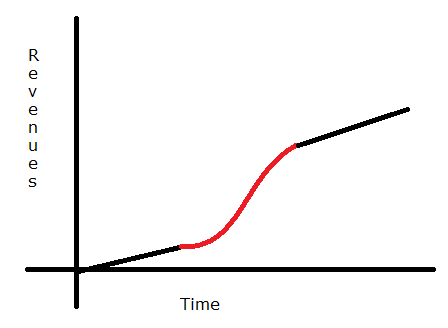
The growth of a new company usually consists of one short period of high growth preceded and followed by rather long periods of steady growth. Sometimes there might be more than one period of high growth, but for most companies, it is that one period when there is a point of inflexion and growth goes to a new trajectory.

Now, my point is that if you want to raise venture funding, you better do it when you think you are on the cusp of one such inflexion. Usually points of inflexion are associated with some increase in “leading” investment, and a small chance that the company will get on to a new trajectory, and a big chance that the company will go under.

This crude chart shows the typical trajectory of a young company. The beginning of the red zone is when you should raise venture money

If you look at the picture here, the beginning of the red region is the state where you need to get venture funding. The thing with the black regions is that irrespective of how you fund those, at best you can expect steady growth. Now, venture capital funds, the way they are structured, are not set out to fund steady growth. The way venture funds make money is when one out of a number of their investments makes shockingly great returns, while the rest go under. They are not in the business of funding steady returns.

Hence, when they fund your company they value you assuming that in case your company is successful there will be steep growth, which will enable them to recover their investment. And if your company is in steady growth phase, it is never going to be able to do that. And you will have a case of your investors pushing you to do more or something different from what you had planned doing. The problem here lies in the fact that you raised the wrong kind of funding!

In times like this or at the turn of the millennium, when venture capital is big, it can sometimes become the preferred mode of fundraising for a lot of companies. The problem, however, is that most of them don’t realize that venture funding is probably not the best form of funding for them at their size and scale, and then get weighed down by investors.

On a similar note, you should go public once you know that there are no really big points of inflexion coming up, and that your company is set on a path to steady growth. Again that follows from the fact that investors in the stock market (where they pick up tiny shares in each company) are usually in it for long-term steady growth. And if you happen to take undue risks and they don’t pay off, your stock will get hammered unnecessarily.

Payment mechanisms

This morning the Meru Cab driver swiped my credit card into the machine in the cab and waited for the response. It was close to ten minutes and there was no response. The system wasn’t even timing out – it tried redialing every time the server timed out. Finally I got frustrated, told the driver that I won’t get charged unless I sign, mustered together enough change and moved on.

I’m a fairly loyal user of Meru Cabs, and it is my preferred means of transportation to the airport, and I fly quite often nowadays. I have an account on their website, which enables me to book a cab quickly and easily. On several occasions I have problems mustering enough change to pay them. Sometimes this morning the credit card machine doesn’t work. I even missed a flight once because I went hunting for an ATM so that I could pay my cabbie.

Given the ongoing relationship I have with Meru, I should have an account with them. When I book a cab online, the cost of my journey can directly billed to my account (which could be pre-paid). When I get a cab at the airport, I can use a Near Field Communication (NFC) based system to inform Meru that I’m in that particular cab, and once again my account can get used.

I think there is a significant amount of work that can potentially be done to further disrupt the payment industry. NFC might hold the key there.

Home Equity

I’m looking to purchase a house. However, the amount of cash I have with me will not suffice to completely fund the house. Given that I’m confident of earning that difference amount in the future means that some bank will give me a mortgage, and I will thus finance my house with debt. Question is why I can’t finance the house with equity instead.

Let’s say the house I want to buy costs Rs. 1 Crore and I have with me Rs. 50 lakh. Instead of taking a loan for the balance Rs. 50 lakh, why can’t I sell equity instead? A consortium of investors can be invited to invest the balance Rs. 50 lakh in exchange for a 50% stake in the house. Rather, we set up a company that owns my house of which I own 50%, and every month I pay a rent to this company. As and when I get additional funds I start buying up additional shares in the company that owns my home and soon I’ll own it completely.

So who will be these people that will invest the balance 50% in my house? They are going to be dedicated real estate investment funds and their business will be to invest in minority stakes in properties of different sizes and in different parts of the town and country. This they are going to fund via a bunch of funds that allow ordinary investors to take exposure to real estate.

Currently there is no way I can invest in real estate except for taking on a large mortgage and purchasing a whole house. If I’m saving up money to buy a house some day and want to invest it in a way that will help me partially hedge against increase in real estate prices (something that I’m unable to do today) I simply buy units in one of these real estate funds. On the other hand, if I sense there might be some problems with my property (let’s say it is ripe for acquisition by the government for some road widening purpose, let’s say) I can sell some part of it to some of these real estate firms, thus reducing my risk of ownership.

These real estate funds can offer a variety of funds that invest in different kinds of properties in different proportions (like you can have a fund that invests 50% of its money in housing, 30% in commercial real estate and 10% in farmland, say). This allows ordinary investors to get exposure to real estate without any large down payments or mortgages. And reduce the risk of owning property in a particular place (let’s say I’m concerned that property prices in Bangalore might fall while those in tier 2 cities might go up. I will simply sell stock in my Bangalore house and invest the money in a fund that invests in houses in tier 2 cities, thus hedging myself).

Why is such a structure not popular already? In fact, I don’t think you have such structures anywhere in the world. One problem in India is the massive transaction taxes on real estate which makes the market illiquid. If that goes, is there anything that prevents us into getting into a culture of home equity?

Money De-laundering

A few months back I got my kitchen remodelled. It set me back by a couple of lakhs, and the guy who did the work for me insisted that I pay him fully in cash. I, who has had all cash inflows so far via bank transfers, was thus forced to withdraw (in several iterations) from the ATM perfectly white money and then hand it over to this guy and permanently convert it to black. Now that I think about it, I overpaid.

The key fact here is that people pay to get their money laundered. If you have Rs. 100 of unaccounted money in wads of cash, you are willing to give it to someone who puts Rs. 80 in your bank (the spread has been pulled out of thin air. Don’t go after me for that) and also some documentation to prove that you legally earned the Rs. 80.

So you have this bunch of people who want their money laundered. And then there are bank-only guys like me who sometimes have to produce wads of hard cash. Why isn’t there an exchange (illegal, of course, but who’s talking legality here? I’m only talking money) where money can be laundered and people with excess bank balances (and little hard cash) can be paid for it? For example, instead of paying Rs. 200000 in hard cash to my carpenter, I would have paid (say) Rs. 160000 to someone by cheque and got a receipt for it, and that person would have paid Rs. 200000 cash to my carpenter.

What does it say about the black economy that no such exchange exists? Does it mean that the market is skewed in a way that the demand for money laundering is much larger than its supply, because of which people who would otherwise have been intermediaries doing one side of the deal themselves? Or does an exchange like this actually exist but I’m not aware of it partly because it’s underground (for obvious legal reasons) and partly I’m seen as too small a fry to be accosted by the exchanges?

Next time I pay wads of hard cash, though, I’m going to try and see if I can get a discount.

The Quants

Since investment bank bashing seems to be in fashion nowadays, let me add my two naya paise to the fire. I exited a large investment bank in September 2011, after having worked for a little over two years there. I used to work as a quant, spending most of my time building pricing and execution models. I was a bit of an anomaly there, since I had an MBA degree. What was also unusual was that I had previously spent time as a salesperson in an investment bank . Most other people in the quant organization came from a heavily technical background, with the most popular degrees being PhDs in Physics and Maths, and had no experience or interest in the business side of things at the bank.

You might wonder what PhDs in Physics and Maths do at investment banks. I used to wonder the same before I joined. Yes, there are some tough mathematical puzzles to be solved in the course of devising pricing and execution algorithms (part of the work that us quants did), which probably kept them interested. However, the one activity for which these pure science PhDs were prized for, and which they spent most of their time doing, was C++ coding. Yeah, you read that right. These guys could write mean algorithms – I don’t know if even Computer Science graduates (and there were plenty of those) could write as clean (and quick) C++ code as these guys.

While most banks stress heavily on diversity, and makes considerable efforts (in the form of recruitment, affiliation groups, etc.)  to ensure a diverse workplace, it is not enough to prevent a large portion of quants coming from a similar kind of background. And when you put large numbers of Physics and Math PhDs together, it is inevitable that there is some degree of groupthink. You have the mavericks like me who like to model things differently, but if everyone else in your organization thinks one way, who do you go to in order to push your idea? You stop dropping your own ideas and start thinking like everyone else does. And you become yet another cog in the big quant wheel.

The biggest problem with hardcore Math people working on trading strategies is that they do not seek to solve a business problem through their work – they seek to solve a math problem, which they will strive to do as elegantly and correctly as it is possible. It doesn’t matter to the quants if the assumption of asset prices being lognormal is widely off the mark. In fact, they don’t care how the models behave. All they care about is about their formulae and results being correct – GIVEN the model of the market. I remember once spending a significant amount of time (maybe a couple of weeks) looking for bugs in my pricing logic because prices from two methods didn’t match up to the required precision of twelve decimal places (or was it fourteen? I’ve forgotten). And this after making the not-very-accurate assumption that asset prices are log normal. The proverb that says, “measure with a micrometer, mark with a chalk, cut with an axe”, is quite apt to describe the priorities of most quants.

Before I joined the firm, I used to wonder how bankers can be so stupid to make the kind of obvious silly errors (like assuming that housing prices cannot go down) that led to the global financial crisis of 2008. Two years at the firm, however, made me realize why these things happen. In fact, the bigger surprise, after the two years there, was about why such gross mistakes don’t occur more regularly. I think I’ve already talked about the culprits earlier in the post, but I should repeat myself.

First, a large number of guys building models come from similar backgrounds, so they think similarly. Because so many people think similarly, the rest train themselves to think similarly (or else get nudged out, by whatever means). So you have massive organizations full of massively talented brilliant minds which all think similarly! Who is to ask the uncomfortable questions? Next, who has time to ask the uncomfortable questions? Every one, from Partner downwards, has significant amount of “day to day work” to take care of every day. Bankers are driven hard (in that sense, and in that they are mostly brilliant, they do deserve the money they make), and everyone has a full plate (if you don’t it is an indication that you may not have a plate any more). There is little scope for strategic thinking. Again, remember that in an organization full of people who think similarly, people who have got promoted and made it to the top are likely to be those that think best along that particular axis. While it is the top management of the firm that is supposed to be responsible for the “big” strategic decisions, the kind of attention to details (which Math/Physics PhDs are rich in) that takes them to the top doesn’t leave them enough bandwidth for such thinking.

And so shit happens. Anyone who had the ability to think differently has either been “converted” to the conventional way of thinking, or is playing around with big bucks at some tiny hedge fund somewhere – because he found that it wasn’t possible to grow significantly in a place where most people think different to the way he thinks, and no one has the patience for his thinking.

This is the real failure in investment banking (markets) culture that has led to innumerable crises. The screwing over of clients and loss of “culture” in terms of ethics is a problem that has existed for a long time, and nothing new, contrary to what Greg Smith (formerly of Goldman Sachs) has written. The real failure of banking culture is this promotion of one-dimensional in-line-with-the-party thought, and the curbs against thinking and acting contrary to popular (in the firm) wisdom. It is this failure of culture that has led to the large negative shocks to the economy in the years gone by, and it is these shocks that have led common people to lose money rather than one off acts by banks where they don’t necessarily act in the interest of clients. And irrespective of how many Business Standards Committees and Risk Committees banks constitute, it is unlikely that this risk is going to go away any time soon. And I can’t think of a regulatory cure against this.

Ancient Bankruptcies

This post was written two weeks back, during one of those days when I didn’t have internet access at home. Posting now. 

In the course of a rather elaborate shower this morning, I started thinking about the global economic crisis. I thought of the crisis of 2008. I thought about the Arab countries where there is revolution. And I thought about Greece. And I began to wonder how such events had been handled in the past.

A long time ago, most parts of the world were ruled by kings. People assumed kings had divine right to rule, and they rather gladly parted with a big part of their income as taxes. These taxes would go into the treasury, and be used to finance, among other things the administration of the kingdom. Those were times of great wars and battles, and hence it was important to keep a ready army, and the treasury also financed that.

The best thing about being a king was that you weren’t really questioned about your spending, and thus kings could also spend a substantial amount from the taxes they collected on themselves. On living a life of opulence, keeping several wives or concubines while large parts of the population went without any, on building monuments to their fathers, their forefathers and to themselves. If Behen Mayawati were a queen, for example, nobody would’ve dared to question her expenses on erecting statues of herself.

This lack of accountability did have an up-shot, though. The large surpluses that were generated for the royal treasury by means of squeezing every last ounce of blood from the subjects (who willingly gave it, remember) meant that kings could invest on art and architecture. Thus, palaces funded artists and musicians. Grand buildings and mausoleums and temples were built, and intricately decorated, the results of which are being seen today in terms of increased revenues from tourism. Sometimes, though, the kings would over-reach and spend much more than their kingdoms could possibly finance. What would happen then?

At first, there would be an attempt to increase taxes. For a while, people, still in the belief that kings were gods, would give in. And then they would begin to protest. And refuse to pay further taxes. In effect, they would go on protests ‘against austerity measures’. In the light of these protests, the king would need greater use of his army in order to consolidate his power. But his treasury would be dwindling.

With the army over-worked, but the kingdom’s finances tight thanks to a depleting treasury, dissent would start to brew in the army. Getting wind of this, a neighbouring king would see an opportunity. Soldiers would be bribed, though one cannot really call it that, tempted with higher salaries backed by a stronger treasury in order to change allegiances. And the neighbouring king would declare war.

The beleaguered king would now come under pressure both internally and externally. He would not be able to keep up the fight for long. The war would soon be lost and the king would either be dead or captured. And the people would gladly accept the new king as their new god, and start paying taxes to him.

The unfortunate thing about this parallel now is that there is now no neighbouring country to Greece that could possibly pull off an audacious annexation. Even the US, the attacker of last resort, has its own set of trouble. Essentially, Greece has chosen a good time to get into trouble – at a time when everyone else is also in trouble. And this also means that the people of Greece will continue to have no respite from this politics. In the medium run (Hail Gebreselassie) they will have no choice but to accept austerity.

Free float and rupee volatility

Following a brief discussion on twitter with @deepakshenoy I’m wondering what’s preventing the RBI from making the rupee fully convertible. The usual argument for full convertibility is that it will make the exchange rates volatile. My argument is that exchange rates are already so volatile that the additional volatility that could stem out of a free float is marginal, and a small price to pay.

The wise men at RBI, though, might argue the precise opposite. They will claim that in terms of already high volatility they wouldn’t want to do anything that might add to volatility, however marginally. This is a constant battle I faced in my last job, of delta improvements. I would frequently argued that when something was already high, making it delta higher was not so bad. I would argue in terms of making systemic changes that would reduce drastically the already high number, rather than focusing on the deltas.

Coming back to the rupee, you can also imagine the wise men talking about some stuff about black money and hawala money and all that. The thing with making the rupee fully convertible would be that hawala would be fully legal now, and the illegal practice would cease to exist. And when something becomes legalized it comes back to the mainstream rather than remaining on the margins, and that is always a good thing.

Then you can expect some strategic affairs experts to bring some national sovereignty and national security argument there. There will be people who will talk about the increase in counterfeit money (since it’ll become easier to “smuggle” rupees into India then), and about how foreign governments might pose a threat to India’s security by manipulating the rupee (who says that threat doesn’t already exist?)!

I don’t know. I don’t find any of these anti-full-convertibility arguments compelling. If we do adopt full convertibility, though, we can at least pay Iran for the oil we get from them, and that might for all you know help tackle inflation. I don’t, however, expect the RBI to act on this.

Travel agents and investment bankers

The more I think about it, the more I’m convinced that travel agents perform a very similar role to investment bankers. In the olden days, not everyone had access to financial markets. In order to buy or sell stocks, one had to go through a brokerage company, who would be paid a hefty commission for his services. The markets weren’t that liquid, and they were definitely not transparent, so the brokers would make a killing on the spread. With the passage of time, advent of electronic trading and transparency in the markets brokers aren’t able to make the same spreads that they used to. Customers know the exact market price for the instruments they are trading, and this results in brokers not able to make too much out of these trades.

It is a similar case with travel agents. Vacation markets (flights, hotels, etc.) are nowhere as liquid as financial markets, and will never be. Sometimes, when you are booking holidays to a strange place, you know little about it, and hence commission a travel agent to find you a place to stay there. Given that you know little about that place, the agent can charge you hefty commissions, and make a nice spread. Of course, nowadays such opportunities are diminishing for agents, as you have websites such as Agoda which allow you to book hotels directly. Now, at one place you can compare the prices of different hotels, and have better information compared to what the agents traditionally offer you. The spread is on the downswing, I must think.

Then, don’t you think package tours are very similar to structured products? Structured products are nothing but a package of several risks packaged together. By acting as a counterparty on a structured product, a bank (even now ) can afford to charge fairly hefty fees. Structured products are illiquid,  and there is no publicly available “market price”, so it is easy for banks to make themselves good spreads on such products. However, all it takes to defeat this is an intelligent customer. All the customer needs to do is to try and understand the risks himself, and start “unbundling” them. Once he unbundles the risks, he can now trade each of them independently, on more liquid markets, and get a much better price than what bankers will offer him. The catch here is that he’ll need to put in that effort in unbundling.

It’s the same with package tours. Given the bundles, it is easy for the agents to make higher spreads. However, if you as a customer simply unbundle the package (hotels, transport, food, etc.), you can find out the price of each (available on sites like agoda and elsewhere) and find out for yourself the spread that the agent is making. And then you compare the agent’s premium with the “cost” of making all the bookings yourself and make an informed choice.

Apart from communication, among the greatest boons of the internet has to do with dismantling middleman monopolies. It is incredible how much use a little information can be of!

The Global Financial Crisis Revisited

When we talk about the global financial crisis, one question that pops up in lots of people’s heads is about where the money went. Since every trade involves two parties, it is argued that every loser has a corresponding winner, and that most commentary about the global financial crisis (of 2008) doesn’t talk about these winners. Everyone knows about the havoc that the crisis caused when prices went down (rather suddenly). The havoc that the crisis caused when prices initially went up (rather slowly) is less well documented.

The reason winners don’t get too much footage is that firstly, they are widely distributed, and secondly they spent away all their money. Think about a stock or a CDO or a bond being a like a parcel that you play by passing the parcel. The only thing is that every time you receive the parcel, you make a payment, and then pass on the parcel after receiving a higher payment. Finally, when the whistle blows, one person has the parcel in his hand, and it explodes in his face, ruining him. We know enough about people like this. A large number of banks lost a lot of money holding parcels when the whistle blew. Some went bust, while others had to be bailed out by governments. We know enough of this story so I don’t need to repeat here.

What is interesting is about the winners. Every person who held the parcel for a small amount of time was a winner, albeit a small winner. There were several such winners, each of whom “won” a small amount of money, and spent it (remember that the asset bubble in the early noughties was responsible for increasing consumption among common people). This spending increased demand for various goods and services produced in several countries. This increasing demand led to greater investment in the production facilities of these goods and services. Apart from that, they also increased expectations of growth in demand of these goods.

The damage the crisis did on the way up was to skew expectations of growth in different sectors, thus skewing investment (both in terms of financial and human capital). The spending caused by “small wins” for consumers put in place unreasonable expectations, and by the time it was known that this increased demand came as a result of an asset bubble, a lot of capital had been committed. And this would create imbalances in the “real economy”.

Yes, the asset bubble of the last decade did produce winners. The winners begat more winners (people whose goods and services were bought). However the skewed expectations that the wins created were to cause damage in the longer term. Unfortunately, I don’t see this story being told adequately, when the financial crisis is being talked about. After all, the losers are more spectacular.