Sales and marketing

On Saturday evening, I drank a Pepsi.

You might wonder why I’m making such a big deal about it. Because it is a big deal. Because I don’t normally drink pepsi. My preferred choice of cola is Thums Up, and if it’s not available I have a Coke. The only time when I have a pepsi is when both Thums Up and Coke are not available. There are times when I end up at PepsiFoods only stores, and sometimes I even have dew instead of pepsi.

You might think I’m extrapolating based on one data point. But I know more people who swear by thums up. For whom Pepsi is only a third choice cola.

The reason I’m bringing this up now is that Pepsi has spent a bombshell on sponsoring the IPL. Yes, despite being on HD, I managed to see a number of their ads. Pepsi Atom seems cool but they didn’t seem to have had its distribution in place when I wanted to try one. I reverted to my old faithful thums up. Now, I hear news that the India head of Pepsi has been sacked because he was deemed to have over spent on the IPL.

Why someone like Pepsi would spend so much on advertising is beyond me. Yes, they need to be on the top of people’s minds. But considering that everyone they advertise to has tried each of the major colas once, and loyalties to cola brands being rather heavy, I don’t see how they seek to influence sales by advertising. That Shah Rukh Khan drinks pepsi doesn’t alter my opinion one bit – I’m loyal to my thums up. I would think the same to be true to a loyal pepsi fan.

After having said so many times that I’m a loyal Thums Up customer, you might want to know why I drank Pepsi on Saturday. Because that little shop in Malleswaram I went to stocked only pepsi products. And he didn’t have dew. Faced with the choice of Pepsi or Mirinda or 7Up, I opted for the first. It was that exclusive agreement that PepsiCo had with that shopkeeper that made me consume their product.

Pepsi should invest more in this. Give higher margins to retailers who are willing to stock only pepsi products. Cola is something in which people have loyalties, but those loyalties are typically not so strong that the shop tends to lose business if the customer’s favourite brand is not available. Given lack of choice, customers will switch.

But then I guess the problem is that Pepsi is a “marketing-driven” rather than “sales-driven” company (we used to hear a lot about this distinction during recruitment time at business school). And the thing with marketing everywhere is that they are not measured. Like this friend who markets phones once gleefully told me that an advertisement he put out had a million likes on facebook. I asked him how many extra phones his company sold as a function of that ad. He had no answer. Marketing is like that everywhere. It is not judged based on real tangible numbers. And I hear that marketers like to keep it that way!

The last time I was in this guru mode I had commented that Nokia’s strategy of promoting Lumia by the strength of its camera was doomed to fail – for people don’t buy phones because they want a camera. Nokia seems to have learnt. The latest ad for the 520 talks about the apps that are available. This time they seem to have got it right.


Doctors marrying doctors

So I’ve learnt that doctors prefer to marry other doctors. Well, there’s nothing new in this. When I think about my extended families, and doctors there, most of them I realize are married to other doctors. The ostensible reason, I’m told, is that it’s a different lifestyle, and only doctors can understand the lifestyles of other doctors, and hence this preference. It cannot be ruled out, however, that it is a fallout of pretty good gender ratios and long hours at medical colleges, which leads to coupling – with the “understand each other’s professions” only being a fig leaf.

While people in other professions also marry within their profession (again put down to ease of “meeting”), this tendency is especially exaggerated among doctors. The problem with this, though, is that it doesn’t make financial sense.

Now, the deal with doctors is that they don’t earn good money until very late. After you’ve finished your bachelors, you first need to slog it off for a few years before you get a masters seat. And once you’ve finished your masters, you need to slog for a few years at a hospital which will pay you a pittance, until a point comes in life when you become senior enough that you start getting paid well.

Typically, most doctors (in India) don’t make much at all till they are 35, and after that they get flooded with money. Now, if two doctors marry, that means they are starved of cash flow during their prime years – time when their engineer and MBA counterparts will be minting money, traveling the world, having kids and buying houses. By the time the doctor couple makes money, they would probably be well past their youth, and it is only their descendants that will get to really enjoy their cash flows.

If a doctor marries an engineer (or an MBA), though, cash flows are better hedged. While it is true of all professions that salary goes up with years of experience, the curve isn’t as steep for professions apart from doctors. So, a doctor-MBA couple (say) can live a good life on the MBAs salary till they are in their mid-late 30s, by which time the doctor’s career would have begun to take off and the MBA would have begun to burn out. And then the doctor’s enhanced cash flow starts kicking in! Great hedge, I would say!

So dear doctors, unless you have fallen in love with a classmate at medical school (which has effectively locked you in to a lifetime of poor cash flow structures), reconsider. Consider marrying out of your profession. Yes, it might be harder for you to get each others’ professions. But at least your finances are taken care of!

PS: Some other professions such as lawyers and accountants also have a fairly steep salary increase curve – starting off at a pittance and then later making money. But in these professions people end up getting to “partner level” at around 30, which is far superior to doctors. Then again, such professionals don’t inter-marry within profession as much as doctors do.

The Upside of ADHD

Attention Deficit Hyperactivity Disorder (ADHD), a condition that I have, isn’t all bad. In fact, it was a recognition of the qualities of this “disorder” that led me to stop my medication for it. I figured that I prefer the with-ADHD me to the without-ADHD me. I found the latter too boring, not creative enough, and unable to connect seemingly unrelated things – something that I’ve always taken a lot of pride in.

Yet another positive of ADHD, I realized yesterday, is that it allows you to lead a “markovian” life. It allows you to easily get rid of historical baggage while taking decisions, and makes you look forward by taking a decision based on the present. Yes, it can sometimes be a bit troublesome, as it prevents you from following long-drawn-out plans, but mostly it’s a good thing.

It makes you disregard that you’d taken a decision for some reason in the past. It makes it easy for you to disconnect from your earlier decisions, and look forward. It doesn’t allow you to be swayed by emotions – on account of some decision you’d taken in the past, and instead makes you rely on rational reasons.

There’s this documentary called “ADD and loving it”. Maybe I should watch that. And maybe I’ll have something to add to that.

Fundraising

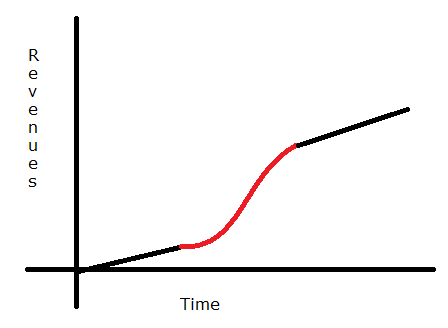
The growth of a new company usually consists of one short period of high growth preceded and followed by rather long periods of steady growth. Sometimes there might be more than one period of high growth, but for most companies, it is that one period when there is a point of inflexion and growth goes to a new trajectory.

Now, my point is that if you want to raise venture funding, you better do it when you think you are on the cusp of one such inflexion. Usually points of inflexion are associated with some increase in “leading” investment, and a small chance that the company will get on to a new trajectory, and a big chance that the company will go under.

This crude chart shows the typical trajectory of a young company. The beginning of the red zone is when you should raise venture money

If you look at the picture here, the beginning of the red region is the state where you need to get venture funding. The thing with the black regions is that irrespective of how you fund those, at best you can expect steady growth. Now, venture capital funds, the way they are structured, are not set out to fund steady growth. The way venture funds make money is when one out of a number of their investments makes shockingly great returns, while the rest go under. They are not in the business of funding steady returns.

Hence, when they fund your company they value you assuming that in case your company is successful there will be steep growth, which will enable them to recover their investment. And if your company is in steady growth phase, it is never going to be able to do that. And you will have a case of your investors pushing you to do more or something different from what you had planned doing. The problem here lies in the fact that you raised the wrong kind of funding!

In times like this or at the turn of the millennium, when venture capital is big, it can sometimes become the preferred mode of fundraising for a lot of companies. The problem, however, is that most of them don’t realize that venture funding is probably not the best form of funding for them at their size and scale, and then get weighed down by investors.

On a similar note, you should go public once you know that there are no really big points of inflexion coming up, and that your company is set on a path to steady growth. Again that follows from the fact that investors in the stock market (where they pick up tiny shares in each company) are usually in it for long-term steady growth. And if you happen to take undue risks and they don’t pay off, your stock will get hammered unnecessarily.

Religion and Probability

If only people were better at mathematics in general and probability in particular, we may not have had religion

Last month I was showing my mother-in-law the video of the meteor that fell in Russia causing much havoc, and soon the conversation drifted to why the meteor fell where it did. “It is simple mathematics that the meteor fell in Russia”, I declared, trying to show off my knowledge of geography and probability, arguing that Russia’s large landmass made it the most probable country for the meteor to fall in. My mother-in-law, however, wasn’t convinced. “It’s all god’s choice”, she said.

Recently I realized the fallacy in my argument. While it was probabilistically most likely that the meteor would fall in Russia than in any other country, there was no good scientific reason to explain why it fell at the exact place it did. It could have just as likely fallen in any other place. It was just a matter of chance that it fell where it did.

Falling meteors are not the only events in life that happen with a certain degree of randomness. There are way too many things that are beyond our control which happen when they happen and the way they happen for no good reason. And the kicker is that it all just doesn’t average out. Think about the meteor itself for example. A meteor falling is such a rare event that it is unlikely to happen (at least with this kind of impact) again in most people’s lifetimes. This can be quite confounding for most people.

Every time I’ve studied probability (be it in school or engineering college or business school), I’ve noticed that most people have much trouble understanding it. I might be generalizing based on my cohort but I don’t think it would be too much of a stretch to say that probability is not the easiest of subjects to grasp for most people. Which is a real tragedy given the amount of randomness that is a fixture in everyone’s lives.

Because of the randomness inherent in everyone’s lives, and because most of these random events don’t really average out in people’s lifetimes, people find the need to call upon an external entity to explain these events. And once the existence of one such entity is established, it is only natural to attribute every random event to the actions of this entity.

And then there is the oldest mistake in statistics – assuming that if two events happen simultaneously or one after another, one of the events is the cause for the other. (I’m writing this post while watching football) Back in 2008-09, the last time Liverpool FC presented a good challenge for the English Premier League, I noticed a pattern over a month where Liverpool won all the games that I happened to watch live (on TV) and either drew or lost the others. Being rather superstitious, I immediately came to the conclusion that my watching a game actually led to a Liverpool victory. And every time that didn’t happen (that 2-2 draw at Hull comes to mind) I would try to rationalize that by attributing it to a factor I had hitherto left out of “my model” (like I was seated on the wrong chair or that my phone was ringing when a goal went in or something).

So you have a number of events which happen the way they happen randomly, and for no particular reason. Then, you have pairs of events that for random reasons happen in conjunction with one another, and the human mind that doesn’t like un-explainable events quickly draws a conclusion that one led to the other. And then when the pattern breaks, the model gets extended in random directions.

Randomness leads you to believe in an external entity who is possibly choreographing the world. When enough of you believe in one such entity, you come up with a name for the entity, for example “God”. Then people come up with their own ways of appeasing this “God”, in the hope that it will lead to “God” choreographing events in their favour. Certain ways of appeasement happen simultaneously with events favourable to the people who appeased. These ways of appeasement are then recognized as legitimate methods to appease “God”. And everyone starts following them.

Of course, the experiment is not repeatable – for the results were purely random. So people carry out activities to appease “God” and yet experience events that are unfavourable to them. This is where model extension kicks in. Over time, certain ways of model extension have proved to be more convincing than others, the most common one (at least in India) being ‘”God” is doing this to me because he/she wants to test me”. Sometimes these model extensions also fail to convince. However, the person has so much faith in the model (it has after all been handed over to him/her by his/her ancestors, and a wrong model could definitely not have propagated?) that he/she is not willing to question the model, and tries instead to further extend it in another random direction.

In different parts of the world, different methods of appeasement to “God” happened in conjunction with events favourable to the appeasers, and so this led to different religions. Some people whose appeasements were correlated with favourable events had greater political power (or negotiation skills) than others, so the methods of appeasement favoured by the former grew dominant in that particular society. Over time, mostly due to political and military superiority, some of these methods of appeasement grew disproportionately, and others lost their way. And we had what are now known as “major religions”. I don’t need to continue this story.

So going back, it all once again boils down to the median man’s poor understanding of concepts of probability and randomness, and the desire to explain all possible events. Had human understanding of probability and randomness been superior, it is possible that religion didn’t exist at all!

The day I learnt to stop worrying and learnt to protect myself

For at least six years, from early 2006 to early 2012 I “suffered” from what medical practitioners term as “anxiety”. It was “co-morbid” with my depression, and I think it was there from much before 2006. I would frequently think about random events, and and wonder what would happen if things happened in a certain way. I would think of “negative black swan” events, events with low probability but which would have a significant negative impact on my life.

While considering various possibilities and preparing for them is a good thing, the way I handled them were anything but good. Somewhere in my system was wired the thought that simply worrying about an event would prevent it from happening. I once got fired from one job. Every day during my next two jobs, I would worry if I would get fired. If I got an uncharitable email from my boss, I would worry if he would fire me. If my blackberry failed to sync one morning I would worry that it was because I had already been fired. Needless to say, I got fired from both these jobs also, for varying reasons.

I used to be a risk-taker. And it so happened that for a prolonged period in my life, a lot of risks paid off. And then for another rather prolonged period, none of them did (Mandelbrot beautifully calls this phenomenon the Joseph effect). The initial period of successful risk-taking probably led me to take more risk than was prudent. The latter period of failure led me to cut down on risks to an unsustainable level. I would be paranoid about any risks I had left myself exposed to. This however doesn’t mean that the risks didn’t materialize.

It was in January of last year that I started medication for my anxiety and depression. For a few days there was no effect. Then, suddenly I seemed to hit a point of inflexion and my anxious days were far behind. While I do credit Venlafaxine Hexachloride I think one event in this period did more than anything else to get me out of my anxiety.

I was riding my Royal Enfield Classic 500 across the country roads of Rajasthan, as part of the Royal Enfield Tour of Rajasthan. The first five days of the tour had gone rather well. Riding across the rather well-made Pradhan Mantri Gram Sadak Yojana (PMGSY) roads set across beautiful landscapes had already helped clear out my mind a fair bit. It gave me the time and space to think without getting distracted. I would make up stories as I rode, and at the end of each day I would write a 500 word essay in my diary. All the riding gear meant that the wind never really got into my hair or my face, but the experience was stunning nevertheless. For a long time in life, I wanted to “be accelerated”. Ride at well-at-a-faster-rate, pulling no stops. And so I rode. On the way to Jaisalmer on a rather empty highway, I even hit 120 kmph, which I had never imagined I would hit on my bike. And I rode fearlessly, the acceleration meaning that my mind didn’t have much space for negative thoughts. Things were already so much better. Until I hit a cow.

Sometimes I rationalize saying I hadn’t consumed my daily quota of Venlafaxine Hexachloride that morning. Sometimes I rationalize that I was doing three things at the same time – one more than the number of activities I can normally successfully carry out simultaneously. There are times when I replay the scene in my head and wonder how things would have been had I done things differently. And I sometimes wonder why the first time I ever suffered a fracture had to happen in the middle of nowhere far off from home.

It had been a wonderful morning. We had left the camp at Sam early, stopping for fuel at Jaisalmer, and then at this wonderful dhaba at Devikot, where we had the most awesome samosa-bajjis (massive chilis were first coated with a layer of potato curry – the one they put in samosa – and then in batter and deep fried). For the first time that day I had the camera out of its bag, hanging around my neck. I would frequently stop to take photos, of black camels and fields and flowers and patterns in the cloud. The last photo I took was of Manjunath (from my tour group) riding past a herd of black camels.

I function best when I do two things at a time. That morning I got over confident and did three. I was riding on a road 10 feet wide at 80 kilometres per hour. I was singing – though I’ve forgotten what I was singing. And I was thinking about something. My processor went nuts. While things were steady state on the road there was no problem. There was a problem, however, when I saw a bit too late that there was a massive herd of massive cows blocking my path further down the road.

There was no time to brake. I instead decided to overtake the herd by moving to the right extreme of the road (the cows were all walking on the road in the same direction as me). To my misfortune, one of the cows decided to move right at the same time, and I hit her flush in the backside. The next thing I remember is of me lying sprawled on the side of the road about five metres from where my bike was fallen. There was no sign of the cow. The bike was oozing petrol but I wasn’t able to get up to lift it up – presently others in my tour group who were a few hundred metres behind reached the scene and picked up my bike. And I don’t know what state of mind I was in but my first thought after I picked myself up was to check on my camera!

The camera wasn’t alright – it required significant repairs after I got back home, but I was! I had broken my fifth metacarpal, which I later realized was a consequence of the impact of the bike hitting the cow. There were some gashes on my bicep where the protective padding of my riding jacket had pressed against my skin. I still have a problem with a ligament in my left thumb, again a consequence of the impact. And that was it.

I had had an accident while traveling at 80 kmph. I had fallen a few metres away from the point of impact (I don’t know if I did a somersault while I fell, though). I fell flush on my shoulder with my head hitting the ground shortly. It was a rather hard fall on the side of the road where the ground was uneven. And there was absolutely no injury because of the fall (all the injury was due to impact)!

It was the protection. No amount of worry would have prevented that accident. Perhaps I was a bit more careless than I should have been but that is no reason for there not being an accident. When you are riding on a two wheeler at a reasonable pace on country roads, irrespective of how careful you are there is always a chance that you may fall. The probability of a fall can never go to zero.

What I had done instead was to protect myself from the consequences of the fall. Each and every piece of protective equipment I wore that day took some impact – helmet, riding jacket, riding gloves, knee guard, shoes.. Without any one of these pieces, there is a chance I might have ended up with serious injury. There was a cost I paid – both monetary and by means of discomfort caused by wearing such heavy gear – but it had paid off.

Black swans exist. However, worrying about them will not ease them. Those events cannot be prevented. What you need to do, however, is to hedge against the consequences of those events. There was always a finite possibility that I would fall. All I did was to protect myself against the consequences of that!

Despite contrary advice from the doctor, I decided to ride on and finish the tour, struggling to wear my riding glove over my swollen right hand – stopping midway would have had a significant adverse impact on my mental state which had just begun to improve. I’ve stopped worrying after that. Yes, there are times when I see a chance of some negative black swan event happening. I don’t worry about that any more, though. I only think of how I can hedge against its consequences.
Being myself

I think I’m a funny guy. And I sometimes like to get pally with people. I don’t like extreme formality. I have a fundamental mistrust of people who wear ties without jackets. I try a bit too hard to break ice. I have a superior long-term memory which makes people think they’re being stalked. And I think one of the reasons I didn’t last long at Goldman was that I couldn’t really reconcile myself working for a company that took itself way too seriously.

My first interaction with Goldman Sachs was back in 2004. Unsure if they’d be able to pronounce “Karthik” I’d introduced myself as Wimpy. Classmates thought I was quite a fool to do that. The way I see it if there was someone with some sense of humour on the other side (6 years later I was to find out that people who took themselves too seriously self-selected themselves to work for Goldman) it would have broken a massive amount of ice. Didn’t work out.

During the same interview process, HSBC asked me about my greatest regret in life. I told them that it was the fact that I’d never been in a relationship. Again, people thought I was being stupid. The way I saw it, I had absolutely no professional regrets, and this one personal regret had been consuming me. In hindsight, though, by saying that I had never been in a relationship I might have sent out a signal that I was a bad marketer, which probably wasn’t something an employer wanted to hear.

As long-term readers of this blog might be aware (I’ve mellowed significantly of late), I’m quite capable of (to use my father’s favourite metaphor) “kicking like a donkey”. Just lashing out without too much evaluation of further consequences. Worked brilliantly at times. Not so brilliantly most of the time.

I don’t know why I’ve been thinking of “systems” such as IIMB a lot nowadays. The “system” tries too hard to make people conform. To make you look like everyone else. I especially loathe the IIM placement process, from both sides (student and recruiter). I think of it as a socialist vestige, where the institute believes that “getting everyone placed” is superior to letting people figure out what tehy want to do.

I think I was secretly happy when yesterday I got a mail from an acquaintance from IIM Shillong stating that placements this year are quite bad and there are no recruiters. It probably serves right people who joined colleges expecting the larger brand name of the college to carry them through, without regard to personal brand equity.

i had thought up this post this morning, but by the time I opened wordpress I’d forgotten what I wanted to write. Remembered it vaguely in the afternoon, started writing and then I see that I’m rambling. Yeah, I guess ramble too much.

Recognition

I just bumped into this guy at the Mumbai airport and the conversation went like this:
Me: hey I’ve seen you somewhere
He: ugh?
Me: you’re from Chennai?
He: yes
Me: svce?
He: yes..
Me: 2001-2005?
He (looking confused) : yes
Me: you represented your college at university challenge in 2003
He: yeah..
Me: you were goach’s teammate. I’m sorry I don’t remember your name… (two seconds later)… arvind chandrasekhar?

He had the look on his face that suggested he almost gave up in life. I decided to put him out of his misery. ‘Back in Madras I used to be known as wimpy’ I said. I’m not sure if he actually remembered me but he mumbled a ‘I thought so but wasn’t sure’ and we parted.

Before you find this way too unusual let
me tell you that he wasn’t some random guy in the airport I accosted. I was catching up with this long lost friend who I’d bumped into at the airport and he happened to be traveling with her..

Nevertheless I’m proud of my long-term memory. And I’m proud to be married to someone who has an equally good, if not better, long term memory. In fact both of us find ourselves on socially awkward situations frequently when we meet someone we recognize but they don’t recognize us back.

Oh and two minutes before I bumped into arvind I was talking to someone about twenty questions and tintoretto!

Teerth Yatre

The Yatre (journey) took us through four different worlds. All at the same time. We kept flipping from one world to another. Each of us were going through the worlds independently, yet we seemed to meet in one of the worlds (let’s call this one “reality”) once in a while. Time moved extremely slowly. It was like TDMA (time division multiple access) was going through our minds, as we went through the four or five worlds simultaneously.

Parts of the human brain are sequential and parts are parallel. I discovered during the course of the Yatre that our minds are equipped with a parallel, maybe even superscalar, processor. However, certain features such as context switches are not very well developed in human minds so this capacity is seldom used. The human mind prefers linear processing and thus most of the time, all but one processor is shut. And there is a continuous stream of thought that allows us to “execute”.

Those like me with ADHD seem to have an easier time in context switching. While this results in a generally higher level of mental output, it also means that there is greater discontinuity in thought. This discontinuity in thought leads to what psychiatrists term as ‘lack of executive functioning’. “Executive functioning” as us humans have defined it depends on a single train of thought working continuously to get things done.

The Teertha (holy water) however ensures that all human beings, ADHD or the lack of it, become equal, and opens up the superscalar processes in people’s heads. It is like everyone who imbibes it reaches a state that is an advanced level of ADHD. Four or five streams of thought. Parallel inhabition of four or five different worlds. And constant switches between the worlds. One moment you have a sense of achievement. The next you are paranoid. Paranoid about getting through the madding crowd and back safely to the dirty hotel room.

Fifteen minutes past six, we are on the way to the river bank to watch the world-famous aarati. An eternity later (but with the watch only showing six twenty) we see a chaat shop on the way and decide to imbibe some chaat. Another eternity later, some parallel thoughts drive us to the aarati, the rest recommend stopping at the restaurant for an early dinner.

I order pav bhaji. Four pieces arrive. In my journeys through the various worlds, I think I’ve spent an enormous amount of time eating it. During fleeting visits to “reality”, though, less than one piece has been eaten. The rest of the table also consists of plates with a lot of leftover food. I break a piece of pav. By the time I bring it to my mouth I’m in another world. And when i return to “reality” the piece of pav is still in my hand, uneaten.

The final bit of the teerth yatre is the most surreal, when we have to get back to the hotel. We are in no mental state to tell our driver where to reach us. We decide to take cycle rickshaws. To get to a cycle rickshaw, though, we need to go through a sea of humanity.

We don’t know where we are going. We hold hands. In the moments when we are in “reality” we check if we are still together. In the fleeting between-moments, we worry about losing each other. We do our independent trips of the other worlds (I think we have our own set of worlds and the only intersection is “reality”). We independently worry where we are going. The sea of humanity means that traffic is rather slow and there is little chance of being run over. Yet, we worry.

The teertha in question is a product of this tiny store at Godowlia Chowk called “Mishrambu”. It came highly recommended by a friend who had studied at the Banaras Hindu University. It was sweet, laced with dry fruits and nuts, and dollops of butter. “Shall I put a little or more?” asked the kindly shopkeeper as he displayed a dirty-looking green paste from a small stainless steel box. In one of those collective fleeting moments of bravado we asked him to put ‘lots’. Maybe our inexperienced showed up there.

So what if we had gone to Varanasi and not seen the famous Ganga Arati? So what if we didn’t take the boat-ride to see the various famous ghats, and instead settled ourselves in a rooftop cafe on the banks of the Ganges (we were the only Indians there)? So what if we went all the way to the Kumbh Mela and spent our time mostly clicking photos and walking around, and didn’t venture close to the river?

We’ve undergone the most exhilarating Teerth Yatre ever. I’m not sure any of the religious experiences could match this parallel journey across four worlds.

Home Equity

I’m looking to purchase a house. However, the amount of cash I have with me will not suffice to completely fund the house. Given that I’m confident of earning that difference amount in the future means that some bank will give me a mortgage, and I will thus finance my house with debt. Question is why I can’t finance the house with equity instead.

Let’s say the house I want to buy costs Rs. 1 Crore and I have with me Rs. 50 lakh. Instead of taking a loan for the balance Rs. 50 lakh, why can’t I sell equity instead? A consortium of investors can be invited to invest the balance Rs. 50 lakh in exchange for a 50% stake in the house. Rather, we set up a company that owns my house of which I own 50%, and every month I pay a rent to this company. As and when I get additional funds I start buying up additional shares in the company that owns my home and soon I’ll own it completely.

So who will be these people that will invest the balance 50% in my house? They are going to be dedicated real estate investment funds and their business will be to invest in minority stakes in properties of different sizes and in different parts of the town and country. This they are going to fund via a bunch of funds that allow ordinary investors to take exposure to real estate.

Currently there is no way I can invest in real estate except for taking on a large mortgage and purchasing a whole house. If I’m saving up money to buy a house some day and want to invest it in a way that will help me partially hedge against increase in real estate prices (something that I’m unable to do today) I simply buy units in one of these real estate funds. On the other hand, if I sense there might be some problems with my property (let’s say it is ripe for acquisition by the government for some road widening purpose, let’s say) I can sell some part of it to some of these real estate firms, thus reducing my risk of ownership.

These real estate funds can offer a variety of funds that invest in different kinds of properties in different proportions (like you can have a fund that invests 50% of its money in housing, 30% in commercial real estate and 10% in farmland, say). This allows ordinary investors to get exposure to real estate without any large down payments or mortgages. And reduce the risk of owning property in a particular place (let’s say I’m concerned that property prices in Bangalore might fall while those in tier 2 cities might go up. I will simply sell stock in my Bangalore house and invest the money in a fund that invests in houses in tier 2 cities, thus hedging myself).

Why is such a structure not popular already? In fact, I don’t think you have such structures anywhere in the world. One problem in India is the massive transaction taxes on real estate which makes the market illiquid. If that goes, is there anything that prevents us into getting into a culture of home equity?