Women are like edge triggered flipflops

Every once in a while, we talk about (in some wonder and amazement) how we came to meet each other, and eventually got married. Most of it is usually the same story, (chinese-whispers induced much-mauled) versions of which are known to quite a few people. But each time we talk about it, there’s something new that comes forth, which makes the discussion enlightening.

So the part about how we first got talking is well-established. Priyanka was excited to find Manu, a distant relative of hers, on Orkut. From his Orkut page, she landed at his website, where back then there was a list of “blogs I follow” (in the standard of mid-2000s websites).

And from there she ended up at my blog (the predecessor of this blog), where she chanced upon this one-line post:

noticed a funny thing at the loo in office today. a number of people tie their janavaaras (sacred thread) around their ears while peeing or crapping!!

She got interested and started reading, and presently landed at this post. Then she started her own blog, scrapped me on Orkut and then disappeared after I’d scrapped her back. And so it went.

A year and half later I saw her at Landmark Quiz, and she messaged me a few days later (when I didn’t know it was the same cute chick I’d seen at the quiz) asking if I remembered her and giving me a puzzle, and then we got added to each other on GTalk, and got talking.

Cut the story two years forward, and we met for the first time in Gandhi Bazaar in 2009. A day later, I wrote this blogpost on “Losing Heart“.

Yesterday I met a friend, an extremely awesome woman. Once I was back home, I sent a mail to my relationship advisor, detailing my meeting with this friend. And I described her (the awesome friend) as being “super CMP”. I wrote in the mail “I find her really awesome. In each and every component she clears the CMP cutoff by a long way”. That’s how I’ve become. I’ve lost it. I’ve lost my heart. And I need to find it back. And I don’t know if I should continue in the arranged scissors market.

And a couple of days later I apparently told her I liked her (I don’t remember this, and our GTalk conversations had gone “off the record” then, so there is no evidence).

And today’s conversation revealed that Priyanka completely misunderstood my “losing heart” post and assumed that I didn’t like her. In her hurry of reading my post (perhaps), she had assumed that I had “lost heart” after meeting her, and had taken it to mean that she was unattractive in whatever way.

Then, when I told her a couple of days later that I liked her, it was a massive boost to her confidence, which had been (rather unintentionally) “pushed down” by way of my blog post.

She had been skeptical of meeting me in the first place, afraid that I’d turn out like “another of those online creeps who hits on you the first time he meets you”, and said that if I’d directly told her I liked her after meeting her, she would’ve got similarly creeped out and never married me. But coming after the blog post that had pushed her confidence down, my telling her that I liked her was enough of a confidence boost to her that she stopped seeing me as “yet another online creep”. There’s more to the story, but we ended up getting married.

From my point of view, the moral of this story, or at least the part that I discovered during our conversation today, is that women are like edge-triggered rather than level-triggered flipflops (the wife is an electrical engineer so I can get away with making such comparisons in normal conversation).

The reason Priyanka liked me is that something I told her caused an instant and massive boost in her self-esteem. The level to which it was raised to wasn’t as important as the extent by which it was raised. And she said that it’s a standard case with all women – it’s the delta to their self-esteem that turns them on rather than the level.

She went on to say that this is a rather standard trick in “the game” – to push down the potential partner’s self-esteem or confidence so that you can raise it by a large extent in the next move and win them over. I admit to having no clue of this back in 2009 (or even now). But like in a typical comedy movie, I had unwittingly stumbled into a great strategy!
Pregnancy and deadlifting

The so-called Sympathetic Pregnancy Belly, which is caused due to something known as the Couvade Syndrome, is not a myth. As the expectant mother’s abdomen swells, to make room for the baby growing within, her partner’s belly starts swelling up as well.

Having personally experienced this, I can think of several reasons due to which this happens. Firstly, the expectant mother (“mother” for short) is encouraged to eat nutritious fattening food during pregnancy, which is sometimes too tempting for the expectant father (“father”) to let go of.

So as the baby grows within the mother’s belly, the father becomes fatter as well, ingesting the same nutritious food his partner has been instructed to ingest.

Then, it is a custom that when you are pregnant, people call you home to feed you lunch/dinner (sometimes you go out of your way to solicit such invitations). It is also custom that these invitations are extended to the father as well, and with rich foods and desserts being staples at such meals, it further contributes to the sympathetic  belly.

And then there is the lack of exercise. With your partner experiencing pains all day, and not being able to walk too much, you prefer to spend time with her doing nothing rather than going out on those romantic long walks of the yesteryear. You take pity on the partner and start taking your car out for even the shortest distances. Even when you travel, you limit your activity so that the partner doesn’t get stressed. And your tummy grows.

Under normal circumstances I wouldn’t have minded growth of my tummy along with my wife’s, but the problem in this case is that my triglyceride levels have shot up as well (thanks to all that eating and little exercise). With the nutritious foods the partner consumes being too tempting to let go of, dieting is not an answer. And hence I’ve decided to resume deadlifting.

Among all the different kinds of exercise I’ve done in the past, the deadlift stands out because of the sheer volume of mass you move in the course of the exercise, and the extent of your body that gets exercised in the process. It is an utterly tiring exercise (you need to make sure you’ve eaten well enough before you embark on it), and if you are deadlifting regularly, no amount of dessert eating can have any impact on your triglycerides (last October, when I was deadlifting sporadically and eating without restraint, I recorded my lowest ever triglyceride numbers since I started testing that thing).

And there is one other major advantage to deadlifting as well – you can continue lifting your partner well into the pregnancy. While both the father and mother put on weight during the pregnancy (as documented above), under normal circumstances there is no addition to the father’s muscle mass. Consequently, it becomes progressively harder to lift the mother through the course of the pregnancy, a task that would have been trivial in ground (non-pregnant) state!

And what better way to be able to lift the partner, than practicing to lift heavy weights? And where else can you lift the kind of weights you can lift when you are deadlifting?

Unfortunately I had given up deadlifting for the first part of the pregnancy, and hence I’ve fallen well behind the curve. I find it extremely hard nowadays to lift my wife, and I’m not proud to say that. Hopefully, having resumed deadlifting, I should be able to make up for this in a few days now! Watch this space!

One final question for those who deadlift – deadlifting what weight (as a function of N) can prepare you to lift a human weighing N kgs off the floor and cradle her in your arms?

Evaluating WhatsApp groups

Over time I’ve come to become a member of several WhatsApp groups. Some of them are temporary, designed to simply coordinate on a particular one-off event. Others are more permanent, existing over a long term, but with no particular agenda.

Over this time I’ve also exited several WhatsApp groups, especially those that have gotten a bit annoying. I remember this day last year when I stepped in and out of a meeting, and I found a hundred messages on a family WhatsApp group, most of them being random forwards, and a few of them being over a page long. I quickly exited that group.

Not everyone quickly exits groups they don’t like, though. There is social pressure to remain, since anyone’s exit gets publicly broadcast in the group. Being a member of a WhatsApp group is the latest measure of conformity, and irrespective of how annoying some groups are, one is forced to endure.

Not all WhatsApp groups are annoying, though. Some groups I’m a member of are an absolute joy. There are times when I explicitly choose to initiate a conversation within the group, than bilaterally, so that others in the group can pitch in. And this taking of the conversation to the group is usually not minded by the intended counterparty as well.

Thinking about good and bad WhatsApp groups, I was wondering if there is a good and clean metric to determine how “good” or “useful” a WhatsApp group might be. Based on my experience, I have one idea. Do let me know if you know a better way to characterise whether a WhatsApp group is going to be good or bad.

When you have a WhatsApp group with N people, you are essentially bringing together N * (N-1)/2 pairs of people. Now, some of these pairs might get along fantastically well. Other pairs might loath each other. And yet others are indifferent to each other.

My hypothesis is that the more the number of pairs in a group that like to talk to each other, the better the group functions (yes it’s a rather simple metric).

Now, this hypothesis is rather simplistic – for example, you can have threesomes of people whose mutual relationship is very different from that of any pair taken together. So this ignores a higher order correlation term, but improves simplicity. It’s like that benzene ring, where six carbon atoms bond together in a way no two of them as a pair can (forget the scientific term for such bonding)!

Yet, what we have here is a good measure of cohesion within the group. It also explains why sometimes the addition of a single member can lead to the destruction of the group – for it can increase the proportion of people who don’t like to talk to each other!

The model is incomplete, though. For now, it doesn’t differentiate between “don’t care conditions” (people in the group who are indifferent to each other) and “don’t get alongs”. If we can incorporate that without making the formula more complex, I think we might be up to something.

Maybe we should form a WhatsApp group to discuss what a good formula might look like!

Ends, beginnings and furniture rearrangement

Back when I was a student at IIT Madras, I would get the feeling from time to time that I needed to “resurrect my life”. The motivation for this would typically be trivial, though at times it might have been an examination or an assignment gone wrong.

And these resurrections followed a pattern – I would begin by cleaning my room, throwing out all the unnecessary papers, and getting things around me in order. Whether my life would be “resurrected” after this is questionable, but I would definitely feel better, and get on with life.

Given this background, it came as a pleasant surprise when I found that the person I had married also had a similar philosophy with respect to life resurrection. In fact, since she had never lived in a hostel room, and had access to larger quarters, her resurrection would mean rearranging furniture, and throwing out clutter from her parents’ house.

And so this became our new paradigm of resurrection. Whenever we felt we needed a new start, we would rearrange the furniture in our house. Most of the time it would be minor, but it was rare for us to go too long without any rearrangement. Along the process, we would also clean and declutter the house (my resurrection formula). Again, whether our life would thus be “resurrected” is in question, but we would feel better and get on with life.

Except when we rearranged the furniture last week. It was the first time we were rearranging the furniture in our present house since we bought it two years ago. This was mainly a function of the wife being away for most of this time, doing an MBA. Living alone, I would simply clean my desk to resurrect my life. The furniture would be left alone.

Given that we were rearranging furniture after such a long time, it was a major exercise. We called Tata Sky and got our TV shifted from our shared study to the living room. A lot of other furniture also got moved around. And the house started looking very different! We found new warmth at home, and our desire to live here for a very long time got reinforced.

While most “resurrections” have been nondescript and I’ve gotten back to living life the normal way after rearranging my desk/furniture, these resurrections are usually a time for introspection, and some rearrangements have actually led to major life changes. And as it happened, this one too has spurred what I think is going to be a major change.

Back in late 2011, after I had just quit my last full-time job, I embarked on “Project Thirty“, where I gave myself a year to do everything I’d wanted to do but had never done. I had no revenue targets for that year (2012), but had some plans. More reading. More writing. More travelling. Maybe some teaching. Maybe to set up a business.

By the end of the year, my career as a freelance consultant had taken off. Six months afterward, I got a contract with Mint to write a column for them. Meanwhile, I got associated with the Takshashila Institution, a public policy think tank. In 2014-15 I taught a full term MBA course at IIMB. And earlier this year I completed the manuscript of a book. In other words, over the last five years I’ve led a full-blown “portfolio life”.

As I ruminated in my newly decluttered study following the rearrangement (the TV and a couch had moved out), I realised that I’ve pretty much achieved most of what I set to achieve when I wanted a portfolio life. And when you have achieved a lot of what you’ve wanted to achieve, it is hard to remain motivated. And when you’re not motivated, Parkinson’s Law takes over, and you become inefficient. Work expands to fill the time available.

So I’ve decided it’s time to rebalance the portfolio, and possibly reduce the number of components. Most importantly, I’m looking to get back to the corporate world, and find a job in Bangalore. I expect this job to take the place of my freelance consulting business in my portfolio. My associations with Mint and Takshashila will remain. The book, having been written, doesn’t need so much attention now. And for reasons you’ll see soon, travel will become significantly tougher.

In moving from freelance consulting to a job, I’ll be losing volatility and uncertainty, and its associated excitement. I’ll be losing significant option value in terms of additional things I can take up. Compensation, of course, will come in the form of a steady paycheck.

And as my current portfolio comes to an end, it is also time for a new beginning. One of the reasons I’m willing to forego excitement in my professional life is that there is a new source of excitement coming up shortly. Gene propagation is happening in September (more on that in a separate post)!

While we did want to resurrect our lives (and my portfolio rebalancing decision does justify that end) when we rearranged the furniture last week, the main motivation behind the exercise was to prepare the house for the expansion in human population. Things are sometimes more interconnected than we tend to think!

Brexit

My facebook feed nowadays is so full of Brexit that I’m tempted to add my own commentary to it. The way I look at it is in terms of option valuation.

While the UK economy hasn’t been doing badly over the last five years (steady strictly positive growth), this growth hasn’t been uniform and a significant proportion of the population has felt left out.

Now, Brexit can have a negative impact on two counts – first, it can have a direct adverse impact on the UK’s GDP (and also Europe’s GDP). Secondly, it can have an adverse impact by increasing uncertainty.

Uncertainty is in general bad for business, and for the economy as a whole. It implies that people can plan less, which they compensate for by means of building in more slacks and buffers. And these slacks and buffers  will take away resources that could’ve been otherwise used for growth, thus affecting growth more adversely.

While the expected value from volatility is likely to be negative, what volatility does is to shake things up. For someone who is currently “out of the money” (doing badly as things stand), though, volatility gives a chance to get “in the money”. There is an equal chance of going deeper out of the money, of course, but the small chance that volatility can bring them out of water (apologies for mixing metaphors) can make volatility appealing.

So the thing with the UK is that a large section of the population has considered itself to be “out of the money” in the last few years, and sees no respite from the existing slow and steady growth. From this background, volatility is a good thing, and anything that can shake things up deserves its chance!

And hence Brexit. It might lower overall GDP, and bring in volatility, but people hope that the mix of fortunes that stem from this volatility will affect them positively (and the negative effects go to someone else). From this perspective, the vote for Brexit is a vote of optimism, with voters in favour of Leave voting for the best possible outcome for themselves from the resulting mess.

In other words, each voter in the UK seems to have optimised for private best case, and hence voted for Brexit. Collectively, it might seem to be an irrational decision, but once you break it down it’s as rational as it gets!

When Jesus fails to cross

Ever since I watched Spain in the 2010 Football World Cup, I’ve been fascinated by what I’ve since called the “Jesus Navas model“. In game theoretic terms, it can be described as a “mixed strategy”.

In that tournament, when the normal tiki-taka strategy failed to break down opposition, Spanish manager Vicente Del Bosque would send on (then) Sevilla winger Jesus Navas. Navas would hug the right touchline and fling in crosses. So the opposition defence which would have otherwise been massed in the middle of the pitch to counter the tiki-taka now had to deal with this new threat.

Based on Spain’s success in that tournament (despite them winning most of their games by only a single goal), the strategy can be termed to be a success. The strategy is also similar to how Kabaddi is typically played (at RSS shakhas at least), where six defenders form a chain to encircle the attacker, but the seventh stays away from them to lure the attacker further inside.

I revisited this Kabaddi-Jesus Navas model some 2-3 years back, during the last days of the UPA government, when senior Congress leader Digvijaya Singh made a series of comments that ran afoul of the party’s stated strategy.

I’d described Digvijaya as “Congress’s official lunatic”, who had been authorised by the party’s high command to take stances contrary to the main party line. The advantage with this strategy, I had reasoned, was that there was one “official looney form of dissent”, which the party rank and file who wanted to dissent could follow.

At that time, I had pointed out that the then-opposition BJP had lacked such an “official lunatic”, because of which there were too many “fringe elements” associated with the party which ended up damaging the party’s prospects.

I don’t know if anyone in the BJP had read that post of mine, but they presently recruited Subramanian Swamy, who, in 1999, had been responsible for bringing down the BJP-led government. While the induction of Swamy into the party didn’t make intuitive sense, it was clear that he was being brought in to be the party’s official lunatic.

From all measures, he seems to have done rather well. The BJP’s looney fringe has rallied around him, and instead of having different fringes representing different ideas, the fringe has now been united. Swamy’s policies are crazy enough to attract the craziest of the fringe, and for those who find him too crazy, there’s always the mainstream party to back.

The problem for the BJP, however, has been that the “official lunatic” has now become too powerful. When Spain put on Navas, it was one guy who represented the alternate strategy – the rest were all committed to tiki-taka. In the BJP’s case, the official lunatic has got much more weight in the party.

And as Raghuram Rajan’s exit, and the attacks on leading finance ministry officials show, Swamy has actually started getting his way, with the rather large looney fringe cheering him onwards. The question is how the BJP should deal with this.

The obvious solution is to appoint a new official lunatic, one who is lunatic enough to attract the fringe, but no so popular as Swamy to have a following that rivals the mainstream party. A Digvijaya Singh equivalent would do well, but such “moderate lunatics” are hard to find. And even if one is found, the question is how the party can move the looney fringe to backing the new official lunatic.

Even worse, if a new official lunatic is appointed, the party will have to (at least temporarily) deal with two internal official lunatics, not an enviable task by any means. And if they decide to expel the incumbent official lunatic, there is the risk of alienating his (now rather large) support base!

It seems like there is no way out of this mess for the BJP! Sometimes copying policies from political rivals may not work out that well!

More football structuring

I’ve commented earlier on innovative structuring of football player contracts, with call options and put options and all other exotic options being involved. Now I see another interesting transfer structure, this time in the contract of Juventus (and Spain) striker Alvaro Morata.

In 2014, Real Madrid sold Morata to Juventus for a transfer fee of €20 million, but the sale had a “buy back clause”. Embedded in the sale was an option for Real Madrid to buy back Morata at any time for €30 million, and now it seems like they’re exercising it!

While this might be based on Morata’s performances (both for Juventus and Spain) in the last couple of years, the interesting thing about the buyback is that Real Madrid are unlikely to keep hold of Morata. Instead, talk is that they plan to sell him on, with PSG and Manchester United being interested in the forward.

Effectively the deal is something like “as long as Morata’s perceived market value is  < €30M, Juventus can keep him, but once his perceived market value goes up, all the upside goes to Real Madrid”. The downside (in case Morata regressed as a player and his market value went below €20M), of course, remained with Juventus. To put it simply, Madrid is exercising its call option on the player.

While loan agreements have earlier had clauses such as “right but obligation to make deal permanent” or “obligation but not right to make deal permanent”, this is the first time I’m seeing an actual transfer deal with this kind of a clause, which is being exercised. So why did Juventus and Real Madrid hammer out such a complicated-looking structure?

For Juventus, the simple answer is that the option they wrote reduced the cost of buying the player. While they have given up on significant upside in writing this call option, this is what perhaps made the purchase possible for them, and in some ways, it’s worked out by giving them two more Scudetti.

The answer is less clear from Real Madrid’s perspective. Clearly, the fact that they got a call option meant that they believed there was a significant chance of Morata improving significantly. At the point of time of sale (2014), however, he was surplus to their requirements and they believed sending him elsewhere would help in this significant improvement.

It is possible that the market in 2014 wasn’t willing to bear the price implied by Real Madrid’s expectation of Morata’s improvement, but was only willing to pay based on his then abilities and form. In other words, while Morata’s current abilities were fairly valued, his future abilities were grossly undervalued.

And Madrid did the smart thing by unbundling the current and future values, by structuring a deal that included a call option!

Again, this is only my speculation of how it would have turned out, but it’s indeed fascinating. Given how global financial markets are performing nowadays, it seems like structuring of football deals is now far more interesting than structuring financial derivatives! But then the market is illiquid!

Commenting on social media

While I’m more off than on in terms of my consumption of social media nowadays, I find myself commenting less and less nowadays.

I’ve stopped commenting on blogs because I primarily consume them using an RSS reader (Feedly) on my iPad, and need to click through and use my iPad keyboard to leave comments, a hard exercise. And comments on this blog make me believe that it’s okay to not comment on blogs any more.

On Facebook, I leave the odd comment but find that most comments add zero value. “Oh, looking so nice” and “nice couple” and things like that which might flatter some people, but which make absolutely no sense once you start seeing through the flattery.

So the problem on Facebook is “congestion”, where a large number of non-value-adding comments may crowd out the odd comment that actually adds value, so you as a value-adding-commentor decide to not comment at all.

The problem on LinkedIn is that people use it mostly as a medium to show off (that might be true of all social media, but LinkedIn is even more so), and when you leave a comment there, you’re likely to attract a large number of show-offers who you are least interested in talking to. Again, there’s the Facebook problem here in terms of congestion. There is also the problem that if you leave a comment on LinkedIn, people might think you’re showing off.

Twitter, in that sense, is good in that you can comment and selectively engage with people who reply to your comment (on Facebook, when all replies are in one place, such selective engagement is hard, and you can offend people by ignoring them). You can occasionally attract trolls, but with a judicious combination of ignoring, muting and blocking, those can be handled.

However, in my effort to avoid outrage (I like to consume news but don’t care about random people’s comments on it), I’ve significantly pruned my following list. Very few “friends”. A few “twitter celebrities”. Topic-specific studs. The problem there is that you can leave comments, but when you see that nobody is replying to them, you lose interest!

So it’s Jai all over the place.

No comments.

Cafe Coffee Day doesn’t serve Espresso!

Yeah, you read that right!

A weird thing happened this evening. I was at the Cafe Coffee Day outlet on Richmond Road this evening meeting someone, and asked for an espresso. The lady at the counter said that espresso wasn’t available, and if I could have Americano instead.

Now, while the coffee at CCD is generally not of the highest quality (it’s basically a meeting space for rent, and the coffee is incidental), I like to have coffee that is of at least somewhat reasonable quality, and on that count their espresso generally does well. When they have it of course.

When the lady told me that espresso wasn’t available, it was hard to believe, and I pressed to find out why that was the case. They could serve Americano (which is Espresso with hot water), or Cappuccino (Espresso with steamed and foamed milk), but not Espresso.

How were they able to make Americano or Cappuccino without the ability to make Espresso. It turned out that the coffee machine was working fine, and they could turn out an Espresso, except that the cup in which Espresso is served was out of stock.

A short argument later (they agreed to make a “cappuccino without milk” but they’d charge the cappuccino price for that), I demanded to see the manager. And then I decided to take down the name of the person at the counter on my phone. At which point an even more bizarre thing happened.

She suddenly fled to take cover behind the counter! She just wouldn’t let me see her name tag, and she wouldn’t come out from behind the counter. And that also effectively meant that the cafe was refusing to serve us, since nobody was willing to take our order – thus forcing us to deny them of their business!

The person I was meeting presently mentioned that there was a Barista not far from there, and a quick walk later, I was sitting down with a cup of double shot espresso there (it’s one of the very few Baristas still operational in Bangalore).

The funny thing is that Barista served me the espresso in a mug that is not normally used to serve Espresso! Maybe there’s really a shortage of Espresso cups in Richmond town!

If anybody from the company is seeing this, this happened today (15th June 2016) at around 5:30 in the evening at the Richmond Road outlet (opposite HDFC Bank). It seems like it’s the result of some messed up incentive structure for employees. 

I have experience in designing salesperson compensation structures, and would be happy to structure a better incentive scheme for the company (for a fee of course)! 

Movie plots and low probability events

First of all I don’t watch too many movies. And nowadays, watching movies has become even harder as I try to double-guess the plot.

Fundamentally, commercial movies like to tell stories that are spectacular, which means they should consist of low-probability events. Think of defusing bombs when there is 1 second left on the timer, for example, or the heroine’s flight getting delayed just so that the hero can catch her at the airport.

Now, the entire plot of the movie cannot consist of such low-probability events, for that will make the movie extremely incredulous, and people won’t like it. Moreover, a few minutes into such a movie, the happenings won’t be low probability any more.

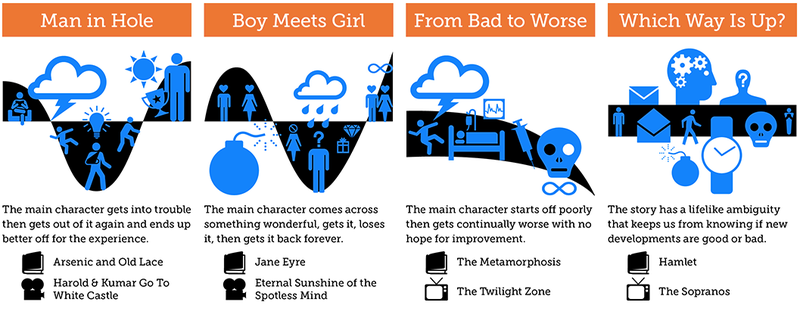
So the key is to intersperse high-probability events with low-probability events so that the viewer’s attention is maintained. There are many ways to do this, but as Kurt Vonnegut once wrote (in his masters thesis, no less), there are a few basic shapes that stories take. These shapes are popular methods in which high and low-probability events get interspersed so that the movie will be interesting.


Kurt Vonnegut’s Masters Thesis on the shapes of stories

So once you understand that there are certain “shapes” that stories take, you can try and guess how a movie’s plot will unfold. You make a mental note of the possible low-probability events that could happen, and with some practice, you will know how the movie will play out.

In an action movie, for example, there is a good chance that one (or more) of the “good guys” dies at the end. Usually (but not always), it is not the hero. Analysing the other characters in his entourage, it shouldn’t be normally hard to guess who will bite the dust. And when the event inevitably happens, it’s not surprising to you any more!

Similarly, in a romantic movie, unless you know that the movie belongs to a particular “type”, you know that the guy will get the girl at the end of the movie. And once you can guess that, it is not hard to guess what improbable events the movie will comprise of.

Finally, based on some of the action movies I’ve watched recently (not many, mind you, so there is a clear small samples bias here), most of their plots can be explained by one simple concept. Rather than spelling it in words, I’ll let you watch this scene from The Good, The Bad and The Ugly.