Revisiting fundamentals of GDP growth

In light of the ongoing Takshashila-Hudson conference on Shaping India’s Growth Agenda, it is instructive to revisit some fundamentals of GDP and GDP growth.

  • Real GDP grows when there is more economic activity in the region in this time period compared to the last time period (the “real” aspect of GDP growth means that growth due to changes in price levels is stripped out)
  • We can have more economic activity in two ways – we can have more of existing economic activities, or when new economic activities get created
  • An example of the former (increase in economic activities) is if say the production and consumption of mangoes in India rises from 100 units last year to 110 units this year. This implies that there is an increase in the economic activity of production and consumption of mangoes
  • In terms of new economic activities, I will take the example of my own business of quantitative management consulting – I help companies use data and quantitative methods to improve their business. I’m providing a service which (say) didn’t exist previously. Thanks to my services, my clients can improve the quality of their business, and their gains from these improvements are more than my fees. Thus my services have resulted in more economic activity
  • Every time a policy is proposed that is supposed to “increase GDP”, ask yourself how it will actually result in an increase in GDP – whether it aids more economic activity in existing goods and services or if it supports the growth of new economic activities
  • Taxation results in increased clearing price and decreased clearing quantity (Econ 101).
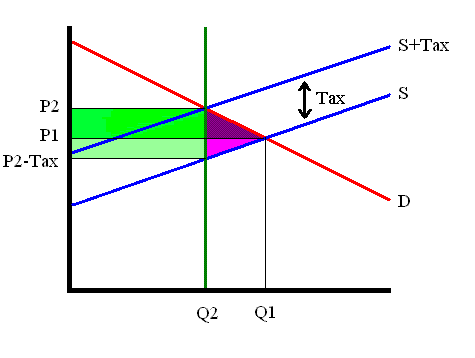
    The effect of tax/transaction cost on clearing price and quantity

    Once can argue that a reduction in taxes can thus foster greater economic activity. However, it must be remembered that taxation is what funds the government. Hence it is not prudent to reduce taxes too much

  • Decrease in transaction cost (cost paid by buyer but that doesn’t go to seller) leads to increased quantity of economic activity (it works exactly the same way as the tax graph above). Decrease in transaction cost is usually Pareto optimal. Any measures that decrease transaction costs can help foster greater economic activity
  • Transaction costs can occur due to multiple ways. In commodity (including food) markets, they can be seen in terms of a high bid-ask spread. Transaction cost, however, is not necessarily monetary. If you need to travel for a transaction, that is transaction cost. If you have to stand in line to buy something, the time spent again is transaction cost. Time spent by goods waiting for customs or octroi clearance is transaction cost
  • Focusing on eliminating transaction costs is a sure fire way to spur economic growth. This is why measures such as the GST (which cuts waiting time of goods at inter-state borders, among other things) are important
  • It is also important to take measures that allow entrepreneurs to take risks and try and create new classes of goods and services which were hitherto not traded. Thus we need policies that reduce the cost (monetary and otherwise) of starting a business. This includes the time taken to set up a business. This also includes policies that allow an unsuccessful business to be wound up quickly so that the capital and labour hitherto employed can be more profitably employed elsewhere

I can go on (and I realize I’ve gone beyond fundamentals here), but I think this does enough to set the agenda for today’s discussions, so I’ll stop here. Just one last thing – a phrase that is likely to be bandied about a fair bit in today’s conference is “this measure can add X% to the GDP”. Whenever someone says that you need to ask the question of whether it is a one time increase in the GDP or if it can lead to a sustainable increase in GDP growth (that’s the “resident quant” bit for this blog post).

Moeen Ali and the counterfactual

There has been much furore in the cricketing world over the last couple of days after the ICC (International Cricket Council) appointed match referee for the ongoing England-India Test match censured England player Moeen Ali for wearing wrist bands in support of Gaza. One the second day of the Test match, when he batted, Ali wore wristbands that said “Free Palestine” and “Save Gaza”.

While the England and Wales Cricket Board (ECB) absolved him of any wrongdoing claiming it was his personal beliefs, the ICC has been less kind to him stating that this is in violation of the ICC code that prevents cricketers from making political or racial statements on the field. Ali has been asked to play the rest of the game without the wrist bands, and might face a fine for the violation of the Code of Conduct.

Source: NDTV

What has complicated matters, however, is that during the third day of the Test match, the English players (including Ali) all wore a “Help for Heroes” message on their shirt collars. Help for heroes is a UK military charity and the symbol on the shirts was meant to commemorate a century of the start of the Great War. As expected this supposed “double standards” by the ICC (allowing the England team to wear a message in support of a charity but not allowing Ali to wear a message in support of Palestine) has drawn attention from commentators about double standards by the ICC.

While it is true that the ongoing undeclared war between Israel and Hamas has been largely one-sided in terms of casualties, and that a large number of Palestinian civilians have been collateral damage in the conflict, we should look at Ali’s wristbands as some kind of a positioning with respect to an (undeclared) ongoing war. And in order to determine whether his message was appropriate, we should use the “flip test”.

What if instead of supporting Gaza, a player in the ongoing Test (Virat Kohli, say, without loss of generality) wore wrist bands supporting Israel? What if Kohli wore bands that said “Save Israel” or “Free Israel”? Would the ICC have reacted similarly? And if the ICC had reacted similarly would commentators have reacted the same way as they have now, censuring the ICC for its stance?

I’m not trying to take sides here, and whether Ali’s wristbands were to be banned is a complex issue beyond the scope of this blog. All I’m trying to say here, however, is that a decision on a case like this should be agnostic of the side that the possibly offensive player is taking. A political statement is a political statement, and whether it falls within the limits of the code of conduct has to be determined irrespective of the side that it is taking. That is the only way regulation can be impartial.

Ramanamurthy, barbells and the bimodal distribution

One of my favourite movies (perhaps my favourite movie) is this 1990 Kannada movie called Ganeshana Maduve (Ganesha’s marriage). It takes off on the 1940 James Stewart starrer The Shop around the corner – ok the story of the movie doesn’t matter here so I’ll stop this digression.

One of the pivotal scenes in the movie is where Ramanamurthy the owner of the “vaTaara” (a kind of apartment that was popular in Bangalore till the 1980s, with lots of small houses in the same compound) wants to whitewash his house. The residents of the vaTaara  demand that if he whitewashes his house he should whitewash the entire vaTaara. After a long and protracted negotiation, Ramanamurthy agrees to their condition – he doesn’t whitewash his house! This negotiation can be seen in this landmark scene from the movie:

In one of his books (perhaps “The Black Swan”) Nassim Nicholas Taleb talks about what he calls the “barbell distribution” for investing. Most of your money, say around 80-90%, he says, should be invested in risk-free securities such as government bonds. The rest, he recommends, should be invested in extremely high risk high return investments – like venture capital or far out of the money options. This kind of investing strategy, he says, produces superior long-term returns than the conventional investing model.

Both the “Ramanamurthy principle” (as I call it, starting with this blog post) and the barbell distribution are instances of “bimodal distributions”. You can also think of bimodal distributions as being a strategy.

To refresh your statistical knowledge, a bimodal distribution is one that has two “modes”. The histogram of this distribution looks something like this (now you might get why Taleb, a self-confessed body builder, likens this to the barbell):

Based on this distribution one can craft a “bimodal strategy” for life – including investing. You either take extremely low risk or extremely high risk – nothing in between. You completely stop taking sugar in your coffee but have the occasional dessert. You either paint the entire building or don’t paint the building at all (like Ramanamurthy). Stripping off all the technical content, this strategy can simply be described as “don’t do things in half measures” or “not spreading oneself too thin”.

Of late I’ve found this kind of a strategy rather useful in my work and other life. One example is the sugar distribution – a little sugar in every cup of coffee doesn’t particularly give much pleasure but adds on to my blood sugar content. The occasional dessert (after having eschewed sugars entirely), on the other hand, can lead to insane pleasure.

Then there is the fitness regime that I’m trying to follow. The classic gym routine is to do a lot of warm up, and then some weights, generally exercising just one muscle set, and this is to be done every day, for over an hour a day. The routine I’m trying to follow dispenses with these warmups and light weights and focuses on lifting a few repetitions of very heavy weights, three times a week.

These are only a few examples of where this kind of a strategy can prove useful. Maybe you should think of where this might be applicable – and it is likely that it will work better than your little bit of everything model!

India’s messed up agricultural markets

Indicat seems like a good website for data on Indian commodity prices. I came across this website when someone tweeted about tomato prices. What struck me was the wide variation in tomato prices both within markets and across markets.

Now, in terms of price variations within market, some of it can be explained by way of commodities of different grades – for example if I’ve brought bright firm and big tomatoes, I’ll expect a better price than what your small squishy tomatoes might fetch. Agricultural markets usually solve this problem by means of grading (unfortunately data of grading is not available, though the website gives data on different kinds of tomato).

The bigger reason why there is such wide price disparity within a market has to do with the auctioning process itself. For this I’ll dwell upon my limited experience of one data point in terms of a day that I spent in the potato market of the APMC yard in Yeshwantpur, Bangalore.

The issue is that the auction happens in lots, and quantities are not aggregated. Let’s say I bring in a couple of sacks of potatoes. The market makers inspect and grade them, and then proceed on an open outcry auction to auction my potatoes. The auction (increasing price English auction) quickly done, the market maker moves on to the next lot which someone else has brought. And so forth.

What this means is that potatoes that a trader can purchase is limited to the extent of the potatoes that were auctioned when he was present at the market. This process of continuous auctioning thus leads to large investments in time for the traders.

More importantly, having several small auctions rather than one big auction (where goods of similar grade are aggregated) leads to fewer buyers and sellers, and that leads to inferior price discovery. A significant portion of the bid-ask spread and uncertainty in the mandies can be eliminated by just aggregating demand and supply and having only one or two auctions for a particular commodity in a day.

In this mechanism, when I bring goods into the market, they will get graded and I will be given a receipt indicating quantity and grade. At the end of the day, there will be auctions for each “micro-commodity” (commodity of a very specific type) and based on the clearing price of the auction I an exchange my receipt for the appropriate amount. This receipt can be made negotiable – in that if I choose to not wait until the auction happens or want to lock in a price, I can simply sell the receipt outside of the market!

There is no rocket science to this mechanism. The reason it is not being implemented is because incumbent operators of the APMC (agricultural produce marketing committee) yards have a monopoly on trading commodities within their respective “areas” and thus have no incentive to improve their mechanisms. On the other hand, the current mechanisms are actually beneficial to increasing the returns to the market makers, with the producers and consumers bearing the price.

Then there is the issue of price variation across markets. While local markets might provide convenience to farmers and prevent them from traveling afar to sell their produce, it once again leads to fragmentation. For example, there is no reason that there need to be 15 tomato markets in Himachal Pradesh or 75 markets in Punjab! If we have a mandi receipt system, the problem of farmers traveling can be solved by aggregators, who can issue grade-quantity receipts to the farmers and collect and aggregate produce, and then take it to the mandi. While it is important that there is competition among mandis (so that the mandi with lowest bid-ask spread gets most of the business – which is how it happens in financial markets), we should not encourage fragmentation. And with increased competition, fragmentation will simply go away.

There has been some indication that the current union government is willing to reform the APMC Act (the first step towards it was taken by the previous NDA dispensation in 2003, but went into cold storage during 10 years of UPA rule). It is perhaps the one step that can have maximum impact on controlling inflation while at the same time giving good returns to farmers and horticulturists.

Figure 1 here shows the number of markets and quantity transacted in various states:


tomato1

Figure 2 shows that the more the quantity transacted per mandi (that is, better the aggregation), the lower is the variation in price:

tomato2

There is massive scope for beating down food inflation by simply increasing efficiencies and cutting down bid-ask spreads in agricultural markets. Unfortunately so far policy in this direction has been hostage to monopolists who dominate such markets. It is imperative that India opens up its agricultural markets in order to aid better price discovery of agricultural goods and consequently provide better prices for both producers and consumers.


Twisting and shouting

Ten years ago to the day, there was tragedy. Around this time I was home. That day I remember my father’s usual Ambassador (his office car) wasn’t available, so he had come in a blue WagonR which looked like anything but a government car. Not that I could see too well, though.

Back in 2004, spectacle lenses made of plastic weren’t yet popular, and even if they were available they were quite expensive. I remember having a shell frame back then (like I do now, except that that one was an ugly-ish brown). The lens was made of glass – the kind that could shatter on impact and enter your eyes.

And shatter and enter it did. I had instinctively closed my eyes, so not much had gone in, though. My first reaction at that point in time was to remember the phone number of my usual opthalmologist (yes I still remember things like that). I even remember calling that guy’s office (yeah, back on those Nokia phones you could type without looking). Friends, however, were of the opinion that I should go to the nearest eye clinic. And Shekar Netralaya (JP Nagar 3rd Phase) was where we ended up.

It was among the freaker of freak accidents. I was playing badminton. <lj user=”amitng”> and I were on one side, two others on the other. We were both close to the baseline when the opponents sent the shuttle high. Both of us went for it, <lj user=”amitng”> slightly ahead and slightly to the left of me. Both of us drew our rackets back with a slight backswing. And that was it.

His racket caught me flush on the left spectacle lens. The lens duly cracked, and parts of it entered my eye. I remember that the game immediately stopped. I remember that one other guy’s car was right there outside the court, so we could go quickly to the hospital. And back in those days there wasn’t even a signal at the Delmia junction, so the U-turn was taken fast so that I could go to hospital.

I don’t remember what they did at the hospital. I think they cleaned up my eye, but one or two pieces remained particularly troublesome. I remember going for a follow-up test two days later. And I remember that one day after the accident I went all the way back to IIMB (after the accident I went home, in my father’s temporary blue WagonR) so that I wouldn’t miss accounting class (yes I was in my first semester so such youthful enthusiasm can be expected). And went back again the following day to write a test which I nearly aced.

And then there was the back story. 2004 was the first time that the IIMs decided to make public the CAT percentile. They had used an algorithm to allocate percentiles, and allocated it up to two decimal places. So if your “percentile” (with decimal places the term doesn’t make sense) was greater than 99.995 (i.e. you were in the top 0.005% of the 130,000 odd people who wrote the exam), your percentile would get rounded up to give a weird-sounding “100.00 percentile”. Top 0.005% of 130,000 means about six or seven people. Two of those were at IIMB. I was one of them. <lj user=”amitng”> was the other.

During our inauguration the certificates for the “directors merit list” of the senior batch were handed out. It was possibly meant to tell us how important being in the top 10 of the batch was, and I’m sure it did inspire a lot of people. And having been the top performers in the entrance test, people perhaps considered <lj user=”amitng”> and I top seeds (neither of us ended up getting it, though he got considerably closer than I did).

And so when I got injured before our first ever unit test and he was in some ways culpable for it (though in fairness it was on the field of play), there was scope for conspiracy theory. And when you have a bunch of creative youngsters and scope for a conspiracy theory, you can well expect someone to stand up and do the honours. And @realslimcody rose to the occasion. And Twisted Shout was born.

The name of the organization has its own story. @realslimcody is a Beatles fan, and he suggested that he name the yellow journalist enterprise as “twist and shout”. Madness heard it as “Twisted Shout” and the name stuck. A couple of episodes later I duly joined Twisted Shout. And we did a lot of twisting and shouting and yellow journalism. If you were our contemporary and not slandered by Twisted Shout you might consider your stint at IIMB of not being worthy enough!

Of course in a place like IIMB, you don’t do something just for the heck of it. Everything has to result in a “bullet point” in your CV (back in 2005 I’d planned to write a book called “In Search of a Bullet Point” about IIMB, but that again didn’t take off. I put NED, I guess). I think I wrote in my final resume that I was a “co-editor in the campus informal journal Twisted Shout”. I think the placement committee (which whetter all CVs) let that one remain (bless them). And as with all such campus endeavours TS quickly died after we graduated (though I tried to resurrect it in a separate blog on this site, it didn’t take off).

It’s ten years since that landmark incident that sparked the birth of Twist and Shout. I must mention my eye is fine – fine enough for me to wear contact lenses as I type this. There’s a scar inside my eye, though, and that’s something I’ll carry all my life. But it doesn’t affect life one bit, and life goes on!

Oh, I wasn’t right on that one – after the injury the doctor had told me that I shouldn’t let sweat enter my eyes. Two months after the injury I managed to get myself a red bandana (with skull and crossbones on it), and I ended up wearing it at all “sweatable opportunities” – when I played or partied. The bandana got legendary in its own way, and its story shall be told another day (or perhaps it’s already been told somewhere on this blog).


Caste, socialism and social capital

Some new research by Dan Ariely (of Predictably Irrational fame) and co shows some interesting correlation between a socialist/communist upbringing and attitude towards lying (The Economist reports this research under the headline “Lying Commies“). While I’m not particularly convinced about the research methodology (sample of 250 respondents under a simulated environment – but then most behavioural research suffers from this problem) I find this research interesting since it supports another hypothesis that my wife and I came up with a few days ago – that India’s low social capital is a consequence of the caste system.

I’ve long maintained that the Indian caste system is perhaps the earliest example of a socialist economy. Assuming that reproductive rates across different castes were similar (there is no reason to believe otherwise) what the caste system ensured was that the relative supply of labour across different occupations remained constant even in small geographical areas, and consequently the relative prices of goods remained broadly constant. We can thus think of the caste system as an instance of a socialist model where each one’s profession is determined at birth, and relative prices are fixed. I will go as far to say that there is no better example of a planned economy than the ancient Indian caste system.

One of the inherent problems of Indian society is the lack of social capital. To use my co-INI blogger Nitin Pai’s framework, Indians value Swaartha (self-interest) over Paraartha (interest of others) to an extent that is far beyond the optimal level. The hypothesis goes that there is an optimal mix of Swaartha and Paraartha that should enter one’s objective function while making decisions in everyday life. For example, do you allow the other car to pass before you so that you avoid the traffic jam or do you rush ahead just because there is space in front of your car? Do you over-graze the commons just because it is there or do you consume it in moderation so that others have something to consume, too? A society with a high degree of social capital gives a higher weight to Paraartha in these objective functions, and people in such societies cooperate more and collectively take decisions that make more sense at the societal level.

Now, societies where life is tough (due to geographical or environmental factors) generally face a higher degree of social capital than those where life is easier. One way to experience this would be to drive from Punjab to Himachal Pradesh. On the wide roads of the Punjab plains, it is dog-eats-dog on the road – people overspeed, overtake like crazy and don’t give too much consideration to others on the road. Once you enter the hills of Himachal Pradesh, though, the whole equation changes. Here, a confrontational paradigm doesn’t get you too far – the narrow roads and winding curves mean that drivers need to cooperate more in order to get their way. Social capital in such societies is naturally higher.

Social capital is sticky in one way – if a particular generation in a particular location has high social capital, it is extremely likely that the preceding generation also had high social capital. The reverse, however, is not necessarily true – social capital can sometimes be destroyed in double quick time (think, for example, of the Lebanese Civil War between 1975 and 1990). Thus, the fact that social capital in India today is low could either be because it was always low, or because there was a particular event that destroyed social capital. Since it is unlikely that there was one event which destroyed social capital in the entire country, it seems more likely that social capital in India has always been low.

Social capital is important in a society where there are no rules – if you have a traffic signal at an intersection, for example, the lights will ensure that there is no jam. However, in the absence of rules (or lights) high degree of cooperation is necessary between drivers in order to lead to higher throughput from the signal. One way of combating a society with low social capital is to have lots of rules – these rules rather than social conventions can then drive the society. The converse is also true – in a highly rule based society there is no real need for social capital, and thus social capital can wear off down the generations.

As explained earlier, the caste system meant that the ancient and medieval Indian society was highly planned and rule based. Complex caste rules ensured that there was a rule for any possible social occurrence which might otherwise require cooperation. A brahmin’s cart and a shudra’s cart on the same one-lane path? There was a rule regarding right of way. Two people reaching the river at the same time to bathe? A rule governed who might swim upstream. And so forth.

My hypothesis is that the rule-based society ancient India had due to the caste system meant that there wasn’t much need for social capital. And thus India has never been a high social capital country (except of course for tracts such as Himachal Pradesh where life has been difficult). To put it another way, we see that a socialist economy from the past ages has led to consistently low social capital.

Which is not that far off from what Ariely et al say in their paper.

Should you stop flying Malaysian?

So Malaysian Airlines faced its second tragedy in four months when its flight MH17 was shot down over Eastern Ukraine yesterday. In response to this terrorist attack, stock prices of Malaysian Airline dropped sharply in today’s trading. Given that the airline has faced two tragedies in quick succession, the question is if you should stop flying the airline, and if the price crash is justified.

The basic question we need to ask ourselves before we book our next ticket is the probability of that Malaysian flight crashing vis-a-vis the probability of a flight belonging to another airline crashing. Now, one never knows what happened to MH370, but most reports (months after the disappearance) point to either sabotage or a terrorist attack. Based on analysis and reports so far, it is extremely unlikely that MH370 disappeared on account of any technical or security lapse on behalf of the airline.

Coming to MH17, which was shot down over Ukraine, again it must be recognized that the airline went down thanks to a terrorist attack. It must also be pointed out that the terrorist attack was from the ground and not from on board, and that there is nothing to indicate that there was any technical or security lapse on the part of the airline that led to the attack.

Moreover, given that neither Malaysia nor the Netherlands (MH17 took off from Amsterdam) has anything to do with either side of the Ukraine conflict, it can be assumed that the targeting of Malaysian Airlines in yesterday’s attack was just incidental. It is more likely that the terrorists wanted to either shoot down a Russian or Ukrainian airline for a particular reason and took down a Malaysian flight by mistake, or just wanted to show their intent by shooting down some airline. Based on this, we can say with very high confidence that the reason a Malaysian airline flight was targeted last night was purely incidental.

Based on this analysis, it is unlikely that there is something specific about Malaysian Airlines that has led to the two accidents in the recent past. In this light, fear of flying Malaysian is irrational, and there is no reason to believe that a Malaysian flight is going to be less safe than a flight of another airline. So if you are flying on a route that is served by Malaysian, after accounting for cost and time and other “normal” factors of consideration, there is no reason why you should prefer to fly another airline rather than Malaysian.

And should you fly at all? If it’s a route that you would normally travel by flight, you should most definitely should, for on a passenger kilometer basis, traveling by flight is definitely safer than traveling by car.

Then what about the markets? The stock price of MH has tanked because the market believes that people are going to fly MH less. Considering that most people are irrational, this is a fair judgment to make, and so one can say that the stock price crash is justified. However, unless something untoward happens (which can actually be traced back to incompetence on behalf of MH), it is likely that MH traffic fall will be much lower than what the markets expect, so it might make sense to buy the stock today – if you have the opportunity to do so. And as a passenger, MH fares are likely to get more competitive in the near term, so you might want to take advantage of that also!

Damodaran on Uber’s Valuation

It is fascinating to watch this back–and–forth between NYU Prof Aswath Damodaran and Uber board member Bill Gurley on the taxi company’s valuation.

To set the context, when the latest funding round for Uber was announced, valuing it at USD 17 billion, Damodaran – a guru in valuation – wrote his own analysis which valued the company at about a third of that value. While it was a typical Damodaran post – long, detailed and making and stating lots of assumptions – it was probably intended as an academic exercise (the way I see it).

Instead it seems to have really caught the fancy of the silicon valley investment community, and led to a response by Gurley (I admit I haven’t read his full response – it seemed to attack straw men in places). And Damodaran has responded to the response. Now that the Three Way Handshake is complete I don’t expect any more backs and forths, but I won’t rule it out either (it’s possible but not plausible, to use Damodaran’s terminology).

What fascinates me is why an academic’s academic post on valuation of a company has created so much of a flutter – so much to merit a long-winded response from the board member. I’m reminded of two things that my valuation professor had told me some 10 years back when I was in business school.

1. Valuation is always wrong
2. Value of a company is what the market thinks it’s valued at

The first of these is a bit of a motherhood statement and adds no value to this particular discussion so let’s not take that into account. It’s the second reason that has got the investors’ knickers in a twist.

In the past, I’ve seen Damodaran publish valuations of companies that are about to go public, or are already public – Tesla and Twitter for example. It is usually an academic exercise, and Damodaran’s valuations value these companies at lower than what the market values. However, given that these posts have appeared after there has been a broad consensus of a company’s valuation, it has not really impacted a company’s valuation, and thus have been treated as an academic exercise.

The problem with Uber is that it is a private company, and unlikely to go public for a very long time. The problem with a private company is that it is difficult for investors to agree on its valuation – there are very few trades and the stock is illiquid (by definition). And illiquidity means extremely high bid-ask spreads (to put a technical spin on it) and widely varying valuations.

Sometimes, when nobody knows what something is valued at (like Uber – which is creating a new category which no one has any experience in valuing), what people look for is some kind of a peg, or an “anchor”. When they see what they think is a reasonable and broadly reliable valuation, they tend to use that valuation as an “anchor” and if a large number of investors agree on one such anchor, the anchor ends up being the company’s valuation itself.

To reiterate, value of a company is what the market thinks it’s valued at. Nobody knows what Uber is valued at. Investors and existing shareholders agreed at a particular valuation, and did a deal at that valuation. However, this valuation is not “deep” – not too many people agree to this valuation.

It is in this context that an (very well renowned) academic’s valuation, which values the company at far less than the last transacted price, can act as an anchor. Damodaran is extremely widely respected in investing circles, and hence his valuation is likely to have received much attention. It might even be possible that his valuation becomes an “anchor” in investors’ minds of Uber’s valuation. And this is where the problem lies.

Even if you were to account for the consistent downward bias in Damodaran’s valuations and adjust Uber’s valuation accordingly, it is likely to lead  to a much lower anchor compared to the last transacted price. And this is not likely to be good for existing investors. Hence, they need to take steps to quickly debunk Damodaran’s valuation, to make sure it doesn’t end up as an anchor! And hence the long response by Gurley, and the silicon valley investor community in general!

To summarize, all that this entire brouhaha on Uber’s valuation shows is that its price discovery so far has been rather shallow.

Reforming Air India (yet again!!)

Being a PSU, Air India faces a unique set of constraints. In order to maximize its performance, the airline should take the most optimal decisions that satisfy these constraints. 

On Monday I had to go to Mumbai on some work and I flew Air India. Normally I prefer to fly either Jet or Indigo, but given the short notice at which I had to plan my trip, and the fare difference between Air India and the other two (leaving aside some airline I don’t trust), I decided to go for the national carrier. Overall it wasn’t an unpleasant experience – my onward flight was late by ten minutes or so, while my return flight was on time. There was plenty of leg space, the food was good and online check in was hassle free. Yet, it looked like there was plenty of scope for improvement.

Now for a digression. The difference between club football and international football is that in the latter you cannot buy players (not strictly true – Spain got Brazilian born Diego Costa to play for them on account of 1. his Spanish passport, 2. that he had never played for his native Brazil, but this is an extreme assumption). To use a cliched term, in international football you need to play the hand that you’re dealt. Thus, the job of a manager of an international football team is to organize his team’s strategy and tactics according to the personnel available to him, rather than the other way round. For example, Dutch manager Louis van Gaal is known to favour a possession based passing game. However, given the set of Dutch players available to him, he has set them out as a counterattacking side.

Given the lack of degrees of freedom in running PSUs, it can be argued that running a PSU is closer to managing a national football team than it is to managing a club team. Government ownership and consequent pay structures, combined with the lack of a good lateral entry system to the Indian public sector, mean that it is hard for a PSU to “buy” personnel like private companies can. On the other hand, sacking PSU employees is a politically charged activity, and not easy to administer, so it is hard to get rid of deadwood also.

The traditional argument is that given these restrictions that PSUs face, it is impossible for them to perform at the same level as comparable private sector units. While this argument is well taken, what we need to be careful is to not let this mask any degree of poor performance by a PSU. The question, instead, that we need to ask is if the PSU is actually making best use of the “hand it has been dealt”. What we need to check is if the PSU is optimizing correct given the resources and constraints at hand.

Coming back to Air India, one of the stated causes of its poor performance is that it is overstaffed – it far exceeds its global peers in terms of the number of employees per aircraft (normally assumed to be a good metric of staff size). This was fully visible at the boarding gate on Monday, for there were four personnel with the task of barcode scanning the boarding passes. Most other airlines have two staff doing this. A clear case of overstaffing. While it may not be under the management’s control to downsize (see constraints listed above), what irked me was that they were not being put to best use.

Just to take a simple example, if you have twice the number of required staff at the boarding counter, all you need to do is to put in an additional barcode scanner and run two boarding lines instead of one – which results in doubling the pace at which the plane is boarded. This doubling of boarding pace means planes can have a much faster turnaround time at each airport – which means the number of flights that Air India can run given its stock of aircraft can increase significantly!

To take another example, Air India probably has the best leg space in the economy class among all Indian carriers – this is probably driven by the fact that a large number of government officers and ministers travel mostly by Air India, and holy cows mean that they are forced to travel  “cattle class”, the airline offers some comfort. Now, while this means each plane has one or two rows of seats less than that of other carriers, it constitutes a massive marketing opportunity for the airline! Given the leg space and comfort and meals (!!), Air India can very well position itself as a premium carrier and try to charge a premium on tickets!

On an absolute basis, the recommendations above may not be optimal – it might be well possible to make more money by sacking boarding gate employees than by cutting boarding time, or it may make more business sense to add an extra row of seats than try to enhance legspace. However, given the constraints the carrier faces, these are possibly the “second best decisions” that the carrier can take. And by not taking these decisions, the carrier is not making as much money as it can make!

Correlated judgment

When you judge people about something, you do not normally judge them on that thing alone. You also judge them on “correlated traits”. For example, there is this popular adage (that was popular when I was in IIT) that goes “beauty times brains equals constant”. This implies that anyone who is above average in terms of looks is likely to be below average in terms of mental capabilities. Whether such a correlation exists is not known, but by instinct if we someone beautiful, we assume that the person is not great in terms of mental ability (in my later years at IIT, we recognized this limitation of the model and proposed “beauty times brains times availability equals constant”, acknowledging that beautiful intelligent people exist, but are most likely taken).

There is no end to such correlations, which usually make rounds around college campuses. For example, there is the “he is the partying types, so is unlikely to be a good worker”. Now, while it is true that the amount of time available to most people is constant, and that heavy partying can come at the cost of working, such an adage discounts the fact that some people could simply be better time managers, or don’t care much for some axis apart from partying and working (sleeping, for example!), which allows them to be good at two things that people are normally not good at!

It is common for people to judge people. However, thanks to implicit correlations of traits that are built into people’s minds, when you get judged on one thing, that is not the only thing you are judged on – you are also judged on the things that are correlated with that!

Time for more examples. Once my parents saw a friend of mine very evidently flirting with a girl. They immediately judged him as being “a flirt” and branded him thus. While judgmental, there is no mistake in that judgment – he was indeed a flirt, and would gladly admit to it. But then my parents, using their inbuilt correlation filters, went one step ahead. “He is such a flirt”, they told me, “We don’t think he is a good person. You should not hang out with him any more”!!

Back in 2005, in IIMB, I had stood for elections to the Academic Council. At a party a week before the elections I happened to get wasted, and ended up talking to people inappropriately. The next morning, as I’m trying to get over my hangover, I heard “dude, how could you get wasted if you are standing for elections?” I have no clue how getting wasted at one party would make me a bad Academic Councillor! I must mention I lost the elections.

It was at a discussion yesterday with Bharati and my wife Priyanka that this topic of correlated judgment came up, when we were discussing how life in a business school can be unforgiving. A few minutes later, Priyanka popped up “that baby was so cute, I expected him to be dumb!”