The NFL Documentary

As you might have figured out from my earlier post, I’m no great fan of American Football. I find it too “discontinuous”, I find that the play has too many breaks, and the game is a lot less “elegant” than rugby. However, there is one thing that the National Football League excels at – to make great videos.

Somehow I’m unable to embed the video here so you’ll have to go to the NFL website to watch it. It’s easily the best sports highlights package I’ve ever seen. Extremely well produced and put together, and puts any other highlights package to shame.

The key is that it’s been set out as a kind of documentary – there isn’t much from the commentators, most of the voice is that captured from the bench, from the players and the coaches. And you can see the levels of motivation in either team through the game. You see the players talking to each other, the interactions between opponents, and the chatter from the benches. It shows the game in a whole new perspective!

That however doesn’t mean that I’m a fan of the game now. The forward pass rule makes it extremely inelegant and clunky. I’m reminded of the “football” we would play with a tennis ball back in school – there was no off-side rule, a bunch of us would go stand in front of the opponent’s goal and our goalie would throw the ball to us. And one of us would try and “head it in” (as much as you can head a tennis ball). Then the ball would turn over and action would shift to the same, but at the other end.

Watching a couple of “touchdowns” made me lose whatever little enthusiasm I had for the game. There was none of the elegance that is there in rugby. The ball would move forward great distances in short amounts of time. There was no passing and moving – in fact, I didn’t see a single back pass in the entire highlights package. The moves were really short. I can go on.

Yet, despite the game itself being atrocious, that doesn’t take away from the totally awesome highlights package. Watch it, even if you (like me) hate American football.

Related: Why American sports are hard to watch. TL;DR – their ad breaks are unpredictable


The deflation controversy

This is my first ever blog post on hand-egg, or the sport that the Americans call as “football” despite you being allowed to run with the ball. I’m writing this as I try to watch the SuperbOwl and try to understand the rules while I’m doing so. So far it looks like a heavily discretised form of rugby, but with none of the elegant pass-and-move routines. People like to fall too much it seems.

Anyway, this post is not about this game. This is about the semi-finals, where the New England Patriots were accused of “deflating” the ball. Over the last week my twitter and facebook timelines have been filled with this controversy. People have mostly been outraging about it one way or the other. I’ve had to mute a lot of people on Twitter for this reason.

As far as I can see it this controversy is similar to the reverse-swing controversy that dogged cricket in the 1990s. The question is if you are allowed to change the ball to suit your conditions as the game goes on. In cricket, people spit on one side of the ball and shine it and try to wear down the other side (sometimes using illegal means such as lozenges and bottle tops respectively). The convention in cricket, however, is that as long as such illegal materials aren’t used to change the ball, there is no problem with maintaining the ball in the way it suits you best. And the opponent (the batting side) can ask for a change of ball if they think it’s been changed too much.

Drawing an analogy from there the rule in hand-egg should be simple. Players should be allowed to do what they can to change the condition of the ball to suit them (inflation/deflation/whatever) as long as they don’t use “illegal materials” for the purpose. So if they use a pin to let out air from the ball, it’s possibly illegal. But if they just use their hands? Possibly not. And so forth.

The only problem is that unlike cricket, hand-egg is a simultaneous game (both teams have opportunity to attack at any point in time), so you might have the two teams wokring the ball at cross purposes. Then again, as long as you have the rule that the opponent can ask for a change of ball in case they think it’s been changed irretrievably, it’s fine!

So coming back to the semifinal controversy, I think the fault lay with the quarterback of whoever the Patriots beat. That guy, if he were clever, should have figured out the “tampered” ball when he got it, and asked for a change. It appears that he was either not clever enough to figure that out or that the Patriots had so much possession that he didn’t have a chance to even touch the ball!

No point crying after the game was up!

Basketball and playing to your strengths

Earlier this week the wife went to play basketball with some classmates in Barcelona. As she was on her way back home, we were talking about the game and I inevitably referred to my own style of playing (it’s a theme now – she says something about school, and I start off my own story with “back when I was in B-school…”). I was telling her about how I never really got good at laying up or dribbling, and I built my game around a careful avoidance of those themes.

She snapped that I was “one of those guys” who doesn’t bother learning certain kind of stuff because I’m good at other kind of stuff, so I assume that I don’t need to learn new stuff. What she said took me back to this piece in Scientific American which talks about two kinds of learning – which the piece calls as “fixed mindset” and “growth mindset”. The piece goes on to say that kids who are usually praised for results or intelligence end up developing “fixed mindsets” and that for such kids, learning stops at some stage. Those praised for effort and process on the other hand, the piece says, continue to learn and their learning is everlasting.

When I read the piece I completely identified with the fixed mindset. I sailed through most of school without putting in much effort, but when the learning curve got steep (like in Class XI physics, or at IIT) I simply gave up and started working around concepts that I found hard to learn. I didn’t do badly then, but it started affecting me when I started working. And over the last three years I’ve institutionalised playing to my strengths, while making an effort to simultaneously learn.

Coming back to basketball, the wife talked that day about how my view of the game was wrong and compared my views to those of people who would ask her “so how many points did you score” after a game – which she said was extremely pointless.

Anyway I had a chance to put that to test this morning when I played basketball (after a gap of close to 9 years) with Rohin, Vivaan and Issac (links not available to latter two). It was a chance occurrence – I stumbled upon Rohin’s tweet calling for people to play basketball with him and I responded. And it was a wonderful morning today, as I played the game after nine years.

Two pertinent observations – firstly I haven’t regressed too much. I missed shots much more frequently than I normally do, but got better as the game wore on. The second and more important pertinent observation – I still play in a fashion similar to how I played back in 1997.

So despite having gone for formal training in basketball for a brief period when I was in class 1 (or 2), I’ve never been good at dribbling. I’ve never learnt to put a good lay up . And I’ve never been a quick runner. And right from the beginning rather than working on these weaknesses, I simply played to my strengths and improving my play in those – I can shoot reasonably well (though I didn’t do so today), my above-average height (by Indian standards) means I can pick rebounds well, I have developed a good sense of positioning to compensate for my lack of speed, which also means I can defend fairly well, and so forth. And I make up for lack of dribbling and layups by relying on quick short passing. And all this put together has made me a reasonable player at casual level, and I had a satisfactory game this morning too.

In short, the way I’ve developed my basketball is by just ignoring what I suck at but focussing on getting better at my strengths. While this means that I rarely put myself outside of my comfort zone, it also means that I become an overall better (though incomplete) player given the amount of effort I put in. I remember times when I would play alone in the half-court behind my hostel at IIT. When you play basketball alone, you have two choices – do layups and shoot. To become a complete player I should’ve practised the former. I chose the latter!

So coming back to the Scientific American piece, while I agree that a fixed mindset can stop growth at some point in time, it is possible to grow around it as long as you recognise your limitations and simply focus on your strengths. And with the coming up of the on-demand economy (which I’m in a weird way part of), division of labour can be such that you can possibly get away doing only those things that you are good at! At least that’s the hope for people like me who’ve grown up with a fixed mindset.

And finally, I realise I’m unfit. Despite going to the gym fairly regularly, the game of basketball this morning showed me up as being severely unfit. Despite being the youngest guy on the court ( I think, but am not sure), it was I who was calling the time outs this morning, and it was I who was panting the most. It’s not good. Basically the kind of fitness you need to play sports such as basketball (lots of short sprints) is very different from what you build by doing “normal gym activities”. To put it another way, squatting 150 lb is no indication of whether you’re capable of playing half-court basketball for 30 minutes!

Analysing Premier League Performance So Far

English Premier League tables can be misleading in that they are a function of the fixture list. At this point in time it doesn’t matter so much since we’re only 2 games into the second half of the season but in the middle of the half of the season it is important.

From this perspective, it is important to compare this season’s results against comparable fixtures of last season to know where teams are. Last season I had a calculator that would run every week. This year, thanks to Liverpool’s indifference performance (as you can see in the first chart), I’ve been late on this.

The list of Premier League teams changes every year, though, thanks to relegation and promotion. For this purpose, we replace teams placed 18,19,20 last year respectively with the Championship winner, runner-up and winner of playoff. So we substitute Leicester, Burnley and QPR respectively for Norwich, Fulham and Cardiff from last year’s table.

So the first graph shows the difference between a team’s points tally this year and the team’s points tally from the corresponding fixture of last year. This illustrates why as a Liverpool fan I’ve put so much NED – they’re the second worst team this year compared to last year, after city rivals Everton.

PLchange15

The most improved team is, of course, West Ham United. Also having improved significantly are Swansea and Chelsea. At the other end, after last year’s high-flying Liverpool and Everton, we have relegation-threatened Crystal Palace and West Brom, along with Arsenal. And QPR is worse off compared to Cardiff last year!

Next, if we assume that the rest of the season goes identically to last year’s corresponding fixtures, what will the final table look like? It will look like this:

pointstable15


According to this, Palace should hang on, but West Brom and Hull will go down, as will QPR. Surprisingly, this says that Arsenal and Spurs will get the last two Champions League places (notice the gap between 2 and 3 here).

The importance of a vice-captain

On the cricket field, people imagine that the role of the vice-captain is one of the most pointless roles ever. Perhaps only marginally pointful than the role of the captain in a game of football. The only time when a vice-captain is called for to show off his vice-captaincy is when the captain is unavailable (due to injury or whatever). And in cricket, that is not particularly common. So the vice-captain’s role is mostly pointless.

Some teams manage by committee – this is where you see the captain, vice-captain and two other (senior) guys assisting a bowler set his field. There the vice-captain might have a job to play. But in general the job is so pointless that sometimes teams don’t even bother naming a vice-captain, and name one only at the point of contingency. At other times, a senior player is made vice-captain (since it is a pointless role anyway) without really testing his fit for the role.

And sometimes, it can backfire spectacularly. I’m reading Martin Crowe’s account of the semi-final loss to Pakistan in Auckland in 1992, and he puts the blame squarely on his then vice-captain John Wright. Crowe got injured while batting and didn’t take the field. Wright led instead and made a mess of Crowe (a master tactician)’s carefully laid out plans. And Pakistan won in a canter. Quoting the article,

Crowe, meanwhile, was fidgety and restless in the dressing room. Along with New Zealand coach Wally Lees, he had laid out an elaborate bowling plan with a heavy emphasis on rotating bowlers. As many as 17 bowling changes were planned and Crowe had worked out how many over spells each of them would bowl in the chase.

“I was the only one who knew the script really,” Crowe says. “Lots of bowling changes, short spells, was the key really because that would not allow any batsman to get in.” But Wright decided to attack straightaway.


The point to be noted is that Wright had not even been part of the team for most of the earlier games in the tournament, where Crowe had come up with some revolutionary tactics such as quick bowling changes involving wibbly, wobbly, dibbly and dobbly (there were only three of those in this game, for Rod Latham had been dropped to make way for Wright), opening with Dipak Patel and careful use of bursts by Danny Morrison.

So when called upon to lead the team in Crowe’s absence, Wright was pretty much clueless, for he had not seen the plan of action from the field too much earlier in the tournament. And he made a mess. And New Zealand lost. Possibly their best ever chance of winning the World Cup till date.

Taking Crowe’s injury a given, would Pakistan had still won if someone else (say Ken Rutherford) who had played a full role in the tournament had taken over? The problem with Wright was twofold – he hadn’t played enough to be familiar with his team’s tactics, and he was probably too senior to just follow Crowe’s advice. The lack of thought in selecting the vice-captain had been shown up.

Management Guru Alert: So the point is that even if a role looks mostly pointless, you need to pick it carefully, and on merit. Because in a contingency the role stops becoming pointless, and you need the best available person for the job then.

Reminded of the Tied Test in Chennai

I started watching the ongoing Test match just after tea, with the score at 210/2 or something. And the resemblances with *that* Test match in Chennai in 1986 were striking.

https://www.youtube.com/watch?v=Hjyaz-vCAb8

1. Australia declared twice in both games. In both games they declared after losing 7 wickets in the first innings and 5 wickets in the second.

2. Overnight declaration on day 4, leaving India to score at approximately 4 an over on the last day

3. Good finger spinners – Lyon here, Bright and Matthews there.

4. Three hundreds for Australia in the first innings – Boon, Border and Jones there; Clarke, Smith and Warner here

Ok there was no Virat Kohli like innings but it seems like he’s combining the roles of Sunil Gavaskar (who scored 90) and Ravi Shastri (who led the final charge with 48*) here. Let’s see how it goes.

Posted with India at 299/6

Rodgers and the Ranatunga Principle

It was a wonderful display of the “Ranatunga Principle” by Brendan Rodgers last night, when he fielded what was effectively a second string Liverpool team at Real Madrid. That they lost only 1-0 shows that it wasn’t that bad a ploy, especially given the more important features coming up ahead.

Firstly, Liverpool have not given up on the Champions League. They have simply prioritised. The group they are is a rather weird one – where one team is significantly superior to the others which are approximately at the same level. It is not inconceivable at all that Real Madrid will win all their six games and get 18 points.

Before the game at Anfield two weeks back the degree of Real Madrid’s superiority over Liverpool wasn’t yet fully established and Rodgers smelt the chances of handing out an upset at home and fielded his strongest team. It backfired spectacularly as Real Madrid hammered Liverpool. The more important result of the night, though, was the unfancied but promising Ludogorets beating Basel at home. It was that result that allowed Rodgers to do what he did yesterday.

Real Madrid’s dominance means that Liverpool, Basel and Ludogorets are effectively playing a 3-team mini league the winner of which will go through to the knockouts (of course the extents of their respective thrashings by Real Madrid will matter if it comes down to goal difference). So far, in this mini group, all games have gone to the “home team”.

Liverpool’s last two games of the season see them take on Basel at home and Ludogorets away, and if they win both of them, they are through to the knockouts. Even if Liverpool had come away with a point in last night’s game, this equation would not have changed significantly (three points last night would have helped but the game at Anfield showed how impossible that was).

Liverpool have had a rather busy fixture list in the last 3 weeks. In the space of three weeks they’ve had to play QPR, Real Madrid, Hull, Swansea, Newcastle, Real Madrid and Chelsea – not an easy fixture list at all, and Liverpool’s poor form in the league has made them take even the Capital One Cup seriously, meaning not too many players could be rotated for the game against Swansea. In the loss to Newcastle on Saturday, the fatigue was evident as Liverpool’s attackers were all anonymous. A rest day was thus in order.

This, combined with the weird nature of the Champions League group that Liverpool are in meant that last night’s game was the “least important” for Liverpool in the current run of fixtures, which permitted them to rest key players and give a run out to the perennial subs. And on the evidence of the 1-0 defeat, it seems it didn’t go too badly. Now if only Liverpool can make use of this rest and beat Chelsea on the weekend!

Postscript

Gerrard came on around three-quarters into last night’s game. I have come to believe that is his best position for the team now. Come on as an “impact substitute” in the second half and play in the “old Gerrard role”.

The Steven Davis Role

The first encounter between Liverpool and Southampton in the 2013-14 English Premier League season happened at Anfield in September, and Southampton won 1-0 with a Dejan Lovren goal from a set piece. So when the two sides met again at St. Mary’s in the latter half of the season, with Liverpool chasing the title, it was known that it would be a tough game for Liverpool.

Southampton dominated the first half, playing a front four of Steven Davis, Adam Lallana, Jay Rodrigues and Rickie Lambert. However, it was Liverpool who scored in that half, and led 1-0 at the break. Here is a picture I found on twitter that was uploaded at half time:
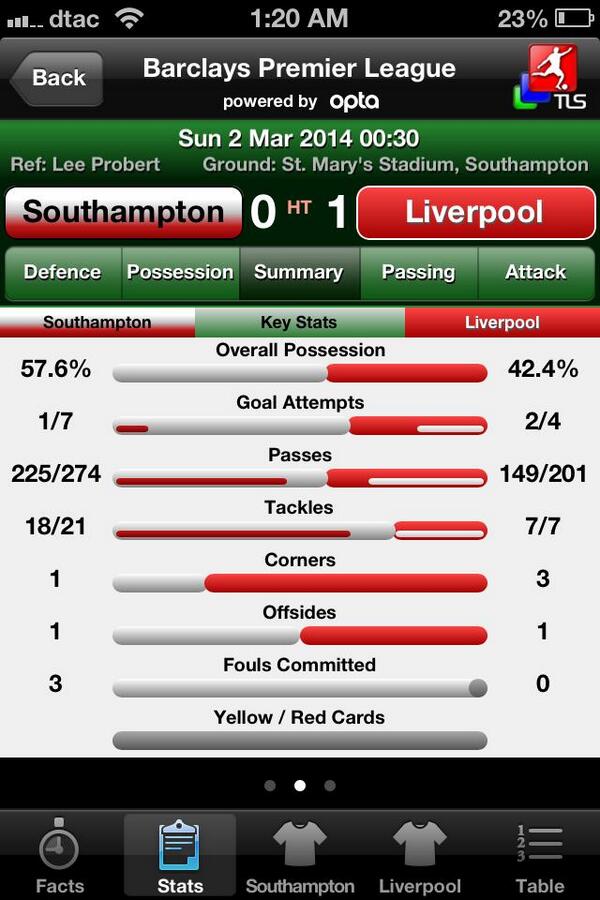
Southampton manager Mauricio Pochettino decided to change things for the second half. He took off his most unspectacular forward player Steven Davis and replaced him with Gaston Ramirez, the promising Uruguayan. Soon, Southampton unravelled and Liverpool completely dominated the second half as they won 3-0.

Now, there is no doubt that Ramirez is more talented than Davis and is definitely a better player in general. However, in the context of the rest of Southampton’s team, Ramirez’s introduction proved to be a disaster and there was little cohesion in their attacking play from the time he came on. Southampton became a disjointed team and went out of the game.

This has led me to define what I have come to call the “Steven Davis role”. It is basically a player who is not individually the best, but provides some kind of a glue that holds the team together. The player’s key skill, rather than looking at it from traditional axes such as passing or shooting or tackling or intercepting, is to change position, and to make sure that the team holds its shape at all times. It is to make sure that any players who are out of position are covered for, and that the attack retains its shape and focus.

Now, it must be remembered that last season Southampton’s attacking play was primarily based on strong movement and interplay between their front four. They had nominal positions defined, but they hardly stuck to those as they moved around in attack. Thus, Lambert who would start upfront would sometimes appear on the wing, with the nominal “number ten” Lallana going forward, for example.

And key to this system was Davis, who wasn’t particularly talented, but who would move in a way that would balance the attack. If the other three would move left to attack, he would take up a position slightly to the right – not too far away from the attack but providing a kind of counterbalance. He never led attacks himself, but he was always available to support the others’ attacks. And this is what made Southampton dangerous.

Once Davis had gone off, Southampton had no one to play this role. The kind of interplay they had in the first half disappeared. And their attacks became toothless and each attack had only one dimension which was easy to cover even for Liverpool’s normally shaky defence, as they kept a clean sheet.

It was a similar case I saw last night at the Camp Nou, with Barcelona’s Pedro Rodriguez playing in a “Steven Davis” role. Messi started in the middle and Neymar wide on the left. Pedro nominally started on the right. But soon it became clear that he was a kind of a “wide support striker” – his job was to appear in positions that complemented the rest of the attack rather than being in positions where he led the attack (though he did lead one glorious counterattack where he hit the post). It was like a kind of balance that he offered the team, and ensured their attacks had coherence (of course this being Barcelona they had Iniesta and Rakitic just behind to offer more “focal points”).

Last night was the last game of Luis Suarez’s ban, and it will be interesting what Barcelona do with him when he gets back this weekend. The instinct will be to remove Pedro in his favour, but it is not clear if an attack of Messi-Neymar-Suarez will be able to offer the same kind of coherence as an attack of Messi-Neymar-Pedro. That said, Suarez is an extremely intelligent player and showed in his Liverpool days that he is capable of being a “fighter”, so he might as well be played. But that will mean that Neymar will have to occasionally play the Davis/Pedro role, and it is not clear if he is capable of doing that.

We are in for interesting times.

The post has so far focussed on football but it is evident that his kind of a role is necessary in other team situations, including corporate teamwork, also. Sometimes you need that one guy who need not be individually spectacular, but is versatile and mobile enough that he can do several things, fill in for different people and make sure that any team he is part of will be “complete”. And in the absence of one such guy, the team can lose coherence and fail in its task.

Brendan Rodgers makes amends

I had been highly critical of Brendan Rodgers’ handling of Liverpool in the game at Basel in mid-week. There was a flurry of criticism all over the interwebs after that game, and no doubt a lot of it reached Rodgers. And in last night’s win against West Bromwich Albion, he seemed to make some amends.

There were a number of things in last night’s game that showed that Rodgers is again showing some imagination, after having stalled (along with the rest of the team) in recent times. For starters, Philippe Coutinho played deep, almost like a regista (deep-lying playmaker) next to Steven Gerrard. This meant that the two box-to-box midfielders Jordan Henderson and Adam Lallana could actually play box-to-box than being boxed in. This led to much better cohesion in Liverpool’s play.

Then, Rickie Lambert offered something different up front than what the static Mario Balotelli had been offering in recent times. Lambert moved  – more than Balotelli, though nowhere as much as the injured Daniel Sturridge would have – and provided the focal point of attack. His touch and finishing were poor, though, and he still looks nowhere close to the player he was at Southampton. But his presence helped in another way – in that his long-standing understanding with Lallana helped them play a beautiful one-two which ended up in Lallana scoring Liverpool’s opener.

One of the great tactical games of Liverpool I’ve watched (it’s unlikely anyone else will call the tactics of this game “great”, though) was the FA Cup final against Chelsea in 2012, in what turned out to be Kenny Dalglish’s last game in charge of Liverpool in his second coming. At the hour mark, Chelsea led 2-0, and Liverpool had struggled to break past the buses that Chelsea had parked. And that’s when Dalglish introduced Andy Carroll, who had long been out of favour at the club following his GBP35m transfer from Newcastle United.

Carroll is a big guy, and he suddenly offered another route for Liverpool to attack – the first ball would be played by Brad Jones (the reserve goalie) long, and Carroll would invariably get to it, and hold it up – this turned out to be a surefire way of getting past Chelsea’s buses (and Chelsea didn’t know how to react to this change in tactic), and Liverpool pulled one back, and could have had more.

Following Carroll’s sale to West Ham United, though, Liverpool have lacked this “route two”. Last season especially, when teams proceeded to park buses in front of Liverpool, there was no way to get around them apart from the usual quick-pass-and-move route. And Liverpool suffered.

The coming of Lambert and Balotelli, though, has reopened the “route two”, and it was interesting to see Liverpool take that route several times during the game yesterday. It will be interesting to see when Sturridge comes back if Liverpool might play two up front and play the same route, but it would work better as a Plan B (IMHO).

Coming back to yesterday’s game, Balotelli’s dropping seems to have inspired him and he put in a much better performance than midweek when he came on for Lambert two-thirds into the game. He held the ball up well, acted as a great focal point and tried hard not to be caught offside. Hopefully we’ll see this side of Balotelli more as we go along.

The most interesting thing about last night’s game, though, is that in the last fifteen minutes, Steven Gerrard was back to playing in the old “Gerrard role”, with Lucas having come in to the holding midfield role. Gerrard played his old role well, and created a couple of chances following interplay with Balotelli. It showed that Gerrard is still good at what we’ve known him to be good for, except that he can’t play that way (it’s a very demanding role) for ninety minutes. Given that he’s much better in attack than defence, it’s a good ploy to get in a specialist holding guy (Lucas or Emre Can) for the last part when Liverpool is trying to close out the game.

It was only a very close win, and it came against West Brom, but it was an important three points and showed that Rodgers has started thinking again. Hopefully with the return of all the injured players after the international break, Liverpool can start playing again like they did against Spurs.