Where to drink

A while back, I was talking to

?about the merits and demerits of drinking in a pub, as against drinking at home. While I was firmly of the opinion that drinking at home is superior, he seemed to be extremely biased towards pubs.

His main argument was that the ambience is simply not there when you drink at home, and that reduces the fun quotient by a big way. Other arguments I could think of in favor of pubs included the availability of cocktails and expert bartenders, and the fact that nobody’s house would get messed up with all the partying (I don’t care if people return after a party and end up ruining their houses).

Yet another argument is exclusivity – if there are people at home that don’t drink, or discourage drinking, then you can’t drink at home and have to go out somewhere. And that naturally sends you to the pub. Also, if you are drinking with a bunch of colleagues or acquaintances, you need to do it in a neutral spot, for no one will be willing to host the rest. Once again, the pub scores.

On the other hand, I could think of several reasons for drinking at home. For starters, it’s infinitely cheaper. The premiums that the pubs charge are way way too high for my liking, and that gets eliminated. And if you are talking about cocktails, I think most of them are just that – cock. Highly over-rated and overpriced. And not as if any of them taste spectacular. Most can be made at home with a few simple ingredients. And the less you think of the snakes to go with the drinks, the better! The margins on that are way too huge.

Then, there is the bit about things like music. At a pub, you are forced to listen to what everyone else wants to listen, and though pubs sometimes segment themselves by the genre of music they play, you are still constrained by the choices of too many unknown people. Pubs can also at times get worryingly noisy, and that can impede the potentially wonderful drinktime conversation. Then there are the other side effects, which again come down to personal preferences – such as smoke.

The most important thing, i think is that if you are drinking at someone’s house, especially a friend’s house, you don’t need to worry about your way back home. No worries about drinking too little because you have to drive, or about booking that cab, or about getting someone to drop you back, and related issues.

I must mention here that in case no one in the drinking group has any place to offer (living with non-drinkers/anti-drinkers, or group not close enough, etc.) then the group has no option but to come together and go through the pub process. But for this kind of a scene, however, I strongly think drinking at home is significantly superior to drinking in a pub. What do you think about it?

Disclaimer: I don’t drink much. In fact, my orkut profile says “Drinking: No”. It’s almost a year since I had my last drink. More than a year since I partied. A year and a half since I got drunk. So my argument is mostly based on perception. But then, perception matters more than reality right?
problem with NED

is that it’s too intrusive. It’s ok if you suddenly lose enthu for something as long as it doesn’t affet everything else t oo much. For example, if you suddenly lose enthu to do wokr, and you have other things to do, it’s still ok, as you spent the time on doing something else that is useful.

however, the problem with NED nowadays is that it’s getting way too intrusive. in the sense that on a large number of occasions, NED stemming from one thing soon morphs into general NED and you end up doing NOTHING. and just wasting your time.

on tuesday at work I faced a strong bout of NED. since i was working from home i could’ve bided my time doing other things such as reading the paper, or reading blogs, or blogging, or running some errands. but no, I ended up doing NOTHING. I have absolutely no idea now as to how i spent the first half of tuesday. apart from having lunch (extremely useful thing), i did NOTHING.

maybe I think it comes back to the tree framework. if the lack of enthu is for one of the branches, you end up doing something else. but if hte root or the trunk get affected, then total jai happens

Gully cricket and baseball

Of late, I’ve been trying to understand baseball. Understand how it’s played. The rules. And so forth. The more i think about it, the more similar I find it to our good old gully cricket. Here are a few:

  • Throw – you throw the ball, don’t bowl it
  • No stumps. How often have you played gully cricket where you have three stones for stumps, and a bowled is almost as complicated as a LBW!
  • Strike out – in cases as mentioned above, sometimes you dispense with the bowled (too hard to judge) and put in the rule that if the batsman gets beaten thrice (or in some cases, twice in consecutive balls) he is out.
  • Current stumping. So how do you run someone out in gully cricket when you don’t have the stumps? You do what is called a current stumping. One foot on one of the stones representing the stumps, and you need to catch the ball cleanly. Isn’t this what always happens in baseball?
  • (my personal favorite) No back runs – when you are playing with a limited number of fielders, you “make it fairer” by eliminating back runs. You have to score in front of the wicket. It’s worse in baseball. You have to hit it between extra cover and midwicket.
  • Deflected catches – in some versions of gully cricket (not all), a batsman is out if the ball bounces off some “externality” such as a tree or a wall. Similarly, in baseball, catches taken off the boundary wall are legal.
  • (ok this is total fraud) Catching with one hand. I must admit this isn’t exactly similar. In baseball you always catch with one hand. In some versions of gully cricket you have the “one pitch one hand out”. If you can catch the ball clean with one hand after it has bounced once, the batsman is out. This rule is usually used in order to make the game fairer for the bowlers.
  • Running without the bat – Typically there is only one bat so the non-striker doesn’t have one. And in order to save time in handing over the bat after a run, the batsman sometimes drops the bat and runs. Just like in baseball. And I’ve always wondered if it’s a rule in baseball. Why don’t the batsmen run with the bat and try ground it in?
  • No concept of overs – in a large number of instances of gully cricket, there is no concept of overs. And the bowler bowls as long as he pleases and you have to actually fight with him to allow you to bowl.

Of course there are a large number of differences – you don’t run around in circles in gully cricket (you run straight or not at all), the other rules are largely simple and so forth. Still, I believe baseball is only a glorified version of our street cricket!

One last rule I’d like to see in baseball – batting aad takshaNa bowling illa? (no bowling immediately after batting) – the ultimate rule of Bangalore individual gully cricket where you can’t bowl immediately after you’ve gotten out. And oh yes, Bombay numbers to determine the batting order would be good too! ?

An Old Joke

A Physics professor, a Chemistry professor and a Math professor were staying in the same hotel. One night t he building catches fire. So what do our mahaanubhaavas do?

The Physics prof uses his knowledge of projectiles, air resistance, angular momentum and the like to turn his bedsheet into a parachute and safely bails out of the building.

The Chemistry professor looks at the flames, and quickly using things from the mini bar makes a substance that keeps fire away. he sprays this all over his room and thus makes it safe. And goes back sleep.

The Math professor wakes up. Puts some sugar into a glass of water and stirs it. Says “solution exists” and goes back to sleep.

Unfortunately, I think I’m too much of a math guy in this regard.??

More on studs and fighters

My recent post on studs and fighters was generally well-received. However, there were a few issues that people raised regarding the framework. Some of them were

  • Stud and fighter are not mutually exclusive – some people are both
  • You can’t categorize those that are not stud or fighter as losers
  • All studs are not similar, and all fighters are also not equally similar

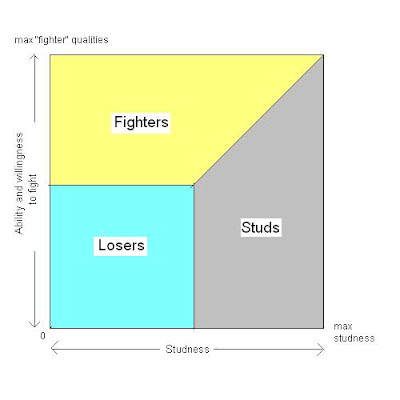
To address some of these, and to further enrich the model, I came up with the following. The basic concept is that everyone (I mean everyone) is both a stud and a fighter. Rather, everyone some bit of studness and some bit of ability to fight, the extent of course varies. And thus, based on their stud and fighter levels, all the people in the world can be mapped on to the following rectangle:

Left bottom is of course the absolute loser. Who has absolutely no talent and also has zero ability to fight. There is a stud cutoff and a fighter cutoff (haven’t marked them explicitly on the graph). All those whose studness exceeds the stud cutoff qualifies to be a stud. Similarly for fighters. If you clear both cutoffs, then you look at the diagonal line to see which category you fall.

Using this, I think we can include a larger number of people into the analysis, compare people, and still retain the old framework of studs and fighters. ?

More NED

NED is getting beyond control. And is about to consume me.

Sometimes I wonder why I invented this concept at all. At other times, I feel not having invented the concept wouldn’t have changed me much – i’d’ve just called it by a different name.

Anyways, don’t be surprised if I disappear suddenly. You can assume that I’ve been taken in by NED

For the sake of cricket…

235 to win from 46 overs and 8 wickets in hand as I write this. Roughly translates to around 320 in an ODI I guess, considering that two wickets are down and relaxed restriction on wides, fielding and bowling quotas. Younis Khan batting on a well made 106, along with Yousuf Youhana. Test cricket at its best.

For the sake of cricket, I hope Pakistan don’t go on to win this game. Conservatism has meant that of late, captains are hesitant to take risks, and go for sporting declarations. They usually prefer to bat the opposition out of the game before declaring, sometimes leaving themselves with too few overs to bowl the opposition out, and the team batting fourth has no incentive to score runs. Just hang in there and protect their wickets.

While that in itself can be a fascinating contest to watch, with stout defense trying to counter a strong bowling attack on a fifth day pitch, cricket would be much better off with more results. More occasions when fourth innings chases come off on the last day. More occasions where the team chasing gets bowled out. A draw is not a bad result, but sometimes the way it is arrived at is. More aggression from the captains would mean lesser, and when they do happen, better draws.

From this point of view, it is important that South Africa don’t lose this game. If they do, Graeme Smith will get unfairly accused for “throwing it all away” and the rare aggression that he has displayed will disappear from cricket altogether. The fear of losing has meant test cricket has already become much more conservative than it was a decade or two ago. It is important that the aggression is restored.

That said, Smith’s performance hasn’t been flawless. For example, he should have promoted de Viliers or Boucher when he got out, and gone for some quick runs, rather than getting Prince to waste a few balls before getting out. It was clear at the outset that he would declare at Kallis’s century. His aim should’ve been to maximzie the runs at the other end while Kallis made his ton.

Anyways, we are all set to have a fascinating afternoon of cricket on. I sincerely hope that after lunch, Pakistan go for the target and end up losing by a small margin. That, I think, would be the best result from the point of view of test cricket in general. Meanwhile, Baada predicts that Inzy will score less than 6 in his last innings, and thus will miss out on breaking Miandad’s record.

Need some economics fundaes….

Over the last few days, I’ve been reading several articles about the GDP growth rate and inflation and balancing the two by means of monetary policy and all that.

Now, aren’t GDP growth rate and inflation extremely highly inter-related? Unless the country has a massive trade imbalance?

Let us take the simplistic case of no foreign trade. Now, the GDP is the total value of goods and services produced in the country. So GDP growth rate is the growth in this total value of goods and services. Now, how does growth in GDP happen? One of 2 things must happen – more goods and services must be produced and sold, or the existing goods and services will become more expensive – in other words, prices go up – in other words inflation happens.

What about the other case, where production goes up? Let us assume that there’s no change to inventory, so what is produced gets consumed. Is it possible for consumption to go up without a corresponding increase in price? Shouldn’t the price change at least in lag? Doesn’t that contribute to inflation? And if suddenly more things are being purchased, doesn’t that mean money supply has gone up? Which implies inflation?

Now, bring back foreign trade and let’s assume the country is an exporter. Then, yeah, one could make more money by increasing prices abroad for all products, and thus improve the GDP growth without affecting domestic inflation. BUT, if there is free flow of capital, there are likely to be inflows, which will put upward pressure on the currency (which will put downward pressure on growth) and consequently on interest rates which will normalize and so on…

Tell me if i’ve got something wrong here… ??

Is David Pleat a management consultant?

Check out this article he has written, trying to recommend who would be the better guy to partner Steven Gerrard in the center of English midfield. To briefly describe his analysis,

1. you develop a framework
2. assign weights to each component (here 1/5 for each)
3. do some qualitative analysis and then arbitrarily assign scores to both guys on each component
4. aggregate across components
5. then forget the wonderful framework and the score and use some “human factors” and stuff to come to the obvious decision

An extremely popular method. A method so commonly used by consultants (and they get paid millions for it). And the consultants would’ve been trained well to use such methods in B-schools – they would’ve used it for numerous course projects and assignments, and rewarded for it.